Hip Fracture: Symptoms, Causes, and Treatment

Updated: 2 days ago
Medically reviewed by Dr. Baraa Alnahhal, MD. Last reviewed October 13, 2026. This content is for educational purposes and is not medical advice.
Quick Answer
A hip fracture is a break in the upper part of the femur, or thigh bone, and becomes more common with age as bones weaken. [1] [3] Signs include sudden severe hip or groin pain, inability to stand after a fall and a shortened, outward-turned leg. [1] An X-ray usually confirms it, and treatment is almost always prompt surgery plus rehabilitation. [2]
What the research says
Faster surgery may help patients whose hearts are under strain. In a post hoc analysis of the HIP ATTACK randomized trial, 322 of 1,392 patients had an elevated troponin (a heart-injury marker) on arrival. Among them, 10% (17 of 163) died within 90 days after accelerated surgery (median 6 hours from diagnosis) versus 23% (36 of 159) with standard care (median 29 hours), a hazard ratio of 0.43 (95% CI 0.24 to 0.77); the authors say the finding needs confirmation (Borges et al., Journal of Bone and Joint Surgery, 2024). [5]
Tailored fall-prevention programs may modestly cut falls. A Cochrane review of 110 randomized trials with 48,919 older adults found that multifactorial interventions, tailored to each person's risk factors, may reduce the rate of falls (rate ratio 0.76, 95% CI 0.67 to 0.87; 29 trials, 9,442 participants; low-certainty evidence) but may have little or no effect on the risk of falling at all (risk ratio 0.95, 95% CI 0.90 to 1.01) (Swarnalatha et al., Cochrane Database of Systematic Reviews, 2026). [6]
Cemented hip implants did not add heart or lung complications. Among 966 patients who received a hip replacement for a femoral neck fracture in HIP ATTACK (61% cemented), cement use was not associated with the combined outcome of death and cardiopulmonary complications at 90 days (odds ratio 1.0, 95% CI 0.7 to 1.4) (Righolt et al., Clinical Orthopaedics and Related Research, 2026). [7]
Key Facts at a Glance
Fact | Detail |
What it is | A break in the upper part of the femur (thigh bone) near the hip joint [3] |
Who is at risk | Older adults; risk rises with age as bones weaken [1] |
Most common cause | A fall from standing height; severe impact at any age [1] |
Main symptoms | Severe hip or groin pain, inability to walk or bear weight, shorter and outward-turned leg [1] |
Diagnosis | Symptoms plus X-ray; MRI or bone scan if a hairline fracture is suspected [2] |
Treatment | Prompt surgery followed by physical therapy and rehabilitation [2] |
Prognosis | Serious injury; about half of patients cannot regain independent living without strong prevention and recovery support |
What Is a Hip Fracture?
A hip fracture is a break in the upper part of the femur, the long bone that extends from the pelvis to the knee. Despite its name, the break is not in the hip joint itself but in the thigh bone just below it.
It is a serious injury. Complications from a hip fracture can be life-threatening, and the risk of having one rises with age. [1] That is because bones tend to weaken as we get older, a loss of bone density known as osteoporosis. [1]
Beyond weakened bone, other factors make older people more likely to fall, and falling is one of the most common causes of a hip fracture. Medicines that cause dizziness, poor vision, and balance problems all increase fall risk.
What Does a Hip Fracture Feel Like?

Symptoms of a hip fracture are dramatic and hard to ignore. After a fall, a person often cannot get up or walk. [1] Severe pain in the hip or groin develops quickly, and putting weight on the leg on the injured side becomes impossible.
The appearance of the leg is also a strong clue. Bruising and swelling appear in and around the hip area. [1] The leg on the injured side may look shorter, and it often turns outward. [1]
Warning sign | Why it matters |
Cannot get up from a fall or walk [1] | The femur cannot support body weight once broken |
Severe pain in the hip or groin [1] | Signals a break near the ball-and-socket joint |
Cannot put weight on the injured leg [1] | The bone has lost its ability to bear load |
Bruising and swelling around the hip [1] | Tissue damage and bleeding around the fracture |
Shorter leg on the injured side [1] | The broken bone ends overlap and collapse |
Leg turns outward on the injured side [1] | Muscles pull the fractured femur out of alignment |
What Causes a Hip Fracture?
A serious impact, such as a car crash, can cause hip fractures in people of all ages. [1] In older adults, however, the story is usually much quieter.
In older adults, a hip fracture is most often the result of a simple fall from standing height. [1] There is no dramatic accident, just a slip, a trip, or a moment of dizziness.
In people with very weak bones, a hip fracture can occur with almost no trauma at all. Simply standing on the leg and twisting [1] can be enough to break a bone that osteoporosis has thinned to a shell.
Who Is at Risk?
Many things can increase the risk of hip fractures. The biggest factors are age, sex, bone health, and anything that raises the chance of falling.
Age and sex. Bone density and muscle mass tend to decrease with age, and older people are more likely to have vision and balance problems. [1] Hip fractures occur in women about three times more often than in men. [1] Women lose bone density faster, in part because the drop in estrogen levels that occurs with menopause accelerates bone loss. [1] However, men also can develop dangerously low levels of bone density. [1]
Medical conditions. Osteoporosis weakens bones and makes them more likely to break. [1] An overactive thyroid can lead to fragile bones. [1] Intestinal disorders that reduce absorption of vitamin D and calcium can also cause weakened bones. [1] Conditions that affect balance, such as Parkinson's disease, stroke, and peripheral neuropathy, increase the risk of falling. [1] Low blood sugar and low blood pressure contribute to fall risk as well. [1]
Medicines. Cortisone medicines, such as prednisone, can weaken bones if taken long term. [1] Certain drugs, or certain combinations of medicines, can cause dizziness and increase fall risk. [1] The most common drugs associated with falls include sleep medicines, antipsychotics, and sedatives. [1]
Nutrition. A lack of calcium and vitamin D in the diet of young people lowers peak bone mass and raises the risk of fracture later in life. [1] Getting enough calcium and vitamin D in older age also helps maintain bone density. [1] Being underweight increases the risk of bone loss. [1]
Lifestyle. A lack of regular weight-bearing exercise, such as walking, results in weakened bones and muscles, making falls and fractures more likely. [1] Tobacco and alcohol both interfere with the normal processes of bone building and maintenance, resulting in bone loss. [1]
Risk factor | How it raises fracture risk |
Age | Bone density and muscle mass decrease; falls become more likely [1] |
Female sex | Bone is lost faster; fractures occur about three times more often than in men [1] |
Osteoporosis | Weakened bones break more easily [1] |
Overactive thyroid | Leads to fragile bones [1] |
Intestinal disorders | Reduce absorption of vitamin D and calcium [1] |
Parkinson's disease, stroke, peripheral neuropathy | Impair balance and raise fall risk [1] |
Low blood sugar or blood pressure | Contribute to dizziness and falls |
Long-term cortisone (prednisone) | Weakens bones over time [1] |
Sleep medicines, antipsychotics, sedatives | Cause dizziness and increase fall risk [1] |
Low calcium and vitamin D | Lowers peak bone mass and raises fracture risk later in life [1] |
Being underweight | Increases the risk of bone loss [1] |
Lack of weight-bearing exercise | Weakens bones and muscles [1] |
Tobacco and alcohol | Interfere with bone building and maintenance [1] |
What Are the Complications?
A hip fracture can reduce independence and sometimes shorten life. About half the people who have a hip fracture are not able to regain the ability to live independently. [1]
When hip fractures prevent movement for a long time, the complications pile up. Blood clots can form in the legs or travel to the lungs. [1] Lying in bed for long periods raises the risk of bedsores and pneumonia. [1] Further loss of muscle mass increases the risk of future falls and injuries. [1] In the worst cases, a hip fracture ends in death. [1]
Complication | What to watch for |
Blood clots in legs or lungs [1] | Swelling, warmth, or pain in the calf; sudden shortness of breath |
Bedsores [1] | Skin breakdown from lying in one position too long |
Pneumonia [1] | Lung infection from reduced movement and shallow breathing |
Muscle mass loss [1] | Further weakness that raises the risk of future falls |
Loss of independence | About half of patients cannot regain independent living [1] |
Death [1] | The most serious possible outcome |
How Is a Hip Fracture Diagnosed?
A healthcare professional can often diagnose a hip fracture based on symptoms and the unusual position of the hip and leg. [2] An X-ray usually confirms the fracture and shows exactly where the break is. [2]
If the X-ray does not show a fracture but hip pain persists, additional imaging may be ordered. An MRI or bone scan can look for a hairline fracture that the X-ray missed. [2]
Understanding the anatomy helps make sense of the diagnosis. Most hip fractures occur in one of two locations on the femur. [2] [3]
The femoral neck. This area sits in the upper portion of the femur, just below the ball part of the joint. That ball is called the femoral head, and it forms the ball-and-socket joint of the hip. [2]
The intertrochanteric region. This region sits a little farther down from the hip joint, in the portion of the upper femur that juts outward. [2]

Diagnostic step | What it involves |
Physical exam | Checks symptoms and the unusual position of the hip and leg [2] |
X-ray | Confirms the fracture and shows its location [2] |
MRI | Looks for a hairline fracture when X-ray is negative but pain persists [2] |
Bone scan | Alternative imaging to detect a hidden hairline fracture [2] |
How Is a Hip Fracture Treated?
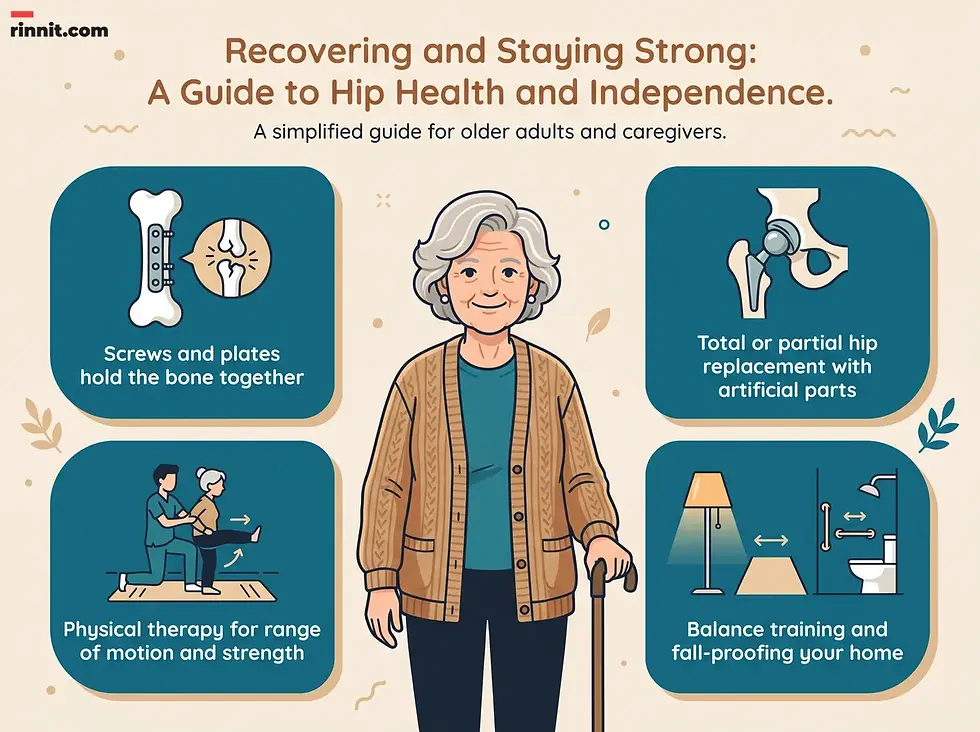
Treatment for a hip fracture usually involves a combination of prompt surgical repair, rehabilitation, and medicine. [2] The medicines manage pain and work to prevent blood clots and infection. [2]
Surgery
The type of surgery depends on where the fracture is, how severe it is, and whether the broken bones are properly aligned. [2] Age and underlying health conditions also play a role. [2]
Internal repair using screws. Metal screws are inserted into the bone to hold it together while the fracture heals. [2] Sometimes the screws are attached to a metal plate that runs down the thigh bone. [2]
Total hip replacement. The upper femur and the socket in the pelvic bone are replaced with artificial parts called prostheses. [2] Increasingly, studies show total hip replacement to be more cost-effective and associated with better long-term outcomes in otherwise healthy adults who live independently. [2]
Partial hip replacement. In some situations, the socket part of the hip does not need to be replaced. [2] Partial hip replacement might be recommended for adults who have other health conditions or who no longer live independently. [2]
Surgeons may recommend a full or partial hip replacement if the blood supply to the ball part of the hip joint was damaged during the fracture. [2] That kind of injury occurs most often in older people with femoral neck fractures, and it means the bone is less likely to heal properly. [2]
Surgical option | How it works |
Internal repair with screws | Screws hold the bone together while it heals; sometimes attached to a plate down the thigh bone [2] |
Total hip replacement | Upper femur and pelvic socket replaced with artificial prostheses [2] |
Partial hip replacement | Only the ball is replaced; the socket is kept [2] |
Rehabilitation
Physical therapy will initially focus on range-of-motion and strengthening exercises. [2] Depending on the type of surgery and whether there is help at home, going to an extended care facility might be necessary. [2]
In extended care and at home, an occupational therapist may help determine if a walker or wheelchair is needed to regain mobility and independence. [2] A therapist also may teach techniques for independence in daily life, such as using the toilet, bathing, dressing, and cooking. [2]
Preparing for Your Appointment
You may be referred to an orthopedic surgeon. [2] Your healthcare professional will want to understand the injury and your overall health before deciding on a treatment plan.
Your healthcare professional might ask about recent falls or injuries to the hip, how severe the pain is, and whether you can put weight on the leg on the injured side. [2] They will want to know whether you have had a bone density test, what other medical conditions you have, and what medicines, vitamins, and supplements you take. [2]
Alcohol and tobacco use, past surgeries and any problems they caused, and a family history of bone fractures or osteoporosis all matter. [2] Whether you live independently also influences the treatment and rehabilitation plan.
What to expect | Example questions |
The injury itself | Have you recently fallen or had another injury to your hip? [2] |
Pain and function | How severe is your pain? Can you put weight on your injured leg? [2] |
Bone health | Have you had a bone density test? Any family history of fractures or osteoporosis? [2] |
Medical history | Other conditions? Medicines, vitamins, and supplements? [2] |
Lifestyle | Do you use alcohol or tobacco? Do you live independently? [2] |
How to Prevent a Hip Fracture
Healthy lifestyle choices in early adulthood build a higher peak bone mass and reduce the risk of osteoporosis in later years. [1] The same measures adopted at any age might lower the risk of falls and improve overall health.
Get enough calcium and vitamin D. In general, men and women age 50 and older should consume 1,200 milligrams of calcium a day, and 600 international units of vitamin D a day. [1]
Exercise to strengthen bones and improve balance. Weight-bearing exercises, such as walking, help maintain peak bone density. [1] Exercise also increases overall strength, decreasing the risk of falling. [1] Balance training is important too, since balance tends to deteriorate with age.
Avoid smoking or excessive drinking. Tobacco and alcohol use can reduce bone density. [1] Drinking too much alcohol also can impair balance and increase the risk of falling. [1]
Assess the home for hazards. Remove throw rugs, keep electrical cords against the wall, and clear excess furniture and anything else that could trip people. [1] [4] Make sure all rooms and passageways are well lit. [1] [4]
Check your eyes. Have an eye exam every other year, or more often if you have diabetes or an eye disease. [1]
Use a cane, walking stick, or walker. If you do not feel steady when you walk, ask a healthcare professional or occupational therapist whether these aids might help. [1]
Prevention step | What it does |
1,200 mg calcium + 600 IU vitamin D daily (age 50+) [1] | Maintains bone density |
Weight-bearing exercise (walking) [1] | Maintains peak bone density and muscle strength |
Reduces fall risk as balance deteriorates with age | |
Avoid smoking and excess alcohol [1] | Protects bone building and balance |
Cuts the number of falls at home | |
Eye exam every other year [1] | Catches vision problems that cause falls |
Cane, walking stick, or walker [1] | Adds stability for unsteady walking |
What to Do in the Meantime
If you or a loved one has fallen and cannot get up, do not try to walk on the injured leg. Keep the person warm and comfortable while help is on the way.
Call emergency services. A hip fracture needs prompt medical evaluation, and the person should not bear weight on the injured leg under any circumstances.
Do not take pain medicine in a way that delays getting care. Let a healthcare professional assess the injury first, since the treatment path depends on the exact location and severity of the break.
Conclusion
A hip fracture is a serious injury that changes lives, but it is not random. It grows out of weakening bones and increased fall risk, and both can be addressed. The warning signs are unmistakable: severe hip or groin pain, an inability to walk, and a shorter, outward-turned leg. They call for immediate medical attention.
Surgery is almost always part of the road to recovery, whether that means screws and plates or a total or partial hip replacement. Rehabilitation through physical and occupational therapy restores range of motion, strength, and daily independence. And the best treatment of all is the prevention work done before any fall happens: strong bones, sharp balance, and a safe home.
Next steps
If you or a loved one has had a fall and cannot bear weight, seek emergency care right away. To stay ahead of the risk, ask a healthcare professional about a bone density test and a personalized prevention plan.
Frequently Asked Questions
How do you know if you have a hip fracture? Severe pain in the hip or groin after a fall, an inability to stand or bear weight on the leg, bruising and swelling around the hip, and a leg that appears shorter and turns outward are the hallmark signs. [1] An X-ray confirms the diagnosis. [2]
Can a hip fracture heal on its own? No. A hip fracture almost always requires surgical repair or replacement. [2] [3] The bone cannot support the body's weight while healing, and leaving it untreated risks blood clots, pneumonia, bedsores, and further muscle loss.
Can you walk on a hip fracture? Generally no. Most people cannot bear weight on the leg on the injured side at all. [3] Even when partial weight is possible, walking on a hip fracture worsens the injury and raises the risk of serious complications.
How long does it take to recover from hip fracture surgery? Recovery is gradual and varies by person. Rehabilitation begins with range-of-motion and strengthening exercises, and some people need an extended care facility before returning home. [2] Regaining full mobility and independence takes weeks to months of dedicated physical therapy.
Is a hip fracture the same as a broken hip? Yes. "Hip fracture" and "broken hip" describe the same injury: a break in the upper part of the femur near the hip joint. [3] The term can be confusing because the break is in the thigh bone, not the pelvis itself.
Trusted External Resources
Related Reading
Bisphosphonates: Uses, Types and Side Effects explains bisphosphonate medicines for osteoporosis.
DEXA Scan (DXA Bone Density Test): Uses, Prep, Results and T-Scores: A DXA bone density scan measures the hips and spine to show whether weak bones are raising your risk of a hip fracture.
Pelvis X-Ray: What It Shows, What to Expect and When You Need More Imaging explains the X-ray of the pelvic bones used for fractures and arthritis.
Hip X-Ray: What It Shows, Views Taken and What to Expect explains the X-ray views used to check the hip joint.
References
Mayo Clinic Staff. Hip fracture: Symptoms and causes. Mayo Clinic. September 10, 2025. https://www.mayoclinic.org/diseases-conditions/hip-fracture/symptoms-causes/syc-20373468
Mayo Clinic Staff. Hip fracture: Diagnosis and treatment. Mayo Clinic. September 10, 2025. https://www.mayoclinic.org/diseases-conditions/hip-fracture/diagnosis-treatment/drc-20373472
American Academy of Orthopaedic Surgeons. Hip Fractures. OrthoInfo. Accessed October 14, 2026. https://www.orthoinfo.org/diseases--conditions/hip-fractures/
Centers for Disease Control and Prevention. Preventing Falls and Hip Fractures. CDC. Last reviewed January 27, 2026. https://www.cdc.gov/falls/prevention/index.html
Borges FK, Guerra-Farfan E, Bhandari M, et al. Myocardial Injury in Patients with Hip Fracture: A HIP ATTACK Randomized Trial Substudy. J Bone Joint Surg Am. 2024;106(24):2303-2312. PMID 39052767. https://doi.org/10.2106/JBJS.23.01459
Swarnalatha C, Wood L, Newell P, et al. Multifactorial and multiple component interventions for preventing falls in older people living in the community. Cochrane Database Syst Rev. 2026;9(9):CD012221. PMID 42764178. https://doi.org/10.1002/14651858.CD012221.pub3
Righolt CH, Borges FK, Sniderman J, et al. Cemented Fixation in Arthroplasty for Hip Fractures Does Not Increase Cardiopulmonary Complications: A Secondary Analysis of the HIP ATTACK Trial. Clin Orthop Relat Res. 2026;484(1):119-128. PMID 40828989. https://doi.org/10.1097/CORR.0000000000003645



Comments