Bisphosphonates: Uses, Types and Side Effects

Updated: 2 days ago
Written and medically reviewed by Dr. Baraa Alnahhal, MD · Last reviewed: November 2026 · How we review
Quick Answer
Bisphosphonates are medicines that slow bone loss and strengthen bones. They're the most common treatment for osteoporosis and also treat Paget's disease. They can lower the risk of spine fractures by about 40% to 70% and hip fractures by about 30% to 50%. Rare risks include jaw bone problems and unusual thigh fractures.
What the research says
A yearly infusion cut fractures: in the HORIZON trial of 7,765 postmenopausal women, a yearly zoledronic acid infusion for 3 years lowered spine fractures by 70% (3.3% vs. 10.9%) and hip fractures by 41% (Black DM et al., New England Journal of Medicine, 2007) [2]
Alendronate nearly halved new fractures: in 2,027 women who already had a spine fracture, alendronate for 3 years cut new spine fractures from 15.0% to 8.0% and lowered hip fracture risk by about half (Black DM et al., Lancet, 1996) [3]
Key takeaways
Bisphosphonates slow bone loss and lower fracture risk.
They're the main medicines for osteoporosis.
Pills are taken daily, weekly or monthly; IV doses are often yearly.
Take pills with water on an empty stomach and stay upright 30 to 60 minutes.
Serious side effects are rare.
What are bisphosphonates?
Your bones are constantly broken down and rebuilt. With age, breakdown can outpace building, causing bones to thin. Bisphosphonates slow the breakdown (resorption), which helps keep bones denser and stronger. Sources: [1]
What they treat
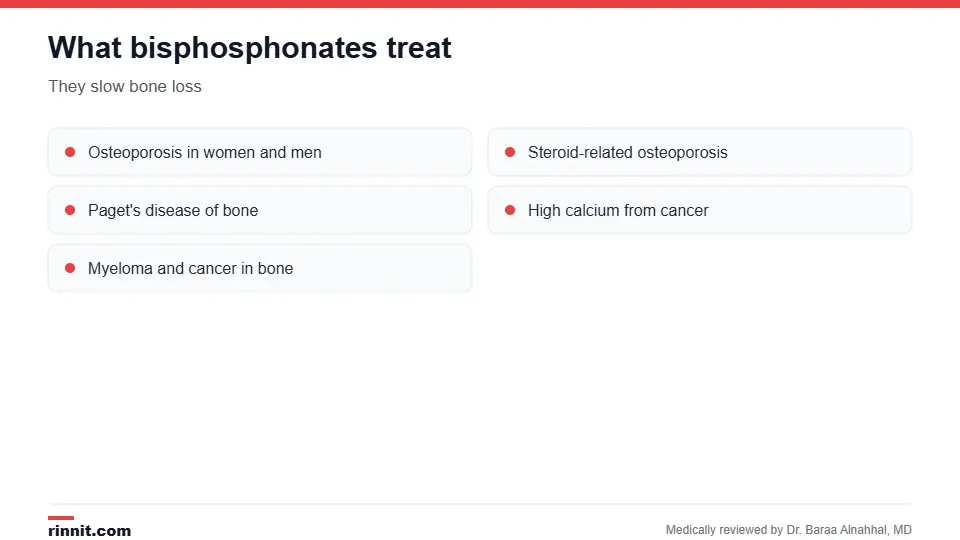
All bisphosphonates improve bone density.
Osteoporosis in postmenopausal women and in men.
Preventing osteoporosis.
Osteoporosis from steroid medicines.
High blood calcium caused by cancer.
Multiple myeloma and cancer that has spread to the bones. Sources: [1]
Types of bisphosphonates

IV forms are usually given once a year.
Medicine | Form | Fracture risk reduction |
Alendronate (Fosamax) | Pill | About 50% spine, 30% hip and other |
Risedronate (Actonel) | Pill | About 40% spine and other |
Ibandronate (Boniva) | Pill or IV | About 50% spine |
Zoledronic acid (Reclast, Zometa) | IV | About 70% spine, 35% hip and other |
Pamidronate (Aredia) | IV | Used mainly for cancer-related bone problems |
Sources: [1]
How to take them
IV doses are given in an infusion center.
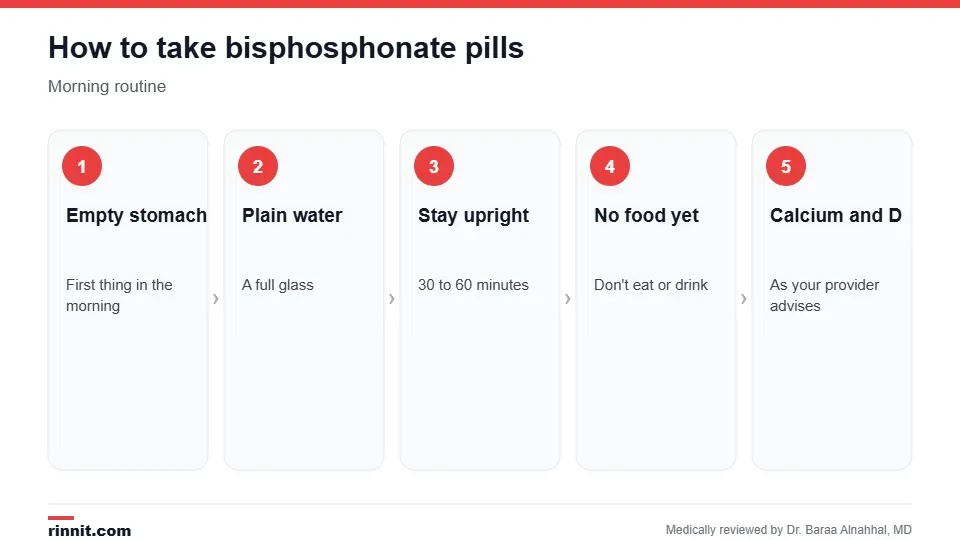
Take pills first thing in the morning on an empty stomach with plain water.
Stay upright, sitting or standing, for 30 to 60 minutes.
Don't eat or drink anything else during that time.
Eat a calcium-rich diet and take vitamin D or calcium supplements if your provider recommends them.
IV doses are given through a vein at a clinic, usually once a year. Sources: [1]
Pills are usually limited to about five years and IV zoledronic acid to about three years to lower the risk of rare side effects, though some people need longer treatment. Sources: [1]
Side effects
Form | Possible side effects |
Pills | Heartburn, irritation or ulcers of the esophagus or stomach |
IV | Flu-like symptoms (fever, aches, headache, bone or muscle pain) for a few days |
Extremely rare | Osteonecrosis of the jaw, unusual (atypical) thigh fractures, eye inflammation |
Flu-like symptoms usually start within one to three days of an infusion and improve with acetaminophen or NSAIDs. The risks are small compared with the risk of a fracture from osteoporosis. Sources: [1, 2]
Monitoring
Your provider may order DEXA bone density scans to track your treatment. Sources: [1]
When to call your provider
Thigh or groin pain after three or more years of use.
Trouble swallowing or chest pain with pills.
Jaw pain or slow-healing sores in the mouth. Sources: [1]
Conclusion
Bisphosphonates are well-studied medicines that strengthen bones and prevent fractures. Taking them correctly and checking in with your provider helps you get the benefits while keeping risks low.
Keep learning: read about osteoporosis and DEXA scans.
Frequently asked questions
What are bisphosphonates?
Medicines that slow bone loss and lower fracture risk.
What do bisphosphonates treat?
Mainly osteoporosis, plus Paget's disease and some cancer-related bone problems.
What are common bisphosphonates?
Alendronate, risedronate, ibandronate and zoledronic acid.
How do I take bisphosphonate pills?
On an empty stomach with water, staying upright for 30 to 60 minutes.
How often is the IV form given?
Usually once a year.
How well do they work?
They can lower spine fracture risk by about 40% to 70%.
What are the side effects?
Heartburn with pills and flu-like symptoms after IV doses.
How long should I take them?
Often about five years for pills and three years for IV, then reassess.
What is osteonecrosis of the jaw?
An extremely rare jaw bone problem linked to bisphosphonates.
Why does my thigh hurt?
After years of use, thigh pain can signal a rare fracture; call your provider.
Related Reading
Osteoporosis: Causes, Symptoms, Diagnosis and Treatment Explained the main condition bisphosphonates treat.
DEXA Scan (DXA Bone Density Test): Uses, Prep, Results and T-Scores the scan that measures bone density.
Paget's Disease of Bone: Symptoms, Causes, and Treatment — A Guide for Adults Over 50 a bone disease treated with bisphosphonates.
Hypercalcemia: Symptoms, Causes & Treatment — A Complete Guide high blood calcium.
Hip Fracture: Symptoms, Causes, and Treatment a fracture bisphosphonates help prevent.
References
Cleveland Clinic. Bisphosphonates: What They Are, Uses, Side Effects & Types. Cleveland Clinic. Last updated February 21, 2023. https://my.clevelandclinic.org/health/treatments/24753-bisphosphonates
Black DM, Delmas PD, Eastell R, et al. Once-yearly zoledronic acid for treatment of postmenopausal osteoporosis. New England Journal of Medicine. 2007;356(18):1809-1822. PMID 17476007. https://doi.org/10.1056/NEJMoa067312
Black DM, Cummings SR, Karpf DB, et al. Randomised trial of effect of alendronate on risk of fracture in women with existing vertebral fractures. Lancet. 1996;348(9041):1535-1541. PMID 8950879. https://doi.org/10.1016/s0140-6736(96)07088-2
Medical disclaimer
This article is for general education only and does not replace advice from a qualified healthcare professional. Talk to your doctor about your own diagnosis and treatment, and seek emergency care right away for severe or sudden symptoms.



Comments