Paget's Disease of Bone: Symptoms, Causes, and Treatment — A Guide for Adults Over 50

Updated: 2 days ago
Medically reviewed by Dr. Baraa Alnahhal, MD · Last reviewed: September 2026
TL;DR
Paget's (PAJ-its) disease of bone is a chronic bone condition in which the body's normal bone recycling process — where new bone gradually replaces old bone — breaks down. Replacement bone forms faster than normal, leaving it disorganized, weaker, and misshapen. The pelvis, skull, spine, and legs are most commonly affected, and most people have no symptoms at all. When symptoms do appear, bone pain is the most common complaint. The disease usually progresses slowly and can be managed effectively in nearly all people. Bisphosphonate medications are the mainstay of treatment, and surgery is rarely needed.
Quick Answer
What it is: A bone condition where the normal bone recycling process goes wrong — new bone forms too fast, leaving bones fragile and misshapen.
Who it affects: Most often adults over 50; men more than women; more common in people with European ancestry and a family history.
Most common symptom: Bone pain — though most people have no symptoms at all.
Bones most affected: Pelvis, skull, spine, and legs.
How it's diagnosed: X-rays, a bone scan, and a blood test (elevated alkaline phosphatase).
How it's treated: Bisphosphonate medications (IV or oral); surgery only in rare cases with complications.
Prognosis: Progresses slowly and can be managed effectively in nearly all people.
What Is Paget's Disease of Bone?
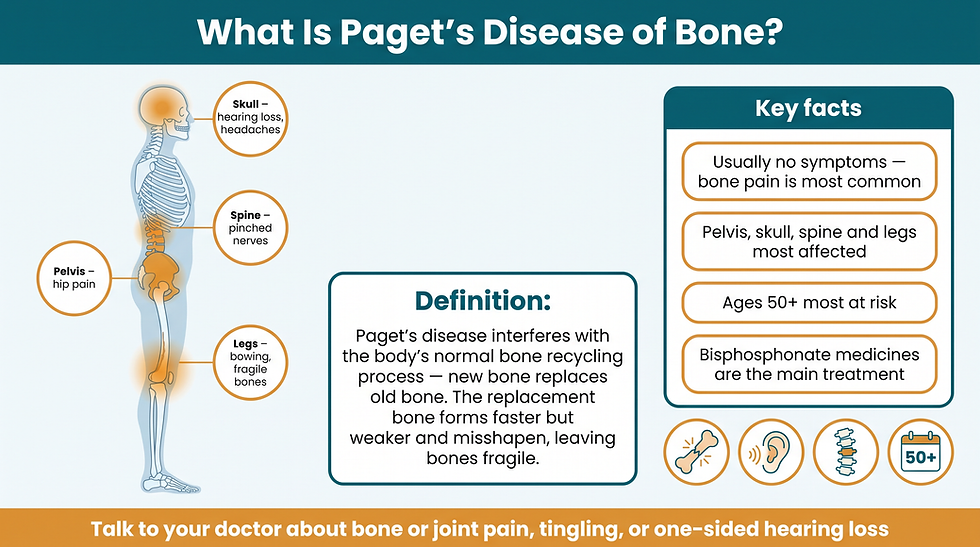
Paget's (PAJ-its) disease of bone is a chronic bone disorder that interferes with the body's normal recycling process. Throughout life, your body constantly renews bone: new bone tissue gradually replaces old bone tissue. Paget's disease disrupts this cycle.
When the disease strikes, bone replacement happens faster than normal. This rapid remodeling produces bone that is less organized and weaker than normal bone. Over time, the affected bones can become fragile and misshapen.
The condition most commonly affects four areas of the body:
Body Area | What Can Happen |
Pelvis | Hip pain |
Skull | Overgrowth of bone can cause hearing loss or headaches |
Spine | Compressed nerve roots cause pain, tingling, and numbness in an arm or leg |
Leg | Weakened bones may bend, causing a bowlegged appearance; stress on nearby joints may cause osteoarthritis in the knee or hip |
The disease might affect only one or two areas of the body, or it might be widespread. Your signs and symptoms, if any, depend on the affected part of your body.
Interestingly, for reasons unknown to doctors, Paget's disease has become less common over the past several years and is less severe when it does develop.
At a Glance
Fact | Detail |
What it is | A disorder of the bone recycling process — new bone replaces old bone too fast and imperfectly |
What goes wrong | Replacement bone is less organized, weaker, and misshapen |
Bones most affected | Pelvis, skull, spine, legs |
Symptoms | Most people have none; bone pain is most common when symptoms occur |
Who it affects | Adults over 50; men more than women; people with family history |
How it's diagnosed | X-rays, bone scan, blood test for alkaline phosphatase |
Main treatment | Bisphosphonate medications (IV or oral) |
Outlook | Slow progression; manageable in nearly all people |
What Are the Symptoms of Paget's Disease of Bone?
Most people who have Paget's disease of bone have no symptoms. When symptoms do occur, the most common complaint is bone pain.
The reason for this lies in how the disease works. Because the disease causes the body to generate new bone faster than normal, the rapid remodeling produces bone that is less organized and weaker than normal bone. That weakened bone can lead to bone pain, deformities, and fractures.
Symptoms by Affected Area
The table below shows how symptoms vary depending on which bones are affected:
Affected Area | Possible Symptoms |
Pelvis | Hip pain |
Skull | Hearing loss, headaches |
Spine | Pain, tingling, and numbness in an arm or leg (from compressed nerve roots) |
Leg | Bones may bend (bowlegged appearance); enlarged and misshapen bones can stress nearby joints, causing osteoarthritis in the knee or hip |
When Should You See a Doctor?
Talk to your doctor if you have any of the following:
Pain in your bones and joints
Tingling and weakness in an extremity
Bone deformities
Unexplained hearing loss, especially if it is only on one side
These signs do not automatically mean Paget's disease — many have ordinary explanations. But they are worth discussing with a healthcare professional, especially if they persist.
What Causes Paget's Disease of Bone?
The cause of Paget's disease of bone is unknown. Scientists suspect a combination of environmental and genetic factors contributes to the disease. Several genes appear to be linked to developing the condition.
Some scientists believe Paget's disease is related to a viral infection in bone cells, but this theory remains controversial and unproven.
What Raises the Risk of Paget's Disease of Bone?
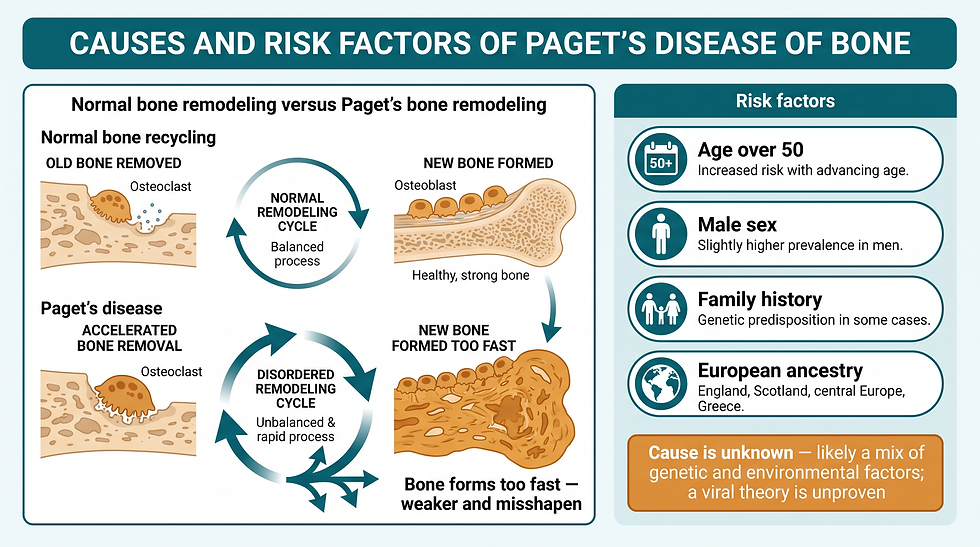
The risk of Paget's disease of bone increases with age and if family members have the disorder. The key risk factors are summarized below:
Risk Factor | Detail |
Age | People older than 50 are most likely to develop the disease |
Sex | Men are more commonly affected than women |
National origin | More common in England, Scotland, central Europe, and Greece — and in countries settled by European immigrants; uncommon in Scandinavia and Asia |
Family history | Having a relative with Paget's disease makes you more likely to develop it |
What Are the Possible Complications?
In most cases, Paget's disease of bone progresses slowly, and the disease can be managed effectively in nearly all people. Possible complications include:
Complication | What Happens |
Fractures and deformities | Affected bones break more easily; extra blood vessels in deformed bones cause more bleeding during repair surgeries; leg bones can bow, affecting the ability to walk |
Osteoarthritis | Misshapen bones increase stress on nearby joints, which can cause osteoarthritis |
Neurological problems | Overgrowth of bone compresses and damages nerves where they pass through bone (spine and skull), causing pain, weakness, or tingling in an arm or leg, or hearing loss |
Heart failure | In severe cases, the heart works harder to pump blood to affected areas, which can sometimes lead to heart failure |
Bone cancer | Bone cancer occurs in up to 1% of people with Paget's disease of bone |
Can Paget's Disease of Bone Be Prevented?
The cause of Paget's disease is not fully understood, so no proven prevention method exists. However, people with risk factors — especially a family history — should mention them to their doctor so that any signs can be caught early.
How Is Paget's Disease of Bone Diagnosed?
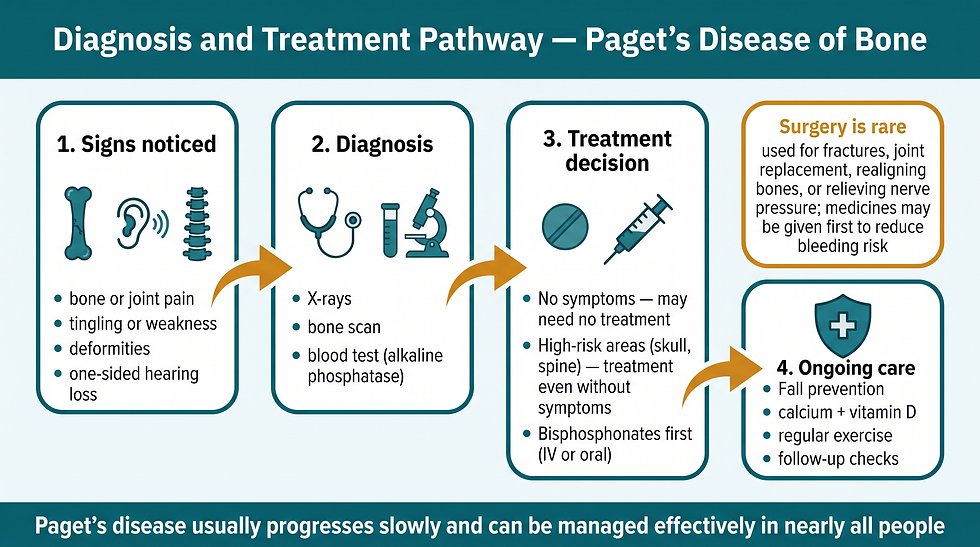
During the physical exam, your doctor will examine areas of your body that are causing you pain. He or she may also order X-rays and blood tests that can help confirm the diagnosis.
Imaging Tests
Bone changes can be revealed by two main imaging tests:
Test | What It Does |
X-rays | Often the first indication of Paget's disease — abnormalities are frequently found on X-rays done for other reasons. X-rays show areas of bone breakdown, bone enlargement, and characteristic deformities such as bowing of the long bones |
Bone scan | Radioactive material is injected into the body and travels to the spots on the bones most affected, which then light up on the scan images |
Lab Tests
People who have Paget's disease of bone usually have elevated levels of alkaline phosphatase in their blood, which can be revealed by a blood test.
Notably, most people with Paget's disease don't have any symptoms and are diagnosed when an X-ray or blood test taken for another reason reveals signs of the disease.
How Is Paget's Disease of Bone Treated?
If you don't have symptoms, you might not need treatment. However, if the disease is active — indicated by an elevated alkaline phosphatase level — and is affecting high-risk sites in your body, such as the skull or spine, your doctor might recommend treatment to prevent complications, even if you don't have symptoms.
Medications
Osteoporosis drugs called bisphosphonates are the most common treatment for Paget's disease of bone. Bisphosphonates are the same class of medications used to strengthen bones weakened by osteoporosis.
Bisphosphonates are typically given by injection into a vein (IV), but they can also be taken by mouth. When taken orally, bisphosphonates are generally well tolerated but can irritate the stomach.
Route | Medications |
IV bisphosphonates | Zoledronic acid (Zometa, Reclast); Pamidronate (Aredia); Ibandronate (Boniva) |
Oral bisphosphonates | Alendronate (Fosamax, Binosto); Risedronate (Actonel, Atelvia) |
Possible side effects: Rarely, bisphosphonate therapy has been linked to severe muscle, joint, or bone pain, which might not resolve when the medication is discontinued. Bisphosphonates can also increase the risk of a rare condition in which a section of jawbone dies and deteriorates — usually associated with active dental disease or oral surgery.
If you can't tolerate bisphosphonates, your doctor might prescribe calcitonin (Miacalcin), a naturally occurring hormone involved in calcium regulation and bone metabolism. Calcitonin is administered by self-injection or nasal spray. Side effects may include nausea, facial flushing, and irritation at the injection site.
Surgery
In rare cases, surgery might be required to:
Help fractures heal
Replace joints damaged by severe arthritis
Realign deformed bones
Reduce pressure on nerves
One important consideration: Paget's disease often causes the body to produce too many blood vessels in the affected bones, increasing the risk of serious blood loss during an operation. If you're scheduled for surgery involving affected bones, your doctor might prescribe medications to reduce the activity of the disease, which may help reduce blood loss during surgery.
What Self-Care Steps Help Manage Paget's Disease?
To reduce your risk of complications associated with Paget's disease of bone, try these tips:
Self-Care Step | What to Do |
Prevent falls | Paget's disease puts you at high risk of bone fractures. Ask your doctor for advice on preventing falls — a cane or walker may be recommended |
Fall-proof your home | Remove slippery floor coverings, use nonskid mats in your bathtub or shower, tuck away cords, and install handrails on stairways and grab bars in your bathroom |
Eat well | Make sure your diet includes adequate calcium and vitamin D, which helps bones absorb calcium. This is especially important if you're taking a bisphosphonate. Review your diet with your doctor and ask about vitamin and calcium supplements |
Exercise regularly | Regular exercise is essential for maintaining joint mobility and bone strength. Talk to your doctor before beginning an exercise program to determine the right type, duration, and intensity — some activities may place too much stress on your affected bones |
How Do You Prepare for Your Appointment?
If you're heading to a doctor's appointment about possible Paget's disease, here's how to prepare. In some cases, you may be referred to a doctor who specializes in metabolic and hormonal disorders (endocrinologist) or in joint and muscle disorders (rheumatologist).
When you make the appointment, ask if there's anything you need to do in advance, such as fasting before a specific test. Make a list of:
Your symptoms, including any that seem unrelated to the reason for your appointment
Key personal information, including major stresses, recent life changes, and family medical history
All medications, vitamins, or other supplements you take, including the doses
Questions to ask your doctor
Taking a family member or friend along can help you remember the information you're given.
Questions to Ask Your Doctor
What's likely causing my symptoms?
What are other possible causes for my symptoms?
What tests do I need?
Is my condition likely temporary or chronic?
What's the best course of action?
What are the alternatives to the primary approach you're suggesting?
How can I best manage this condition with my other health conditions?
Are there restrictions I need to follow?
Should I see a specialist?
Are there brochures or other printed material I can have? What websites do you recommend?
What the Doctor May Ask You
Have you had numbness or tingling?
How about muscle weakness?
Any new headaches?
Has your hearing recently worsened?
What's New in Paget's Disease Research?
Clinical trials are exploring new treatments, interventions, and tests as a means to prevent, detect, treat, or manage this condition. If standard treatments aren't enough, clinical trials may offer additional options — ask your care team.
Conclusion
Paget's disease of bone is a chronic condition that disrupts how your body renews its bones. The good news: most people have no symptoms, the disease usually progresses slowly, and it can be managed effectively in nearly all people. Bisphosphonate medications are highly effective, and self-care steps like fall prevention, proper nutrition, and regular exercise help protect bone health.
If you're over 50 and experiencing unexplained bone or joint pain, tingling or weakness in your limbs, or hearing loss in one ear — schedule an appointment with your doctor for an evaluation.
Frequently Asked Questions
Is Paget's disease of bone the same as osteoporosis?
No. Osteoporosis is a condition where bones lose density and become thin and fragile. Paget's disease is different — the body replaces bone too quickly, producing new bone that is disorganized, enlarged, and weaker than normal. The two conditions are distinct, though bisphosphonate medications are used to treat both.
What is the most common symptom of Paget's disease?
Most people with Paget's disease have no symptoms at all. When symptoms do occur, bone pain is the most common complaint. Other symptoms depend on which bones are affected — hip pain (pelvis), headaches or hearing loss (skull), tingling or numbness in an arm or leg (spine), or bowing of the leg bones.
What is alkaline phosphatase and why does it matter?
Alkaline phosphatase is an enzyme measured by a blood test. People with Paget's disease usually have elevated levels of alkaline phosphatase, which reflects increased bone activity. An elevated level helps doctors confirm the diagnosis and tell whether the disease is active.
Do I need treatment if I have no symptoms?
Not always. If you don't have symptoms, you might not need treatment. However, if the disease is active (shown by elevated alkaline phosphatase) and is affecting high-risk sites like the skull or spine, your doctor might recommend treatment to prevent complications even without symptoms.
Can Paget's disease of bone cause hearing loss?
Yes. When Paget's disease affects the skull, the overgrowth of bone can cause hearing loss or headaches. Unexplained hearing loss — especially if it occurs in only one ear — is one of the signs that should prompt a visit to the doctor.
How is Paget's disease of bone treated?
Bisphosphonates — the same class of drugs used for osteoporosis — are the mainstay of treatment. They're typically given by IV injection but can also be taken orally. If bisphosphonates can't be tolerated, calcitonin is an alternative. Surgery is rarely needed and reserved for complications like fractures, severe joint damage, or nerve compression.
Is Paget's disease of bone inherited?
The disease runs in families more often than chance would predict — having a relative with Paget's disease raises your risk. Several genes appear to be linked to the condition, though the exact cause is not fully understood.
Can Paget's disease of bone lead to bone cancer?
Bone cancer can occur, but it is rare — it develops in up to 1% of people with Paget's disease of bone. The disease usually progresses slowly and can be managed effectively in nearly all people.
What self-care steps help with Paget's disease of bone?
Four key steps: prevent falls (a cane or walker may help), fall-proof your home (remove slippery rugs, add nonskid mats and grab bars), eat well (adequate calcium and vitamin D), and exercise regularly (after discussing the right type and intensity with your doctor).
References
Paget's disease of bone — Symptoms & causes — Mayo Clinic, last reviewed January 11, 2023
Paget's disease of bone — Diagnosis & treatment — Mayo Clinic, last reviewed January 11, 2023
This article is for general information only and is not a substitute for professional medical advice. Always consult a qualified healthcare professional for diagnosis and treatment decisions.
Comments