What Is a Compression Fracture? Symptoms, Causes, Treatment & Outlook Explained

Updated: 3 days ago
Medically reviewed by Dr. Baraa Alnahhal, MD · Last reviewed: October 2026
Quick Answer: What is a compression fracture?
A compression fracture is a collapse of a vertebral body, the thick front part of a spine bone [3], most often in the middle of the back. It mainly affects women over 50 and people with osteoporosis, causing sudden back pain and sometimes height loss [3]. Many heal over a few months with rest, bracing and pain medication [2].
Key takeaways
A compression fracture is a break or crack in a vertebra; the bone collapses when broken [3].
It can happen in any part of the spine, but usually in the thoracic (middle) section [3] [4].
Main causes are osteoporosis, trauma (falls, car accidents) and cancer weakening the bone [3] [4].
An estimated 700,000 to 1.5 million occur per year in the United States [1] [2].
Key symptoms include sudden back pain, limited mobility, tingling or numbness, tenderness, muscle weakness and loss of height.
There are three types: wedge (most common), crush and burst (most serious).
Risk factors include being female after menopause, age 50+, bone-weakening conditions and a prior fracture.
Diagnosis uses a physical exam plus spine X-ray, CT, MRI, DEXA scan, myelogram or bone scan [2] [3].
Treatment includes pain medication, a back brace (4–12 weeks), bisphosphonates, physical therapy and vertebroplasty or kyphoplasty.
Pain usually eases around 4 weeks [4], and complete healing takes around 12 weeks.
Many fractures heal after a few months of rest, but osteoporosis raises the risk of future fractures [2] [4].
Emergency signs: sudden severe back pain with weakness, numbness, loss of bladder or bowel control, or fever [3].
What the research says
A first vertebral fracture is a strong warning sign for the next one. In an analysis of 2,725 postmenopausal women from the placebo groups of four osteoporosis trials, women with an existing vertebral fracture had about 5 times the risk of a new one in the first year (relative risk 5.1, 95% CI 3.1 to 8.4). Among the 381 women who had a new vertebral fracture, 19.2% (95% CI 13.6% to 24.8%) had another within the next year (Lindsay et al., JAMA, 2001) [6].
A once-yearly bone-strengthening infusion cut new spine fractures. In a trial of 7,765 postmenopausal women with osteoporosis (mean age 73), three yearly infusions of zoledronic acid, a bisphosphonate, lowered the 3-year risk of new morphometric vertebral fractures to 3.3% from 10.9% with placebo (relative risk 0.30, a 70% reduction). Serious atrial fibrillation was more frequent with the drug (50 vs 20 patients) (Black et al., N Engl J Med, 2007) [7].
Vertebroplasty did not beat a sham procedure in one small trial. In a double-blind trial of 78 people with one or two painful, unhealed osteoporotic vertebral fractures, vertebroplasty gave no significant advantage over a sham procedure at 1 week or at 1, 3 or 6 months. Pain fell in both groups (a 2.6-point vs 1.9-point drop on a 0-to-10 scale at 3 months; adjusted difference 0.6, 95% CI -0.7 to 1.8) (Buchbinder et al., N Engl J Med, 2009) [8].
What Is a Compression Fracture?

A compression fracture is a break or crack in a vertebra — one of the bones that make up your spinal column. When a vertebra breaks, the bone collapses [3]. The breaks happen in the vertebral body, which is the thick, rounded part on the front of each vertebra. These fractures cause your spine to weaken and collapse, and over time they can affect your posture.
Compression fractures can happen to any part of your spine, but they usually occur in the thoracic spine — the middle section of your back [3] [4]. Osteoporosis is a common cause, in addition to trauma (like after an accident) or tumors that weaken the bone [3] [4].
You may hear a healthcare provider refer to this injury as a spinal compression fracture or a vertebral compression fracture.
The three types of compression fractures
Compression fractures come in three shapes, and the shape tells the story of how the bone gave way:
Type | What happens | How serious |
Wedge | The fracture forms on the front of the vertebra; the broken bone collapses and takes on a wedge shape | The most common form — more than half of all compression fractures are wedge-shaped |
Crush | The break involves the entire vertebra, not just one side; the bone collapses on itself | More extensive than a wedge fracture |
Burst | The break causes bone pieces to spread in multiple directions when it breaks | The most serious — requires immediate medical attention |
Stable vs. unstable fractures
Compression fractures are also classified by whether the bone pieces stay in place:
Classification | What it means |
Stable | The fractured bone usually doesn't move out of place |
Unstable | The fracture moves bone pieces out of place; they may interfere with nearby nerves and tissue; this typically only occurs if there are other fractures or the spinal ligaments are injured as well |
How common are compression fractures?
Compression fractures are common. An estimated 700,000 to 1.5 million compression fractures happen every year in the United States [1] [2].
Compression Fracture Symptoms
The symptoms of a compression fracture may include:
Symptom | What it looks like |
Pain may get better with rest and worse when you move [2] | |
Limited mobility and flexibility | Difficulty standing, walking, bending or twisting |
Tingling or numbness | A feeling in the back related to pinched nerves |
Tenderness | The area directly at the fracture site is sensitive to touch [4] |
Muscle weakness or spasms | Weakness in the surrounding muscles or involuntary spasms |
Loss of height | A common sign — the bone collapse may affect how tall you are [3] |
Compression fracture symptoms range from mild to severe. You may not notice or feel symptoms with mild fractures [4]. However, a common sign of a compression fracture is a loss of height — the fracture causes the bone to collapse, which may affect how tall you are [3] [4].

What Causes a Compression Fracture?
Pressure on or against the vertebrae in your spine may cause your spinal bones to break and collapse. Some of the most common causes of a compression fracture include:
Osteoporosis. Your bones naturally weaken with age, and weakened bones are more likely to fracture. Severe osteoporosis fractures may happen while doing ordinary daily activities — like getting out of a car, sneezing, coughing or twisting suddenly [2] [3].
Injuries or accidents. This could include falls, car accidents or other types of physical trauma [3].
Cancer. Cancerous tumors can spread to your spine, weaken your vertebrae and cause the bones to break [3].
Risk factors
You may be more at risk of a compression fracture if you are female and have been through menopause, have a condition that affects the strength of your bones, are 50 years of age or older, or have had a compression fracture before. Studies show that an estimated 40% of women aged 80 or over have experienced a compression fracture at some point [3].
Risk factor | Why it matters |
Female, post-menopause | Bone loss accelerates after menopause |
Bone-weakening conditions | Weaker bones fracture more easily |
Age 50 or older | Natural bone weakening increases with age |
Prior compression fracture | |
Women 80+ | An estimated 40% of this group has had at least one compression fracture [3] |
How Is a Compression Fracture Diagnosed?
To diagnose a compression fracture, your provider will offer a physical exam to learn more about your symptoms. During the exam, the provider checks your spine's alignment and your height and posture, gently presses on different areas of your back to identify the source of pain [2], and looks for signs of nerve damage, which may include numbness, tingling or muscle weakness.
Your provider will also recommend imaging tests to see pictures of the bones, muscles and soft tissues in your back. These imaging studies include:
Test | What it does |
Spine X-ray, CT scan or MRI | |
DEXA scan | |
Myelogram | A contrast dye is injected into your spinal column before a CT scan or X-ray; the dye makes images clearer |
Three-phase bone scan | An imaging test that takes three sets of pictures during three different visits |
In some cases, your provider may find a compression fracture while performing an imaging test for another reason [1] [4] — an incidental discovery during a scan ordered for something else entirely.
Compression Fracture Treatment Options
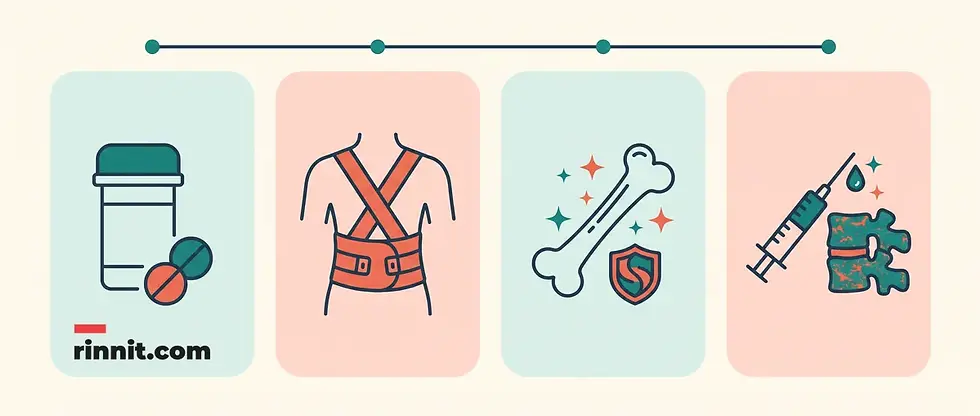
Compression fracture treatment focuses on three goals: relieving pain, stabilizing the bones in your spine, and preventing another fracture. Depending on the type and severity of the fracture, treatment may include:
Pain relief medication. Your provider may recommend over-the-counter nonsteroidal anti-inflammatory drugs (NSAIDs), or may prescribe muscle relaxers or other prescription drugs [3]. Follow your provider's instructions carefully when taking these medications.
Braces. A special type of back brace can support your vertebrae and relieve pain by reducing how much you move your spine [3]. You may need to wear the brace for four to 12 weeks.
Medications to strengthen bones. Medications called bisphosphonates can slow further bone loss, stabilize bones and prevent fractures if you have osteoporosis [3] [4].
Physical therapy. A physical therapist will teach you stretches and exercises to strengthen the muscles around your spine [1] [4].
Surgery (vertebroplasty or kyphoplasty). These are minimally invasive outpatient procedures that stabilize and support your vertebra with bone cement [2] [3].
Treatment | How it helps |
Pain relief medication | |
Back brace | Supports the vertebrae and reduces spine movement to relieve pain; worn 4 to 12 weeks |
Bone-strengthening medication | |
Surgery | Vertebroplasty or kyphoplasty — minimally invasive outpatient procedures that stabilize the vertebra with bone cement [2] [3] |
Can a compression fracture heal by itself?
Yes, some types of compression fractures can heal on their own. Healing can take several months [2]. A healthcare provider may offer treatment options like a brace to make sure your spine heals as expected. Let your provider know if you have symptoms that interfere with your daily routine and mobility as you heal.
Long-Term Effects and Outlook
Long-term complications
The long-term complications of a compression fracture may include:
What's the outlook for a compression fracture?
Your outlook after a compression fracture varies based on the severity of the fracture, your age, your general health, and any underlying conditions you have. Many compression fractures heal after a few months of rest and limited movement [2]. If symptoms are bothersome, a healthcare provider may offer different treatment options to relieve pain.
If you have osteoporosis, you have a higher chance of having another compression fracture [2] [4]. Your provider can help you manage osteoporosis to prevent future fractures.
How long do compression fractures last?
As your spine bones heal, you may notice symptoms like pain decrease after about four weeks [4]. It should completely heal after 12 weeks. Your age and other factors may affect your healing time.
What about life expectancy after a compression fracture?
A compression fracture is only one factor that helps calculate your life expectancy — it isn't the only thing your provider will consider. For example, a first-time vertebral compression fracture may indicate to a provider that osteoporosis is progressing and taking a greater toll on your body, even if you're in otherwise good health. Know that your situation may or may not fit statistics; your provider can give you the best information about what you can expect.
Prevention
You can't prevent all causes of compression fractures. One of the most common causes is osteoporosis, and there are concrete steps you can take to reduce your risk of an osteoporosis-related compression fracture:
Prevention step | How it helps |
Protect yourself from injury and accidents | Remove tripping hazards and wear a seatbelt |
Eat balanced meals with enough vitamin D and calcium | Strengthens your bones |
Quit smoking and tobacco products | Nicotine weakens bones |
Regular checkups and prescribed medication | Slows bone loss if you're at risk of osteoporosis |
Living With a Compression Fracture
When should you see a healthcare provider?
Visit a healthcare provider if you have sudden back pain or other symptoms of a compression fracture that don't resolve in a couple of days. It's especially important to stay regular with visits to your provider if you have osteoporosis.
Contact emergency services or visit the emergency room if you have sudden, severe back pain and any of the following [3]:
Weakness or numbness.
A loss of bladder or bowel control.
A fever.
Questions to ask your healthcare provider
If you have a compression fracture, you may want to ask your provider:
What type of fracture do I have?
What treatment do you recommend?
Do I need surgery?
Are there side effects of the treatment?
How do I prevent future fractures?
A note on healing
No one wants a broken bone, especially a break in the bones that support your body and help you sit, stand and move. Compression fractures — small breaks or cracks in the vertebrae — come with symptoms like pain and discomfort, which may take you out of some of your favorite activities for several weeks.
These fractures are common and not always preventable. But there are steps you can take to reduce your risk, like removing tripping hazards from your living space or wearing a seatbelt when riding in a vehicle. Your provider may have more suggestions specific to you and your lifestyle.
When healing from a fracture, don't rush the process. It could extend your recovery time or lead to complications. Be sure to follow your provider's instructions carefully so you can heal properly.
Conclusion
A compression fracture is a break or crack in a vertebra — the thick, rounded front portion of a spine bone — that causes the bone to collapse [3]. With an estimated 700,000 to 1.5 million cases every year in the United States [1] [2], it is one of the most common spine injuries, most often striking the middle (thoracic) section of the back [3] [4]. Osteoporosis is the leading cause, followed by physical trauma and cancer that spreads to the spine [3] [4]. The classic warning signs are sudden back pain that worsens with movement, limited mobility, tingling or numbness, tenderness at the fracture site, and — tellingly — a loss of height.
Diagnosis starts with a careful physical exam and is confirmed through imaging: X-rays, CT scans, MRIs, bone density (DEXA) scans, myelograms or bone scans [2] [3]. Treatment is built around three goals — relieve pain, stabilize the spine and prevent the next fracture — and may involve NSAIDs or muscle relaxers, a back brace worn four to 12 weeks, bisphosphonates to slow bone loss, physical therapy, or minimally invasive vertebroplasty or kyphoplasty procedures using bone cement. Pain usually eases after about four weeks [4], and most fractures heal completely around the 12-week mark.
The key to a good outcome is not rushing recovery and managing any underlying osteoporosis. Without that management, the risk of kyphosis, chronic pain, bladder and bowel problems, and future fractures rises significantly. If sudden severe back pain arrives with weakness, numbness, loss of bladder or bowel control, or fever, treat it as an emergency [3].
If you find visual explanations helpful for understanding or teaching others about complex health topics, explore Rinnit's infographic templates — designed to turn dense medical information into clear, shareable visuals.
Frequently Asked Questions
What is a compression fracture?
A compression fracture is a break or crack in a vertebra — one of the bones that make up your spinal column. When the vertebra breaks, the bone collapses.
What part of the vertebra breaks in a compression fracture?
The break happens in the vertebral body, the thick, rounded part on the front of each vertebra.
What is another name for a compression fracture?
You may hear it called a spinal compression fracture or a vertebral compression fracture.
Where do compression fractures most commonly occur?
They can happen anywhere in the spine, but they usually occur in the thoracic spine — the middle section of your back.
How common are compression fractures?
They are common — an estimated 700,000 to 1.5 million compression fractures happen every year in the United States.
What are the three types of compression fractures?
Wedge, crush and burst fractures.
What is a wedge compression fracture?
A fracture that forms on the front of the vertebra; the broken bone collapses and takes on a wedge shape. More than half of all compression fractures are wedge-shaped.
What is a crush fracture?
A break in the entire vertebra, not just one side, in which the bone collapses on itself.
What is a burst fracture?
A break that causes bone pieces to spread in multiple directions when it breaks. This is the most serious type and requires immediate medical attention.
What is a stable compression fracture?
A fracture in which the broken bone usually doesn't move out of place.
What is an unstable compression fracture?
A fracture in which bone pieces move out of place and may interfere with nearby nerves and tissue. This typically only occurs if there are other fractures or the spinal ligaments are also injured.
What does a compression fracture feel like?
It typically causes sudden back pain that may get better with rest and worse when you move.
What are the symptoms of a compression fracture?
Symptoms may include sudden back pain, limited mobility and flexibility, tingling or numbness in the back, tenderness at the fracture site, and muscle weakness or spasms.
Does a compression fracture cause numbness?
It can — tingling or numbness may occur when the fracture pinches a nerve.
Does a compression fracture cause muscle spasms?
Yes, muscle weakness or spasms are among the possible symptoms.
Can a compression fracture make you shorter?
Yes. A common sign of a compression fracture is a loss of height — the bone collapse may affect how tall you are.
Are compression fracture symptoms always noticeable?
No — symptoms range from mild to severe, and you may not notice or feel symptoms with mild fractures.
What causes a compression fracture?
Pressure on or against the vertebrae may cause the spinal bones to break and collapse. The most common causes are osteoporosis, injuries or accidents, and cancer.
Can osteoporosis cause compression fractures?
Yes — osteoporosis is a common cause. Weakened bones fracture more easily as they lose density with age.
Can a compression fracture happen from sneezing?
Yes, in severe osteoporosis. Fractures may happen during ordinary daily activities like getting out of a car, sneezing, coughing or twisting suddenly.
Can sneezing cause a spinal fracture?
If you have severe osteoporosis, the pressure of a sneeze or cough can be enough to fracture a weakened vertebra.
Can twisting suddenly cause a compression fracture?
Yes — a sudden twist can break a vertebra that has been weakened by osteoporosis.
Can a fall cause a compression fracture?
Yes — falls, car accidents and other physical trauma are common causes.
Can cancer cause a compression fracture?
Yes — cancerous tumors can spread to your spine, weaken your vertebrae and cause the bones to break.
Who is most at risk of a compression fracture?
Women who have been through menopause, people aged 50 or older, people with conditions that affect bone strength, and anyone who has had a compression fracture before.
Are women more likely to get compression fractures?
Women who have been through menopause are at increased risk because bone loss accelerates after menopause.
At what age do compression fractures become more common?
Risk rises from age 50 onward, and an estimated 40% of women aged 80 or over have experienced a compression fracture.
What does a 40% rate in women over 80 mean?
Studies show that an estimated 40% of women aged 80 or older have experienced a compression fracture at some point.
Does having one compression fracture raise the risk of another?
Yes — a prior compression fracture is itself a risk factor for future fractures.
How is a compression fracture diagnosed?
Your provider performs a physical exam and orders imaging tests to see the bones, muscles and soft tissues in your back.
What happens during the physical exam for a compression fracture?
The provider checks your spine's alignment, height and posture, gently presses on different areas of your back to locate the pain, and looks for signs of nerve damage such as numbness, tingling or muscle weakness.
What imaging tests are used to diagnose a compression fracture?
A spine X-ray, CT scan or MRI to look for fractures; a DEXA scan to measure bone density; a myelogram; and a three-phase bone scan.
What is a DEXA scan?
Dual-energy X-ray absorptiometry — a special X-ray that measures bone loss, also called a bone density test.
What is a myelogram?
A procedure in which contrast dye is injected into your spinal column before a CT scan or X-ray; the dye makes the images clearer.
What is a three-phase bone scan?
An imaging test that takes three sets of pictures during three different visits.
Can a compression fracture be found by accident?
Yes — in some cases your provider may find a compression fracture while performing an imaging test for another reason.
What is the best treatment for compression fractures?
Treatment focuses on relieving pain, stabilizing the spine bones and preventing another fracture, using medication, bracing, bone-strengthening drugs, physical therapy and sometimes surgery.
What pain medications treat compression fractures?
Over-the-counter nonsteroidal anti-inflammatory drugs (NSAIDs), or prescribed muscle relaxers or other prescription drugs, taken exactly as your provider instructs.
Why would a doctor prescribe a back brace?
A special back brace supports your vertebrae and relieves pain by reducing how much your spine moves.
How long do you wear a brace for a compression fracture?
You may need to wear the brace for four to 12 weeks.
What are bisphosphonates?
Medications that slow further bone loss, stabilize bones and prevent fractures in people with osteoporosis.
How do bisphosphonates help after a compression fracture?
They slow bone loss and stabilize bones, which helps prevent additional fractures if osteoporosis is the underlying cause.
What is physical therapy's role in compression fracture recovery?
A physical therapist teaches stretches and exercises to strengthen the muscles around your spine.
What are vertebroplasty and kyphoplasty?
Minimally invasive outpatient surgical procedures that stabilize and support your vertebra with bone cement.
What is bone cement?
A material injected into the fractured vertebra during vertebroplasty or kyphoplasty to stabilize and support the bone.
Can a compression fracture heal by itself?
Yes, some types can heal on their own. Healing can take several months, and your provider may offer treatments like a brace to ensure your spine heals as expected.
How long does a compression fracture take to heal?
Pain may decrease after about four weeks, and the fracture should completely heal after about 12 weeks, though age and other factors may affect healing time.
What is the outlook after a compression fracture?
It varies based on the severity of the fracture, your age, your general health and any underlying conditions. Many compression fractures heal after a few months of rest and limited movement.
Can you get back to normal activities after a compression fracture?
If symptoms are bothersome, your provider can offer treatment options to relieve pain so you can resume daily activities; many people heal after a few months of rest and limited movement.
Does osteoporosis affect the outlook after a compression fracture?
Yes — if you have osteoporosis, you have a higher chance of another compression fracture. Your provider can help you manage osteoporosis to prevent future fractures.
What are the long-term effects of a compression fracture?
Long-term complications may include a forward-curving spine with a hunched appearance (kyphosis), problems controlling your bladder or bowels, chronic pain and future fractures.
What is kyphosis?
A forward-curving spine with a hunched-over appearance — one possible long-term complication of compression fractures.
Can a compression fracture cause bladder problems?
Yes — problems controlling your bladder or bowels are among the possible long-term complications.
Can compression fractures cause chronic pain?
Yes — long-lasting pain is one possible long-term complication.
Does a compression fracture increase the risk of future fractures?
Yes — future fractures are a recognized long-term complication, especially when osteoporosis is not managed.
How does a compression fracture affect life expectancy?
A compression fracture is only one factor your provider considers when estimating life expectancy. A first-time vertebral compression fracture may indicate that osteoporosis is progressing, even if you are otherwise in good health. Your provider can give you the best information about what to expect.
Can compression fractures be prevented?
You can't prevent all causes, but you can reduce your osteoporosis-related risk by protecting yourself from injury and accidents, eating balanced meals with enough vitamin D and calcium, quitting smoking, and keeping regular checkups.
Does smoking affect compression fracture risk?
Yes — nicotine weakens bones, so quitting smoking and tobacco products reduces risk.
Do calcium and vitamin D help prevent compression fractures?
Yes — balanced meals with enough vitamin D and calcium strengthen your bones.
Should you remove tripping hazards at home?
Yes — protecting yourself from injury and accidents, such as removing tripping hazards and wearing a seatbelt, reduces fracture risk.
When should you see a healthcare provider for back pain?
Visit a provider if you have sudden back pain or other compression fracture symptoms that don't resolve in a couple of days, and especially stay regular with visits if you have osteoporosis.
When should you go to the emergency room for back pain?
Contact emergency services or visit the emergency room if you have sudden, severe back pain along with weakness or numbness, a loss of bladder or bowel control, or a fever.
What questions should you ask your provider about a compression fracture?
Ask what type of fracture you have, what treatment is recommended, whether you need surgery, whether there are side effects of treatment, and how to prevent future fractures.
Should you rush healing after a compression fracture?
No — rushing the healing process could extend your recovery time or lead to complications. Follow your provider's instructions carefully.
How do you prevent future fractures after one compression fracture?
Work with your provider to manage osteoporosis — including prescribed medications to slow bone loss — and take practical safety steps like removing tripping hazards and wearing a seatbelt.
Related Reading
Spinal Fractures: Symptoms, Causes, Diagnosis, Treatment and Outlook — What You Need to Know
Understanding Your Spine: The Foundation of Movement and Support
Osteoporosis: Causes, Symptoms, Diagnosis and Treatment Explained
Pinched Nerve (Radiculopathy): Symptoms, Causes, and the Full Treatment Pathway
Kyphoplasty: Procedure, Recovery, Results and Risks explains the balloon-and-cement procedure for spinal compression fractures, recovery and risks.
DEXA Scan (DXA Bone Density Test): Uses, Prep, Results and T-Scores: A DXA scan checks spine and hip bone density and is often advised for people who have lost 1.5 inches or more of height.
Spine X-Ray: What It Shows, How to Prepare, What Happens and What the Results Mean explains the imaging test often used to look at the bones of the spine.
References
Alsoof D, Anderson G, McDonald CL, et al. Diagnosis and management of vertebral compression fracture. Am J Med. 2022;135(7):815-821. PMID: 35307360. https://doi.org/10.1016/j.amjmed.2022.02.035
American Academy of Orthopaedic Surgeons. Osteoporosis and Spinal Fractures. OrthoInfo. Accessed October 30, 2026. https://www.orthoinfo.org/diseases--conditions/osteoporosis-and-spinal-fractures
Pilitsis JG. Vertebral Compression Fractures. American Association of Neurological Surgeons. Accessed October 30, 2026. https://www.aans.org/patients/conditions-treatments/vertebral-compression-fractures/
Campagne D. Vertebral Compression Fractures. Merck Manual Professional Version. Full review March 2025; last updated March 2025. https://www.merckmanuals.com/professional/injuries-poisoning/fractures/vertebral-compression-fractures
Son HJ, Park SJ, Kim JK, et al. Mortality risk after the first occurrence of osteoporotic vertebral compression fractures in the general population: a nationwide cohort study. PLoS One. 2023;18(9):e0291561. PMID: 37708119. https://doi.org/10.1371/journal.pone.0291561
Lindsay R, Silverman SL, Cooper C, et al. Risk of new vertebral fracture in the year following a fracture. JAMA. 2001;285(3):320-323. PMID: 11176842. https://doi.org/10.1001/jama.285.3.320
Black DM, Delmas PD, Eastell R, et al. Once-yearly zoledronic acid for treatment of postmenopausal osteoporosis. N Engl J Med. 2007;356(18):1809-1822. PMID: 17476007. https://doi.org/10.1056/NEJMoa067312
Buchbinder R, Osborne RH, Ebeling PR, et al. A randomized trial of vertebroplasty for painful osteoporotic vertebral fractures. N Engl J Med. 2009;361(6):557-568. PMID: 19657121. https://doi.org/10.1056/NEJMoa0900429
Medical disclaimer
This article is for informational purposes only and is not a substitute for professional medical advice, diagnosis, or treatment. Always consult a qualified healthcare provider with questions about a medical condition or before starting or changing any treatment plan.



Comments