Spine X-Ray: What It Shows, How to Prepare, What Happens and What the Results Mean

Updated: 2 days ago
Written and medically reviewed by Dr. Baraa Alnahhal, MD · Last reviewed: November 2026 · How we review
Quick Answer: What is a spine X-ray?
A spine X-ray is a quick imaging test that uses a small dose of radiation to take pictures of the bones (vertebrae) in the neck and back. It helps find the cause of neck or back pain and can reveal fractures, arthritis, osteoporosis and spinal curves such as scoliosis. It takes about 15 minutes and needs no preparation. [1]
What the research says
Routine X-rays for ordinary low back pain don't speed recovery. In six randomized trials with 1,804 people who had low back pain without warning signs of a serious cause, getting imaging right away (X-ray, MRI or CT) did not improve pain or function at 3 months or at 6 to 12 months compared with usual care. (Chou et al., The Lancet, 2009) [2]
After serious trauma, CT finds neck injuries that X-rays can miss. Pooling seven studies of blunt trauma, plain neck X-rays picked up about 52% of cervical spine injuries, while CT picked up about 98%, so CT is favored first in the most severely injured patients. (Holmes and Akkinepalli, The Journal of Trauma, 2005) [3]
Key takeaways
A spine X-ray takes pictures of the vertebrae in your neck, upper and mid-back, lower back or tailbone. [1]
It helps find the cause of back or neck pain, including fractures, arthritis, osteoporosis and spinal curves. [1]
Most people need no special preparation and can eat and drink as usual. [1]
The test takes about 15 minutes and is painless, though positioning may feel uncomfortable if your back is sore. [1]
Radiation from an occasional diagnostic X-ray is low, but tell your provider if you are or might be pregnant. [1]
What is a spine X-ray?
A spine X-ray is an imaging test that uses electromagnetic waves to make pictures of the bones in your neck and back. On the images, the vertebrae appear white and soft tissues such as muscles and organs appear in shades of gray. [1]
It can show problems a physical exam alone can't detect, such as a broken vertebra, a narrowed disk space or an abnormal curve, which helps your provider decide on the right treatment. [1]
What are the different types of spine X-ray?

A spine X-ray is named for the section of the spine it images.
Your spine is divided into sections, and the X-ray is usually named for the part being imaged. [1]
Spine section | Location | Number of vertebrae | Name of the X-ray |
Cervical | Neck | 7 | Cervical spine X-ray |
Thoracic | Upper and middle back | 12 | Thoracic spine X-ray |
Lumbar | Lower back | 5 | Lumbosacral spine X-ray |
Sacrum | Just above the tailbone | 5 fused | Lumbosacral spine X-ray |
Coccyx | Tailbone | 4 fused | Coccyx X-ray |
Sources: [1]
Why would I need a spine X-ray?
Your provider may order a spine X-ray to find out what is causing pain in your neck or back. Common reasons include pain after an injury, a suspected structural problem you were born with, and conditions such as arthritis or osteoporosis. [1]
What can a spine X-ray show?
A spine X-ray can help detect: [1]
Fractures (broken vertebrae)
Osteoporosis (thinning, weakened bones)
Arthritis of the spine
Spinal tumors
Narrowed disk spaces (an MRI is needed to see a herniated disk)
Spinal curvature disorders, including lordosis, kyphosis and scoliosis
Congenital conditions such as neural tube defects, including spina bifida
How does a spine X-ray work?
A small amount of radiation passes through your body to a detector, which may be film or a specially coated plate. Dense tissue like bone absorbs much of the X-ray energy, so it looks white, while skin, muscle and organs let more of it pass and look gray. [1]
How do I prepare for a spine X-ray?
In most cases, you don't need to do anything special. You can eat and drink as usual unless your provider tells you otherwise. [1]
What happens during a spine X-ray?

A spine X-ray usually takes about 15 minutes from start to finish.
The test is done by a trained imaging team, and the steps are simple. [1]
You remove any metal objects and may change into a hospital gown.
You are positioned for the images, most often lying on your back on an exam table. Some views are taken while you stand, with the X-ray tube in front of you and the detector behind you.
A lead apron is placed over parts of your body that aren't being imaged.
The technologist steps behind a protective window and gives you instructions, such as raising your arms or holding your breath for a few seconds.
The images are taken, and more may be added if needed.
Sources: [1]
How long does a spine X-ray take?
The whole test usually takes about 15 minutes. It may take longer if your provider needs extra views. [1]
Does a spine X-ray hurt?
The X-ray itself is painless. If your back or neck is sore, getting into certain positions may be uncomfortable, and the staff will help you stay as comfortable as possible. [1]
What are the risks of a spine X-ray?
X-rays are generally considered safe. High levels of radiation over many repeated exposures can damage DNA over time, but the dose from an occasional diagnostic X-ray is far too low to do this. A lead apron further limits radiation to the rest of your body. [1]
To keep your lifetime exposure low, you can: [1]
Talk with your provider about any radiation concerns.
Keep a record of the X-rays you've had.
Share that record with every provider who cares for you.
Can I have a spine X-ray while pregnant?
Spine X-rays are usually considered acceptable during pregnancy, but it is best to wait until after delivery when possible. If you are pregnant, ask your provider whether the test can be postponed. [1]
What do spine X-ray results mean?
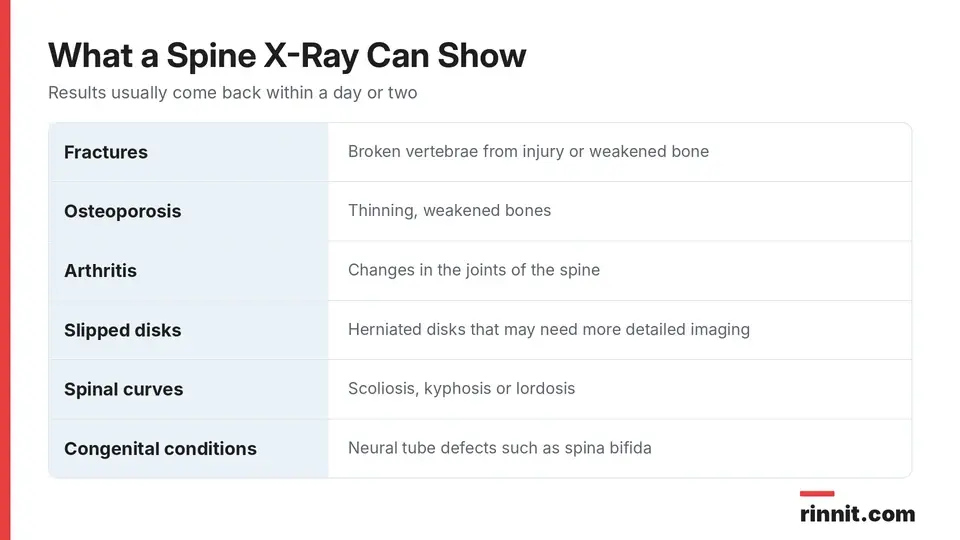
A spine X-ray can point to several causes of neck and back pain.
The images are sent to your primary care provider, who usually goes over the results with you within a day or two. [1]
Finding | What it may mean |
Break in a vertebra | Spinal fracture from injury or weakened bone |
Thin-looking bone | Osteoporosis |
Bone changes around the joints | Arthritis of the spine |
Abnormal sideways or front-to-back curve | Scoliosis, kyphosis or lordosis |
Problems with how the spine formed | Congenital conditions such as spina bifida |
Sources: [1]
What happens if more tests are needed?
If the X-ray doesn't give enough information, your provider may suggest a myelogram. In this test, contrast dye is injected into the spinal canal before X-rays and a CT scan are taken, which gives a more detailed view. [1]
Conclusion
A spine X-ray is a fast, painless and widely available way to look at the bones of your neck and back. It can point to fractures, arthritis, osteoporosis, spinal curves and other causes of pain, usually with no preparation at all.
If your results show a problem, or the images don't fully explain your symptoms, ask your provider what comes next and whether another test, such as a myelogram, CT or MRI, would help.
Keep learning: Read our X-ray guide or our MRI guide, and see how a DEXA scan measures bone density. For more background, see MedlinePlus on lumbosacral spine X-rays.
FAQ
What is a spine X-ray?
It is an imaging test that uses a small amount of radiation to take pictures of the bones in your neck and back.
Why would a doctor order a spine X-ray?
To find the cause of neck or back pain, such as an injury, arthritis, osteoporosis or a structural problem present from birth.
What can a spine X-ray show?
It can show fractures, osteoporosis, arthritis, spinal tumors, narrowed disk spaces, spinal curves and congenital conditions like spina bifida.
Can a spine X-ray show a herniated disk?
It can suggest a slipped disk, and your provider may order more detailed imaging if more information is needed.
How do I prepare for a spine X-ray?
Usually no preparation is needed; wear comfortable clothes and leave jewelry and other metal at home.
Can I eat before a spine X-ray?
Yes, you can usually eat and drink normally unless your provider gives you other instructions.
How long does a spine X-ray take?
It usually takes about 15 minutes, or a bit longer if extra images are needed.
Is a spine X-ray painful?
No, the X-ray itself is painless, though some positions may feel uncomfortable if your back is sore.
Is the radiation from a spine X-ray dangerous?
The dose from an occasional diagnostic X-ray is low and generally considered safe, and a lead apron shields other areas.
When will I get my spine X-ray results?
Your provider usually discusses the results with you within a day or two.
Related Reading
Scoliosis Guide: Symptoms, Causes, Diagnosis, and Treatment explains a sideways spinal curve that a spine X-ray can show.
Spinal Stenosis: Symptoms, Causes, Diagnosis, and Treatment — Complete Guide covers narrowing of the spinal canal that may be investigated with spine imaging.
What Is a Compression Fracture? Symptoms, Causes, Treatment & Outlook Explained describes a type of vertebral break that a spine X-ray can detect.
Osteoporosis: Causes, Symptoms, Diagnosis and Treatment Explained explains the bone-thinning condition a spine X-ray can help reveal.
Ankylosing Spondylitis: Symptoms, Causes, Treatment & Complete Guide covers a form of spinal arthritis that can show changes on X-ray.
Back Pain: Symptoms, Causes, and Proven Relief Strategies explains the common symptom that most often leads to a spine X-ray.
References
Cleveland Clinic. Spine X-Ray: What It Is, Purpose, Procedure, Results & Types. Cleveland Clinic. Last updated September 1, 2023. https://my.clevelandclinic.org/health/diagnostics/10229-spine-x-ray
Chou R, Fu R, Carrino JA, et al. Imaging strategies for low-back pain: systematic review and meta-analysis. Lancet. 2009;373(9662):463-472. PMID 19200918. https://doi.org/10.1016/S0140-6736(09)60172-0
Holmes JF, Akkinepalli R. Computed tomography versus plain radiography to screen for cervical spine injury: a meta-analysis. J Trauma. 2005;58(5):902-905. PMID 15920400. https://doi.org/10.1097/01.ta.0000162138.36519.2a
Medical disclaimer
This article is for general education only and does not replace advice from a qualified healthcare professional. Talk to your doctor about your own diagnosis and treatment, and seek emergency care right away for severe or sudden symptoms.



Comments