Back Pain: Symptoms, Causes, and Proven Relief Strategies

Updated: 3 days ago
Medically reviewed by Dr. Baraa Alnahhal, MD · Last reviewed: October 2026
Quick Answer
Back pain is pain ranging from a dull muscle ache to a sharp, shooting pain that can travel down a leg, most often from muscle strain, disk problems or arthritis. [1] Most improves within a few weeks with home care and light activity. [2] Seek immediate care for back pain with new bowel or bladder problems, fever, or after a serious injury. [1]
What the research says
Exercise reduces chronic low back pain by a clinically important amount. A Cochrane review of 249 trials found moderate-certainty evidence that exercise lowered pain by 15.2 points on a 0–100 scale (95% CI 12.2 to 18.3 points) compared with no treatment, usual care or placebo at the earliest follow-up. Gains in function were smaller (6.8 points), and the side effects reported were mostly minor, such as muscle soreness (PubMed: Hayden et al., Cochrane Database Syst Rev, 2021) [3].
For acute low back pain, advice to stay active beats advice to rest in bed. A Cochrane review of 10 randomized trials found that in two trials (401 people), staying active gave small improvements in pain (SMD 0.22, 95% CI 0.02 to 0.41) and function (SMD 0.29, 95% CI 0.09 to 0.49) compared with bed rest. For sciatica, the two approaches made little or no difference (PubMed: Dahm et al., Cochrane Database Syst Rev, 2010) [4].
Smoking is modestly linked to more back pain. A meta-analysis of 40 studies found that current smokers had a higher prevalence of chronic low back pain (OR 1.79, 95% CI 1.27 to 2.50), and in cohort studies a higher incidence of low back pain (OR 1.31, 95% CI 1.11 to 1.55) than never smokers. The authors described the association as fairly modest (PubMed: Shiri et al., Am J Med, 2010) [5].
What Is Back Pain?
Back pain is one of the most common reasons people seek medical help or miss work, and it is a leading cause of disability worldwide. [1]
The good news is that most back pain episodes can be prevented or relieved, especially in people younger than age 60. [1] When prevention fails, simple home treatment and using the body correctly often heal the back within a few weeks. [1] Surgery is rarely needed. [1]
What Does Back Pain Feel Like?
Back pain can range from a simple muscle ache to a shooting, burning or stabbing feeling, and it can radiate down a leg. [1] Bending, twisting, lifting, standing and walking tend to make it worse. [1]
Symptom Feature | How It Presents |
Pain quality | Muscle ache, shooting, burning or stabbing sensation |
Radiation | Pain can travel down one leg |
Aggravating movements | Bending, twisting, lifting, standing, walking |
When should you see a doctor for back pain?
Most back pain improves within a few weeks with home treatment and self-care, so a doctor visit is not always needed right away. [1] However, some situations deserve professional attention. Contact a healthcare professional for back pain that:
Warning Sign | Description |
Duration | Lasts longer than a few weeks [1] |
Severity | Is severe and does not improve with rest [1] |
Radiation | Spreads down one or both legs, especially below the knee [1] |
Nerve symptoms | Causes weakness, numbness or tingling in one or both legs [1] |
Weight loss | Is paired with unexplained weight loss [1] |
In some people, back pain can signal a serious medical problem. [1] This is rare, but seek immediate care for back pain that:
What Causes Back Pain?
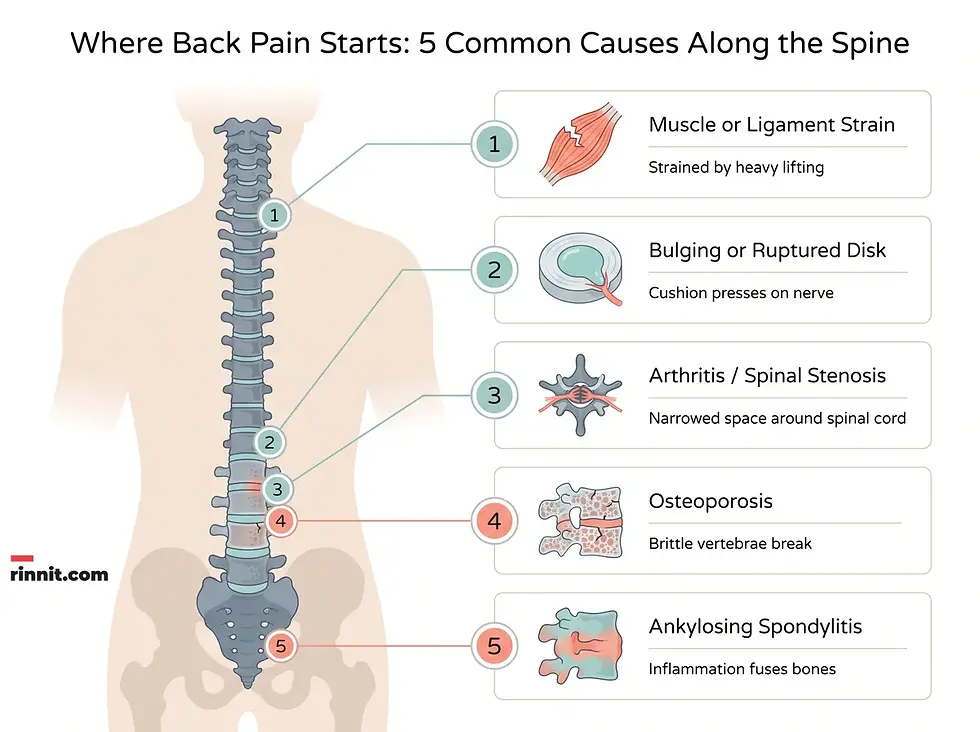
Back pain often develops without a cause that shows up in a test or an imaging study. [1] Several conditions are commonly linked to it:
Muscle or ligament strain: Repeated heavy lifting or a sudden awkward movement can strain back muscles and spinal ligaments. [1] In people in poor physical condition, constant strain can cause painful muscle spasms. [1]
Bulging or ruptured disks: Disks act as cushions between the bones of the spine. [1] The soft material inside a disk can bulge or rupture and press on a nerve [1] (see our guide to the herniated disk). Notably, a bulging or ruptured disk might not cause back pain at all, and is often found on imaging done for another reason. [1]
Arthritis: Osteoarthritis can affect the lower back. [1] In some cases, arthritis in the spine narrows the space around the spinal cord, a condition called spinal stenosis.
Osteoporosis: The spine’s vertebrae can develop painful breaks if the bones become porous and brittle. [1]
Ankylosing spondylitis (axial spondyloarthritis): An inflammatory disease that can cause some spine bones to fuse, making the spine less flexible. [1]
Cause | What Happens |
Muscle or ligament strain | Heavy lifting or an awkward movement strains muscles and spinal ligaments; poor conditioning can trigger muscle spasms [1] |
Bulging or ruptured disks | Inner disk material bulges or ruptures and presses on a nerve; may also cause no pain at all [1] |
Arthritis | Osteoarthritis affects the lower back; can lead to spinal stenosis (narrowed space around the spinal cord) [1] |
Osteoporosis | Porous, brittle vertebrae develop painful breaks [1] |
Ankylosing spondylitis | Inflammatory disease fuses some spine bones, reducing flexibility [1] |
Who is at risk of back pain?
Back pain can develop in anyone, including children and teens, not only adults. [1] Several factors raise the risk:
Risk Factor | Why It Increases Risk |
Age | Back pain becomes more common starting around age 30 to 40 [1] |
Lack of exercise | Weak, unused back and abdominal muscles [1] |
Excess weight | Extra stress on the back [1] |
Diseases | Some types of arthritis and cancer can contribute [1] |
Improper lifting | Using the back instead of the legs [1] |
Depression, anxiety and stress | People prone to depression and anxiety appear to have a greater risk; stress causes muscle tension [1] |
Smoking | Coughing can lead to herniated disks; smoking also reduces blood flow to the spine and raises the risk of osteoporosis [1] |
How can you prevent back pain?
Improving your physical condition and learning how to use your body correctly can help prevent back pain. [1]
Keep the Back Healthy and Strong
Exercise: Regular low-impact aerobic activities increase strength and endurance in the back. [1] Walking, bicycling and swimming are good choices because they do not strain or jolt the back. [1] Talk with your healthcare team about which activities to try.
Build muscle strength and flexibility: Abdominal and back muscle exercises strengthen the core so these muscles work together to support the back. [1]
Maintain a healthy weight: Being overweight strains back muscles. [1]
Quit smoking: The risk of low back pain rises with the number of cigarettes smoked each day, so quitting can help reduce it. [1]
Use Your Body Properly
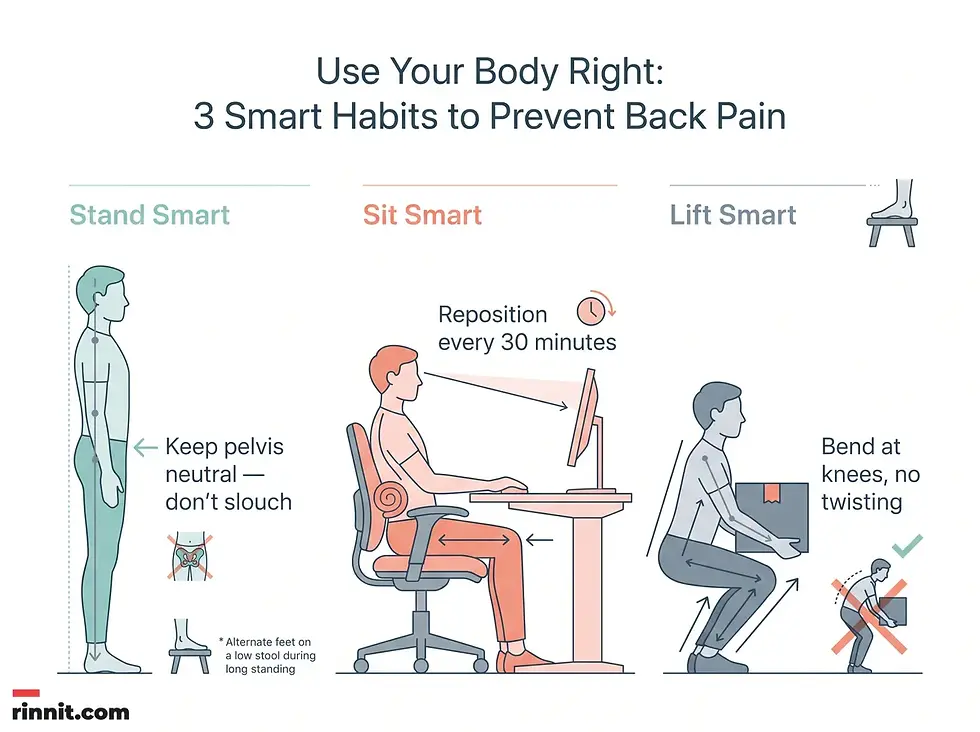
Avoid movements that twist or strain the back.
Stand smart: Do not slouch, and keep a neutral pelvic position. When standing for long periods, place one foot on a low footstool and alternate feet. [1] Good posture reduces stress on back muscles.
Sit smart: Choose a seat with good lower back support, armrests and a swivel base. A pillow or rolled towel in the small of the back maintains its typical curve. [1] Keep knees and hips level and change position at least every half hour. [1]
Lift smart: Avoid heavy lifting if possible. If you must lift something heavy, let your legs do the work: keep your back straight, bend only at the knees, do not twist, and hold the load close to your body. [1] Find a lifting partner if the object is heavy or awkward. [1]
Buyer Beware
Because back pain is common, many products promise prevention or relief. There is no good evidence that special shoes, shoe inserts, back supports or specially designed furniture can help. [1] There also does not appear to be one type of mattress that is best for people with back pain; it is probably a matter of what feels most comfortable to each person. [1]
How is back pain diagnosed?
To diagnose back pain, a healthcare professional examines your back and checks your ability to sit, stand, walk and lift your legs. [2] They may ask you to rate your pain on a scale of zero to 10 and describe how it affects daily activities. [2] These assessments help show where the pain comes from, how much you can move before pain or spasms force you to stop, and whether a more serious cause needs to be ruled out. [2] One or more of these tests might pinpoint the cause:
Diagnostic Test | What It Reveals |
Physical exam | Pain rating (0–10), movement, and sit, stand, walk and leg-lift function [2] |
X-ray | Arthritis or broken bones; cannot show conditions of the spinal cord, muscles, nerves or disks [2] |
MRI or CT scan | Herniated disks and problems with bones, muscles, tissue, tendons, nerves, ligaments and blood vessels [2] |
Blood tests | Infection or other conditions that might be causing pain [2] |
EMG (nerve studies) | Confirms nerve pressure from herniated disks or spinal stenosis [2] |
How is back pain treated?
Most back pain gets better within a month with home treatment, especially in people younger than 60, though for many the pain lasts several months. [2] Pain relievers and heat might be all that is needed. [2] Bed rest is not recommended. [2] [4]

Continue your activities as much as you can. Try light activity such as walking, and stop activity that increases pain, but do not avoid activity out of fear of pain. [2] If home treatments are not working after several weeks, your healthcare professional might recommend stronger medicines or other therapies. [2]
Medicines
Medicines depend on the type of back pain. [2] They might include:
Medicine Type | Examples | Key Notes |
Pain relievers (NSAIDs) | Ibuprofen, naproxen sodium | Take only as directed; overuse can cause serious side effects; prescription NSAIDs if over-the-counter ones fail [2] |
Muscle relaxants | Prescription muscle relaxants | Used if pain relievers do not help mild to moderate pain; can cause dizziness and sleepiness [2] |
Topical pain relievers | Creams, salves, ointments, patches | Deliver pain-relieving substances through the skin [2] |
Narcotics (opioids) | Oxycodone, hydrocodone | Short-term use only, with close medical supervision [2] |
Antidepressants | Duloxetine, amitriptyline | Shown to relieve chronic back pain [2] |
Physical Therapy
A physical therapist can teach exercises to increase flexibility, strengthen back and abdominal muscles and improve posture, and regular use of these techniques can help keep pain from returning. [2] Therapists also teach how to modify movements during an episode of back pain so you can stay active without flaring symptoms. [2] Learn more in our guide to physical therapy.
Surgical and Other Procedures
Procedure | How It Works | Best For |
Cortisone injections | Cortisone plus a numbing medicine around the spinal cord reduces inflammation near nerve roots | Pain that radiates down the leg; relief often lasts only a month or two [2] |
Radiofrequency ablation | A fine needle delivers radio waves that damage nearby nerves and interfere with pain signals [2] | Pain from a specific area |
Implanted nerve stimulators | Devices under the skin send electrical impulses to certain nerves to block pain signals [2] | Pain blocking when other measures have not helped |
Surgery | Creates more space within the spine | Increasing muscle weakness or pain down a leg, related to herniated disks or narrowed nerve spaces [2] |
Alternative Treatments
A number of alternative treatments might ease back pain. [2] Always discuss the benefits and risks with your healthcare professional before starting a new therapy.
Alternative Treatment | How It Works | Evidence |
Acupuncture | Thin sterilized needles inserted at specific body points | A growing body of scientific evidence suggests it can help [2] |
Chiropractic care | A chiropractor manipulates the spine to ease pain | Commonly used to ease pain |
Massage | Relieves tense or overworked muscles | May help pain caused by muscle tension [2] |
TENS | A battery-powered device delivers electrical impulses through the skin | Studies show mixed results [2] |
Yoga | Postures, breathing exercises and relaxation techniques | Stretches and strengthens muscles and improves posture; adjust poses that worsen symptoms [2] |
How can people cope and live well with back pain?
Most people recover from back pain without long-term disability. The single most important strategy is staying active: bed rest is not recommended, and avoiding movement out of fear of pain can slow recovery. [2] [4] If home treatments are not working after several weeks, do not wait to seek help. Stronger medicines, physical therapy and procedures can all play a role when simple measures fall short.
Conclusion
Back pain is one of the most common and burdensome health problems in the world, but most episodes are manageable and heal within a few weeks. [1] The fundamentals are simple: stay active, use proper body mechanics when lifting and sitting, keep your core strong, maintain a healthy weight and avoid smoking. Seek medical care promptly if pain lasts more than a few weeks, travels down a leg, or comes with weakness, numbness, fever or injury. [1]
Your next step: If you are dealing with persistent back pain, book an appointment with a healthcare professional and bring this guide’s key questions with you.
Frequently Asked Questions
1. How long does back pain usually last?
Most back pain gets better within a month with home treatment, especially in people younger than 60. Simple home treatment and correct body use often heal the back within a few weeks, although for many people the pain lasts several months.
2. Is bed rest good for back pain?
No. Bed rest is not recommended. Continue your activities as much as you can, try light activity such as walking, and stop activity that increases pain, but do not avoid activity out of fear of pain.
3. What are the most common causes of back pain?
Common causes include muscle or ligament strain from heavy lifting or awkward movements, bulging or ruptured disks pressing on nerves, arthritis (including spinal stenosis), osteoporosis causing painful vertebral breaks, and ankylosing spondylitis.
4. When is back pain an emergency?
Seek immediate care for back pain that causes new bowel or bladder problems, comes with a fever, or follows a fall, a blow to the back or another injury. These signs are rare but can point to a serious medical problem.
5. Can a bulging disk cause no pain at all?
Yes. A bulging or ruptured disk might not cause back pain. Disk disease is often found by chance on spine X-rays, CT scans or MRIs done for another reason.
6. Does smoking affect back pain?
Yes. People who smoke have higher rates of back pain. Smoking can cause coughing that may lead to herniated disks, decreases blood flow to the spine and increases the risk of osteoporosis. The risk rises with the number of cigarettes smoked each day.
7. What exercises help prevent back pain?
Regular low-impact aerobic activities such as walking, bicycling and swimming build strength and endurance in the back without straining or jolting it. Abdominal and back muscle exercises strengthen the core so these muscles work together to support the back.
8. What medicines treat back pain?
Options include over-the-counter or prescription NSAIDs, muscle relaxants, topical creams and patches, short-term opioids under close medical supervision, and certain antidepressants such as duloxetine and amitriptyline for chronic pain.
9. Does surgery fix most back pain?
No. Surgery is rarely needed to treat back pain. It is sometimes helpful for people with increasing muscle weakness or pain that goes down a leg, often related to herniated disks or conditions that narrow the spaces where nerves pass through the spine.
10. Do special shoes or mattresses help back pain?
There is no good evidence that special shoes, shoe inserts, back supports or specially designed furniture can help. No single type of mattress is best for back pain; it is probably a matter of what feels most comfortable to each person.
11. What tests diagnose back pain?
Diagnosis starts with a physical exam and a pain rating. Tests may include X-rays, MRI or CT scans, blood tests and nerve studies (EMG) to find the cause of the pain.
Related Reading
Prolotherapy: How It Works, Uses and Side Effects explains prolotherapy injections for joint pain.
Discogram (Discography): Procedure, Risks and What Results Mean explains the dye test used to find which spinal disc is causing pain.
Spine X-Ray: What It Shows, How to Prepare, What Happens and What the Results Mean explains the imaging test often used to look at the bones of the spine.
Further Reading
References
Mayo Clinic Staff. Back pain - Symptoms and causes. Mayo Clinic. Sept. 26, 2024. https://www.mayoclinic.org/diseases-conditions/back-pain/symptoms-causes/syc-20369906
Mayo Clinic Staff. Back pain - Diagnosis and treatment. Mayo Clinic. Sept. 26, 2024. https://www.mayoclinic.org/diseases-conditions/back-pain/diagnosis-treatment/drc-20369911
Hayden JA, Ellis J, Ogilvie R, et al. Exercise therapy for chronic low back pain. Cochrane Database Syst Rev. 2021;9(9):CD009790. PMID 34580864. https://doi.org/10.1002/14651858.CD009790.pub2
Dahm KT, Brurberg KG, Jamtvedt G, et al. Advice to rest in bed versus advice to stay active for acute low-back pain and sciatica. Cochrane Database Syst Rev. 2010;(6):CD007612. PMID 20556780. https://doi.org/10.1002/14651858.CD007612.pub2
Shiri R, Karppinen J, Leino-Arjas P, et al. The association between smoking and low back pain: a meta-analysis. Am J Med. 2010;123(1):87.e7-35. PMID 20102998. https://doi.org/10.1016/j.amjmed.2009.05.028
Medical Disclaimer
This article is for informational purposes only and does not constitute medical advice. Always seek the advice of your physician or other qualified health provider with any questions you may have regarding a medical condition. Never disregard professional medical advice or delay in seeking it because of something you have read here.



Comments