Prolotherapy: How It Works, Uses and Side Effects

Updated: 2 days ago
Written and medically reviewed by Dr. Baraa Alnahhal, MD · Last reviewed: November 2026 · How we review
Quick Answer
Prolotherapy is an injection treatment for joint and soft tissue pain in which a provider injects an irritating solution, most often dextrose, into or near a painful joint, tendon or ligament. Supporters believe it triggers the body's healing response, but this hasn't been proven. Research is mixed. It's not FDA-approved and is usually not covered by insurance.
What the research says
Some benefit for knee arthritis: in 5 randomized trials with 319 people with knee osteoarthritis, dextrose prolotherapy improved pain and function scores more than control treatments at about 5 months, with no serious side effects, though results varied widely (Wang J et al., Aging Clinical and Experimental Research, 2022) [2]
Results for shoulder tendons are mixed: in 5 trials with 272 people with rotator cuff problems, dextrose injections eased pain more than physical therapy alone, but guided injections did no better than saline or steroid shots (Catapano M et al., PM&R, 2020) [3]
Key takeaways
Prolotherapy injects an irritant, usually dextrose, near painful joints or tendons.
It's meant to trigger healing, but this hasn't been proven.
A course is usually three to six injections.
Side effects are usually mild soreness.
It isn't FDA-approved and is rarely covered by insurance.
What is prolotherapy?
Prolotherapy, short for proliferation therapy, is given as a series of injections to relieve pain. The idea is that the body treats the injected irritant like a small injury and sends healing cells to the area. Prolotherapy doesn't cure the underlying condition and shouldn't replace treatments your provider has prescribed. Sources: [1]
What it's used for
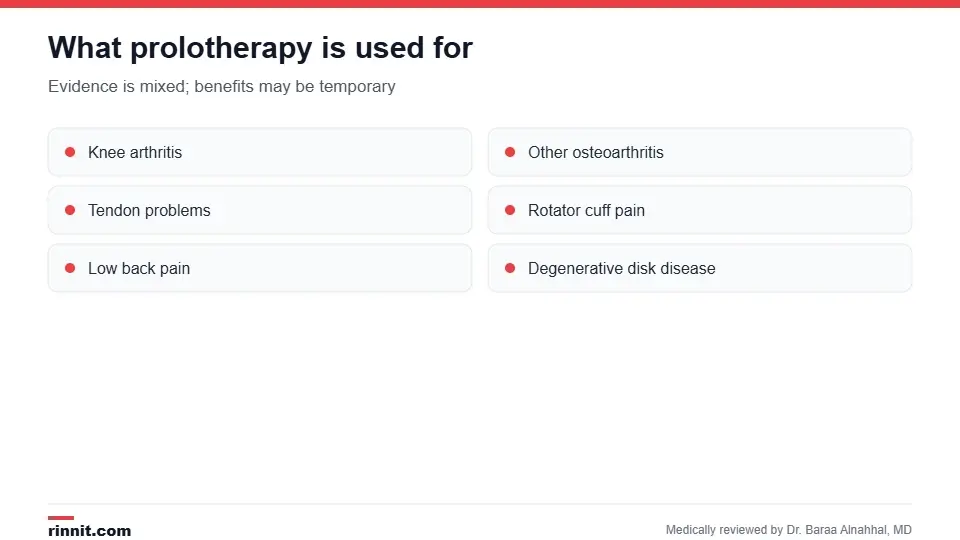
Evidence is mixed, and benefits may be temporary.
Osteoarthritis, such as knee pain from arthritis.
Tendon problems (tendinopathy).
Low back pain and degenerative disk disease.
Fibromyalgia and other chronic pain in bones, muscles and connective tissue. Sources: [1]
How it works

This mechanism hasn't been proven scientifically.
The most common solution is dextrose, a type of sugar. It's injected near the painful area or directly into the joint, tendon or ligament, sometimes guided by ultrasound. Supporters say the irritation sparks tissue repair, but scientists haven't confirmed this. Sources: [1]
What to expect

Ask before intense exercise or sports.
Talk with your provider first to make sure it's safe with your other treatments.
Choose a reputable clinic and a certified provider.
The solution is injected near or into the painful area, sometimes with ultrasound guidance.
Most people have three to six injections over several sessions.
You can usually return to normal activities right away. Sources: [1]
Side effects and risks
Risk | Notes |
Pain or soreness at the injection site | Most common |
Bruising | Rare |
Nerve, joint or tissue damage | Very rare |
No benefit or temporary benefit | A real possibility |
Cost | Often hundreds of dollars per session; rarely covered by insurance |
Sources: [1, 3]
Does it work?
The evidence is inconclusive. Some studies show less pain and better function, especially for knee arthritis, while others suggest the benefit may be a placebo effect. Many studies don't follow people for long, so it's unclear how long relief lasts. Sources: [1, 2, 3]
When to call your provider
New or worsening pain.
Swelling.
Skin color changes or bruising.
A rash or hives. Sources: [1]
Conclusion
Prolotherapy is a low-risk injection that some people try for stubborn joint and tendon pain, but the evidence is mixed and it's often not covered by insurance. Talk with your provider about whether it makes sense alongside proven treatments.
Keep learning: read about chronic pain and physical therapy.
Frequently asked questions
What is prolotherapy?
Injections of an irritating solution, usually dextrose, to relieve joint or tendon pain.
What is injected?
Most often dextrose, a sugar solution.
What conditions does it treat?
Arthritis, tendon problems, low back pain and other musculoskeletal pain.
How many injections will I need?
Usually three to six over several sessions.
Does prolotherapy hurt?
You may feel soreness at the injection site.
Does it work?
Research is mixed; some people get relief, but it may be temporary.
Is prolotherapy FDA-approved?
No.
Does insurance cover it?
Usually not; sessions often cost hundreds of dollars.
What is the recovery time?
Little or none; most people resume activities right away.
Is it safe?
Serious side effects are very rare.
Related Reading
PEMF Therapy: What Pulsed Electromagnetic Field Therapy Does explains PEMF therapy and what research shows.
What Is Chronic Pain? Causes, Types, and Management Options long-lasting pain and its treatment.
Knee Pain: Symptoms, Causes, Diagnosis, and Treatment Guide a common reason people try prolotherapy.
Back Pain: Symptoms, Causes, and Proven Relief Strategies another common target for injections.
Physical Therapy: Enhancing Mobility, Strength, and Recovery a proven treatment for joint pain.
Genicular Nerve Block: Targeted Relief for Chronic Knee Pain another injection for knee pain.
References
Cleveland Clinic. Prolotherapy: What It Is, Uses & Side Effects. Cleveland Clinic. Last updated May 19, 2026. https://my.clevelandclinic.org/health/treatments/22426-prolotherapy
Wang J, Liang J, Yao J, et al. Meta-analysis of clinical trials focusing on hypertonic dextrose prolotherapy (HDP) for knee osteoarthritis. Aging Clinical and Experimental Research. 2022;34(4):715-724. PMID 34449061. https://doi.org/10.1007/s40520-021-01963-3
Catapano M, Zhang K, Mittal N, et al. Effectiveness of dextrose prolotherapy for rotator cuff tendinopathy: a systematic review. PM&R. 2020;12(3):288-300. PMID 31642203. https://doi.org/10.1002/pmrj.12268
Medical disclaimer
This article is for general education only and does not replace advice from a qualified healthcare professional. Talk to your doctor about your own diagnosis and treatment, and seek emergency care right away for severe or sudden symptoms.



Comments