PEMF Therapy: What Pulsed Electromagnetic Field Therapy Does

Updated: 2 days ago
Written and medically reviewed by Dr. Baraa Alnahhal, MD · Last reviewed: November 2026 · How we review
Quick Answer
Pulsed electromagnetic field (PEMF) therapy is a complementary therapy that uses low-level pulses of electromagnetic energy to try to ease pain, reduce inflammation and support healing. The evidence is mixed, and benefits haven't been proven. It's safe for most people, but not if you're pregnant, have a pacemaker or insulin pump, use a medicine patch or have epilepsy.
What the research says
Some benefit for arthritis pain: in 15 placebo-controlled trials in people with osteoarthritis, PEMF improved pain, stiffness and physical function compared with sham treatment, though the evidence covered only short-term effects (Yang X et al., Physical Therapy, 2020) [2]
Other studies found no pain relief: pooling 8 trials with 421 people with knee osteoarthritis, PEMF improved physical function by about 5 points but didn't significantly reduce pain or stiffness compared with placebo (Chen L et al., Journal of Rehabilitation Medicine, 2019) [3]
Key takeaways
PEMF therapy uses pulses of electromagnetic energy to ease symptoms.
It's used for arthritis, injury pain, nerve pain and slow-healing fractures.
Devices include whole-body mats and small portable pads.
Benefits aren't proven, and results are mixed.
Avoid it if you're pregnant, have epilepsy or use an implanted device.
What is PEMF therapy?
In PEMF therapy, magnets in a device pulse on and off to create an electromagnetic field around part of your body. Supporters believe it works at the cellular level to relieve symptoms and help tissue heal. It's meant to be used with, not instead of, standard treatments. Sources: [1]
What it's used for

Benefits are possible but not proven.
Arthritis, such as knee osteoarthritis.
Pain after an injury or trauma.
Broken bones that don't heal on their own (nonunion fractures). Sources: [1]
Possible effects include less pain and inflammation, better circulation and natural healing, but none of these has been definitively proven. Sources: [1]
Types of devices

At-home devices can be expensive.
Device | What it's like |
Whole-body mat | Like a yoga mat with electromagnets inside |
Portable device | Like a small heating pad placed on one area |
In-office device | Used during visits to a provider |
Sources: [1]
How to use it safely
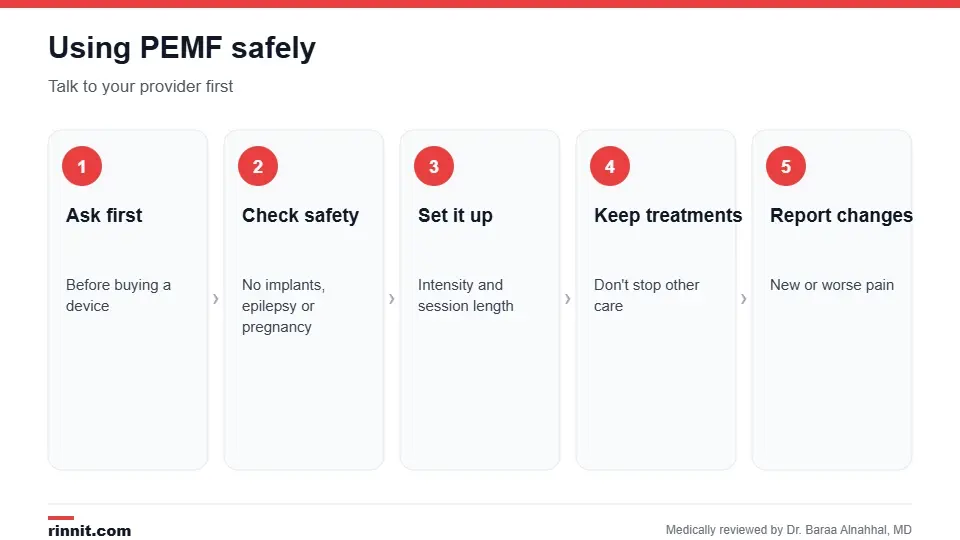
It's a complementary therapy, not a replacement.
Talk with your provider before starting or buying a home device.
Make sure you don't have a reason to avoid it.
Ask your provider how to set the intensity and session length.
Keep using your other prescribed treatments.
Report any new or worsening symptoms. Sources: [1]
Who should avoid it
People who are pregnant.
People with a pacemaker, insulin pump or other implanted device.
People who take medicine through a skin patch.
People with epilepsy. Sources: [1]
Downsides
The biggest downside is that PEMF may not help at all. Some of the benefit people notice may be a placebo effect. Insurance may not cover it, and home devices can be very expensive. Sources: [1, 3]
Does it work?
Research is mixed. One knee arthritis study found people felt their knees moved better, but pain and stiffness mostly didn't change. Other reviews found some short-term pain relief. More research is needed. Sources: [1, 2, 3]
When to call your provider
New pain.
Pain or other symptoms that get worse. Sources: [1]
Conclusion
PEMF therapy is a low-risk complementary option some people try for arthritis and other pain, but its benefits aren't proven. Talk with your provider before spending money on a home device, and keep using treatments that are known to work.
Keep learning: read about TENS units and pain management.
Frequently asked questions
What is PEMF therapy?
A therapy that uses pulses of electromagnetic energy to ease pain and support healing.
What does PEMF treat?
Arthritis, injury pain, nerve pain and slow-healing fractures.
Does PEMF therapy work?
The evidence is mixed, and benefits aren't proven.
Is PEMF therapy safe?
It's safe for most people.
Who shouldn't use PEMF?
People who are pregnant, have epilepsy or have an implanted device.
Can I use PEMF at home?
Yes, but talk to your provider first; devices can be expensive.
What does a PEMF mat do?
It surrounds your body with an electromagnetic field during a session.
Is PEMF covered by insurance?
Often not.
Can PEMF replace my other treatments?
No. It's meant to be used alongside them.
What's the difference between PEMF and TENS?
PEMF uses electromagnetic fields; TENS uses mild electrical currents through skin pads.
Related Reading
TENS Unit: How Transcutaneous Electrical Nerve Stimulation Relieves Pain another drug-free pain device.
Pain Management: Types, Treatments and What to Expect an overview of pain treatments.
What is Knee Osteoarthritis? a common reason people try PEMF.
Neuropathic Pain: Symptoms, Causes, and Relief Strategies nerve pain and its treatment.
Prolotherapy: How It Works, Uses and Side Effects another complementary treatment for joint pain.
References
Cleveland Clinic. PEMF (Pulsed Electromagnetic Field) Therapy: What It Is. Cleveland Clinic. Last updated June 10, 2026. https://my.clevelandclinic.org/health/treatments/pulsed-electromagnetic-field-pemf-therapy
Yang X, He H, Ye W, et al. Effects of pulsed electromagnetic field therapy on pain, stiffness, physical function, and quality of life in patients with osteoarthritis: a systematic review and meta-analysis of randomized placebo-controlled trials. Physical Therapy. 2020;100(7):1118-1131. PMID 32251502. https://doi.org/10.1093/ptj/pzaa054
Chen L, Duan X, Xing F, et al. Effects of pulsed electromagnetic field therapy on pain, stiffness and physical function in patients with knee osteoarthritis: a systematic review and meta-analysis of randomized controlled trials. Journal of Rehabilitation Medicine. 2019;51(11):821-827. PMID 31583420. https://doi.org/10.2340/16501977-2613
Medical disclaimer
This article is for general education only and does not replace advice from a qualified healthcare professional. Talk to your doctor about your own diagnosis and treatment, and seek emergency care right away for severe or sudden symptoms.



Comments