Pain Management: Types, Treatments and What to Expect

Updated: 2 days ago
Written and medically reviewed by Dr. Baraa Alnahhal, MD · Last reviewed: November 2026 · How we review
Quick Answer
Pain management uses medicines, procedures, exercise, therapy and lifestyle changes to prevent, reduce or relieve pain and help you function better. It treats both acute pain, such as after an injury or surgery, and chronic pain that lasts months or years. Opioids are generally avoided when possible. The goal is better daily life; complete relief isn't always possible.
What the research says
Opioids help chronic pain only a little: in 96 trials with 26,169 people with chronic noncancer pain, opioids reduced pain only slightly more than placebo and worked about as well as NSAIDs, antidepressants and antiseizure drugs, with more vomiting (Busse JW et al., JAMA, 2018) [2]
Non-opioid medicines worked as well or better: in the SPACE trial of 240 people with chronic back, hip or knee pain, opioids were no better than non-opioid medicines for function over 12 months, and pain was slightly worse with more side effects (Krebs EE et al., JAMA, 2018) [3]
Key takeaways
Pain management combines treatments to reduce pain and improve function.
It treats both short-term and chronic pain.
Options include therapy, exercise, injections, devices and medicines.
Opioids are generally avoided when possible.
Treatments often reduce pain by about 30%; total relief isn't always possible.
What is pain management?
Pain management is a medical field, sometimes called algiatry, that treats pain from many causes. A pain team may include pain specialists, anesthesiologists, nurses, mental health providers, physical and occupational therapists and social workers. Together they create a plan for your body and your daily life. Sources: [1]
Types of pain it treats
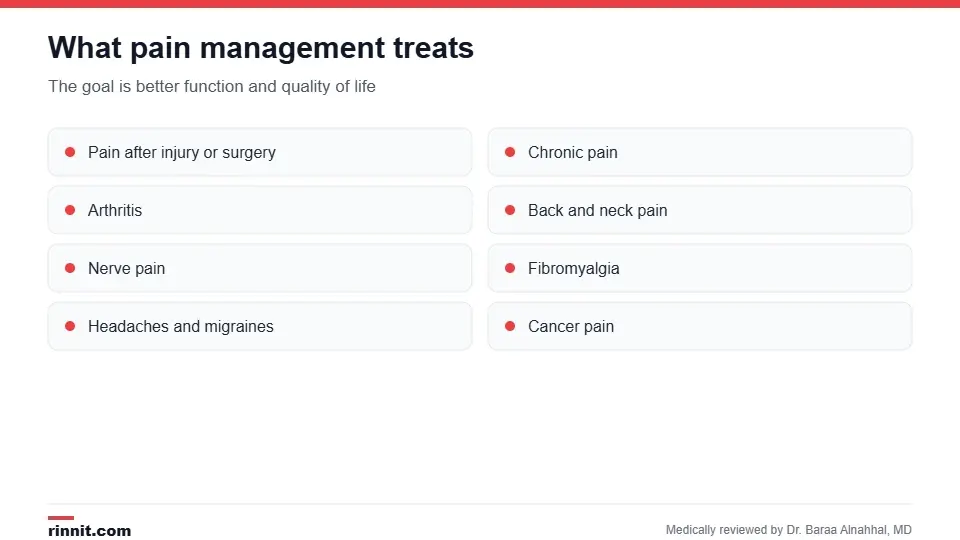
The goal is better function and quality of life.
Acute pain after an injury or surgery.
Chronic pain lasting months or years.
Arthritis, back pain and spine conditions.
Fibromyalgia, lupus and Crohn's disease.
Headaches, migraines, endometriosis, burns and cancer pain. Sources: [1]
Pain management options

Several treatments are often combined.
Approach | Examples |
Self-care | Rest, ice, compression and elevation; heat or cold; activity; sleep; stress management |
Therapy | Physical therapy, occupational therapy |
Mind-body | Cognitive behavioral therapy, relaxation, mindfulness, pain diaries |
Complementary | Acupuncture, massage, chiropractic care, biofeedback, yoga, meditation |
Nerve stimulation | TENS, peripheral nerve stimulation, spinal cord stimulation |
Procedures | Steroid injections, nerve blocks, radiofrequency ablation, Botox, pain pumps, surgery |
Medicines | NSAIDs, acetaminophen, numbing creams, antiseizure drugs, antidepressants, muscle relaxers, steroids; opioids only when needed |
Conservative, low-risk options are usually tried before riskier ones. People respond differently, even with the same condition. Sources: [1]
Getting started

A pain diary helps your team understand your pain.
See your primary care provider, who may refer you to a pain specialist.
Get evaluated with a physical and neurological exam and possibly blood tests, imaging or nerve tests.
Describe how pain affects your sleep, mood, work and relationships.
Keep a pain diary to track what helps and what makes it worse.
Work with your team to adjust the plan over time. Sources: [1]
Risks
Treatment | Possible risks |
Acetaminophen | Overuse is the most common cause of acute liver failure in the U.S. |
Opioids | Risk of opioid use disorder and overdose |
Procedures and surgery | Infection and, rarely, permanent nerve damage |
Always follow dosing instructions and tell your provider about every medicine and supplement you take. Sources: [1, 2]
What to expect
Pain may not go away completely or right away, and you may need to try several treatments. Current treatments for chronic pain lower pain scores by about 30% on average, and fewer than half of people with nerve pain get enough relief from a single treatment. Many people still report better quality of life and well-being with a pain management program. Sources: [1, 2, 3]
When to call your provider
Pain keeps you from your usual activities.
Pain doesn't improve, gets worse or comes back after treatment.
You feel anxious or depressed.
Pain makes it hard to sleep. Sources: [1]
Conclusion
Pain management works best as a team effort that combines several approaches tailored to you. Even when pain can't be fully removed, the right plan can help you sleep, move and live better.
Keep learning: read about chronic pain and nerve pain.
Frequently asked questions
What is pain management?
Using medicines, procedures, exercise and therapy to reduce pain and improve function.
What's the difference between acute and chronic pain?
Acute pain is short-term; chronic pain lasts months or years.
Who provides pain management?
A team of pain specialists, anesthesiologists, therapists and mental health providers.
What treatments are used?
Self-care, therapy, nerve stimulation, injections and medicines.
Are opioids used for pain?
They're generally avoided when possible because of the risk of addiction.
Can therapy help with pain?
Yes. Physical therapy and CBT are key parts of many plans.
Will my pain go away completely?
Not always; the goal is less pain and better function.
How much do treatments help?
Chronic pain treatments lower pain scores by about 30% on average.
What is a pain diary?
A log of your pain levels, triggers and what helps.
When should I see a pain specialist?
When pain limits your daily life or doesn't improve with treatment.
Related Reading
PEMF Therapy: What Pulsed Electromagnetic Field Therapy Does explains PEMF therapy and what research shows.
What Is Chronic Pain? Causes, Types, and Management Options pain that lasts months or years.
Neuropathic Pain: Symptoms, Causes, and Relief Strategies pain caused by nerve damage.
TENS Unit: How Transcutaneous Electrical Nerve Stimulation Relieves Pain a drug-free pain relief device.
Spinal Cord Stimulator (SCS): How It Works, Surgery, Recovery and Risks an implanted device for chronic pain.
What Is Complex Regional Pain Syndrome (CRPS)? Symptoms, Causes, Diagnosis, Treatment & Outlook a hard-to-treat pain condition.
References
Cleveland Clinic. Pain Management: What It Is, Types, Benefits & Risks. Cleveland Clinic. Last updated July 10, 2024. https://my.clevelandclinic.org/health/treatments/21514-pain-management
Busse JW, Wang L, Kamaleldin M, et al. Opioids for chronic noncancer pain: a systematic review and meta-analysis. JAMA. 2018;320(23):2448-2460. PMID 30561481. https://doi.org/10.1001/jama.2018.18472
Krebs EE, Gravely A, Nugent S, et al. Effect of opioid vs nonopioid medications on pain-related function in patients with chronic back pain or hip or knee osteoarthritis pain: the SPACE randomized clinical trial. JAMA. 2018;319(9):872-882. PMID 29509867. https://doi.org/10.1001/jama.2018.0899
Medical disclaimer
This article is for general education only and does not replace advice from a qualified healthcare professional. Talk to your doctor about your own diagnosis and treatment, and seek emergency care right away for severe or sudden symptoms.



Comments