Spinal Cord Stimulator (SCS): How It Works, Surgery, Recovery and Risks

Updated: 6 days ago
Written and medically reviewed by Dr. Baraa Alnahhal, MD · Last reviewed: October 2026 · How we review
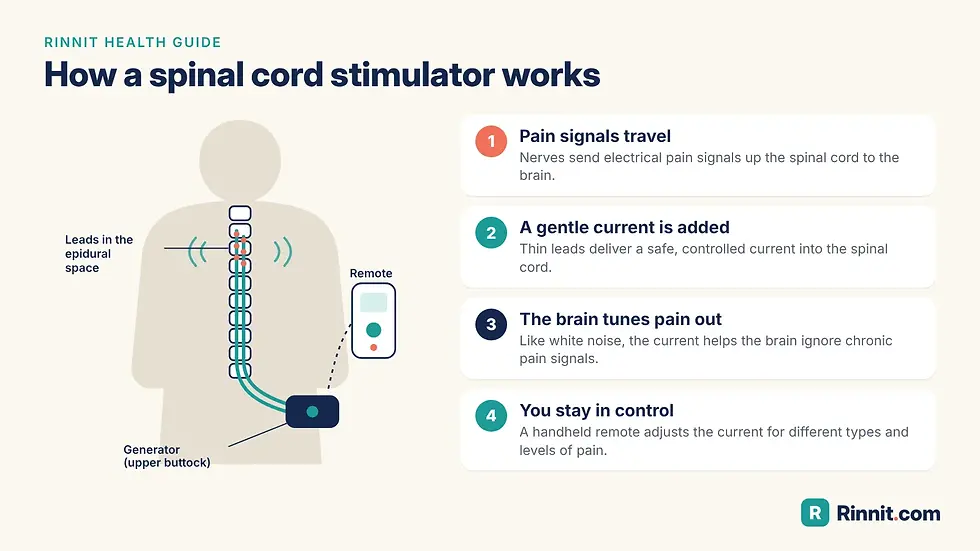
Quick Answer: What is a spinal cord stimulator?
A spinal cord stimulator (SCS) is a small implanted device that sends a mild electrical current into the spinal cord to help the brain ignore chronic pain signals. It is used when other treatments fail or opioids are unsafe. A temporary trial comes first; if pain drops by at least half, a permanent device is implanted. [1]
What the research says
Stimulators clearly lowered pain in diabetic nerve pain. A meta-analysis of 9 studies (416 people) found spinal cord stimulation reduced pain by about 4 points on a 0–10 scale at 6 months compared with standard medical care, with low complication rates. (Liu et al., Pain Res Manag, 2026)
Most people avoid complications, but some issues do happen. Across 33 studies and 3,445 patients, 24% had at least one complication and 3% had a serious one. Leads moving out of place happened more often than infection (7.05 vs 2.82 events per 100 patient-years). (Raccagni et al., Neuromodulation, 2026)
When relief fades, a new setting often helps. A review of 22 studies (1,591 patients) found that switching the device to a different stimulation pattern restored relief in 77.9% of attempts (685 of 879). (Yener et al., Neuromodulation, 2026)
Key takeaways
A spinal cord stimulator does not remove the cause of pain. It helps your brain tune pain signals out. [1]
You get a trial period first, so you can test it before committing to permanent surgery. [1]
The trial is usually a same-day procedure. [1]
Full adjustment after the permanent implant takes about 4 to 6 weeks. [1]
Most batteries last at least 10 years. [1]
Many newer devices allow MRI under specific conditions, but always tell your care team you have one. [1]
What is a spinal cord stimulator?
A spinal cord stimulator is a medical device a surgeon implants in your body to help treat severe chronic pain. [1]
Your provider will usually suggest nonsurgical treatments first, like physical therapy and medicines. A spinal cord stimulator becomes an option when: [1]
Other treatments haven't worked, or
It isn't safe for you to take certain medicines, such as opioids.
Getting one involves two procedures: a trial phase, then a second surgery to place the permanent device. [1]
How does a spinal cord stimulator work?
A spinal cord stimulator works by sending a safe, alternate electrical current into your spinal cord, which can block chronic pain signals and help your brain ignore them. [1]
Pain signals are electrical currents. They start in your nerves, travel up your spinal cord and reach your brain, which turns them into the pain you feel. [1]
Think of it like a good white noise machine. The hum doesn't remove the annoying noise in the room, but it helps you tune it out. In the same way, a stimulator doesn't eliminate pain signals. It helps you focus on work, sleep and daily life instead. [1]
You control the current with a handheld remote when you feel pain, and you can adjust it for different types and levels of pain. [1]
What conditions can a spinal cord stimulator treat?
A spinal cord stimulator can treat many conditions and injuries that cause long-lasting pain, including these examples: [1]
Condition | What it involves |
Angina and other chest pain | Ongoing chest pain, often linked to the heart (learn about unstable angina) |
Back pain | Long-term pain in the back |
Intense, lasting pain, usually in one limb | |
Diabetes-related neuropathy | Nerve pain caused by diabetes |
Pain from damaged or misfiring nerves | |
Persistent spinal pain syndrome after laminectomy | Pain that continues after spine surgery |
Phantom limb pain | Pain felt in a limb that has been removed (related: residual limb pain) |
Postherpetic neuralgia | Nerve pain that remains after shingles |
Spinal cord injuries | Pain after damage to the spinal cord |
These are only examples. Researchers are still studying other types of pain it may help, and your provider will tell you whether a stimulator is a good fit for you. [1]
How do you prepare for spinal cord stimulator surgery?
You prepare for spinal cord stimulator surgery with a physical exam, blood tests and imaging, following the exact instructions your surgeon gives you. [1]
In general, you'll need: [1]
A physical exam to confirm you're healthy enough for surgery
Blood tests
Imaging tests, such as a spine X-ray, an MRI or both
Tell your provider about every medicine and supplement you take, including over-the-counter ones. You may need to stop some before surgery. [1]
What happens during a spinal cord stimulator trial?
During a spinal cord stimulator trial, your surgeon places a temporary version of the device so you can try stimulation, usually for a few weeks, before anything permanent is placed. [1]
A successful trial usually means the stimulator reduces your pain by at least half. If it does, and you feel comfortable using it, your surgeon will implant the permanent version. [1]
Trial surgery steps
For both the trial and the permanent implant, you receive anesthesia so you don't feel pain. Some people need general anesthesia, which puts you to sleep. [1]
During the trial, your surgeon will: [1]
Make a small cut (incision) in the skin of your back, usually in the middle.
Insert thin wires called leads into the epidural space, the area between your spinal cord and your spinal bones (vertebrae).
Connect the leads to a power source (generator) outside your body. It may be stitched to your skin or held with strong temporary surgical glue.
Adjust the current to match the kind of pain you feel.
You wear the outside generator for the whole trial and use the remote to control the current. Your surgeon shows you how. [1]
How is a permanent spinal cord stimulator implanted?
A permanent spinal cord stimulator is implanted a few weeks after a successful trial, using similar steps, except that every part is placed under your skin. [1]
Your surgeon will: [1]
Make an incision in the same spot as the trial.
Insert a small needle.
Place the permanent leads. Most people get two, though some need only one.
Thread the leads under your skin to where the generator will go.
Implant the generator, usually near the top of one buttock. You may be able to choose the side, so mention which side you usually sleep on.
Turn on and program the device, making sure it works before closing the incisions.
Unlike the trial, nothing stays outside your body. The generator is small: a few inches long and about half an inch thick. [1]

Trial vs permanent stimulator at a glance
Feature | Trial stimulator | Permanent stimulator |
Purpose | Test whether stimulation works for you | Long-term pain management |
Generator location | Outside the body, attached to the skin | Under the skin, near the top of one buttock |
Leads | In the epidural space, connected outside | Usually two, threaded under the skin |
Duration | Usually a few weeks | Long term; most batteries last 10+ years |
Going home | Usually the same day | As advised by your surgeon |
Water | Keep leads and generator dry | Follow your surgeon's advice |
What happens after spinal cord stimulator surgery?
After spinal cord stimulator surgery, your care team teaches you how to care for your incisions and use the remote, and after the trial you usually go home the same day. [1]
After both procedures, your care team will: [1]
Show you how to keep your incisions clean
Ask you to change your bandages for about a week
Make sure you know how to use and adjust the remote before you leave
About two weeks after the permanent implant, you'll have a follow-up visit to remove the stitches or staples around the generator. [1]
What are the benefits of a spinal cord stimulator?
The main benefits of a spinal cord stimulator are needing less pain medicine, having fewer medicine side effects and being able to test the device before permanent surgery. [1]
Less medication. You may be able to lower how much pain medicine you take, and some people stop needing it.
Fewer medicine side effects. This matters most if you can't take opioids.
A built-in test drive. Few surgeries let you try them first. If the trial doesn't help enough, you don't have to get the permanent implant.
What are the risks of a spinal cord stimulator?
The risks of a spinal cord stimulator include infection, lead and generator problems, tingling or numbness, pain returning and, rarely, spinal cord injury. [1]
Complication | What it means |
Tingling or numbness | Can be felt while using the device |
Infection | At or around the surgical sites |
Lead problems | Leads can move out of place, break or stop working correctly |
Pain returning | Can happen once your body adjusts to the device |
Generator problems | The generator can fail or malfunction |
Spinal cord injury | Rare; from surgery or a broken lead |
Some people worry their body will reject the device. This isn't like an organ transplant, where the immune system attacks the new tissue. Still, tell your surgeon about any new or changing pain around your implants. [1]
How long is recovery after spinal cord stimulator surgery?
Recovery after a permanent spinal cord stimulator implant takes about 4 to 6 weeks, which gives your body time to heal around the generator and leads and get used to their effects. [1]
Plan to rest after both the trial and the permanent implant. Early on, you'll likely need to avoid: [1]
Bending
Exercise or other intense activity
Lifting heavy objects (your surgeon will give you a weight limit)
Stretching
During the trial, the leads and outside generator must stay dry. Avoid swimming, hot tubs and baths. You may need to wash without showering until your surgeon says it's safe. [1]
Your surgeon will tell you when you can return to your usual routine. [1]

How long does a spinal cord stimulator battery last?
Most permanent spinal cord stimulator batteries last at least 10 years. Some models are rechargeable: you hold a charger near your skin to recharge it, and your surgeon will show you how. [1]
What precautions do you need with a spinal cord stimulator?
A spinal cord stimulator needs a few lasting precautions around MRI scans, metal detectors and driving or using machinery. [1]
Once you've healed, you can return to many usual activities, and many people get back to things pain made them avoid. [1]
Situation | What to do |
MRI scans | Many newer devices allow MRI scans under specific conditions, but older ones may not. Always tell your care team about your device before any imaging test. |
Metal detectors | You'll set off alarms at airports, concerts and arenas. They won't affect your device, but you may need to tell security staff. |
Driving, machinery, power tools | Turn the stimulator off first. A malfunction is very rare, but it could cause you to lose control and hurt yourself or others. |
What is the success rate of a spinal cord stimulator?
Most people with a spinal cord stimulator experience about half as much pain, though success depends on the condition being treated and how severe the pain was to begin with. [1]
Sometimes a stimulator becomes less effective over time, for reasons that aren't fully known. Your surgeon can give you a clearer idea of what to expect in your situation. [1]
When should you go to the ER after spinal cord stimulator surgery?
You should go to the emergency room after spinal cord stimulator surgery if you notice any of these warning signs: [1]
A headache that's constant when you sit or stand but goes away when you lie down. This can signal a cerebrospinal fluid (CSF) leak from the needle or lead placement. These headaches, called post-dural puncture headaches, often improve on their own in a week or two.
Signs of infection or sepsis at your surgical sites. Look for discoloration, swelling, pain, or oozing or bad-smelling discharge.
Sudden numbness, tingling or muscle weakness on one or both sides of your body below the leads. This may mean the leads have shifted, which can damage your spinal cord or nearby nerves.
Some tingling is normal with certain types of stimulators. Ask your surgeon which sensations are expected and which are warning signs. [1]
Your surgeon will also schedule follow-up visits after the permanent implant to help you adjust to the stimulation. [1]
Conclusion
Chronic pain is different from everyday pain. Instead of a useful warning, it lingers. It can disrupt sleep, make work hard and leave you exhausted, especially after many treatments haven't helped.
A spinal cord stimulator can sound intimidating, but it offers something rare in surgery: a trial run. You can see how well it controls your pain before deciding on a permanent implant. It is a safe, effective option for the right person, and your surgeon can answer every question along the way.
Next step: Bring this guide to your next appointment. Use the FAQ below to build your list of questions, and keep learning with our guides on chronic pain, central pain syndrome and back spasms.
FAQ
Is spinal cord stimulator surgery painful?
Spinal cord stimulator surgery should not be painful because you receive anesthesia that numbs your spine and back, and some people are put to sleep with general anesthesia. Afterward, you'll rest and care for your incisions for about a week.
How long is the spinal cord stimulator trial?
The spinal cord stimulator trial usually lasts a few weeks. You use the temporary device during that time before deciding on the permanent implant.
What counts as a successful spinal cord stimulator trial?
A spinal cord stimulator trial is usually considered successful when the device reduces your pain by at least half and you feel comfortable using it.
How long does it take to recover from a permanent spinal cord stimulator implant?
Recovery from a permanent spinal cord stimulator implant takes about 4 to 6 weeks. That gives your body time to heal around the generator and leads and to get used to the stimulation.
Where is the spinal cord stimulator battery placed?
The spinal cord stimulator battery (generator) usually sits under the skin near the top of one buttock. You may be able to choose which side.
How long does a spinal cord stimulator battery last?
Most spinal cord stimulator batteries last at least 10 years. Some models are rechargeable using a charger held near your skin.
Can I have an MRI with a spinal cord stimulator?
Many newer spinal cord stimulators allow MRI scans under specific conditions, but some older ones do not. Always tell your healthcare providers you have one before any imaging test.
Will a spinal cord stimulator set off airport security?
Yes, a spinal cord stimulator will set off metal detectors, but the detectors won't affect how it works. You may need to explain that you have a medical device.
Can my body reject a spinal cord stimulator?
A spinal cord stimulator is not rejected the way a transplanted organ can be. Tell your surgeon about any new or changing pain around the implants.
Can a spinal cord stimulator stop working over time?
Yes, some spinal cord stimulators lose effectiveness over time for unknown reasons. Talk with your surgeon about your options if relief fades.
Related Reading
Pain Management: Types, Treatments and What to Expect explains the treatment options for acute and chronic pain.
References
Cleveland Clinic. Spinal Cord Stimulator: What It Is, Side Effects & Recovery. Cleveland Clinic. Last updated December 22, 2025. https://my.clevelandclinic.org/health/treatments/24237-spinal-cord-stimulator-scs
Anderson B, Cockroft KM. Spinal Cord Stimulation. AANS Patient Resources. Last updated April 15, 2024. https://www.aans.org/patients/conditions-treatments/spinal-cord-stimulation/
Sivanesan E. Spinal Cord Stimulator. Johns Hopkins Medicine. Last updated March 20, 2026. https://www.hopkinsmedicine.org/health/expert-qa/treating-pain-with-spinal-cord-stimulators
Dua A, Collier SA, Garcia K, et al. Spinal Cord Stimulation. StatPearls. Treasure Island (FL): StatPearls Publishing; updated 2025 Dec 13. PMID 31985947. https://pubmed.ncbi.nlm.nih.gov/31985947/
Liu C, Xu Z, Liang Y, et al. Spinal Cord Stimulation for Painful Diabetic Neuropathy: A Systematic Review and Meta-Analysis of High- and Low-Frequency Modalities. Pain Res Manag. 2026;2026(1):e9347376. PMID 42183586. https://doi.org/10.1155/prm/9347376
Raccagni NG, Dotti M, Goudarzi B, et al. Complication Rates of Spinal Cord Stimulation: A Systematic Review and Meta-Analysis. Neuromodulation. 2026;29(6):904-912. PMID 42383966. https://doi.org/10.1016/j.neurom.2026.05.005
Yener U, Caparó M, Naeimi T, et al. Waveform-Conversion to Salvage Failed Spinal Cord Stimulation: A Systematic Review of Current Evidence. Neuromodulation. 2026;29(6):921-936. PMID 42249871. https://doi.org/10.1016/j.neurom.2026.04.018
Medical disclaimer
This article is for education only and does not replace advice from your own doctor. Always talk with your care team about your own pain treatment, surgery and recovery.



Comments