Discogram (Discography): Procedure, Risks and What Results Mean

Updated: 2 days ago
Written and medically reviewed by Dr. Baraa Alnahhal, MD · Last reviewed: November 2026 · How we review
Quick Answer
A discogram (discography) is a test that helps find which spinal disc is causing back or neck pain. Guided by live X-ray, a provider injects contrast dye into one or more discs and asks whether the injection reproduces your usual pain. It's usually considered only before surgery such as spinal fusion, and its use is debated.
What the research says
The test can harm healthy discs: a 10-year matched cohort study found that discs punctured during modern discography showed faster degeneration, more new herniations on the side of the needle puncture and greater loss of disc height than matched control discs; the authors urge careful weighing of risks and benefits (Carragee EJ et al., Spine (Phila Pa 1976), 2009) [2]
False positives are uncommon with strict criteria: a systematic review and meta-analysis in people without back pain found that, when strict low-pressure criteria were used, discography had a specificity of 94% and a false-positive rate of about 6% for diagnosing disc-related pain (Wolfer LR et al., Pain Physician, 2008) [3]
Key takeaways
A discogram tests whether a specific disc is the source of your pain.
Contrast dye is injected into discs under X-ray guidance.
Reproducing your usual pain suggests the disc is the cause.
A CT or MRI afterward shows tears or wear inside the disc.
It's used mainly before surgery, and experts disagree on its value.
What is a discogram?
Your spinal discs are soft cushions between the vertebrae. As they wear down or tear, they can cause pain, a condition called discogenic pain. But many discs that look damaged on an MRI don't actually hurt. A discogram tries to link your pain to a specific disc by gently pressurizing it with fluid. Sources: [1]
Why it's done
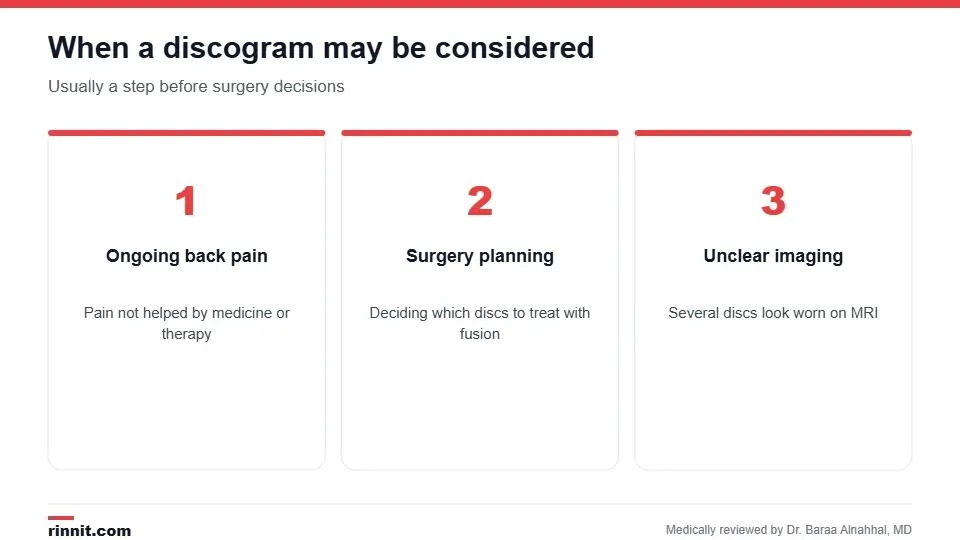
A discogram is usually a last step before surgery decisions.
Back or neck pain that hasn't improved with medicine, physical therapy or other treatments.
Planning surgery such as spinal fusion, to decide which discs to treat.
Unclear imaging where several discs look worn. Sources: [1]
Many surgeons don't use discograms because damaged discs don't always cause pain, and the test itself can damage discs. Sources: [1, 2]
What happens during a discogram

The test usually takes about an hour.
You lie on your stomach or side, get IV sedation to relax and have your skin numbed.
Using fluoroscopy, the provider guides a thin needle into the center of each disc being tested.
Contrast dye is injected, and you tell the provider whether you feel pressure, no pain, or pain that matches your usual pain.
You may then have a CT scan or MRI to show the dye's pattern inside the discs. Sources: [1]
You'll need someone to drive you home. Most people return to normal activities after about 24 hours. Sources: [1]
Risks
Complications are rare but can include infection of the disc, bleeding, worse back pain, headache, allergic reaction to the dye and, very rarely, nerve or blood vessel injury or paralysis. Call your provider for a fever over 101°F (38.3°C), severe pain, or new numbness or weakness. Sources: [1]
Understanding results
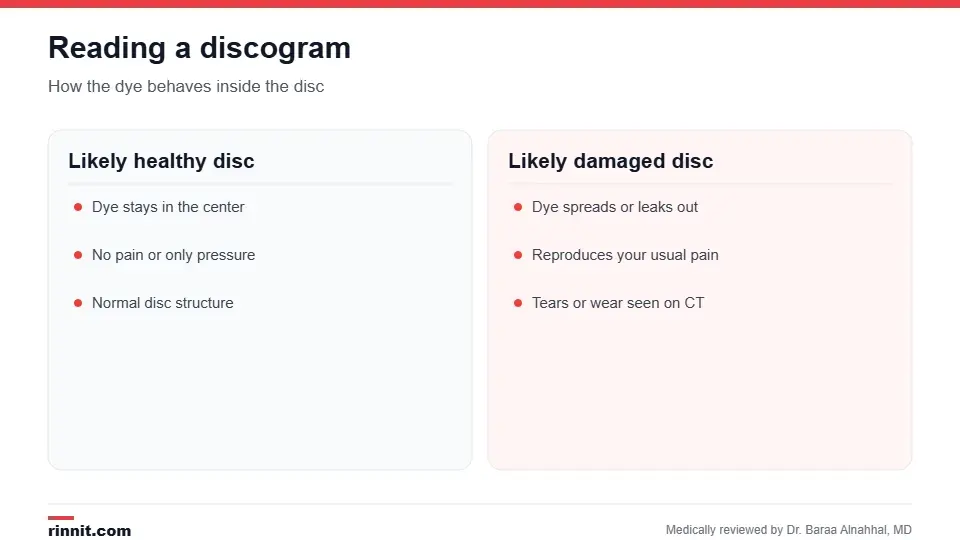
The dye pattern shows how intact each disc is.
Finding | What it may mean |
Dye stays in the center of the disc, no pain | The disc is likely healthy |
Dye spreads through cracks or leaks out | The disc is worn or torn |
Injection reproduces your usual pain | That disc may be the pain source |
Results usually come within about a week. Your provider combines them with your exam and MRI to plan treatment, which may include treatment for a herniated disk or surgery. Sources: [1, 3]
Conclusion
A discogram can help pinpoint a painful disc before surgery, but it isn't right for everyone. Ask your provider how the results would change your treatment and whether the benefits outweigh the risks for you.
Keep learning: read about lower back pain and spinal fusion.
Frequently asked questions
What is a discogram used for?
To find which spinal disc is causing your pain, usually before surgery.
Is a discogram painful?
It can be uncomfortable, since it aims to reproduce your pain; sedation and numbing help.
How long does a discogram take?
About an hour.
Will I be awake?
You'll usually be relaxed with IV sedation but awake enough to describe your pain.
What happens after the test?
You may have a CT or MRI, then go home with a driver and rest for 24 hours.
What does a positive discogram mean?
The injection reproduced your usual pain, suggesting that disc is the source.
What are the risks?
Rarely infection, bleeding, worse pain, headache, allergy or nerve injury.
Why is the discogram controversial?
Damaged discs don't always cause pain, and the test may speed up disc wear.
When will I get results?
Usually within about a week.
When should I call my provider?
For fever over 101°F, severe pain, or new numbness or weakness.
Related Reading
Spinal Fusion Surgery: What It Is, How It Works, and What Recovery Looks Like the surgery a discogram is most often used to plan.
Herniated Disk: Symptoms, Causes & What Actually Helps a common disc problem and its treatments.
Understanding Lower Back Pain: Causes, Symptoms, and Solutions the many causes of lower back pain.
Vertebrogenic Low Back Pain: Causes, Symptoms, and Treatment another source of chronic low back pain.
Back Pain: Symptoms, Causes, and Proven Relief Strategies ways to relieve back pain without surgery.
References
Cleveland Clinic. Discogram (Discography): What It Is, Procedure & Side Effects. Cleveland Clinic. Last updated November 2, 2023. https://my.clevelandclinic.org/health/diagnostics/discogram
Carragee EJ, Don AS, Hurwitz EL, et al. 2009 ISSLS Prize Winner: Does discography cause accelerated progression of degeneration changes in the lumbar disc: a ten-year matched cohort study. Spine (Phila Pa 1976). 2009;34(21):2338-2345. PMID 19755936. https://doi.org/10.1097/BRS.0b013e3181ab5432
Wolfer LR, Derby R, Lee JE, et al. Systematic review of lumbar provocation discography in asymptomatic subjects with a meta-analysis of false-positive rates. Pain Physician. 2008;11(4):513-538. PMID 18690280. https://pubmed.ncbi.nlm.nih.gov/18690280/
Medical disclaimer
This article is for general education only and does not replace advice from a qualified healthcare professional. Talk to your doctor about your own diagnosis and treatment, and seek emergency care right away for severe or sudden symptoms.



Comments