Vertebrogenic Low Back Pain: Causes, Symptoms, and Treatment

Updated: 3 days ago
Medically reviewed by Dr. Baraa Alnahhal, MD · Last reviewed: October 2026
TL;DR: Vertebrogenic low back pain is a distinct type of chronic back pain that starts in the vertebral endplates, the thin protective layers between your spinal bones and the cushioning disks. Rather than arthritis or muscle strain, the pain signals come from basivertebral nerves inside the vertebrae that become sensitized when the endplates are damaged. It typically causes a deep, burning, or aching pain in the middle of the lower back that gets worse with sitting, bending forward, or physical activity. [1] Treatment starts with conservative care such as NSAIDs and physical therapy. If you have not improved after at least six months, a procedure called basivertebral nerve ablation may be an option. [1]
Quick Answer
Vertebrogenic low back pain is pain that arises when the vertebral endplates are worn or injured, irritating the basivertebral nerves inside the vertebrae. It often feels like a deep, central lower back ache worsened by sitting, bending forward or activity. MRI or CT can show endplate changes. [1] Treatment ranges from NSAIDs and physical therapy to basivertebral nerve ablation.
What the research says
Nerve ablation outperformed a sham procedure at 3 months. In a double-blind trial of 225 patients with chronic low back pain and Modic type I or II changes, disability scores (ODI) fell by 20.5 points with basivertebral nerve ablation versus 15.2 points with a sham procedure (p = 0.019, per-protocol analysis), and 75.6% vs 55.3% had a clinically meaningful improvement (≥10-point ODI drop) (Fischgrund et al., Eur Spine J, 2018) [2].
It also beat standard care in a randomized trial. In 140 randomized patients, the 3-month difference in ODI change between ablation and standard care was −20.3 points (95% CI −25.9 to −14.7; p < 0.001); at 12 months in the ablation group, 64% had at least a 50% reduction in pain and 29% were pain free (open-label design) (Smuck et al., Reg Anesth Pain Med, 2021) [3].
Roughly two in three treated patients report at least 50% pain relief. A systematic review with single-arm meta-analysis (12 publications, six study populations, 414 treated participants) found at least 50% pain relief in 65% (95% CI 51–78%) at 6 months and 64% (95% CI 43–82%) at 12 months, and rated the evidence as moderate quality (Conger et al., Pain Med, 2022) [4].
What Is Vertebrogenic Low Back Pain?
Vertebrogenic low back pain is a specific type of chronic back pain that originates from the vertebral endplates. These endplates are thin, protective layers between the vertebral bones and the cushioning intervertebral disks. For many years, chronic back pain was attributed mainly to degenerative disk disease or arthritis. [1] Researchers later found that the endplates themselves can be a primary source of pain when they become damaged or inflamed.
Inside each vertebra are basivertebral nerves. When the endplates break down, these nerves can become compressed or sensitized and send persistent pain signals to the brain. This discovery gives a clearer explanation for many cases of non-specific back pain that previously had no clear cause.
More than 30 million people in the United States have some type of chronic low back pain [1], yet healthcare providers can identify a direct cause in only about 20% of cases. [1] How many of the remaining cases are vertebrogenic is still being studied.

Recognizing the Symptoms
The symptoms of vertebrogenic pain can look like other types of back pain, but a few characteristics help healthcare providers tell them apart.
Feature | Description |
Pain quality | Often described as a deep, burning, or aching sensation. [1] |
Location | Mainly in the middle of the lower back; some people also have referred pain in other areas. [1] |
What makes it worse | Bending forward, sitting for long periods, or physical activity. [1] |
Associated signs | If a degenerated disk is also present, you may notice tingling, numbness, or weakness. [1] |
Because the symptoms overlap with degenerative disk disease, vertebrogenic pain can be misdiagnosed, and some people have both conditions. [1] Identifying the true source early is the key to moving beyond general treatments and finding a targeted solution.
Causes and Risk Factors
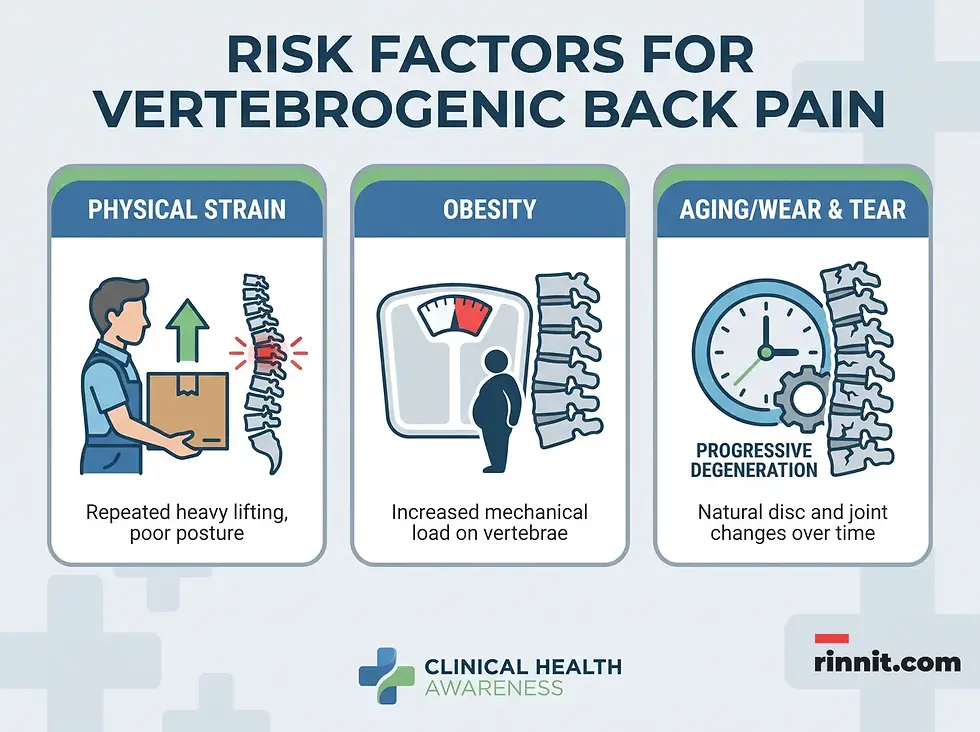
Vertebrogenic pain is caused by the breakdown of the vertebral endplates. Several factors can speed up that process or make it more likely.
Lifestyle and Physical Factors
Natural aging: everyday wear and tear over time is the most common contributor.
Obesity: extra body weight puts additional stress on the vertebral structures. [1]
Physical demands: jobs or hobbies that involve heavy lifting or repetitive strain on the spine.
Smoking: tobacco use is linked to the breakdown of endplate tissue. [1]
Increased height: taller people may be more likely to develop endplate damage. [1]
Other Contributing Factors
Genetics also play a role, and a family history of chronic back pain is a risk factor. [1] Sudden trauma, such as a fall or a high-impact injury, can also damage the endplates and lead to chronic vertebrogenic pain. [1]
Diagnosis and Clinical Testing
Diagnosis begins with a physical examination. Your provider may feel along your spine, ask you to move in specific ways to see which positions trigger pain, and ask whether chronic back pain runs in your family. [1]
A spine X-ray is a common starting point to evaluate back pain. [1] Because symptoms overlap with other conditions, a magnetic resonance imaging (MRI) or CT scan is often needed to see detailed changes in the vertebral endplates. Providers look for bone marrow inflammation and other signs of endplate changes, which point to the endplates as the source of chronic pain. [1]
Treatment and Management Pathway
Vertebrogenic pain is usually managed in steps, starting with conservative treatment before more advanced options are considered.
Conservative Treatments
NSAIDs: medicines such as ibuprofen or naproxen can ease daily pain and inflammation. [1]
Physical therapy: a physical therapist can teach stretches and exercises that help ease chronic low back pain. [1]
Muscle relaxers: these are usually recommended only as a short-term option because of side effects such as drowsiness and the risk of physical dependence. [1]
The Intracept® Procedure
If you have tried nonsurgical treatments for at least six months without improvement, your provider may recommend the Intracept® procedure, also called basivertebral nerve ablation. In this minimally invasive procedure, heat is used to ablate (damage) the basivertebral nerve so it can no longer send pain signals. [1] It is considered the most effective treatment for vertebrogenic pain, although you will probably need to try more conservative treatments first to qualify for insurance coverage. [1]

Conclusion
Vertebrogenic low back pain is an important advance in how we understand chronic spine problems. By identifying the vertebral endplates and the basivertebral nerve as a specific source of pain, doctors can now offer more targeted treatment than before. Getting to a diagnosis may take patience and specialized imaging, but options now range from conservative care to procedures such as the Intracept® procedure. Maintaining a healthy weight, staying active, avoiding smoking, and working closely with a spine specialist are the most practical ways to manage this type of back pain.
Related reading: Intracept procedure · Lower back pain · Herniated disk · Your spine · Physical therapy · NSAIDs
Frequently Asked Questions
Is vertebrogenic pain the same as a herniated disk?
No. Both can cause back pain, but a herniated disk involves the cushioning material between the vertebrae, while vertebrogenic pain comes from the endplates of the vertebrae themselves. Some people have both.
Can I prevent vertebrogenic low back pain?
Natural wear and tear is hard to avoid, but you can lower your risk by maintaining a healthy weight, exercising regularly (including core strengthening), stretching often if you have a sedentary job, and avoiding smoking.
How do I know if my pain is vertebrogenic?
If you have a deep, central ache in your lower back that has not improved with standard treatments, ask your doctor about endplate-related pain. Only a healthcare provider can diagnose it, usually with a physical exam and imaging.
Is the Intracept procedure safe?
The Intracept procedure is a minimally invasive treatment. Your doctor will decide whether you are a good candidate based on your medical history and imaging results.
Will insurance cover advanced treatments?
Coverage rules vary, but insurers typically expect you to try more conservative treatments, such as physical therapy and medication, before they cover a procedure like nerve ablation. The procedure is generally considered after at least six months of nonsurgical care.
Does physical therapy really help?
Physical therapy can. A physical therapist can teach stretches and exercises that help ease chronic low back pain, and physical therapy is one of the first treatments used for vertebrogenic pain.
What does referred pain mean?
Referred pain is pain you feel in a different part of the body from where the actual injury or damage is located.
Can smoking really affect my back?
Yes. Smoking is one of the factors that can contribute to the breakdown of the vertebral endplates, and avoiding it is one way to lower your risk.
Is vertebrogenic pain common?
Chronic low back pain affects more than 30 million people in the United States. Healthcare providers can identify a direct cause in only about 20% of cases, and how many of the remaining cases are vertebrogenic is still being studied.
How long is the recovery after nerve ablation?
Recovery times vary from person to person, so follow the instructions from your treating doctor. The procedure is minimally invasive, which means it does not involve the large incision of open spine surgery.
Related Reading
Discogram (Discography): Procedure, Risks and What Results Mean explains the dye test used to find which spinal disc is causing pain.
References
Cleveland Clinic. Vertebrogenic Low Back Pain: Causes, Symptoms & Treatment. Cleveland Clinic. Last updated 01/08/2024. https://my.clevelandclinic.org/health/diseases/vertebrogenic-low-back-pain
Fischgrund JS, Rhyne A, Franke J, et al. Intraosseous basivertebral nerve ablation for the treatment of chronic low back pain: a prospective randomized double-blind sham-controlled multi-center study. Eur Spine J. 2018;27(5):1146-1156. PMID 29423885. https://doi.org/10.1007/s00586-018-5496-1
Smuck M, Khalil J, Barrette K, et al. Prospective, randomized, multicenter study of intraosseous basivertebral nerve ablation for the treatment of chronic low back pain: 12-month results. Reg Anesth Pain Med. 2021;46(8):683-693. PMID 34031220. https://doi.org/10.1136/rapm-2020-102259
Conger A, Burnham TR, Clark T, et al. The effectiveness of intraosseous basivertebral nerve radiofrequency ablation for the treatment of vertebrogenic low back pain: an updated systematic review with single-arm meta-analysis. Pain Med. 2022;23(Suppl 2):S50-S62. PMID 35856331. https://doi.org/10.1093/pm/pnac070
Medical disclaimer
This article is for educational purposes only and is not a substitute for professional medical advice, diagnosis, or treatment. Always seek the advice of your physician or other qualified health provider with any questions about a medical condition.



Comments