Spinal Fusion Surgery: What It Is, How It Works, and What Recovery Looks Like

Updated: 6 days ago
Written and medically reviewed by Dr. Baraa Alnahhal, MD · Last reviewed: October 2026 · How we review
Quick Answer: What is spinal fusion?
Spinal fusion is surgery that permanently joins two or more vertebrae so they stop moving separately, making the spine more stable and easing pressure on the spinal cord and nerves. It can relieve pain, numbness, tingling and weakness. The operation takes about 1 to 5 hours, and doctors usually suggest it only after other treatments have not worked. [1]
What the research says
Adding fusion to decompression did not improve outcomes for spinal stenosis. In a trial of 247 adults aged 50 to 80, disability scores two years after surgery were similar with fusion (27) and without it (24), and the gap stayed flat at five years. Hospital stays were longer with fusion: 7.4 vs 4.1 days. (Försth et al., N Engl J Med, 2016) [2]
For a mild forward slip of a vertebra, fusion gave a modest boost. In 66 people with grade I degenerative spondylolisthesis, physical quality-of-life scores rose 15.2 points with fusion vs 9.5 with decompression alone at two years. Repeat surgery was needed in 14% vs 34%. (Ghogawala et al., N Engl J Med, 2016) [3]
Smoking nearly doubles the risk that bones fail to fuse. Across 20 studies and 3,009 patients, smokers had a 1.91-times higher risk of nonunion, whether they had one level or several fused. (Nunna et al., Global Spine J, 2022) [4]
Key takeaways
Spinal fusion links vertebrae so they heal into one solid unit.
It treats problems that press on the spinal cord or nerves, such as herniated disks, stenosis, scoliosis, fractures and tumors.
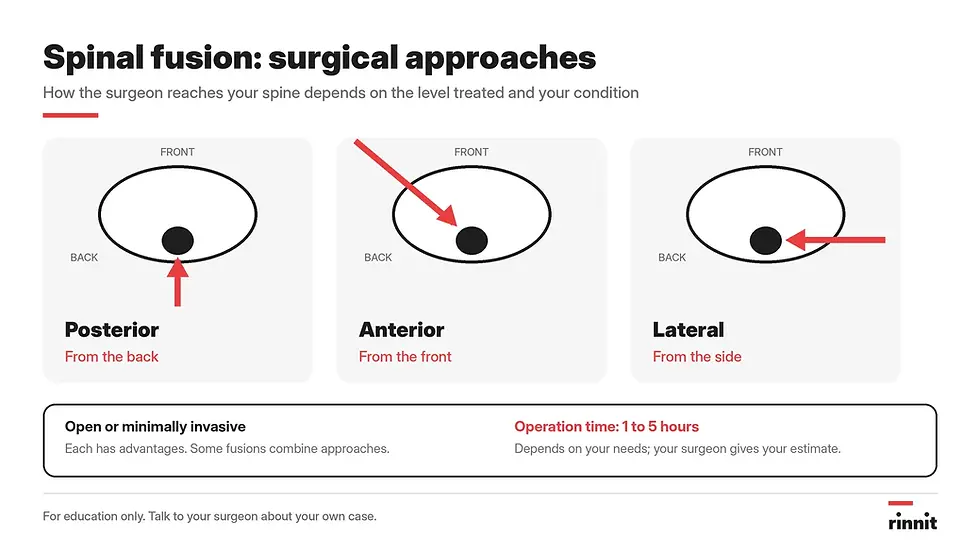
Surgeons may reach the spine from the back, front or side, using open or minimally invasive techniques.
Recovery is gradual. Expect activity limits, and possibly a brace and physical therapy.
Fused segments no longer move, so some loss of flexibility is normal.
What is spinal fusion?
Spinal fusion is surgery that connects two or more vertebrae so they heal together, support each other and stop moving independently. This reinforces the structure of your back. [1]
Your spine is a column of ring-shaped bones called vertebrae. Together, they hold your body upright and protect your spinal cord.
Two types of surgeons perform it: neurosurgeons and orthopedic surgeons. Which one you see depends on your condition and your needs. [1]

Why is spinal fusion done?
Spinal fusion is done to stabilize weak or unstable areas of the spine that squeeze the spinal cord or the nerves branching off it. That pressure disrupts the signals traveling through them. [1]
The result can be pain, numbness, tingling or muscle weakness, sometimes far from the spine itself, such as in your arms or legs.
What conditions can spinal fusion treat?
Condition | What is happening |
Herniated disk | A slipped, ruptured or bulging disk presses on nearby nerves |
Pinched nerve | Nerve compression in the neck (cervical radiculopathy) or lower back, which can cause sciatica |
Spinal and foraminal stenosis | Narrowing of the spaces the spinal cord and nerves pass through |
Spondylolisthesis | One vertebra slips out of place over another |
Spondylosis | Wear-related changes in the spine |
A sideways curve of the spine, in children or adults | |
Broken or damaged vertebrae that leave the spine unstable | |
Infections | Infection in the bones or soft tissue of the spine |
Growths affecting the bones, soft tissue, spinal cord or nerves | |
Congenital conditions | Spine problems present from birth |
[1]
Surgery is not always the first or best choice. Other treatments can work better or carry fewer risks for some people. For others, fusion is the right option.
How do you prepare for spinal fusion?
You prepare for spinal fusion with a medical checkup, a medication review, stopping all nicotine and planning help at home. [1]
Medical checkup and lab tests. These look for hidden issues such as high blood pressure, clotting problems or kidney trouble.
Medication review. Tell your team about every medicine, vitamin and supplement you take. Follow their instructions exactly.
Stop all nicotine. Smoking, vaping and smokeless tobacco seriously slow bone healing, which is the whole point of the surgery. [4]
Plan your support at home. Lifting and driving limits mean you will need help for a while.
Anesthesia meeting. The anesthesia team explains your options and their recommendation.
Blood planning. Most people do not need a transfusion, but your team may discuss it as a precaution.
Cleansing and fasting. You may get skin-cleansing supplies and instructions on when to stop eating and drinking.
What happens during spinal fusion?
During spinal fusion, you are under anesthesia while the surgeon reaches your spine, places a bone graft and holds the vertebrae steady with hardware. [1]
Before the operation
A nurse reviews your health history, medicines and family contacts. The anesthesia team checks in with you. The surgical team confirms your consent and marks the surgery site. An IV line goes into a vein in your arm or hand.
In the operating room, the team places monitors, introduces themselves and runs a safety check. Then you are put to sleep.
During the operation
Every fusion is tailored to the part of the spine being treated and the type of fusion needed. The main choices are:
Choice | Options |
Approach | From the back (posterior), front (anterior), side (lateral), or a combination |
Incision | Open surgery or a minimally invasive technique |
Bone graft | Your own bone (autologous), donor bone, or a synthetic bone-like material |
Hardware | Screws, plates or rods to hold the vertebrae steady |
Extra steps | Often decompression surgery to relieve pressure on nerves |
[1]
The bone graft acts as a scaffold. Your body's natural healing process builds on it, helping the vertebrae grow together. If you have a metal allergy, tell your surgeon before the operation.
The incision is closed with staples, sutures or other methods. Some sutures dissolve; others need removal at a follow-up visit.
How long does spinal fusion take?
The fusion itself takes 1 to 5 hours. Your total time in the operating room is longer because of preparation steps. Your surgeon can give you an estimate based on your case. [1]
Right after surgery
You wake up in a recovery area where the team eases you out of anesthesia and manages your pain. You may notice tubes, such as a bladder catheter and IV lines for fluids and medicine. Family can usually visit, though you may not remember it well.
What is recovery like after spinal fusion?
Recovery after spinal fusion is gradual: many daily activities resume within a few weeks, while the full benefit builds over months. What happens first depends on whether your surgery was outpatient or inpatient. [1]
Type | What to expect |
Outpatient | Home the same day or early the next day |
Inpatient | A hospital stay of a few days |
Recovery timeline

Stage | What usually happens |
Surgery day | 1 to 5 hours of surgery under anesthesia |
First few weeks | Return to many daily activities; slow start to light exercise; firm limits on lifting, driving and certain movements |
A few weeks in | Physical therapy often begins to rebuild strength |
Weeks to months | Return to work, depending on the type of job |
Months later | Benefits keep improving; reduced flexibility at the fused levels is common |
[1]
You may need to learn new ways to sit, stand, walk and hold your posture. Some people wear a brace or support.
Follow activity limits closely. If any instruction is unclear, ask before you act. One wrong movement can set your healing back.
Physical therapy helps you rebuild strength, heal and adjust to how your back moves after fusion.
What are the benefits and risks of spinal fusion?
The main benefit of spinal fusion is easing pain, tingling and numbness, while the risks range from infection and bleeding to rare nerve damage or paralysis. [1]
Benefits
Spinal fusion can ease pain and related symptoms such as tingling or numbness in the arms or legs. Less pain means more time for the things you enjoy. Most people who have the surgery are happy with the results. [1]
Risks
General surgical risks | Spine-specific risks (rare) |
Infection | Nerve pain |
Bleeding | Muscle weakness |
Pain | Paralysis |
Medical or anesthesia problems | Reduced movement, because fused vertebrae no longer move independently |
Wound problems | — |
[1]
Because the surgery works close to the spinal cord and nerve roots, your surgeon will weigh these risks with you carefully before recommending it.
When should you call your doctor after spinal fusion?
Call your doctor after spinal fusion if your symptoms change or last longer than expected, and get help quickly for signs of infection or nerve trouble. Keep every follow-up visit. [1]
Get medical help as soon as possible if you notice signs of infection:
Fever
Swelling, heat or warmth around the incision
Oozing or bleeding from the incision
Feeling dizzy or weak
Seek immediate care for signs of nerve or spinal cord trouble:
Sudden or noticeably different tingling or numbness in your legs or feet
Severe pain
Loss of strength or any degree of paralysis in your legs or feet
What is life like with a fused spine?
Life with a fused spine is the same as before for some people, while others notice limits, mainly because the fused part of the back is less flexible. The more levels fused, the more likely you are to feel this. [1]
Fusion can stay effective for many years, but this varies. Some people need another surgery later to re-fuse vertebrae or treat changes that develop over time. [1]
Conclusion
Spinal fusion is a serious operation, but for the right person it can be the best way to stabilize the spine and relieve pain, numbness and weakness caused by pressure on the nerves. It is not a magic cure, and doctors usually try other treatments first.
If fusion is on the table for you, go in prepared: stop nicotine, plan help at home, understand your activity limits, and know the warning signs that need urgent care.
Next step: Save or print this guide and bring it to your next appointment. Use it to ask your surgeon which approach, graft and recovery plan fit your case. For more plain-language, research-backed health guides, explore Rinnit.com, starting with our guide to how your spine works.
FAQ
How serious is spinal fusion surgery?
It is a major operation. Your doctor will likely suggest other treatments first, but for many people it is the best option for ongoing back problems.
How long does spinal fusion surgery take?
The fusion itself usually takes 1 to 5 hours. Total time in the operating room is longer because of preparation.
How painful is spinal fusion?
You will not feel pain during surgery because of anesthesia. Recovery can be painful, and your care team will help you manage it.
How long is recovery after spinal fusion?
Many daily activities resume within a few weeks. Returning to work can take weeks to months, and benefits keep improving for months.
Can you live a normal life after spinal fusion?
Many people can. Some notice less flexibility in the fused area, especially after fusions that span several levels.
How many years does a spinal fusion last?
It can work for many years, but results vary. Some people need another surgery later for changes over time.
Who performs spinal fusion surgery?
Neurosurgeons and orthopedic surgeons both perform it, depending on your condition and needs.
Does smoking affect spinal fusion?
Yes. Smoking, vaping and smokeless tobacco slow bone healing, and smokers have nearly twice the risk that the bones fail to fuse. Ask your provider for help quitting before surgery.
What is a bone graft in spinal fusion?
A bone graft is bone or bone-like material placed between the vertebrae. It acts as a scaffold that your body builds on, helping the bones grow together into one solid piece.
Will I need to wear a brace after spinal fusion?
Some people do. Your surgeon may recommend a brace for a while to support your spine as it heals, depending on the type and location of your surgery.
Related reading on Rinnit
External resources: Spinal Fusion — American Academy of Orthopaedic Surgeons (OrthoInfo) · Back Surgery — American Society of Anesthesiologists
Related Reading
Discogram (Discography): Procedure, Risks and What Results Mean explains the dye test used to find which spinal disc is causing pain.
References
Cleveland Clinic. Spinal Fusion: What It Is, Purpose, Procedure, Risks & Recovery. Cleveland Clinic. Last updated August 3, 2023. https://my.clevelandclinic.org/health/treatments/25168-spinal-fusion
Försth P, Ólafsson G, Carlsson T, et al. A Randomized, Controlled Trial of Fusion Surgery for Lumbar Spinal Stenosis. N Engl J Med. 2016;374(15):1413-1423. PMID 27074066. https://doi.org/10.1056/NEJMoa1513721
Ghogawala Z, Dziura J, Butler WE, et al. Laminectomy plus Fusion versus Laminectomy Alone for Lumbar Spondylolisthesis. N Engl J Med. 2016;374(15):1424-1434. PMID 27074067. https://doi.org/10.1056/NEJMoa1508788
Nunna RS, Ostrov PB, Ansari D, et al. The Risk of Nonunion in Smokers Revisited: A Systematic Review and Meta-Analysis. Global Spine J. 2022;12(3):526-539. PMID 34583570. https://doi.org/10.1177/21925682211046899
Medical disclaimer
This article is for general education only and is not a substitute for professional medical advice, diagnosis or treatment. Always talk with your surgeon or a qualified healthcare provider about your own situation before making decisions about surgery.



Comments