Kyphosis: Symptoms, Causes & Treatment — A Complete Guide

Updated: 2 days ago
Medically reviewed by Dr. Baraa Alnahhal, MD · Last reviewed: September 2026
TL;DR: Kyphosis is an excessive forward rounding of the upper back. Everyone's spine has a natural curve, but when the vertebrae become wedge-shaped instead of cylinder-shaped, the curve grows excessive. Mild kyphosis often causes few problems. Serious kyphosis can cause pain, limit daily tasks, and even compress the digestive tract. Treatment depends on your age, the cause, and how serious the curve is — and most people manage without surgery.
Quick Answer
What is kyphosis? An excessive forward rounding of the upper back caused by vertebrae becoming wedge-shaped instead of cylinder-shaped.
Who gets it? Most commonly older adults (from weakened bones and disk aging), but it can appear in infants and teens from birth defects or growth-related conditions.
Most common cause: Compression fractures in weakened bone — often from osteoporosis.
Main symptoms: Back pain and stiffness; mild cases may have no symptoms at all.
How it's treated: Pain relievers, osteoporosis medicines, stretching and strengthening exercises, bracing for children, and — in severe cases — spinal fusion surgery.
Does everyone need surgery? No. Compression fractures are usually treated without surgery, and most people manage with non-surgical care.
When to see a doctor: If you notice an increased curve in your upper back — or in your child's spine.

What Exactly Is Kyphosis?
Kyphosis is an excessive forward rounding of the upper back. Every spine naturally has a small front-to-back curve in the upper back — that's normal. Kyphosis is diagnosed when this curve becomes too pronounced.
Think of the spine as a column of bones. In a healthy spine, these bones — called vertebrae — look like cylinders stacked on top of each other. Kyphosis develops when the vertebrae in the back become more wedge-shaped, like a doorstop, which tilts the column forward.
The good news for many readers: mild kyphosis causes few problems. Serious kyphosis, however, can cause pain and be disfiguring. Treatment depends on three things — your age, the cause, and how serious the curvature is.
Key distinction: Kyphosis appears in different age groups for different reasons. In older people, it is usually due to weakness in the spinal bones that causes them to compress or crack. In infants and teens, it usually comes from a malformation of the spine or from wedging of the spinal bones over time.
Kyphosis feature | What it means |
Definition | Excessive forward rounding of the upper back |
Normal baseline | The upper back naturally has a small curve — that's healthy |
The mechanism | Vertebrae become wedge-shaped instead of cylinder-shaped |
Older adults | Usually from weakened spinal bones that compress or crack |
Infants and teens | Usually from a spine malformation or bone wedging over time |
Prognosis | Mild cases cause few problems; serious cases can cause pain and disfigurement |
Kyphosis Symptoms: What to Look For
Here's an important fact many people miss: mild kyphosis may not have any noticeable symptoms. Because a gentle upper-back curve is normal, a slowly developing curve can go unnoticed for years.
When symptoms do appear, they usually involve two things — back pain and stiffness. People with excessive curvature experience these as the curve progresses.
Symptom | What to expect |
Back pain | Common in serious kyphosis; may develop gradually |
Stiffness | A feeling of tightness in the upper back |
Visible rounding | A curve that becomes noticeable when standing sideways |
No symptoms | Mild kyphosis often causes nothing at all |
Because symptoms can be subtle, the most reliable early clue is simply watching the curve itself. If the upper back looks increasingly rounded — on yourself or on a child — that's the moment to act.
When Should You See a Doctor About Kyphosis?
The guidance is simple: make an appointment with your healthcare professional if you notice an increased curve in your upper back or in your child's spine.
Don't wait for pain. Pain often comes later — sometimes after the curve has grown significant. Early evaluation is especially valuable in children, because bracing during a growth spurt can slow progression. In adults, early care can mean catching an osteoporosis diagnosis before more compression fractures occur.
What Causes Kyphosis?
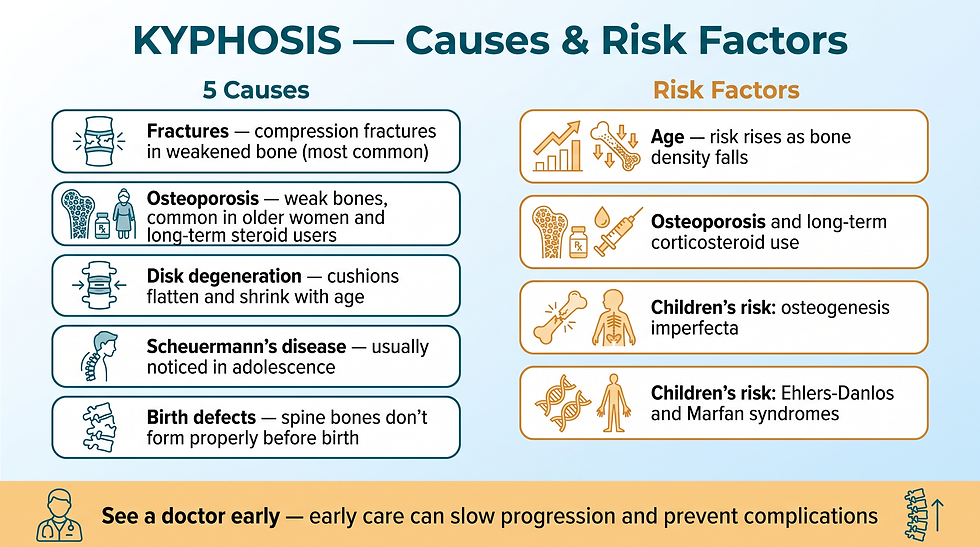
Kyphosis happens when the vertebrae in the back become more wedge-shaped. Five things can change the shape of these bones.
1. Fractures
Broken vertebrae can result in curvature of the spine. Compression fractures — which happen in weakened bone — are the most common cause. One important note: mild compression fractures may not produce noticeable symptoms, so a broken vertebra can silently set the stage for kyphosis.
2. Osteoporosis
Weak bones can cause spinal curvature, especially if weakened vertebrae develop compression fractures. Osteoporosis is most common in older women and in people who have taken corticosteroids for long periods.
3. Disk Degeneration
Soft, circular disks act as cushions between the spinal vertebrae. With age, these disks flatten and shrink — which often worsens kyphosis.
4. Scheuermann's Disease
Also called Scheuermann's kyphosis, this condition usually becomes noticeable during adolescence. It is one of the main reasons a teenager develops a rounded upper back.
5. Other Problems
Spinal bones that don't develop properly before birth can cause kyphosis (congenital kyphosis). Kyphosis in children can also be associated with certain medical conditions.
Cause | Who it affects most | How it creates the curve |
Fractures (compression) | Anyone with weakened bone; most common cause overall | Broken vertebrae tilt forward |
Osteoporosis | Older women; long-term steroid users | Weak vertebrae compress and fracture |
Disk degeneration | Older adults | Spinal cushions flatten and shrink with age |
Scheuermann's disease | Adolescents | Vertebral wedging during growth |
Birth defects and other conditions | Infants and children | Spine bones form abnormally before birth |
Who Is at Risk for Kyphosis?
For adults, the risk rises steadily with age. Bone density decreases and spinal disks degenerate over the decades, both of which push the curve forward.
Children face a different risk profile. Certain genetic and metabolic conditions put them at increased risk:
Group | Specific risk factors |
Older adults | Decreasing bone density with age; spinal disk degeneration |
Older women | Higher osteoporosis rates |
Long-term steroid users | Medicines weaken bone |
Children | Osteogenesis imperfecta (brittle bone disease) |
Children | Ehlers-Danlos syndrome |
Children | Marfan syndrome |
If a child has one of these conditions, spine monitoring becomes part of routine care — and it's worth asking their pediatric team about it.
Kyphosis Complications: Why Early Care Matters
Left unchecked, serious kyphosis does more than change appearance. Four main complications are worth knowing.
Limited physical functions. Kyphosis is associated with weakened back muscles and difficulty doing tasks such as walking and getting out of chairs. The curvature can make it difficult to gaze upward or drive, and can cause pain when lying down.
Digestive problems. Serious kyphosis can compress the digestive tract, causing problems such as acid reflux and difficulty swallowing.
Back pain. Some patients with serious kyphosis experience persistent back pain.
Body image problems. People with kyphosis — especially adolescents — may develop poor body image from having a rounded back. This is a real, documented concern worth raising with the care team, particularly for teens.
Complication | What it looks like in daily life |
Limited physical function | Difficulty walking, getting out of chairs, gazing upward, or driving; pain when lying down |
Digestive problems | Acid reflux and difficulty swallowing from pressure on the digestive tract |
Back pain | Persistent pain in serious cases |
Body image concerns | Poor self-image, especially in adolescents with a rounded back |
How Is Kyphosis Diagnosed?
Diagnosis starts with a hands-on exam and is supported by imaging.
Physical exam. Your healthcare professional will generally conduct a thorough physical exam. You may be asked to bend forward from the waist so they can view your spine from the side.
Neurological exam. This checks your reflexes and muscle strength, and can reveal whether the curvature is affecting nerves.
From there, four types of tests may be ordered:
Test | What it reveals |
X-ray | Measures the degree of curvature and detects vertebrae deformities |
CT scan | Provides more detailed imaging when X-rays aren't enough |
MRI | Uses a strong magnetic field to detect a recent fracture in the spine |
Nerve tests | Check how well nerve impulses travel between the spinal cord and your extremities |
Bone density test | Low-density bone raises compression fracture risk — and can often be improved with medicines |
The bone density test deserves special attention: it doesn't just diagnose the curve — it identifies treatable bone weakness that, if improved, can prevent the fractures that worsen kyphosis in the first place.
Kyphosis Treatment: From Self-Care to Surgery
Treatment depends on the cause and seriousness of your condition. The ladder of options moves from medicines and exercises up to surgery — and most people never need the top rung.
Medicines
Pain relievers. If over-the-counter medicines — such as acetaminophen (Tylenol), ibuprofen (Advil, Motrin IB), or naproxen sodium (Aleve) — aren't enough, stronger pain medicines are available by prescription.
Osteoporosis medicines. Certain medicines may help strengthen your vertebrae and prevent additional spinal fractures that could worsen your kyphosis. This is the treatment that attacks the root cause for many older adults.
Therapy
Exercises. Stretching and strengthening exercises may help improve spinal flexibility and relieve back pain.
Bracing. Children who have Scheuermann's disease may be able to slow the progression of kyphosis by wearing a spine brace while they are in a rapid growth spurt.
Surgery
Severe kyphosis can result in symptoms, and rarely it can pinch the spinal cord or nerves — more common with congenital kyphosis or kyphosis after previous surgeries. To correct the kyphosis, surgery may be needed. The most common procedure is spinal fusion: the surgeon uses metal rods and screws to fasten the spinal bones together in the correct position.
One reassuring fact, repeated for emphasis: compression fractures are usually treated without surgery.
Treatment | What it does | Who it's for |
Pain relievers (OTC and prescription) | Relieves back pain | All symptom levels |
Osteoporosis medicines | Strengthens vertebrae; prevents further fractures | People with bone weakness |
Stretching & strengthening exercises | Improves spinal flexibility; relieves pain | Most patients |
Spine bracing | Slows progression during a growth spurt | Children with Scheuermann's disease |
Spinal fusion surgery | Rods and screws fasten vertebrae in the correct position | Severe cases; nerve or spinal cord pinching |
Compression fracture care | Usually non-surgical | Fracture-related kyphosis |
Everyday Self-Care for Kyphosis
The practical self-care picture for kyphosis centers on protecting bone, staying active, and catching changes early.
Stretching and strengthening exercises are the cornerstone — they improve spinal flexibility and relieve back pain, and they can be discussed with any healthcare professional or physical therapist. For older adults, protecting bone density is equally important: ask whether a bone density test or osteoporosis treatment is right for you, especially after any fracture, however mild.
And because kyphosis is progressive, a simple habit matters: periodically check the curve itself, especially in growing children and aging family members.

Preparing for Your Appointment
You may be referred to a doctor who specializes in the diagnosis and treatment of spine disorders. Preparation makes that visit count.
Before the visit, be aware of any pre-appointment restrictions, such as diet. Write down your symptoms (including any that seem unrelated), a list of all medicines, vitamins and supplements you take, your key medical information including other conditions, key personal information such as recent changes or stressors, and the questions you want to ask. Consider asking a relative or friend to accompany you to help remember what the team says.
Question | Why it helps |
What tests do I need? Is there any special preparation? | Clarifies imaging and any prep steps |
Will I need treatment? What are my options, and what are the benefits and risks of each? | Covers the full ladder from exercises to surgery |
I have other health problems. How can I best manage these together? | Coordinates kyphosis care with other conditions |
What your healthcare professional may ask: When did your symptoms begin? How serious are they? Have they been continuous or occasional? What seems to improve or worsen them?
Conclusion: Kyphosis Is Treatable — and Often Without Surgery
Kyphosis — an excessive forward rounding of the upper back — ranges from a harmless mild curve to a serious condition that causes pain, limits movement, and compresses the digestive tract. Its most common driver is compression fractures in weakened bone, which is why older adults and people with osteoporosis are at the center of the story. But it also affects children and teens through birth defects and growth-related conditions like Scheuermann's disease.
The encouraging part: most people manage kyphosis without surgery. Pain relievers, osteoporosis medicines, stretching and strengthening exercises, and bracing during growth spurts cover the majority of cases. Spinal fusion surgery is reserved for severe curvature or pinched nerves. The single most valuable step is the first one — noticing the curve.
If you've spotted an increasing roundness in your upper back — your own or your child's — make an appointment with your healthcare professional. A simple exam and an X-ray can establish what's happening, and early care is the best way to keep kyphosis from becoming more than a curve on paper.
Frequently Asked Questions (FAQ)
What is kyphosis?
Kyphosis is an excessive forward rounding of the upper back. The spine naturally has a small upper-back curve; kyphosis is diagnosed when that curve becomes too pronounced because the vertebrae become wedge-shaped.
What causes kyphosis in older adults?
In older people, kyphosis is most often due to weakness in the spinal bones that causes them to compress or crack — especially compression fractures from osteoporosis. Disk degeneration also worsens it with age.
Can children get kyphosis?
Yes. It can appear in infants and teens from spinal bones that don't form properly before birth, or from conditions such as Scheuermann's disease. Children with osteogenesis imperfecta, Ehlers-Danlos syndrome, or Marfan syndrome are also at higher risk.
Does kyphosis always cause pain?
No. Mild kyphosis may not have any noticeable symptoms. When symptoms appear, back pain and stiffness are the most common.
Is kyphosis treated with surgery?
Usually not. Most cases are managed with pain relievers, osteoporosis medicines, exercises, and bracing for children. Spinal fusion surgery is reserved for severe cases, and compression fractures are usually treated without surgery.
When should I see a doctor about kyphosis?
See a healthcare professional if you notice an increased curve in your upper back — or in your child's spine. Don't wait for pain; early evaluation matters most for children and adults at risk of further fractures.
Can kyphosis affect digestion?
Yes. Serious kyphosis can compress the digestive tract, causing problems such as acid reflux and difficulty swallowing — one reason early care matters.
How is kyphosis diagnosed?
With a physical exam (often including a bend-forward test), a neurological exam, and imaging — X-rays measure the curve, CT scans provide detail, MRI detects recent fractures, and bone density tests identify treatable bone weakness.
References
Kyphosis — Symptoms & causes (medically expert-reviewed content dated September 28, 2024)
Kyphosis — Diagnosis & treatment (medically expert-reviewed content dated September 28, 2024)
Rinnit.com health articles are written for general education and are not a substitute for professional medical advice, diagnosis, or treatment. Always consult a qualified healthcare provider for decisions about your health.
Comments