Gallium Scan: What It Shows, How It Works and What to Expect

Updated: 2 days ago
Written and medically reviewed by Dr. Baraa Alnahhal, MD · Last reviewed: November 2026 · How we review
Quick Answer
A gallium scan is a nuclear medicine test that uses a small amount of radioactive gallium to look for cancer, infection and inflammation. Gallium is injected into a vein, and 1 to 2 days later a special camera takes pictures of where it has collected. The radiation dose is small, about the same as a few X-rays.
What the research says
It can help explain a fever of unknown origin: in a study of patients with fever of unknown origin, gallium scanning gave diagnostic information in 29% of cases, far more often than ultrasound (6%) or CT (14%) in the same group; the authors suggest using it as a second-step test rather than a last resort (Knockaert DC et al., Clin Infect Dis, 1994) [2]
Newer PET imaging often performs better: a prospective comparison in fever of unknown origin found FDG imaging outperformed gallium SPECT; planar gallium imaging had 100% specificity but a negative predictive value of only 54%, meaning a normal gallium scan didn't reliably rule out disease (Meller J et al., Eur J Nucl Med, 2000) [3]
Key takeaways
A gallium scan shows areas of cancer, infection or inflammation.
Gallium is injected, then scanned 1 to 2 days later.
Plan for 2 or 3 visits; each scan takes about an hour.
The radiation dose is small and leaves your body within days.
Tell your provider if you're pregnant or breastfeeding.
What is a gallium scan?
Gallium attaches to proteins in your blood and collects in areas of inflammation, infection and some tumors. It gives off gamma rays that a gamma camera detects, creating color-coded pictures for a radiologist to read. The camera itself doesn't give off radiation. Today, PET scans are often used instead, but gallium scans are still useful in some situations. Sources: [1, 3]
Why it's done
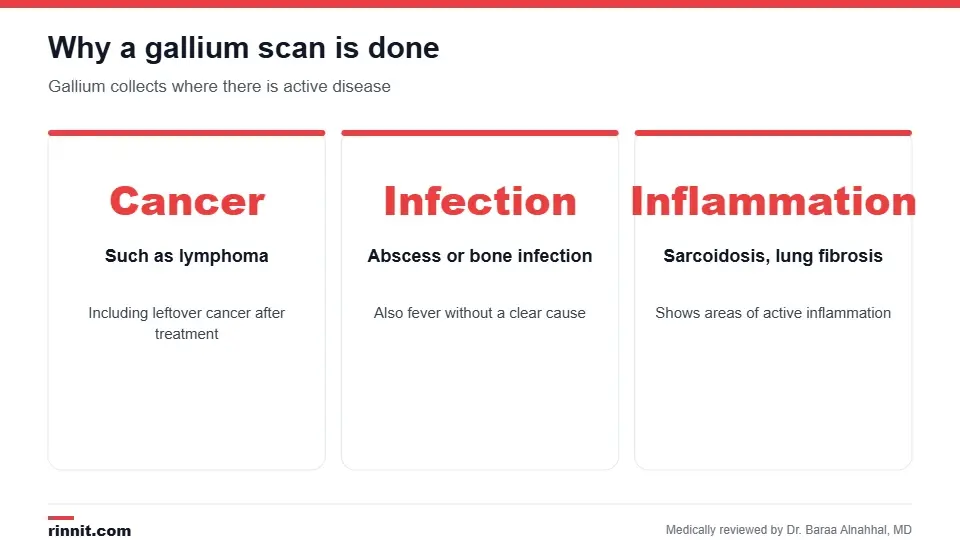
Gallium collects where there is active disease.
Cancer: such as Hodgkin lymphoma, including checking for cancer cells left after treatment.
Infection: such as an abscess or a bone infection.
Inflammation: such as pulmonary fibrosis or sarcoidosis.
Fever of unknown cause: to help locate a hidden source. Sources: [1, 2]
How to prepare
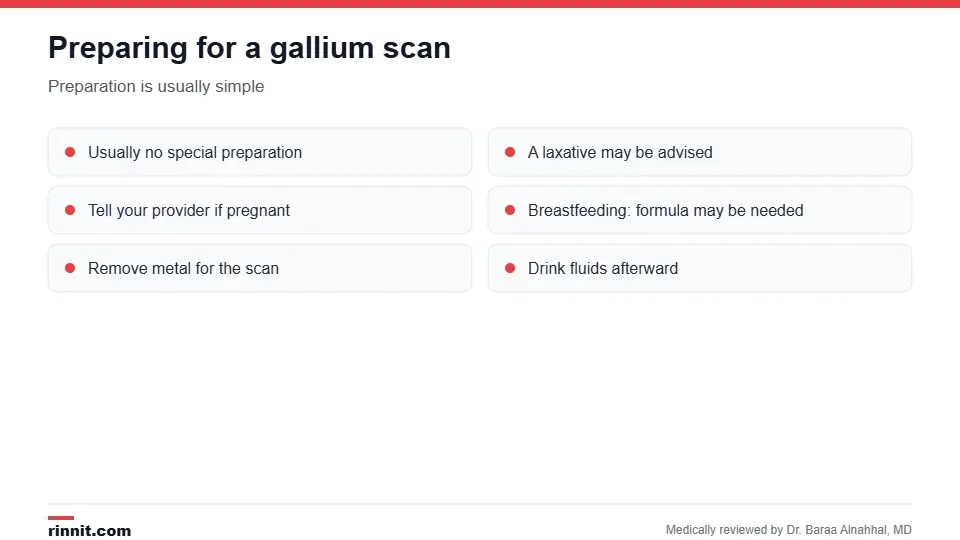
Preparation is usually simple.
There's usually no special preparation; follow your provider's instructions.
You may be asked to take a laxative to clear your bowel, which can make images clearer.
Tell your provider if you are or could be pregnant.
If you're breastfeeding, you may need to use formula until the gallium has left your body. Sources: [1]
What happens during the scan

A gallium scan usually takes 2 or 3 visits.
Visit 1: gallium is injected into a vein in your arm, and you go home.
Visit 2 (1 to 2 days later): you remove metal, lie on a table and stay still while the camera moves over your body, changing position when asked; this takes about an hour.
Visit 3 (if needed): you return a day or two later for more pictures. Sources: [1]
After the test
The gallium leaves your body through urine and stool over the next few days. Flush twice, clean up splashes and wash your hands well. Drinking extra fluids may help. Some airport detectors can pick up traces of gallium, so ask for a letter if you travel within three months. Sources: [1]
Risks
A gallium scan isn't considered dangerous. Rarely, people have an allergic reaction such as a rash or nausea. Call your provider if this happens. Sources: [1]
Results
A radiologist reviews the images and sends a report to your provider, usually within 2 to 3 days. Areas where gallium has collected abnormally may point to cancer, infection or inflammation, and more tests are often needed to confirm the cause. A normal scan doesn't always rule out disease. Sources: [1, 3]
Conclusion
A gallium scan is a simple, low-risk way to look for hidden infection, inflammation or certain cancers. It takes a few visits, but most people go home the same day each time.
Frequently asked questions
What does a gallium scan show?
Areas of cancer, infection or inflammation where gallium collects.
How long does a gallium scan take?
About an hour per scan, over 2 or 3 visits.
Why is there a wait after the injection?
Gallium needs 1 to 2 days to circulate and settle.
Is a gallium scan safe?
Yes. It uses a small radiation dose, about the same as a few X-rays.
Do I need to fast?
Usually not. You may be asked to take a laxative.
Can I have it while pregnant?
Tell your provider; radiation can harm a developing baby.
Can I breastfeed afterward?
You may need to use formula until the gallium leaves your body.
How long does gallium stay in my body?
It leaves through urine and stool over a few days.
When will I get results?
Usually within 2 to 3 days.
Is a gallium scan the same as a PET scan?
No. Both are nuclear scans, but they use different tracers.
Related Reading
Nuclear Medicine Imaging: How Tracer Scans Work, Safety and Results explains how tracer-based scans show how organs work.
PET Scan: Uses, Preparation, What to Expect and Results a newer nuclear scan often used instead of gallium.
Bone Scan: What It Shows, How It's Done, Results and Risks another nuclear medicine scan for bone problems.
Hodgkin's Lymphoma: Symptoms, Causes & Treatment a cancer gallium scans can help find.
Sarcoidosis: Complete Guide to the Condition That Forms Granulomas Throughout the Body an inflammatory disease that shows on gallium scans.
Osteomyelitis: Symptoms, Causes, and Treatment a bone infection a gallium scan can detect.
References
Cleveland Clinic. Gallium Scan: What It Is & Why It's Done. Cleveland Clinic. Last updated May 6, 2021. https://my.clevelandclinic.org/health/diagnostics/17015-gallium-scan
Knockaert DC, Mortelmans LA, De Roo MC, et al. Clinical value of gallium-67 scintigraphy in evaluation of fever of unknown origin. Clin Infect Dis. 1994;18(4):601-605. PMID 8038316. https://doi.org/10.1093/clinids/18.4.601
Meller J, Altenvoerde G, Munzel U, et al. Fever of unknown origin: prospective comparison of [18F]FDG imaging with a double-head coincidence camera and gallium-67 citrate SPET. Eur J Nucl Med. 2000;27(11):1617-1625. PMID 11105817. https://doi.org/10.1007/s002590000341
Medical disclaimer
This article is for general education only and does not replace advice from a qualified healthcare professional. Talk to your doctor about your own diagnosis and treatment, and seek emergency care right away for severe or sudden symptoms.



Comments