Parkinson's Disease: Symptoms, Causes, and Treatment — A Clear Guide to Understanding and Managing the Condition

Updated: 2 days ago
Medically reviewed by Dr. Baraa Alnahhal, MD · Last reviewed: September 2026
TL;DR
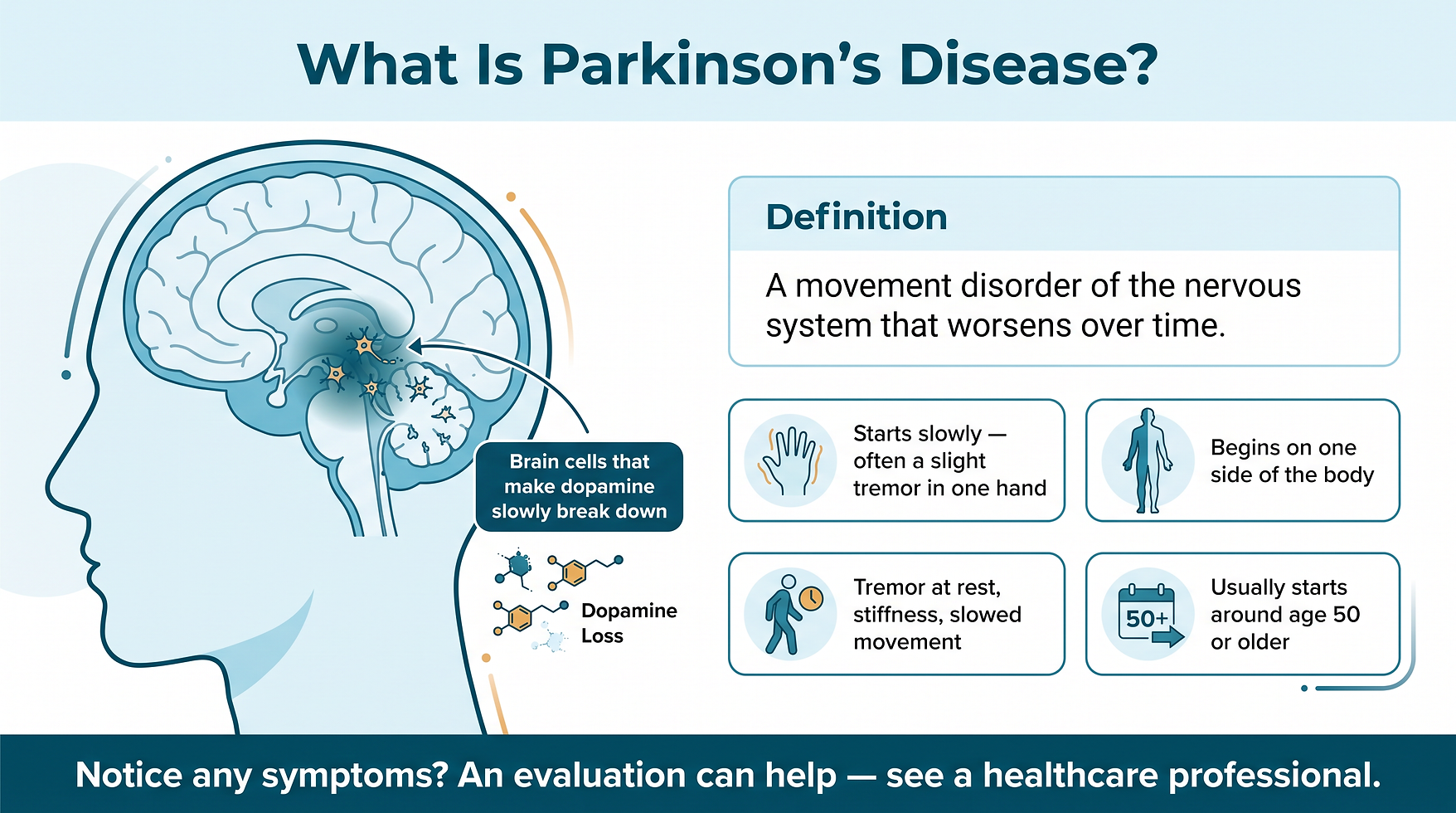
Parkinson's disease is a movement disorder of the nervous system that worsens over time. The nervous system is a network of nerve cells that controls many parts of the body, including movement. Symptoms start slowly — the first sign is often a barely noticeable tremor in just one hand, foot, or jaw. The disorder also causes stiffness, slowing of movement, and balance problems that raise the risk of falls.
The underlying cause is the slow breakdown of nerve cells in the brain, especially those that produce dopamine, a chemical messenger that helps control movement. Low dopamine leads to irregular brain activity and the movement symptoms of Parkinson's. The exact cause is unknown, and no proven way to prevent it exists.
Parkinson's cannot be cured, but medicines often work very well. The most effective is levodopa, which the brain converts into dopamine. When medicines stop working well, surgery such as deep brain stimulation (DBS) may help. Exercise, physical therapy, speech therapy, and lifestyle changes are important parts of care, along with safety measures to prevent falls. Anyone who notices symptoms should see a healthcare professional for an evaluation.
Quick Answer
What is Parkinson's disease?
Parkinson's disease is a movement disorder of the nervous system that worsens over time. It is caused by the slow loss of nerve cells — especially dopamine-producing cells — in the brain.
Early signs are subtle: a slight tremor in one hand, foot, or jaw; a loss of facial expression; arms that don't swing when walking; and soft or slurred speech.
Main symptoms include tremor (often a "pill-rolling" motion of thumb and forefinger), slowed movement (bradykinesia), rigid muscles, poor posture and balance, and changes in speech and writing.
Nonmotor symptoms are common too: depression, anxiety, constipation, sleep problems, acting out dreams, reduced sense of smell, fatigue, and thinking or memory changes.
Diagnosis is made by a neurologist based on medical history, symptom review, and a neurological exam — there is no single specific test.
Treatment centers on medicines that increase or substitute for dopamine (levodopa is the most effective), plus exercise, physical and speech therapy. Surgery (deep brain stimulation) is an option when medicines falter.
It can't be cured, but medicines often work very well, and options exist when symptoms change.
What Is Parkinson's Disease?
Parkinson's disease is a movement disorder of the nervous system that worsens over time. The nervous system is a network of nerve cells that controls many parts of the body, including movement.
Symptoms start slowly. The first symptom may be a barely noticeable tremor in just one hand — or sometimes a foot or the jaw. Tremor is common in Parkinson's disease. But the disorder also may cause stiffness, slowing of movement, and trouble with balance that raises the risk of falls.
In the early stages of Parkinson's disease, the face may show little or no expression. The arms may not swing when walking. Speech may become soft or slurred. Symptoms get worse over time.
Although Parkinson's disease can't be cured, medicines may help symptoms get better. Sometimes a healthcare professional may suggest surgery to help control parts of the brain, which may lessen symptoms.
| Fact | Detail | |------|--------| | What it is | A movement disorder of the nervous system that worsens over time | | What causes symptoms | Loss of dopamine-producing nerve cells in the brain | | First symptom | Often a slight tremor in one hand, foot, or jaw | | How it begins | Slowly, often on one side of the body | | Typical onset age | Around 50 or older; average around age 70 | | Can it be cured? | No — but medicines often work very well | | When medicines falter | Surgery (deep brain stimulation) may help |
What Are the Symptoms of Parkinson's Disease?
Parkinson's disease symptoms can be different for everyone. Early symptoms may be mild, and you may not even notice them. Symptoms often begin on one side of the body, then affect both sides. They are usually worse on one side than the other. Some Parkinson's symptoms are similar to those of other disorders — which is why a professional evaluation matters.
Parkinson's symptoms may include tremor — a rhythmic shaking that usually begins in the hands or fingers (a "pill-rolling" motion of thumb and forefinger), and sometimes in a foot or the jaw, often at rest; slowed movement (bradykinesia), making simple tasks like getting out of a chair or getting dressed harder; rigid, tense muscles with short, jerky arm movements; poor posture and balance, with a stooped stance and fall risk; loss of automatic movements such as blinking, smiling, or arm swing while walking; speech changes that turn soft, slurred, or monotone; cramped, small handwriting; and nonmotor symptoms including depression, anxiety, constipation, sleep problems, acting out dreams, frequent urination, reduced sense of smell, thinking or memory problems, and fatigue.
| Symptom | What it looks like | |---------|-------------------| | Tremor | Rhythmic shaking, often in a hand at rest; "pill-rolling" of thumb and forefinger | | Slowed movement | Hard to get out of chairs, dress, shower; reduced facial expression | | Rigid muscles | Stiff, tense, painful muscles; short, jerky arm movements | | Poor posture and balance | Stooped posture; falls or balance problems | | Loss of automatic movements | Less blinking, smiling, arm swing when walking | | Speech changes | Soft, slurred, hesitant, or monotone speech | | Writing changes | Cramped, small handwriting | | Nonmotor symptoms | Depression, anxiety, constipation, sleep problems, reduced smell, fatigue |
When Should You See a Doctor?
If you have any symptoms of Parkinson's disease, see a healthcare professional. An evaluation helps diagnose your condition and rules out other causes.
The symptoms that matter most are not dramatic at first — a slight tremor in one hand, a change in handwriting, a softer voice. Because early signs are easy to miss or blame on aging, noticing them early and getting them checked is the single most useful step you can take. Schedule an appointment for a slight tremor in one hand, foot, or jaw; slowed movement or difficulty with simple tasks; reduced facial expression or arms not swinging when walking; stiff muscles, balance problems, or falls; or any of these symptoms appearing on just one side of the body — one-sided onset is typical of Parkinson's.
What Causes Parkinson's Disease?
In Parkinson's disease, nerve cells in the brain — called neurons — slowly break down or die. Many Parkinson's symptoms are caused by a loss of neurons that produce dopamine, a chemical messenger in the brain.
Decreased dopamine leads to irregular brain activity. This causes movement problems and other symptoms. People with Parkinson's disease also lose norepinephrine, a chemical messenger that controls many body functions, such as blood pressure.
The cause of Parkinson's disease is unknown, but several factors seem to play a role:
Genes. Specific genetic changes are linked to Parkinson's disease. But these are rare unless many family members have had it.
Environmental factors. Exposure to certain toxins or other environmental factors may increase the risk of later Parkinson's disease. One example is MPTP, a substance found in some illegal drugs and sometimes sold illegally as "synthetic heroin." Other examples include pesticides and drinking well water. But no environmental factor has proved to be a cause.
What Researchers Are Studying
Many changes happen in the brains of people with Parkinson's disease. Researchers are studying why they happen and the roles they play:
Lewy bodies. Clumps of proteins in the brain are associated with Parkinson's disease. Researchers believe these proteins hold an important clue to the cause.
Alpha-synuclein within Lewy bodies. Alpha-synuclein is a protein found in all Lewy bodies. It occurs in a clumped form that cells cannot break down. It has been found in the spinal fluid of people who later develop Parkinson's disease.
Altered mitochondria. Mitochondria are powerhouse compartments inside cells that create most of the body's energy. Changes to mitochondria can cause cell damage, and these changes have been found in the brains of people with Parkinson's disease.
What Are the Risk Factors?
| Risk factor | How it affects risk | |-------------|--------------------| | Age | Risk increases with age; usually starts around age 50 or older; average onset around 70 | | Early-onset Parkinson's | Can occur in younger adults, but it is rare (under age 50) | | Genetics | One or more first-degree relatives (parents, siblings) with Parkinson's raises risk — still small unless many relatives have it | | Male sex | Men are more likely to develop Parkinson's disease than women | | Toxin exposure | Ongoing exposure to herbicides and pesticides may slightly increase risk |
The most important risk factor is age: Parkinson's disease usually starts around age 50 or older, with an average onset around 70; when it occurs before 50, it's called early-onset Parkinson's disease. Genetics matters too — having a first-degree relative (a parent or sibling) with the condition raises your risk, though it stays small unless many blood relatives are affected.
What Are the Complications?
People with Parkinson's disease may develop other complications that may be treatable, including trouble thinking clearly — affecting memory, language, and reasoning, and sometimes leading to dementia, usually later in the disease, with only modest benefit from medicines; emotional changes and depression, which medicines and other treatments can help; trouble swallowing and chewing in late-stage disease, which can affect nutrition and cause choking or drooling if food or saliva collects in the mouth; and sleep problems, including frequent waking, nightmares, daytime sleepiness, and REM sleep behavior disorder (acting out dreams), which medicines and therapies may improve.
Other symptoms that can occur include:
| Symptom | What it involves | |---------|------------------| | Bladder problems | Urgency — a sudden strong need to urinate | | Constipation | Difficulty passing stool; fewer than three times a week | | Blood pressure changes | Dizziness, lightheadedness, or fainting when standing (orthostatic hypotension) | | Loss of smell | Full or partial loss of the sense of smell | | Tiredness | Low energy, especially late in the day | | Pain | Pain or cramps in muscles and joints | | Sexual symptoms | Decreased desire or performance |
Can Parkinson's Disease Be Prevented?
Because the cause is not known, there are no proven ways to prevent Parkinson's disease. Research links some factors to a lower risk — aerobic exercise, caffeinated beverages such as coffee and green tea, and some medicines such as ibuprofen and statins — but these are associations, not guarantees, and none is a proven prevention strategy.
How Is Parkinson's Disease Diagnosed?
Currently, there isn't a specific test to diagnose Parkinson's disease. A diagnosis is made by a neurologist — a doctor trained in nervous system conditions. The diagnosis is based on your medical history, a review of your symptoms, and a neurological and physical exam.
It can take time to diagnose Parkinson's disease. Healthcare professionals may recommend regular follow-up appointments with neurologists trained in movement disorders to evaluate your condition over time.
Your healthcare team may order some of these tests and procedures:
| Test or procedure | Purpose | |-------------------|---------| | Physical and neurological exam | Tests thinking and mental abilities, senses, coordination, and reflexes | | Blood and lab tests | Rule out other conditions causing your symptoms | | Imaging (MRI, brain ultrasound, PET scan) | Rule out other conditions; not very helpful in diagnosing Parkinson's itself | | DAT scan | A specific SPECT scan that can support suspicion and identify tremor types; most people do not require it | | Genetic testing | Tests for gene changes with known family history or early-onset disease | | Short, low-dose medicine trial | Parkinson's medicines given to see if symptoms improve; significant improvement may confirm diagnosis | | Follow-up appointments | Regular visits over time may be needed to confirm a diagnosis | | Alpha-synuclein test | A newer test that detects protein clumps in skin or spinal fluid; research suggests high accuracy |
A DAT scan (dopamine transporter scan) can help support the suspicion of Parkinson's disease and help identify different types of tremor. But it is your symptoms and neurological exam results that determine your diagnosis — most people do not require a DAT scan.
A short medicine trial may also help. You may be given Parkinson's medicines to see if you get better. If your symptoms show significant improvement, this may help confirm your diagnosis. A sufficient dose is needed — low doses for a day or two are not reliable.
A Newer Test: Alpha-Synuclein
An alpha-synuclein seed amplification assay can detect Parkinson's disease before symptoms begin. It tests skin or spinal fluid for clumps of alpha-synuclein — a hallmark sign of the disease.
In a 2023 study — the largest so far — researchers tested the spinal fluid of more than 1,000 people; the test accurately identified people with Parkinson's disease 87.7% of the time and was highly sensitive for detecting people at risk. Some researchers call it a possible breakthrough for diagnosis, research, and treatment trials, though larger studies are needed, and there is hope future versions could use blood rather than spinal fluid.
How Is Parkinson's Disease Treated?
Parkinson's disease can't be cured, but medicines can help control the symptoms — and they often work very well. When medicine is no longer helping, some people may have surgery. The healthcare team also may recommend aerobic exercise, physical therapy focused on balancing and stretching, and speech therapy.
Medicines
Medicines may help improve problems with walking, movement, and tremor. They work by increasing or substituting for dopamine in the brain.
People with Parkinson's disease have low levels of brain dopamine. But dopamine can't be given directly because it can't enter the brain.
Your symptoms may improve significantly after you start treatment. The benefits may lessen over time, but usually medicines still control symptoms well.
| Medicine type | How it works | Examples | Notes | |---------------|--------------|----------|-------| | Carbidopa-levodopa | Levodopa passes into the brain and becomes dopamine; carbidopa helps it reach the brain and lessens nausea | Rytary, Sinemet, others | The most effective Parkinson's medicine | | Inhaled levodopa | Delivers levodopa through the lungs | Inbrija | Helps when oral medicines suddenly stop working during the day | | Levodopa infusion | Gel delivered through a feeding tube into the small intestine | Duopa | For advanced Parkinson's needing a constant levodopa level | | Dopamine agonists | Mimic dopamine effects in the brain | Pramipexole (Mirapex ER), Rotigotine (Neupro, patch), Apomorphine (Apokyn, injection) | Less effective than levodopa but last longer | | MAO B inhibitors | Block the enzyme that breaks down dopamine | Selegiline (Zelapar), Rasagiline (Azilect), Safinamide (Xadago) | Avoid with most antidepressants | | COMT inhibitors | Help levodopa last longer | Entacapone (Comtan), Opicapone (Ongentys) | Tolcapone (Tasmar) rarely used due to liver risk | | Anticholinergics | Older medicines; help severe tremor for some | Benztropine, Trihexyphenidyl | Modest benefits; more side effects | | Amantadine | Short-term relief of mild symptoms; controls involuntary movements | Gocovri | Mainly used with levodopa in advanced disease | | A2A receptor antagonists | Prevent dopamine "wearing off" | Istradefylline (Nourianz) | Newer class under study | | Pimavanserin | Treats hallucinations and delusions | Nuplazid | For psychosis symptoms in Parkinson's |
Carbidopa-levodopa is the most effective Parkinson's medicine. Side effects may include nausea and lightheadedness when standing (orthostatic hypotension). Higher doses may cause involuntary movements, known as dyskinesia — if this happens, the dose may need adjustment. The benefit may lessen or "wax and wane" over time, a pattern called wearing off. It is usually best taken on an empty stomach in advanced disease.
Dopamine agonists aren't as effective as levodopa but last longer. Side effects may include lightheadedness, nausea, hallucinations, and sleepiness. These medicines may also cause involuntary movements and compulsive behaviors — such as hypersexuality, gambling, and eating. If you are taking these medicines and behaving in ways that aren't typical for you, talk with your healthcare team.
MAO B inhibitors may cause headaches, nausea, insomnia, confusion, and hallucinations, and the hallucination risk rises when added to carbidopa-levodopa; they usually aren't combined with most antidepressants or some pain medicines due to rare but serious reactions, so always ask first. COMT inhibitors may increase involuntary movements, diarrhea, nausea, or vomiting; Tolcapone (Tasmar) is rarely prescribed due to its liver-damage risk. Anticholinergics are used less often now given their modest benefits and side effects — memory loss, urinary problems, confusion, blurred vision, dry mouth, and constipation — though they may still help control severe tremor in some people.
Surgery
Deep brain stimulation (DBS) involves implanting an electrode deep within the brain. The electrodes are connected to a pacemaker-like device inserted under the skin on the chest, near the collarbone. A wire traveling under the skin connects the device to the electrode. The generator sends electrical pulses to the brain and may reduce Parkinson's disease symptoms.
DBS can be very helpful for improving severe tremor and controlling dyskinesia. It is effective for changing responses to levodopa or for dyskinesia that doesn't improve with medicine changes. It is most effective for people who respond to levodopa therapy.
You may need follow-up appointments to adjust the settings, and some people experience problems with the DBS system that require adjustment or replacement.
An important limitation: although DBS may have long-term benefits for symptoms, it does not stop Parkinson's disease from getting worse. Possible side effects include bleeding in the brain, injury or death of tissue, infection, skin breakage, muscle twitches, depression, and speech or vision problems.
Advanced Treatments
MRI-guided focused ultrasound (MRgFUS) is a minimally invasive treatment that helps manage tremor in some people: an MRI guides high-temperature ultrasound waves to burn the brain areas where tremor starts. Side effects may include walking and speech problems and new involuntary muscle movements (dyskinesia).
Clinical Trials
Researchers continue to study new treatments, interventions, and tests for Parkinson's disease. Clinical trials are worth discussing with your healthcare team.
What Lifestyle Changes Help?
Some lifestyle changes may help ease Parkinson's disease symptoms. But certain medicines can make symptoms worse. Ask your healthcare team which remedies provide the greatest symptom relief with the fewest side effects.
Healthy eating. No foods are proved to treat Parkinson's disease, but fiber-rich foods and plenty of fluids can help prevent constipation, and a balanced diet with nutrients such as omega-3 fatty acids may help ease symptoms.
Exercise may improve muscle strength, walking, flexibility, and balance, and may also help ease depression and anxiety. A physical therapist can help build a program; helpful activities include walking, swimming, gardening, dancing, water aerobics, and stretching.
To improve balance and gait: don't move too quickly, put your heel down first when walking, and look straight ahead rather than down.
Preventing Falls
Falls are one of the most serious everyday risks of Parkinson's disease. These tips may help:
| Fall-prevention step | Why it helps | |----------------------|--------------| | Don't rush or multitask | Steady, single-task movement is safer | | Use handrails and night-lights | Better support and visibility | | Remove throw rugs, rolling chairs, and cords | Fewer trip hazards | | Learn turning and walking techniques | Heel-first steps, standing tall, looking ahead | | Stop and check posture if you start shuffling | Resets balance and stance | | Use a walker or cane if recommended | Extra stability when needed |
Daily Living Support
An occupational therapist can help with activities such as dressing, bathing, and cooking, and a speech therapist can help with swallowing and speech problems.
What Supportive Therapies May Help?
Supportive therapies may help ease some symptoms, such as pain, fatigue, and depression. Combined with medical treatments, they may improve quality of life.
Massage can reduce muscle tension and promote relaxation, though it is rarely covered by health insurance.
Tai chi and yoga use slow, flowing movements or gentle stretches and poses that may improve flexibility, balance, and muscle strength, and may help prevent falls; most poses can be modified to fit your abilities.
The Alexander technique focuses on posture, balance, and how you use your muscles, and may reduce muscle tension and pain.
Meditation, relaxation techniques, and self-hypnosis may reduce stress and pain, lower blood pressure and heart rate, and improve your sense of well-being.
How Do You Cope and Find Support?
Living with any chronic illness can be hard, and it is common to feel angry, depressed, or discouraged at times. Parkinson's disease can be profoundly frustrating as walking, talking, and even eating become more difficult and time-consuming. Depression is common, but antidepressant medicines can help — talk with your healthcare team if feelings of sadness or hopelessness don't go away.
Support groups aren't for everyone, but for many people with Parkinson's disease and their families, they offer practical information and a place to find others in similar situations. Trying to maintain your usual activities, focusing on the present, and keeping a positive attitude can help. To find a support group, talk with your healthcare team, a social worker, or a local public health nurse; a mental health professional can also help you and your family cope.
How Should You Prepare for Your Appointment?
You are likely to first see your family healthcare professional, who may then refer you to a neurologist. Because there is often a lot to discuss, preparation helps.
What you can do: write down any symptoms you have, including ones that may seem unrelated; note key personal information such as major stresses or recent life changes; list all medicines, vitamins, and supplements you take; bring a family member or friend; and write down your questions in advance.
Questions to ask your doctor: What is the most likely cause of my symptoms, and are there other possible causes? What tests do I need, and do they require special preparation? How does Parkinson's disease usually get worse, and will I eventually need long-term care? What treatments do you recommend, and what side effects should I expect? If treatment stops working, what other options exist? How do I manage my other health conditions alongside this one, and are there brochures or websites you'd recommend?
What to expect from your doctor: When did you first begin having symptoms? Do symptoms come and go or stay steady? Does anything seem to improve or worsen them?
Conclusion: What to Remember About Parkinson's Disease
Parkinson's disease is a movement disorder that begins quietly — often with a barely noticeable tremor in one hand — and worsens over time. Its root cause is the slow loss of nerve cells in the brain, especially those that produce dopamine, the chemical messenger that controls movement.
The condition cannot be cured, but the picture is far from hopeless. Medicines often work very well, especially at first. When they falter, options exist: deep brain stimulation, focused ultrasound, and medicine combinations that smooth out the "wearing off" effect. Exercise, physical therapy, speech therapy, and fall-prevention habits are just as important as any pill.
Because there is no specific diagnostic test, the most powerful step is simple: get noticed symptoms evaluated. A tremor in one hand, slowed movement, stiff muscles, or a fading sense of smell deserve a professional look — early diagnosis opens the door to better symptom control and a better quality of life.
Your next step: if you or someone you love has any symptoms of Parkinson's disease — however slight — schedule an appointment with a healthcare professional. An early evaluation helps diagnose the condition and rules out other causes, and starting care early makes the biggest difference in how well symptoms can be managed.
FAQ
Is Parkinson's disease curable?
No. There is currently no cure for Parkinson's disease. However, medicines can help control symptoms and often work very well. When medicines stop helping, surgery such as deep brain stimulation may be an option.
What is the first sign of Parkinson's disease?
The first symptom is often a barely noticeable tremor in just one hand — or sometimes a foot or the jaw. Other early signs include reduced facial expression, arms that don't swing when walking, and soft or slurred speech.
Why does a tremor happen in Parkinson's disease?
Nerve cells in the brain that produce dopamine slowly break down. Low dopamine leads to irregular brain activity, which causes movement problems including the characteristic resting tremor.
Can young people get Parkinson's disease?
Yes, but it is rare. Parkinson's disease usually starts around age 50 or older, with an average onset around 70. When it occurs in people under 50, it is called early-onset Parkinson's disease.
How is Parkinson's disease diagnosed if there is no specific test?
A neurologist makes the diagnosis based on your medical history, a review of symptoms, and a neurological and physical exam. Blood tests, imaging, and sometimes a DAT scan or medicine trial help rule out other conditions and support the diagnosis. Regular follow-up over time may be needed to confirm it.
What is the best medicine for Parkinson's disease?
Levodopa (combined with carbidopa) is the most effective Parkinson's medicine. It passes into the brain and becomes dopamine. Over time, its benefit may lessen or "wear off," and other medicines or combinations may be added.
What is deep brain stimulation?
Deep brain stimulation (DBS) involves implanting electrodes deep in the brain, connected to a pacemaker-like device placed under the skin of the chest. It can greatly improve severe tremor and control involuntary movements, especially in people who respond to levodopa. It does not stop the disease from progressing.
Does Parkinson's disease affect thinking and memory?
It can, usually later in the disease. Parkinson's can affect memory, language, and reasoning, and can lead to dementia. Medicines have only a modest benefit for these symptoms.
Is Parkinson's disease inherited?
Specific genetic changes are linked to Parkinson's disease, but they are rare unless many family members have had it. Having one or more first-degree relatives (parents or siblings) with the condition increases your risk, though the risk remains small unless many relatives are affected.
Can exercise help with Parkinson's disease?
Yes. Aerobic exercise is linked to a lower risk of developing Parkinson's disease, and regular exercise in people who have it may improve muscle strength, walking, flexibility, balance, and mood. Activities such as walking, swimming, dancing, tai chi, and yoga are all helpful.
External References
Parkinson's disease — Symptoms & causes. https://www.mayoclinic.org/diseases-conditions/parkinsons-disease/symptoms-causes/syc-20376055
Parkinson's disease — Diagnosis & treatment. https://www.mayoclinic.org/diseases-conditions/parkinsons-disease/diagnosis-treatment/drc-20376062
This article is for informational purposes only and is not a substitute for professional medical advice.
Comments