Parkinson's Physical Therapy: Goals, Exercises and What to Expect

Updated: 2 days ago
Written and medically reviewed by Dr. Baraa Alnahhal, MD · Last reviewed: November 2026 · How we review
Quick Answer
Parkinson's physical therapy (PT) is a program of customized exercises and stretches that helps you manage Parkinson's symptoms such as stiffness, tremors, freezing and unsteadiness. It can build strength and flexibility, improve walking and balance and lower the risk of falls. It can't cure or reverse Parkinson's, but staying active might help slow its progress.
What the research says
Physiotherapy improved walking and balance: a Cochrane review of 39 trials with 1,827 people found physiotherapy improved walking speed, balance (3.71 points on the Berg Balance Scale) and overall Parkinson's scores (6.15 points) in the short term, though not falls (Tomlinson CL et al., Cochrane Database of Systematic Reviews, 2013) [2]
Many kinds of exercise help: a review of 154 trials with 7,837 people found most types of exercise eased movement symptoms, with dance (10.18 points) and gait and balance training (7.50 points) showing the largest benefits versus no exercise (Ernst M et al., Cochrane Database of Systematic Reviews, 2024) [3]
Key takeaways
Parkinson's PT uses custom exercises to ease movement symptoms.
It can improve strength, flexibility, walking and balance.
It may help with freezing and lower fall risk.
You'll do exercises at home between sessions.
PT can't cure Parkinson's, but staying active may help.
What is Parkinson's physical therapy?
Parkinson's disease affects how you move. Physical therapy helps you move more safely and with more confidence. It's ongoing, not pass or fail, and your plan changes as your needs change. Sources: [1]
Goals of PT
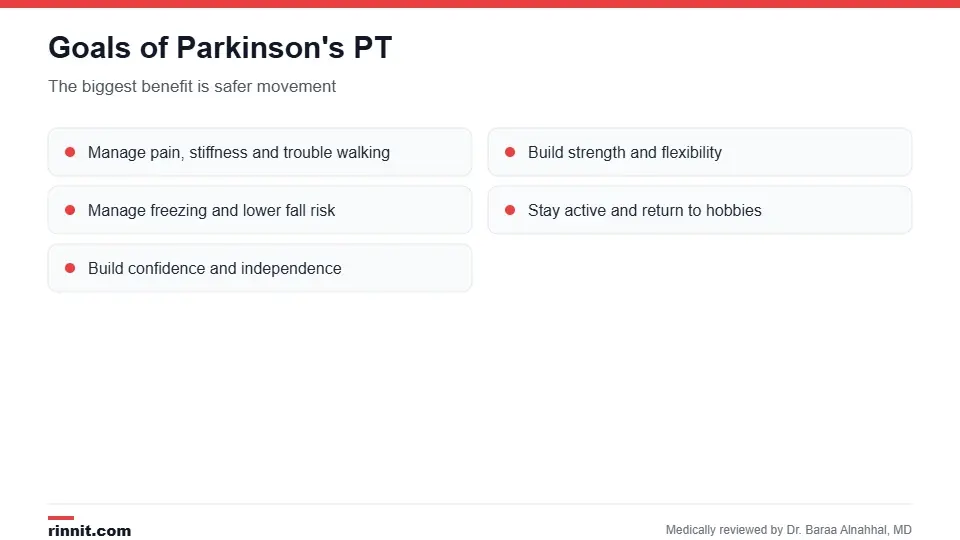
The biggest benefit is safer movement.
Manage pain, stiffness and trouble walking.
Strengthen muscles and improve flexibility.
Manage freezing and lower your risk of falls.
Stay active and return to hobbies.
Build confidence and independence. Sources: [1]
Types of exercises
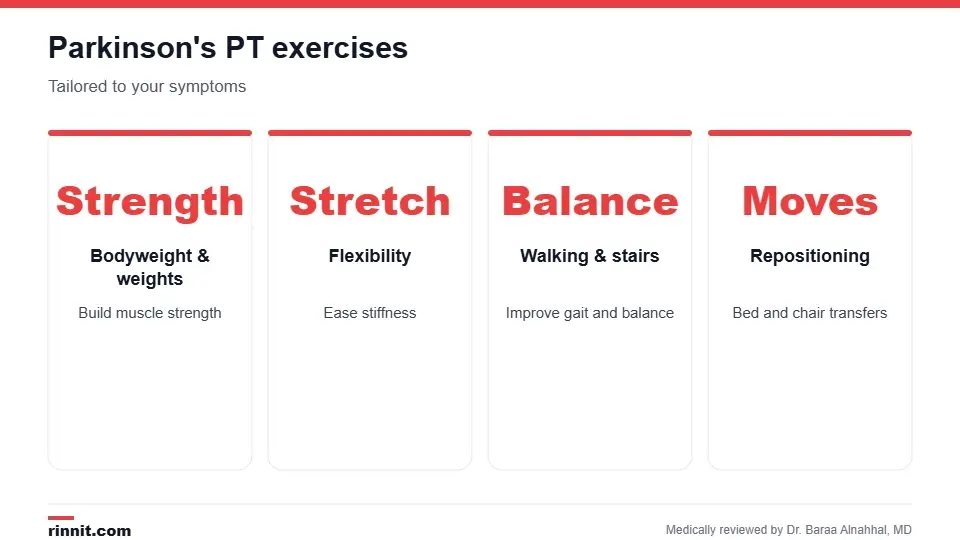
Your therapist tailors exercises to you.
Your provider may also suggest occupational therapy. Sources: [1, 3]
What to expect
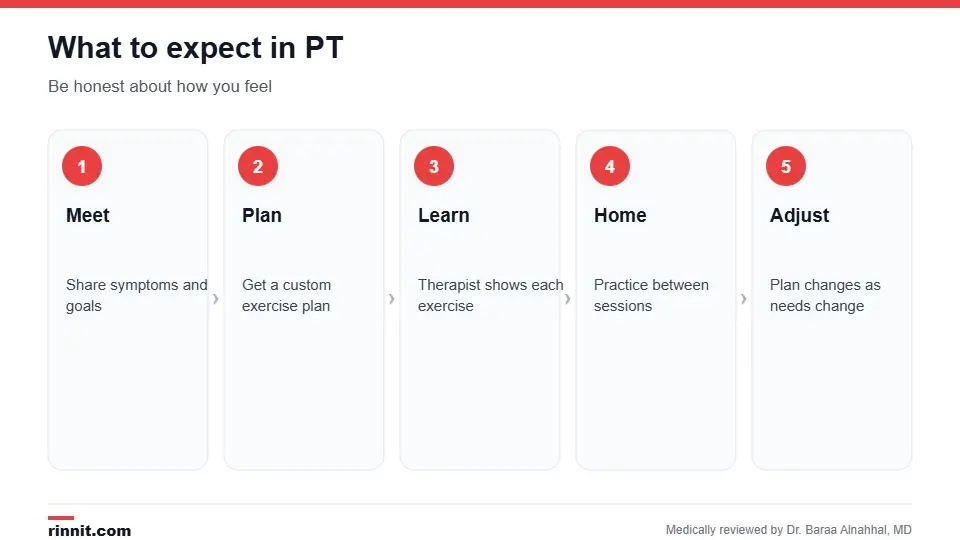
Be honest about how you feel during exercises.
Meet your therapist and talk about your symptoms, how they affect movement and what you want to do.
Set realistic goals together.
Your therapist builds a custom plan and shows you each exercise.
You practice exercises at home between sessions.
Your therapist changes exercises if anything feels unsafe. Sources: [1]
Risks
PT has very few risks. The main one is a small chance of falls or other injury, which your therapist helps prevent. Don't do anything that feels unsafe, and check with your provider before starting new physical activities. Sources: [1]
What it feels like
PT can be challenging, especially at first, and may cause pain or soreness. Tell your therapist so your plan can be changed. Sources: [1]
Outlook
Parkinson's is progressive, so you may still need support at home. But PT can help you move more safely, and staying active might help slow progression. PT works alongside Parkinson's medicines. Sources: [1, 2]
When to call your provider
New or worsening Parkinson's symptoms.
Pain or soreness during PT (tell your therapist).
Feeling unsafe during exercises. Sources: [1]
Conclusion
Physical therapy is one of the best ways to stay strong, steady and independent with Parkinson's. Sticking with your home exercises and keeping your therapist updated helps you get the most from it.
Keep learning: read about Parkinson's disease and occupational therapy.
Frequently asked questions
What is Parkinson's physical therapy?
Custom exercises and stretches to help manage Parkinson's movement symptoms.
Can physical therapy cure Parkinson's?
No, but it can help you move more safely.
What symptoms can PT help?
Stiffness, freezing, unsteadiness, trouble walking and shuffling steps.
Can PT prevent falls?
It may lower your fall risk.
What exercises are used?
Strengthening, stretching, walking, balance and stair practice.
Will I exercise at home?
Yes, between sessions.
Is PT safe with Parkinson's?
Yes. The main risk is a small chance of falls.
Will PT hurt?
It may cause soreness at first; tell your therapist.
Can exercise slow Parkinson's?
Staying active might help slow progression.
Does dancing help Parkinson's?
Studies found dance was among the most helpful types of exercise.
Related Reading
Parkinson's Disease: Symptoms, Causes, and Treatment — A Clear Guide to Understanding and Managing the Condition an overview of Parkinson's disease.
Occupational Therapy: What It Is, Who Needs It, and What to Expect help with daily tasks.
Parkinson's Disease Medications: A Comprehensive Guide to Treatment Options medicines for Parkinson's.
Gait Disorders: Symptoms, Types, and Management Options walking problems and their care.
References
Cleveland Clinic. Parkinson's Disease Physical Therapy (PT) Treatment. Cleveland Clinic. Last updated July 27, 2026. https://my.clevelandclinic.org/health/treatments/parkinsons-pt-treatment
Tomlinson CL, Patel S, Meek C, et al. Physiotherapy versus placebo or no intervention in Parkinson's disease. Cochrane Database of Systematic Reviews. 2013;2013(9):CD002817. PMID 24018704. https://doi.org/10.1002/14651858.CD002817.pub4
Ernst M, Folkerts AK, Gollan R, et al. Physical exercise for people with Parkinson's disease: a systematic review and network meta-analysis. Cochrane Database of Systematic Reviews. 2024;4(4):CD013856. PMID 38588457. https://doi.org/10.1002/14651858.CD013856.pub3
Medical disclaimer
This article is for general education only and does not replace advice from a qualified healthcare professional. Talk to your doctor about your own diagnosis and treatment, and seek emergency care right away for severe or sudden symptoms.



Comments