Gait Disorders: Symptoms, Types, and Management Options

Updated: 2 days ago
Medically reviewed by Dr. Baraa Alnahhal, MD · Last reviewed: October 2026
Quick Answer: What is a gait disorder?
A gait disorder is a change in walking pattern, such as limping, shuffling or feeling off balance. About 15% of people have one by age 60, and more than 80% of people over 85. Causes include pain, injuries, nerve damage, Parkinson's disease and stroke. Treatment targets the cause, and the most important goal is preventing falls and preserving independence. [2]
What the research says
About 1 in 3 older adults living at home has an abnormal gait. In the Einstein Aging Study of 488 adults aged 70 to 99, 168 of 468 people evaluated (35.0%, 95% CI 28.6% to 42.1%) had an abnormal gait: 70 neurological, 81 nonneurological and 17 both. The incidence of abnormal gait was 168.6 per 1,000 person-years and rose with age (Verghese et al., Journal of the American Geriatrics Society, 2006).
Abnormal gaits raise the risk of institutionalization and death, especially when severe. In the same study, abnormal gait was linked to a higher risk of institutionalization and death (hazard ratio 2.2, 95% CI 1.5 to 3.2). The risk was higher for moderate to severe gait abnormalities (hazard ratio 3.2, 95% CI 1.9 to 5.2) than for mild ones (hazard ratio 1.8, 95% CI 1.0 to 2.8) (Verghese et al., Journal of the American Geriatrics Society, 2006).

Understanding Gait and Abnormal Walking Patterns
Gait is your pattern of walking. When you walk, your muscles balance and coordinate your movement. Everyone's natural walking style is unique, but anything that affects your brain, spinal cord, legs or feet can change it [2].
An abnormal gait is a change in your walking pattern, also called ambulatory dysfunction. Common examples include limping, dragging your toes, shuffling your feet, taking short steps, having difficulty supporting your body weight and having trouble with coordination [2].
Gait abnormalities become more common as you age. Around 15% of people have one by age 60, and more than 80% of people over 85 do. Children are less likely to have a gait abnormality unless they have an underlying health condition or an injury [2].
Common Types of Gait Abnormalities
Identifying the type of gait is a key step in finding the cause and choosing treatment [2].
Gait type | Description | Common causes |
|---|---|---|
Antalgic | A limp from avoiding weight on a painful leg or foot; the most common type | Pain from injury or other causes |
Propulsive (parkinsonian) | Stooped, rigid posture with head and neck forward and short, fast steps (festinating gait) | Parkinson's disease or parkinsonism |
Scissors | Knees and thighs hit or cross in a scissors-like pattern; steps may be slow and small | Spastic cerebral palsy |
Spastic (hemiplegic) | One stiff leg that drags or swings in a semicircle | Cerebral palsy, multiple sclerosis, hemiplegia |
Steppage (neuropathic) | A high step with a floppy foot; toes point down and scrape the ground | Muscle atrophy or peroneal nerve injury, such as from spinal stenosis or a herniated disc |
Waddling | Exaggerated upper body movement, like a duck's walk | Progressive muscular dystrophy or hip dislocation present from birth |
Crouching | Ankles, knees and hips stay flexed, as if about to bend down; toes may drag | Cerebral palsy |
Ataxic | Irregular steps and difficulty walking heel to toe in a straight line; feeling unsteady | Cerebellar degeneration |
Other variations include the shuffling gait, where the feet don't fully leave the ground, and the lurching gait, a slow, long stride with the upper body jerking forward or backward, common with paralysis or weakness of the gluteal muscles [2].
Symptoms and Warning Signs
Symptoms depend on the type of abnormality. Some of the most common are [2]:
Dragging or shuffling your feet
Feeling out of balance when you walk
Stiff muscles or joints in your hips and legs
Swaying side to side with each step (waddle)
Walking with your head and neck bent toward the ground
Taking higher than normal steps and dropping your feet with each step
Taking small steps
Pain when walking
Underlying Causes and Risk Factors
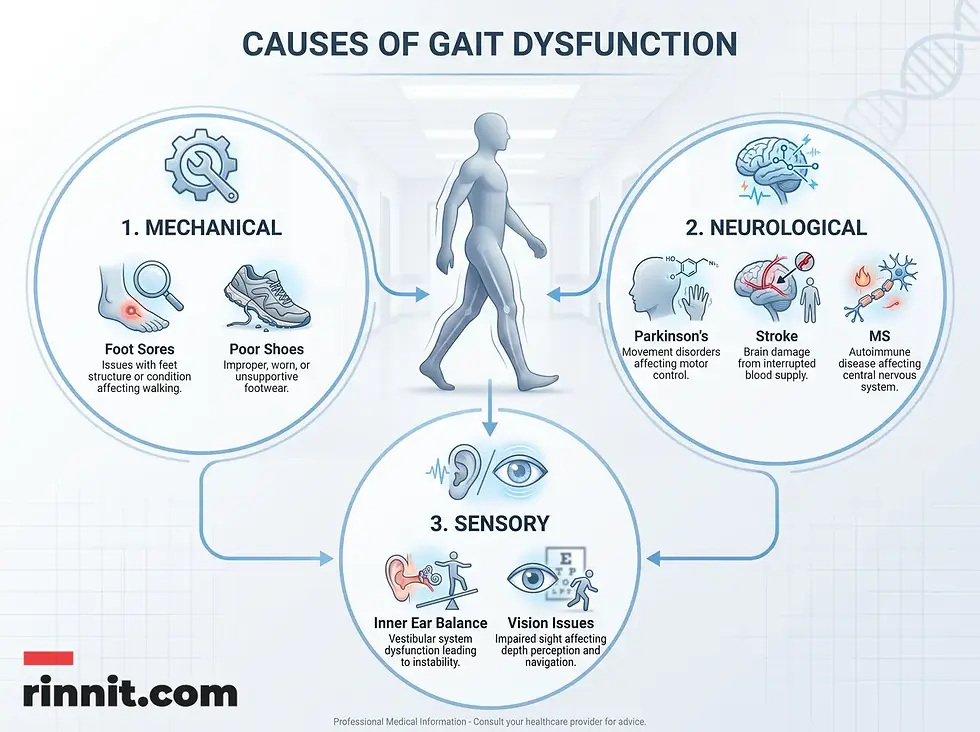
There are many possible causes and contributing factors. The most common include joint pain, injuries (including fractures and sprains), foot sores, calluses, ingrown toenails, warts and corns, shoes that don't fit properly, inner ear problems, nerve damage and vision problems [2].
Category | Conditions |
|---|---|
Neurological | Parkinson's disease or parkinsonism, multiple sclerosis, stroke, cerebral palsy, hemiplegia |
Musculoskeletal | Arthritis, fractures and sprains, hip dislocation, muscle atrophy |
Spinal | Spinal stenosis, herniated disk |
You may be at higher risk if you are older than 60, have a condition that affects your movement, joints, bones, muscles, brain or spinal cord, or have had an injury. Some abnormal gaits have more than one cause [2].
Complications
Increased risk of falls or injuries
Muscle weakness
Sudden inability to walk
Pain
Reduced ability to maintain independence
[2].
How Gait Disorders Are Diagnosed
A healthcare provider diagnoses gait abnormalities during a physical exam and takes a complete medical history. They will [2]:
Assess your muscle strength, tone and coordination
Check the length of your legs (artificial hips, for example, can cause different leg lengths)
Examine your vision and blood pressure
Examine your neck and spine
Assess your balance
Assess the range of motion of the joints used for walking
They may also run tests to learn more about the type of gait abnormality and its cause. Imaging tests such as an X-ray and laboratory tests may be necessary [2].
Management and Treatment
Treatment varies with the type of gait and its cause. Options can include [2]:
Medicines to treat the underlying condition, such as arthritis, Parkinson's disease or multiple sclerosis
Rest if you have an injury
Physical therapy and strengthening exercises
Surgery, including hip or knee replacement
Mobility devices, such as a cane or walker
Footwear changes, such as shoe lifts, splints or braces
Your provider will also give you instructions to prevent falls and injuries. Talk to your provider about the side effects of treatment before you begin, since surgery can cause pain, swelling or scarring and medicines have their own side effects [2].

Outlook and Prevention
Some gait abnormalities are temporary and go away when your body heals, especially after an injury. Others can be lifelong and need continued maintenance. The most important part of your outlook is preventing falls. Many people find a cane or walker helpful, because these devices improve your ability to get around independently and can improve confidence if you are unsteady [2].
You can't prevent gait abnormalities caused by an underlying medical condition, but you can reduce your risk of injury by [2]:
Wearing protective equipment when playing sports or working
Listening to your body and taking breaks or stopping when you feel sore
Resting after an injury to prevent further irritation or damage
Training for strenuous activities with proper technique, stronger muscles and more flexibility
Getting your vision checked regularly
When to See a Healthcare Provider
Visit a healthcare provider if you have changes to your walking pattern, pain when walking, feel out of balance when standing up or can't walk as well as usual [2].
Go to the emergency room or call your local emergency number if you have an injury that causes severe pain or swelling, or you can't get up or move. Contact emergency services right away if you fall or have another trauma. Call 911 right away if trouble walking starts suddenly with weakness or numbness on one side, a drooping face, slurred speech or confusion, because these can be signs of a stroke [2].
Conclusion
Gait disorders are common and become more common with age, but they are not something you have to accept. Noticing early signs such as shuffling, pain or unsteadiness lets you get medical care for the cause. With treatment such as physical therapy, mobility aids and managing the underlying condition, many people stay mobile and protect their independence [2].
Your next step: if your walking pattern has changed, book an appointment with a healthcare provider and ask how to prevent falls.
Frequently Asked Questions
What is the most common type of gait disorder?
The antalgic gait is the most common type of abnormal gait. It is the result of pain and makes you limp, avoiding stepping on or putting pressure on the affected leg or foot. [2]
Can a gait disorder be cured?
It depends on the cause. Some gait abnormalities are temporary and go away when your body heals, especially after an injury. Others can be lifelong and need continued maintenance. [2]
How do I know if my gait is abnormal?
You may notice an abnormal gait if you drag your toes, shuffle your feet, take short or high steps, limp or feel off balance when walking. See a healthcare provider if your walking pattern changes or walking is painful. [2]
Is a gait disorder a sign of Parkinson's disease?
A propulsive (parkinsonian) gait affects people with parkinsonism or Parkinson's disease, but many other conditions can also change how you walk, so a healthcare provider needs to find the cause. [2]
What are the risks of ignoring a gait disorder?
Complications can include an increased risk of falls or injuries, muscle weakness, a sudden inability to walk, pain and less independence. In one study, older adults with abnormal gaits had about twice the risk of institutionalization or death. [2][1]
Do I need surgery for a gait abnormality?
Not always. Treatment depends on the type of gait and its cause. Surgery, such as hip or knee replacement, is one option; others include medicines for the underlying condition, rest, physical therapy, mobility devices and footwear changes. [2]
What is a festinating gait?
A festinating gait is part of the propulsive (parkinsonian) gait. Steps are short and fast to maintain your center of gravity, with a stooped, rigid posture and the head and neck bent forward. [2]
How does physical therapy help with gait problems?
Physical therapy and strengthening exercises are among the treatment options for gait abnormalities, and your provider can tailor treatment to the type of gait and its cause. [2]
When should I seek emergency care for a walking problem?
Go to the emergency room or call your local emergency number if you have an injury that causes severe pain or swelling or you are unable to get up or move, and contact emergency services right away after a fall or other trauma. [2]
Related Reading
Parkinson's Physical Therapy: Goals, Exercises and What to Expect explains physical therapy for Parkinson's disease.
Berg Balance Scale: The 14 Tasks, How It's Scored and What Your Fall-Risk Score Means explains the 14-task balance test used to estimate fall risk.
References
Verghese J, LeValley A, Hall CB, et al. Epidemiology of gait disorders in community-residing older adults. Journal of the American Geriatrics Society. 2006;54(2):255-261. PMID 16460376. https://doi.org/10.1111/j.1532-5415.2005.00580.x
Cleveland Clinic. Gait disorders and abnormalities. Cleveland Clinic. February 22, 2023. https://my.clevelandclinic.org/health/diseases/21092-gait-disorders
Medical disclaimer
This article was prepared for general information only and is not a substitute for professional medical advice.



Comments