Berg Balance Scale: The 14 Tasks, How It's Scored and What Your Fall-Risk Score Means

Updated: 2 days ago
Written and medically reviewed by Dr. Baraa Alnahhal, MD · Last reviewed: November 2026 · How we review
Quick Answer
The Berg Balance Scale (BBS) is a test of balance that helps a provider, usually a physical therapist, estimate the risk of falling. You perform 14 everyday tasks, each scored from 0 to 4, for a total of 56. Scores of 41–56 suggest you need no help to move safely. It takes 15–20 minutes and isn't a pass-or-fail test.
What the research says
It predicts falls moderately well: a meta-analysis of 21 studies found the Berg Balance Scale identified people who went on to fall with a pooled sensitivity of 72% and specificity of 73% (accuracy 0.84), performing better with cutoffs of 45 to 49 points and in people with neuromuscular disease (Park SH et al., Western Journal of Nursing Research, 2017) [2]
It shouldn't be used alone: a systematic review of 8 studies in older adults found suggested fall-risk cutoffs ranging from 45 to 51 points and concluded that the evidence is insufficient to use the Berg scale on its own to predict falls (Lima CA et al., Physiotherapy, 2018) [3]
Key takeaways
A 14-task balance test scored from 0 to 56; lower scores mean higher fall risk.
0–20: may need a wheelchair; 21–40: may need a cane or walker; 41–56: usually safe without help.
Takes about 15–20 minutes with a chair, a stool and a small object.
Used for stroke, Parkinson's disease, MS, dementia, inner ear problems, amputation and more.
It doesn't assess walking (gait), so it's combined with other tests.
What is the Berg Balance Scale?
Balance relies on your inner ear, vision, sensation in your feet, muscle strength and brain coordinating them all. The Berg Balance Scale checks how well you keep your balance while sitting, standing, reaching and turning. It was designed to measure balance in older adults and is now widely used in rehabilitation. Research shows it's reliable for checking balance. Sources: [1]

Each of the 14 tasks is scored from 0 to 4.
Who is it for?
Providers use the Berg scale for people whose conditions can affect balance, including: Sources: [1]
Parkinson's disease and multiple sclerosis.
Stroke, traumatic brain injury and spinal cord injury.
Alzheimer's disease and other progressive dementias.
Inner ear (vestibular) problems causing dizziness or vertigo.
Osteoarthritis, lung disease and limb loss.
The 14 tasks
Sitting to standing.
Standing unsupported.
Sitting unsupported.
Standing to sitting.
Transferring between two chairs.
Standing with eyes closed.
Standing with feet together.
Reaching forward with an outstretched arm.
Picking up an object from the floor.
Turning to look behind you.
Turning in a full circle.
Placing each foot alternately on a stool.
Standing with one foot in front of the other.
Standing on one leg as long as possible. Sources: [1]
For each task, the provider scores whether you can do it on your own, how long you can hold a position (up to a minute for some), and how steady you are. The provider stays close by to support you. Sources: [1]
Understanding your score
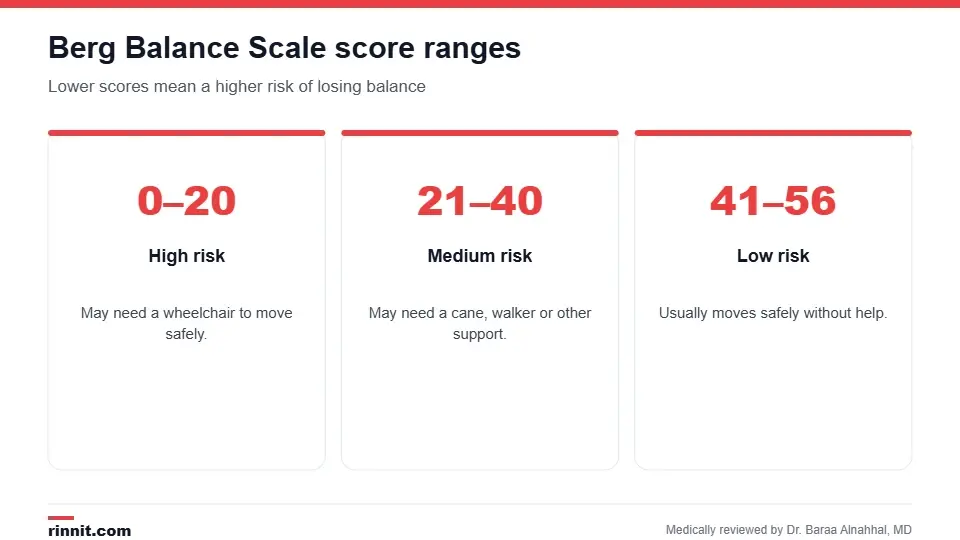
Lower scores mean a higher risk of losing balance.
Total score | Fall risk | What it may mean |
0–20 | High | May need a wheelchair to move safely |
21–40 | Medium | May need a cane, walker or other walking support |
41–56 | Low | Usually able to move safely without help |
Many clinicians treat scores below about 45 as a sign of increased fall risk, but cutoffs vary between studies. Sources: [1, 2, 3]
How accurate is it?

The Berg scale is useful but not perfect at predicting falls.
In pooled studies, the Berg scale correctly flagged about 7 in 10 people who later fell. It doesn't test walking, so it can miss gait problems, and it works best alongside other checks such as the Romberg test, walking tests and a review of medicines, vision and home hazards. Sources: [1, 2, 3]
What happens next?
Your provider uses the score to recommend the support you need, such as a cane or walker, balance and strength training, or vestibular rehabilitation. Repeating the test over time shows whether balance is improving. Sources: [1]
Contact a provider right away if you feel dizzy or unsteady for more than an hour, or if unsteadiness comes with a headache, neck pain, nausea or vomiting. Sources: [1]
Conclusion
The Berg Balance Scale turns a hard-to-measure skill into a clear score that guides safety and rehabilitation. It isn't pass or fail, and it isn't perfect at predicting falls, but it helps you and your provider choose the right support and track progress. Tell your provider if any task hurts or makes you afraid of falling.
Keep learning: read about gait disorders and using a walker safely.
Frequently asked questions
What is a normal Berg Balance Scale score?
41 to 56 means you can usually move safely without help; 56 is the maximum.
What score means high fall risk?
0 to 20 suggests high risk; many clinicians consider scores below about 45 a sign of increased risk.
How long does the test take?
About 15 to 20 minutes.
How many tasks are there?
Fourteen, each scored from 0 to 4.
Is it a pass-or-fail test?
No. The score shows how much support you may need.
Who gives the test?
Usually a physical or occupational therapist, or another trained provider.
Does the test check walking?
No. It can't detect gait problems, so walking tests are often added.
Can I hold on during the test?
Some tasks allow support, but needing help lowers the score; your provider stays close by.
How accurate is it for predicting falls?
About 72% sensitive and 73% specific in pooled studies; it's best used with other tests.
Can my score improve?
Yes. Balance and strength training or vestibular therapy can raise it over time.
Related Reading
Gait Disorders: Symptoms, Types, and Management Options walking problems the Berg scale doesn't capture.
Parkinson's Disease: Symptoms, Causes, and Treatment — A Clear Guide to Understanding and Managing the Condition a common condition assessed with this scale.
Vestibular Rehabilitation Therapy: Managing Dizziness and Balance therapy that can improve balance scores.
How to Use a Walker Safely support recommended for scores of 21–40.
Dizziness and Vertigo: Symptoms, Causes & Treatment Guide inner ear problems that affect balance.
References
Cleveland Clinic. Berg Balance Scale (BBS). Cleveland Clinic. Last updated October 20, 2025. https://my.clevelandclinic.org/health/diagnostics/22090-berg-balance-scale
Park SH, Lee YS. The diagnostic accuracy of the Berg Balance Scale in predicting falls. Western Journal of Nursing Research. 2017;39(11):1502-1525. PMID 27784833. https://doi.org/10.1177/0193945916670894
Lima CA, Ricci NA, Nogueira EC, et al. The Berg Balance Scale as a clinical screening tool to predict fall risk in older adults: a systematic review. Physiotherapy. 2018;104(4):383-394. PMID 29945726. https://doi.org/10.1016/j.physio.2018.02.002
Medical disclaimer
This article is for general education only and does not replace advice from a qualified healthcare professional. Talk to your doctor about your own diagnosis and treatment, and seek emergency care right away for severe or sudden symptoms.



Comments