Romberg Test: How It's Done, What It Checks and What Results Mean

Updated: 2 days ago
Written and medically reviewed by Dr. Baraa Alnahhal, MD · Last reviewed: November 2026 · How we review
Quick Answer: What is the Romberg test?
The Romberg test is a quick physical exam that checks your balance. You stand with your feet together, first with your eyes open and then closed, while a provider watches how much you sway. Losing balance only when your eyes are closed points to a problem with proprioception, your body's sense of its own position. It has no risks. [1]
What the research says
The Romberg test is not enough on its own for inner ear problems. In 136 people with suspected sudden inner ear balance loss, the Romberg test had a sensitivity of only 26%, compared with 92% for spontaneous nystagmus, showing why it is combined with other checks. (von Bernstorff et al., The Neurologist, 2024) [2]
Combined with a second stance test, it helped flag brain causes of dizziness. A two-step bedside method built on the Romberg test identified central (brain-related) dizziness with 88% sensitivity and 94% specificity against MRI in 109 patients. (Li et al., Heliyon, 2024) [3]
Key takeaways
The Romberg test checks balance problems related to proprioception. [1]
You stand still with feet together, eyes open and then eyes closed. [1]
A positive result means increased sway, a step or a fall with your eyes closed. [1]
It cannot name the cause, so more tests usually follow a positive result. [1]
Variations include the sharpened Romberg and the single-leg stance test. [1]
What is the Romberg test?
The Romberg test is a simple, short physical test that providers use to check for balance problems linked to proprioception. It is also called Romberg's sign. [1]
It tests the dorsal column pathway of your spinal cord and brain, which carries the sense of position. The test is named after 19th-century neurologist Moritz Romberg, who developed it to diagnose late-stage syphilis. [1]
How does balance work?
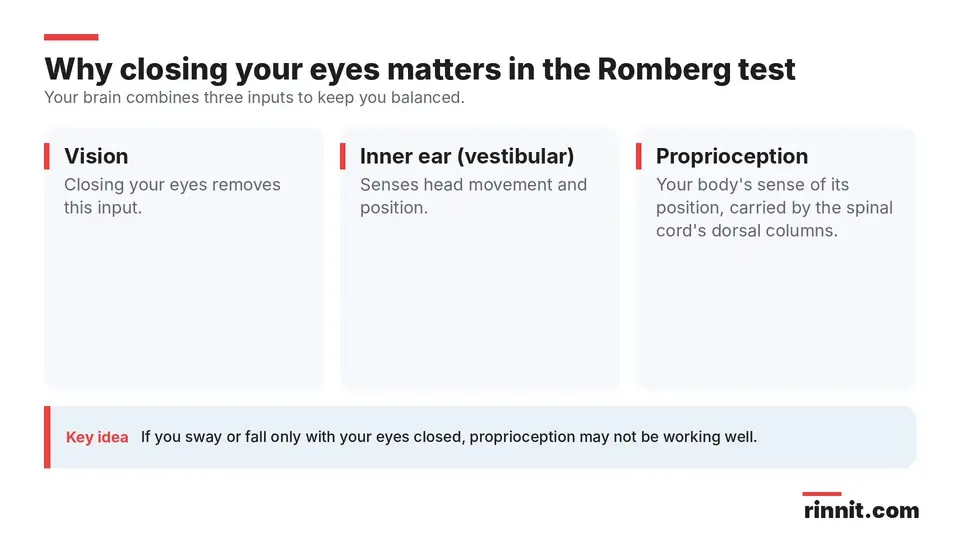
Staying balanced depends on several systems working together: [1]
Vision: what your eyes see around you
Vestibular system: the balance organs in your inner ear
Proprioception: your body's sense of where it is in space
Your brain: which combines these inputs and sends signals to your eyes and muscles
The dorsal column pathway carries fine touch, vibration and position sense from your skin, muscles and joints to your brain. By asking you to close your eyes, the Romberg test removes vision, so your provider can see how well proprioception holds you steady. [1]
Why is the Romberg test done?
Providers usually perform it if you have balance problems, dizziness or falls, and it is often part of a neurological exam. It can help evaluate or confirm: [1]
Parkinson's disease
Friedreich's ataxia
Vitamin B12 deficiency
Tertiary (late) syphilis
Normal pressure hydrocephalus in older people who fall often
Wernicke's syndrome
Ménière's disease
Brown-Séquard syndrome and posterior cord syndrome
Any provider trained in the test can perform it, and neurologists often do. [1]
How is the Romberg test done?

You take off your shoes and stand with your feet together.
You keep your arms at your sides or crossed in front of your body.
With your eyes open, you stand still for about 30 seconds while your provider watches.
You close your eyes and stand for 30 seconds to one minute while your provider watches again.
Sources: [1]
You are not given anything to hold on to. Your provider stays close, clears objects from the area and steps in if you start to fall. No special preparation is needed, and the test is very quick. [1]
What do Romberg test results mean?
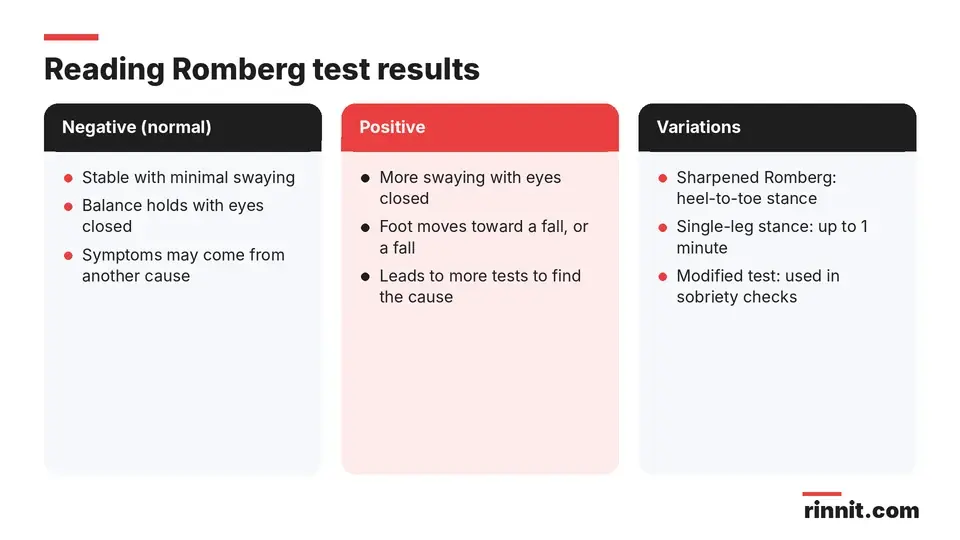
You get your result as soon as the test is over. [1]
Result | What it looks like | What it suggests |
Negative | You stay steady with minimal swaying | Your symptoms may not come from a proprioception problem |
Positive | More swaying, a step toward a fall or a fall when your eyes are closed | A possible problem with the dorsal column pathway; more tests are needed |
Sources: [1]
The test cannot identify the specific cause. If your result is positive, your provider will order more tests to confirm or rule out possible causes. [1]
What are the variations of the Romberg test?
Sharpened Romberg test: you stand heel-to-toe. It is used to check coordination in people recovering from decompression sickness, such as divers. [1]
Single-leg stance test: you stand on one leg with your eyes open for up to one minute, three times on each leg. It is used in older adults and people with Parkinson's disease. [1]
Modified Romberg balance test: sometimes used by police to check for intoxication. You stand with feet together, head tilted back slightly and eyes closed, and say "stop" when you think 30 seconds have passed. It is not one of the standardized field sobriety tests. [1]
When should you see a doctor about balance?
See a provider if you have: [1]
Unsteadiness or losing your balance
Dizziness or lightheadedness
Blurred vision or feeling disoriented
Falling, or a feeling that you are falling
A feeling that the room is spinning, even briefly, or that you are moving while standing still
Conclusion
The Romberg test is one of the simplest tools in a neurological exam. In about a minute, it shows whether your body's position sense can keep you steady once your eyes are closed.
A positive result is a starting point, not a diagnosis. If you have been unsteady or falling, tell your provider so they can look for the cause.
Keep learning: Read our peripheral neuropathy guide or our guide to vitamin B12 deficiency. For more background, see the MedlinePlus page on balance problems.
FAQ
What is the Romberg test?
It is a quick balance test in which you stand with feet together, first with eyes open and then with eyes closed. [1]
What does the Romberg test check?
It checks proprioception, your body's sense of its position, carried by the spinal cord's dorsal columns. [1]
What is a positive Romberg test?
Increased swaying, a step toward a fall or a fall when your eyes are closed. [1]
What does a negative Romberg test mean?
You stay steady with minimal sway, so a proprioception problem is less likely. [1]
What conditions cause a positive Romberg sign?
Examples include vitamin B12 deficiency, Friedreich's ataxia, Parkinson's disease and late syphilis. [1]
How long do you close your eyes in the Romberg test?
For 30 seconds to one minute. [1]
Is the Romberg test risky?
No known risks occur when a trained provider does it in a safe setting. [1]
Do I need to prepare for a Romberg test?
No special preparation is needed. [1]
What is the sharpened Romberg test?
A version done with the feet heel-to-toe, used for people such as divers recovering from decompression sickness. [1]
Can the Romberg test diagnose the cause of imbalance?
No. It shows a problem exists, and other tests find the cause. [1]
Related Reading
Peripheral Neuropathy: Symptoms, Causes, and Treatment Options Explained explains nerve damage that can weaken position sense.
Understanding Vitamin B12 Deficiency: Causes, Symptoms, and Recovery covers a classic cause of a positive Romberg sign.
Friedreich’s Ataxia: Symptoms, Causes, Diagnosis, Treatment and Outlook — What You Need to Know describes an inherited balance disorder this test helps evaluate.
Normal Pressure Hydrocephalus (NPH): The Reversible Form of Dementia You Need to Know explains a cause of falls in older adults.
Parkinson's Disease: Symptoms, Causes, and Treatment — A Clear Guide to Understanding and Managing the Condition covers a movement disorder where balance testing is common.
Neurological Exam: What It Checks, What to Expect and What Happens Next explains the hands-on exam of the brain, spinal cord and nerves.
References
Cleveland Clinic. Romberg Test for Balance Issues: What It Is & Types. Cleveland Clinic. Last updated April 28, 2022. https://my.clevelandclinic.org/health/diagnostics/22901-romberg-test
von Bernstorff M, Obermueller T, Blum J, et al. Accuracy of the Bedside Examination in Patients With Suspected Acute Unilateral Peripheral Vestibulopathy. Neurologist. 2024;29(4):238-242. PMID 38797929. https://doi.org/10.1097/NRL.0000000000000571
Li M, Tan B, Wu Q, et al. R-cVR, a two-step bedside algorithm for the differential diagnosis of acute dizziness and vertigo. Heliyon. 2024;10(19):e38532. PMID 39397912. https://doi.org/10.1016/j.heliyon.2024.e38532
Medical disclaimer
This article is for general education only and does not replace advice from a qualified healthcare professional. Talk to your doctor about your own diagnosis and treatment, and seek emergency care right away for severe or sudden symptoms.



Comments