Neurological Exam: What It Checks, What to Expect and What Happens Next

Updated: 2 days ago
Written and medically reviewed by Dr. Baraa Alnahhal, MD · Last reviewed: November 2026 · How we review
Quick Answer
A neurological exam is a hands-on physical examination that checks how well the brain, spinal cord and nerves are working. A clinician tests thinking and memory, the cranial nerves, strength, coordination, balance, walking, reflexes and sensation. It has no risks and helps decide which tests, such as MRI, EEG or nerve studies, are needed next.
What the research says
A routine exam is better at ruling in than ruling out: a meta-analysis for the GRACE-3 guideline found that in emergency patients with acute dizziness, a general neurological exam had 46.8% sensitivity and 92.8% specificity for a central (brain) cause, while the targeted HINTS eye-movement exam had 92.9% sensitivity and 83.4% specificity, rising to 99.0% with a hearing check (HINTS+) (Shah VP et al., Academic Emergency Medicine, 2023) [2]
Trained hands can beat early MRI: across 14 articles and 800 patients with acute vestibular syndrome, the HINTS exam had 95.3% sensitivity and 92.6% specificity for stroke, while MRI in the first 24–48 hours missed 15% of strokes (sensitivity 85.1%); specificity was higher when subspecialists did the exam (Tarnutzer AA et al., Annals of Neurology, 2023) [3]
Key takeaways
Checks mental status, cranial nerves, motor strength, coordination, balance, gait, reflexes, sensation and, when needed, consciousness and autonomic function.
Used for symptoms such as weakness, numbness, dizziness, headaches, seizures, memory problems, vision or speech changes.
No preparation beyond loose clothing and a list of your symptoms and history.
Painless and without risk; it can take a while because many functions are tested.
Abnormal findings guide next tests: blood tests, MRI or CT, EEG, EMG or a lumbar puncture.
What is a neurological exam?
The nervous system controls thinking, movement, sensation and automatic functions such as blood pressure and bladder control. A neurological exam tests each of these in turn, which helps a clinician work out where in the nervous system a problem lies, for example the brain, spinal cord or a single nerve, and which conditions could explain it. It is performed by a neurologist or a trained nurse practitioner or physician assistant. Sources: [1]
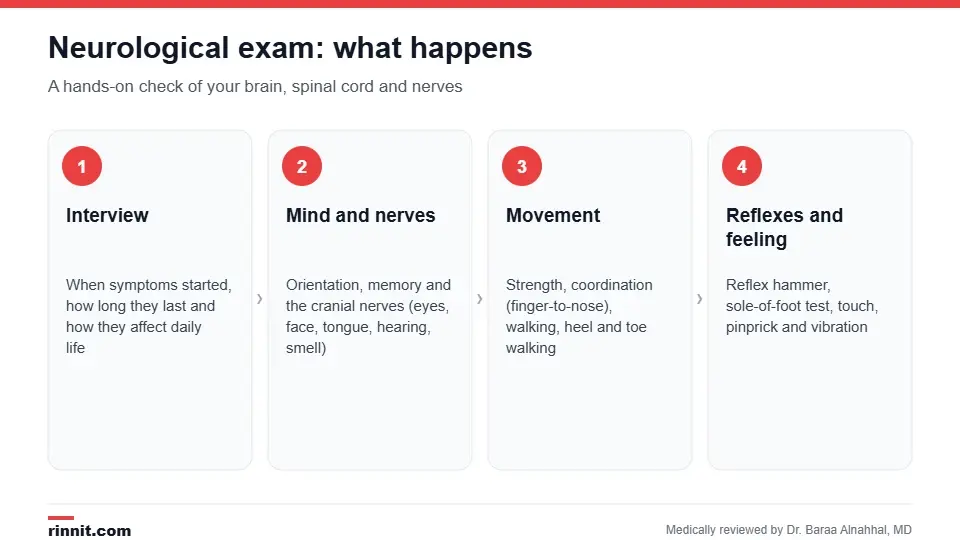
A neurological exam checks the brain, spinal cord and nerves step by step.
Why is it done?
Changes in consciousness, confusion, memory loss or behavior changes.
Blurred or double vision, hearing or smell loss.
Slurred speech or difficulty finding words.
Balance or coordination problems, dizziness.
Headaches.
Muscle weakness, numbness or tingling.
Seizures.
Tracking how a known condition responds to treatment. Sources: [1]
It can help detect stroke, multiple sclerosis, Parkinson's disease, Alzheimer's disease and other dementias, ALS, epilepsy, meningitis and encephalitis, traumatic brain injury, nerve disorders such as CIDP, and headache disorders such as migraine and cluster headache. Sources: [1]
The parts of the exam
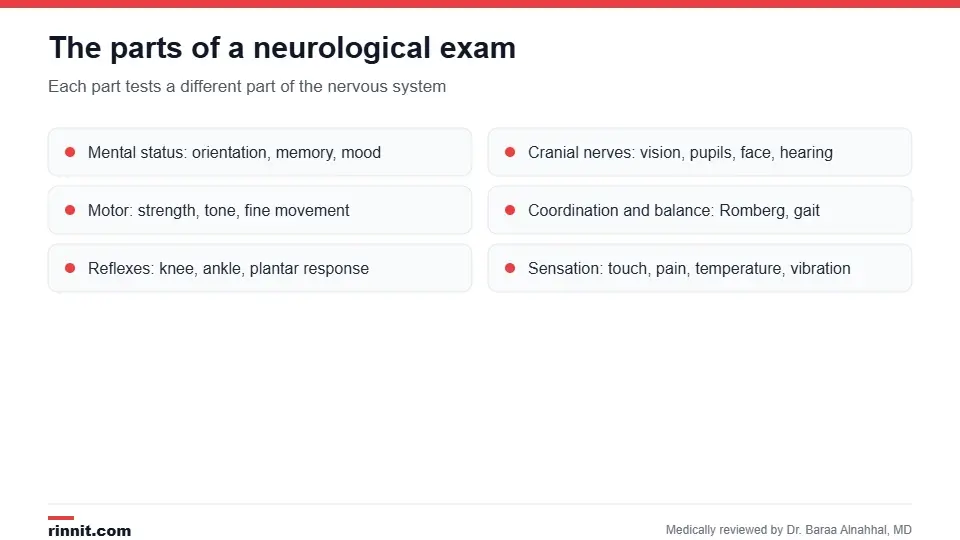
Each part of the exam tests a different part of the nervous system.
Part | What is tested | Examples |
Interview | Your symptoms and history | When symptoms began, how long they last, daily impact |
Mental status | Orientation, attention, memory, mood | Date and place, counting, repeating a word list |
Cranial nerves | Nerves of the head and face | Pupils, vision, eye and face movement, tongue, hearing, smell |
Motor | Strength, tone, fine movement | Pushing against resistance, writing your name |
Coordination and balance | Cerebellum and balance pathways | Finger-to-nose, walking a straight line, heel and toe walking, Romberg test |
Reflexes | Reflex arcs and spinal cord | Knee and ankle taps, sole-of-foot (plantar) test, abdominal reflex |
Sensation | Sensory nerves and pathways | Light touch, pinprick, temperature, vibration with a tuning fork |
Consciousness | Alertness when not fully awake | |
Autonomic | Automatic body functions | Bladder and bowel control, blood pressure lying and standing |
Sources: [1]
How do I prepare?
Little preparation is needed. Wear loose, comfortable clothing, and write down your symptoms, when they started, your medicines and your health history. Bring glasses or hearing aids if you use them. Sources: [1]
What happens during the exam?
The clinician asks about your symptoms and history.
You answer simple questions and do short memory tasks.
Your eyes, face, hearing and other cranial nerve functions are checked.
You push and pull against the examiner's hands, touch your nose with your finger, and walk normally, on your heels and on your toes.
Reflexes are tested with a rubber hammer, and the sole of your foot is stroked.
With your eyes closed, you report what you feel as you are touched with cotton, a pin or a vibrating tuning fork. Sources: [1]
The exam is painless. It has no fixed length, and a full exam can take a while because many functions are tested. Sources: [1]
Understanding your results
The clinician explains the findings at the end of the exam. A normal exam is reassuring, but because many findings are better at confirming than excluding a problem, a normal result does not rule out every condition. In emergency patients with dizziness, for example, a general exam detected only about 47% of brain causes, while a focused eye-movement exam (HINTS) done by trained clinicians detected 93–95%, outperforming MRI in the first 24–48 hours. Sources: [2, 3]

How bedside examination compares with imaging in acute dizziness.
Possible follow-up tests
Blood tests, for example for vitamin B12 deficiency.
Brain MRI or CT.
Electroencephalogram (EEG) for seizures.
EMG and nerve conduction studies for nerve and muscle problems.
Lumbar puncture to test spinal fluid. Sources: [1]
Risks
There are no risks. Some tests, such as pinprick or a tuning fork, can feel briefly uncomfortable, but nothing breaks the skin. Sources: [1]
Conclusion
The neurological exam is the clinician's map of your nervous system. In a short, painless visit it shows where a problem is likely to be and which tests will answer the question fastest. Bring a clear timeline of your symptoms; it is often the most useful part of the exam.
Keep learning: read about the NIH Stroke Scale and the mental status exam.
Frequently asked questions
Who performs a neurological exam?
A neurologist, or a trained nurse practitioner or physician assistant. Primary care and emergency clinicians also perform shorter versions.
How long does a neurological exam take?
There is no fixed time. A focused exam can take minutes; a complete exam can take longer because many functions are tested.
Does a neurological exam hurt?
No. A pinprick or tuning fork may feel briefly uncomfortable, but nothing breaks the skin.
What should I bring?
A list of symptoms, when they started, your medicines and health history, plus glasses or hearing aids.
What is the Babinski sign?
When the sole of the foot is stroked, the big toe normally curls down. If it goes up in an adult, it can signal a brain or spinal cord problem.
Can a normal exam miss a problem?
Yes. Many findings are better at confirming than excluding a condition, so tests may still be needed if symptoms continue.
What is the HINTS exam?
A focused eye-movement exam for sudden prolonged dizziness that, when done by trained clinicians, detects about 93–95% of strokes.
What tests might follow?
Blood tests, MRI or CT, EEG, EMG and nerve conduction studies, or a lumbar puncture.
Is a neurological exam part of a stroke check?
Yes. Tools such as the NIH Stroke Scale use parts of the neurological exam to measure stroke severity.
Can I prepare in any special way?
No special preparation is needed beyond comfortable clothing and a clear account of your symptoms.
Related Reading
Romberg Test: How It's Done, What It Checks and What Results Mean a balance test included in the neurological exam.
NIH Stroke Scale (NIHSS): What It Checks and What Your Score Means the stroke score built from neurological exam findings.
Glasgow Coma Scale (GCS): Scoring Chart, What Scores Mean and GCS-P how consciousness is rated when someone isn't fully alert.
Brain MRI: Why It's Done, How to Prepare and What to Expect the imaging test that often follows an abnormal exam.
What Is CIDP (Chronic Inflammatory Demyelinating Polyneuropathy)? Symptoms, Causes, Diagnosis & Treatment a nerve disorder first suspected from reflex and strength changes.
Deep Tendon Reflexes (DTRs): How They're Tested, Graded and What Abnormal Reflexes Mean explains how reflexes are tested and graded with a reflex hammer.
References
Cleveland Clinic. Neurological Exam: What It Is, Purpose & Procedure. Cleveland Clinic. Last updated April 1, 2022. https://my.clevelandclinic.org/health/diagnostics/22664-neurological-exam
Shah VP, Oliveira J E Silva L, Farah W, et al. Diagnostic accuracy of the physical examination in emergency department patients with acute vertigo or dizziness: a systematic review and meta-analysis for GRACE-3. Academic Emergency Medicine. 2023;30(5):552-578. PMID 36453134. https://doi.org/10.1111/acem.14630
Tarnutzer AA, Gold D, Wang Z, et al. Impact of clinician training background and stroke location on bedside diagnostic test accuracy in the acute vestibular syndrome: a meta-analysis. Annals of Neurology. 2023;94(2):295-308. PMID 37038843. https://doi.org/10.1002/ana.26661
Medical disclaimer
This article is for general education only and does not replace advice from a qualified healthcare professional. Talk to your doctor about your own diagnosis and treatment, and seek emergency care right away for severe or sudden symptoms.



Comments