Mental Status Exam: What It Checks, What Happens and What the Results Mean

Updated: 2 days ago
Written and medically reviewed by Dr. Baraa Alnahhal, MD · Last reviewed: November 2026 · How we review
Quick Answer: What is a mental status exam?
A mental status exam is a structured way for a provider to check how you think, feel and behave. Through observation and questions, the provider looks at your appearance, behavior, speech, mood, thoughts, judgment and cognition. The results can point toward mental health or neurological conditions, but a diagnosis also needs your history, a physical exam and other tests.
What the research says
A widely used cognitive screen is fairly accurate for dementia but should not be used alone. A Cochrane review found the Mini-Mental State Examination, at a cut point of 24, detected dementia in community settings with a sensitivity of 85% and specificity of 90%, and the authors advised against using it alone to confirm or rule out the disease. (Creavin et al., Cochrane Database of Systematic Reviews, 2016) [2]
Several short cognitive tests perform about as well as the MMSE. A meta-analysis of 149 studies with more than 49,000 participants found the MMSE had a combined sensitivity of 81% and specificity of 89% for dementia, while the Mini-Cog and ACE-R performed comparably and the MoCA was best for mild cognitive impairment. (Tsoi et al., JAMA Internal Medicine, 2015) [3]
Key takeaways
A mental status exam checks cognition, mood, behavior and perceptions using observations and questions [1].
Any healthcare provider can perform it, often in part during routine or follow-up visits [1].
It covers appearance, behavior, movements, speech, affect, thought process, mood, thought content, perception, insight, judgment and cognition [1].
It is subjective, and culture, language, education, sleep, hunger, pain and stress can affect performance [1].
Results can point toward conditions such as dementia, schizophrenia, bipolar disorder or Parkinson's disease, but are not a diagnosis on their own [1].
Abnormal results may lead to blood and urine tests, brain imaging, an EEG or cerebrospinal fluid analysis [1].
What is a mental status exam?
A mental status exam is a way for providers to assess your mental capacity, meaning how you learn about and understand your surroundings [1]. It uses observation and questions to look at your general appearance, behavior and movements, perceptions, mood and affect, and cognition, which includes attention, orientation, memory, reasoning and judgment [1].
It is often compared to a psychiatrist's version of a physical exam, but any healthcare provider can perform it [1]. It can help detect and track mental health conditions, such as schizophrenia and anxiety, and neurological conditions, such as Alzheimer's disease and Parkinson's disease [1].
When is a mental status exam done?
Parts of the exam may be done at regular checkups or follow-up visits [1]. The results help your provider decide what further testing you need and which treatments may help [1].
Because it is a subjective assessment, two providers may reach different conclusions about the same person, and their specialty may play a role [1]. Several factors can affect how you do on the exam [1]:
A diagnosis is never based on this exam alone. Providers combine it with your current illness, past mental health and medical history, substance use and social history, a physical and neurological exam, and test results such as blood tests [1].
What a mental status exam includes
Providers use a mix of observations and questions, grouped into broad categories [1].

Observations
Area | What the provider notices |
Appearance | Hygiene, whether you look your stated age, and any visible injuries or scars [1] |
Behavior | Level of distress, cooperation and discomfort, and whether behavior fits the reason for the visit [1] |
Motor activity | Unusual movements such as hyperactivity, tremors, tics, rigidity or parkinsonism [1] |
Speech | Amount, fluency, speed, rhythm, volume and tone, including problems such as slurred speech [1] |
Affect | Nonverbal cues such as sad, anxious, agitated, blunted, bright or euphoric, and whether they match your reported mood [1] |
Thought process | Whether thinking is straightforward and goal-directed or shows patterns such as a flight of ideas [1] |
Sources: [1]
Questions
Mood: You describe how you feel, and your answer is recorded [1].
Thought content: The provider checks for thoughts of suicide or harming others and for delusions, which are firmly held false beliefs [1].
Perception: Questions about what you hear, see, feel, smell or taste, mainly to check for hallucinations [1].
Insight: How well you understand yourself and how you are functioning, rated from good to poor [1].
Judgment: Your ability to make sound decisions, often explored through everyday scenarios or habits such as taking medicines regularly [1].
Cognition
Cognition is checked in five areas [1]:
Alertness: Your level of consciousness, from awake and responsive to stupor or coma [1].
Orientation: Whether you know your name, where you are and the date [1].
Attention and concentration: How well you stay focused, for example tapping the provider's hand each time a certain letter appears in a list [1].
Memory: Immediate recall, recent memory and long-term memory, such as repeating a phrase or naming your birthplace [1].
Abstract reasoning: Your ability to understand concepts, such as saying what two objects have in common or explaining a common saying [1].

Mental status exam results
After the exam, your provider reviews your answers and their observations together to see whether they point to a specific problem [1]. For example, trouble with at least two cognitive or behavioral functions may point toward mild cognitive impairment or dementia [1]. Reported hallucinations may point toward a manic episode of bipolar disorder, schizophrenia or a neurological condition such as Parkinson's disease [1].
The exam can also help track how a neurological condition changes over time, and providers usually add their notes to your medical record [1].
If the results are abnormal
Your provider may ask more about your medical and mental health history; for example, three nights of poor sleep could explain trouble concentrating [1]. Lab tests may look for physical causes [1]:
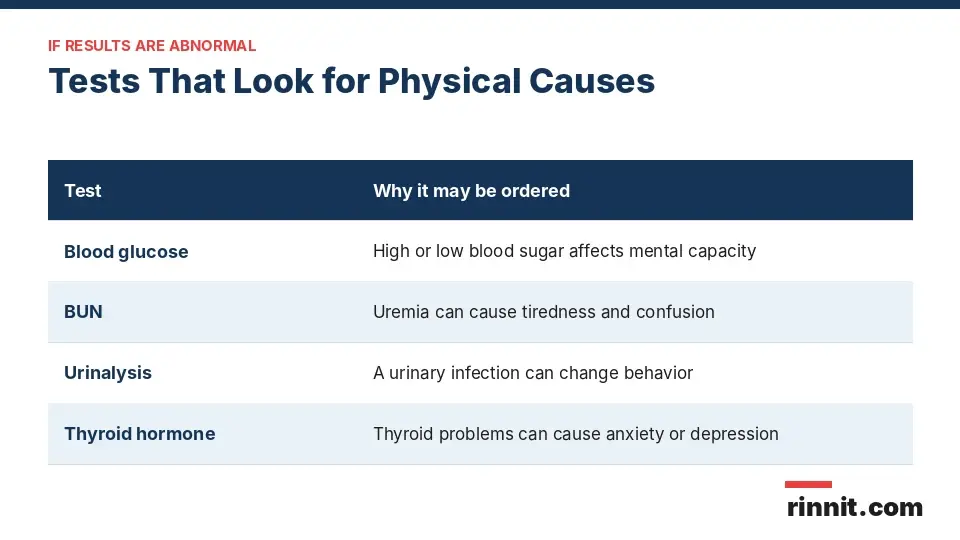
Test | Why it may be ordered |
Blood glucose test | High or low blood sugar can affect mental capacity [1] |
Blood urea nitrogen (BUN) test | Uremia can cause tiredness and confusion [1] |
Urinalysis | A urinary tract infection can change thinking and behavior [1] |
Thyroid hormone test | An overactive thyroid can cause anxiety, and an underactive thyroid can cause depression [1] |
Sources: [1]
Other tests may include brain imaging such as a PET scan or MRI, an electroencephalogram (EEG) and cerebrospinal fluid analysis [1]. Your provider will explain the results and plan next steps with you [1].
Conclusion
A mental status exam is a simple but important way to look at how you think, feel, behave and perceive the world. It can point toward mental health or neurological conditions and help track them over time.
Because the exam is subjective and many everyday factors affect it, more testing is usually needed before a diagnosis. Ask your provider what your results mean for you.
Keep learning: Read our guide to neuropsychological testing, our guide to the lumbar puncture (spinal tap) or our guide to the MRI scan. For more background, see the MedlinePlus guide to dementia.
FAQ
What is a mental status exam?
It is a structured check of your thinking, mood, behavior and perceptions using observation and questions.
Who performs a mental status exam?
Any healthcare provider can perform it. It is often compared to a psychiatrist's version of a physical exam.
What does a mental status exam include?
Appearance, behavior, movements, speech, affect, thought process, mood, thought content, perception, insight, judgment and cognition.
What cognitive areas does it test?
Alertness, orientation, attention and concentration, memory and abstract reasoning.
How do I prepare for a mental status exam?
No preparation is needed. Tell your provider if you are tired, hungry, in pain or more comfortable in another language.
Can a mental status exam diagnose a condition?
Not on its own. Providers combine it with your history, a physical exam and other tests before making a diagnosis.
What conditions can a mental status exam point to?
It can point toward dementia, mild cognitive impairment, schizophrenia, bipolar disorder, anxiety or Parkinson's disease, among others.
What can affect my results?
Culture, native language, education, literacy, lack of sleep, hunger, pain and stress can all affect performance.
What happens if my results are abnormal?
You may have blood or urine tests, a thyroid test, brain imaging, an EEG or a spinal fluid test to look for causes.
Is the mental status exam the same as the MMSE?
No. The MMSE is a short scored cognitive test, while the mental status exam is a broader look at mood, behavior and thinking.
Related Reading
Alzheimer's Disease: Symptoms, Causes, Treatment & Complete Guide explains Alzheimer's disease, a condition a mental status exam can help detect and track.
Delirium: Causes, Symptoms, Diagnosis & Treatment — Complete Guide covers sudden confusion, which shows up in alertness, attention and orientation checks.
What Is Mild Cognitive Impairment? A Plain-Language Guide to the In-Between Stage of Memory Loss explains mild cognitive impairment, one possible finding of an abnormal exam.
Bipolar Disorder: Symptoms, Causes, and Treatment covers bipolar disorder, which mood and perception questions can point toward.
Generalized Anxiety Disorder: Symptoms, Causes, Treatment & Complete Guide explains anxiety, a mental health condition the exam can help detect.
Paranoid Schizophrenia: Understanding an Evolving Diagnosis covers schizophrenia, which thought content and perception questions can help reveal.
BIMS Score: What the Brief Interview for Mental Status Measures and How to Interpret It explains the 15-point memory screen used in nursing homes.
SAGE Test: How the Self-Administered Memory Screen Works and What Scores Mean explains the self-administered screening test for early memory and thinking problems.
References
Cleveland Clinic. Mental Status Exam: What It Is, Uses & Examples. Cleveland Clinic. Last updated September 15, 2023. https://my.clevelandclinic.org/health/diagnostics/mental-status-exam
Creavin ST, Wisniewski S, Noel-Storr AH, et al. Mini-Mental State Examination (MMSE) for the detection of dementia in clinically unevaluated people aged 65 and over in community and primary care populations. Cochrane Database Syst Rev. 2016;2016(1):CD011145. PMID 26760674. https://doi.org/10.1002/14651858.CD011145.pub2
Tsoi KK, Chan JY, Hirai HW, et al. Cognitive Tests to Detect Dementia: A Systematic Review and Meta-analysis. JAMA Intern Med. 2015;175(9):1450-1458. PMID 26052687. https://doi.org/10.1001/jamainternmed.2015.2152
Medical disclaimer
This article is for general education only and does not replace advice from a qualified healthcare professional. Talk to your doctor about your own diagnosis and treatment, and seek emergency care right away for severe or sudden symptoms.



Comments