What Is Mild Cognitive Impairment? A Plain-Language Guide to the In-Between Stage of Memory Loss

Updated: 2 days ago
Medically reviewed by Dr. Baraa Alnahhal, MD · Last reviewed: October 2026
Quick Answer: Key Facts About Mild Cognitive Impairment
Mild cognitive impairment (MCI) is a stage between normal thinking and dementia, marked by memory, language, and judgment changes that do not disrupt daily life. Main signs include forgetting things more often, missing appointments and losing your train of thought. Symptoms can stay stable for years or improve, and there is no single test for it [1].
Question | Answer |
What is it? | A stage between normal thinking and dementia, marked by memory, language, and judgment changes that do not disrupt daily life. [1] |
What are the main signs? | Forgetting things more often, missing appointments, losing your train of thought, and trouble with words, decisions, or familiar places. [1] |
What causes it? | The causes vary: in some people it is an early sign of Alzheimer's disease, but symptoms can also stay stable for years or improve. [1] |
How is it diagnosed? | There is no single test — diagnosis rests on symptom history, mental status testing, blood tests, and brain imaging, and on ruling out dementia. [2] |
How is it treated? | Treatment depends on the cause: Alzheimer's-related MCI may be treated with FDA-approved medicines, while medicines and health conditions that harm memory are treated or stopped. [2] |
What the research says
Progression to dementia is common but far from certain. A meta-analysis of 41 inception cohort studies found that, using Mayo-defined MCI, the adjusted annual rate of progression to dementia was 9.6% in specialist clinic settings and 4.9% in community studies. The cumulative share who developed dementia was 39.2% in specialist settings and 21.9% in population studies, and the authors concluded that most people with MCI will not progress to dementia even after 10 years of follow-up. (Mitchell & Shiri-Feshki, Acta Psychiatr Scand, 2009) [5]
An anti-amyloid antibody modestly slowed decline in early Alzheimer's disease. In the 18-month Clarity AD trial of 1,795 people with early Alzheimer's disease (MCI or mild dementia with evidence of amyloid), the CDR-SB score worsened by 1.21 points with lecanemab versus 1.66 with placebo (difference −0.45; 95% CI −0.67 to −0.23). Infusion-related reactions occurred in 26.4% of people given lecanemab, and amyloid-related imaging abnormalities with edema or effusions in 12.6%. (van Dyck et al., N Engl J Med, 2023) [6]
Healthy lifestyle changes can help protect thinking skills. In the FINGER trial of 1,260 at-risk adults aged 60 to 77, a 2-year program of diet, exercise, cognitive training and vascular risk monitoring modestly improved overall cognitive scores compared with general health advice. (Ngandu et al., The Lancet, 2015) [7]
What is mild cognitive impairment?
Mild cognitive impairment, also known as MCI, is the in-between stage between typical thinking skills and dementia. The condition causes memory loss and trouble with language and judgment, but it doesn't affect daily activities. [1]
People with MCI may be aware that their memory or mental ability has changed. Family and close friends also may notice changes. But these changes aren't bad enough to impact daily life or affect usual activities. [1] [3]
MCI raises the risk of developing dementia caused by Alzheimer's disease or other brain conditions. But for some people with mild cognitive impairment, symptoms might never get worse or even get better. [1]
What does mild cognitive impairment look like?
Symptoms of MCI include trouble with memory, language, and judgment. The symptoms are more serious than the memory issues that are expected as people get older. But the symptoms don't affect daily life at work or at home. [1]
The brain, like the rest of the body, changes with age. Many people notice they become more forgetful as they age. It may take longer to think of a word or to recall a person's name. But if concerns with memory go beyond what's expected, the symptoms may be due to mild cognitive impairment. [1]
What are the symptoms of mild cognitive impairment?
People with MCI may have symptoms that include the following.
Symptom | What it looks like |
Frequent forgetting | Forgetting things more often than before [1] |
Missed plans | Missing appointments or social events [1] |
Lost thread | Losing their train of thought, or not following the plot of a book or movie [1] |
Conversation trouble | Trouble following a conversation [1] |
Word trouble | Trouble finding the right word or with language [1] |
Task trouble | Finding it hard to make decisions, finish a task, or follow instructions [1] |
Getting lost | Trouble finding their way around places they know well [1] |
Poor judgment | Poor judgment [1] |
Others notice | Changes that are noticed by family and friends [1] |
People with MCI also may experience depression, anxiety, a short temper and aggression, and a lack of interest. [1]
How is mild cognitive impairment different from normal aging?
Becoming more forgetful with age, such as taking longer to recall a word or name, is normal, while mild cognitive impairment causes more serious memory problems. The key difference is degree. MCI symptoms are more serious than the memory issues expected with aging, yet they still leave a person able to live their life as usual. If memory concerns go beyond what's expected for age, they may be due to mild cognitive impairment. [1]

What causes mild cognitive impairment?
There's no single cause of mild cognitive impairment. In some people, mild cognitive impairment is due to Alzheimer's disease. But there's no single outcome. Symptoms may remain stable for years or they may improve over time. Or mild cognitive impairment may progress to Alzheimer's disease dementia or another type of dementia. [1]
MCI often involves the same types of brain changes seen in Alzheimer's disease or other dementias. But in MCI, the changes occur at a lesser degree. Some of these changes have been seen in autopsy studies of people with mild cognitive impairment. [1]
Brain change | What it involves | Related condition |
Amyloid plaques and tau tangles | Clumps of beta-amyloid protein (plaques) and neurofibrillary tangles of tau proteins [1] | Alzheimer's disease |
Lewy bodies | Microscopic clumps of a protein called Lewy bodies [1] | Parkinson's disease, dementia with Lewy bodies, sometimes Alzheimer's disease [1] |
Small strokes | Small strokes or less blood flow through brain blood vessels [1] | Vascular brain disease |
Brain-imaging studies show that the following changes may be related to MCI.
Imaging finding | What it means |
Smaller hippocampus | Decreased size of the hippocampus, an area of the brain important for memory [1] |
Larger ventricles | Larger size of the brain's fluid-filled spaces, known as ventricles [1] |
Less glucose use | Reduced use of glucose in key brain areas; glucose is the sugar that is the main source of energy for cells [1] |
Some changes in brain structure are typical with aging. For example, the size of the brain's memory center, known as the hippocampus, gets smaller with age. But the reduction in size is greater in those with mild cognitive impairment and even more dramatic in people with Alzheimer's disease. [1]

Who is at risk for mild cognitive impairment?
The strongest risk factors for mild cognitive impairment are older age and having a form of a gene known as APOE e4. This gene also is linked to Alzheimer's disease. But having the gene doesn't guarantee a decline in thinking and memory. [1]
Other medical conditions and lifestyle factors have been linked to a higher risk of changes in thinking: [1]
Diabetes
High blood pressure
Obesity
Obstructive sleep apnea
Traumatic brain injury
Low education level
Air pollution exposure
Smoking
High cholesterol (especially LDL)
Depression
Untreated hearing or vision loss
Lack of physical exercise
Lack of mentally or socially stimulating activities
Does mild cognitive impairment always lead to dementia?
No. Complications of mild cognitive impairment include a higher risk — but not a certainty — of dementia. Overall, about 1% to 3% of older adults develop dementia every year. [1] Studies suggest that around 10% to 15% of people with mild cognitive impairment go on to develop dementia each year. [1] [3] For others, symptoms may remain stable for years or improve over time. [1]
When should you see a doctor?
Talk to your healthcare professional if you or someone close to you notices changes in memory or thinking. This may include forgetting recent events or having trouble thinking clearly. [1]
How is mild cognitive impairment diagnosed?
No one test can diagnose mild cognitive impairment. A diagnosis is made based on the information you provide, your medical evaluation, and results of tests. [2]
Many healthcare professionals diagnose MCI based on criteria developed by a panel of international experts. [2]
Diagnostic criterion | What it looks for |
Changes in memory or mental ability | Symptoms related to memory, planning, following instructions, or making decisions; a healthcare professional may confirm these with a family member or close friend [2] |
Decline over time | Mental ability that declines over time, revealed with a careful medical history and confirmed by family or a friend [2] |
Daily activities unaffected | Symptoms may cause worry, but people with MCI are still able to live their lives as usual [2] |
Mild changes on testing | Mental status testing shows mild changes for age and education level [2] |
Not dementia | Symptoms aren't serious enough to be diagnosed as Alzheimer's disease dementia or another type of dementia [2] |
What tests are used?
Mental status testing. Short forms of mental status testing can be done in about 10 minutes. The test will ask the person to name the date and follow written instructions. Longer forms of the tests look at how a person's mental abilities compare with others of a similar age and education. These tests also may find patterns of change that offer clues about the cause of symptoms. Common brief tests include the Short Test of Mental Status, the Montreal Cognitive Assessment (MoCA), and the Mini-Mental State Examination (MMSE). More detailed testing may show to what degree memory has changed, the types of memory most affected, and whether other mental skills are affected. [2]
Neurological exam. As part of a physical exam, a healthcare professional may test how well your brain and nervous system works. These tests can help look for conditions that affect memory and other mental abilities, such as Parkinson's disease, strokes, and tumors. The neurological exam may test reflexes, eye movements, and walking and balance. [2]
Lab tests. Blood tests can help rule out some physical causes of memory loss. This can include too little vitamin B-12 or thyroid hormone. Blood tests also can check for proteins in the brain that are related to Alzheimer's disease. A sample of the fluid that surrounds the brain and spinal cord may be removed and checked for proteins related to Alzheimer's disease. This test may confirm Alzheimer's as a cause of cognitive impairment. [2]
Brain imaging. An MRI or CT scan can check for a brain tumor, stroke, or bleeding. Positron emission tomography (PET) can look for protein buildup related to Alzheimer's disease. [2]
Biomarkers. If MCI is thought to be due to mild Alzheimer's disease, tests can check for biomarkers of Alzheimer's disease. Biomarkers include the buildup of proteins in the brain. These proteins can be found in samples of blood or the fluid that surrounds the brain and spinal cord. Biomarkers also can be found in scans of the brain. If biomarkers are present, MCI symptoms may be a sign of mild Alzheimer's disease. [2]

How is mild cognitive impairment treated?
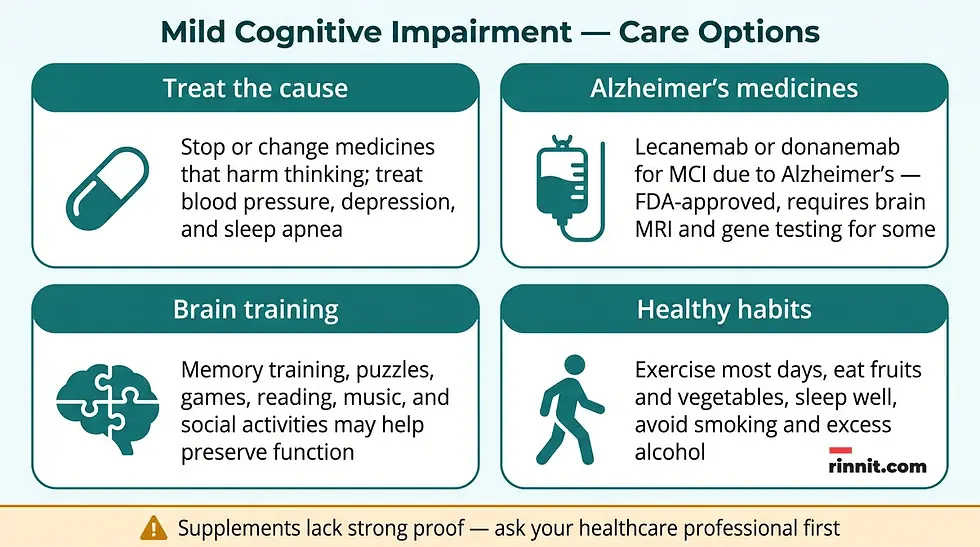
Treatment for mild cognitive impairment may include medicines for Alzheimer's disease. If memory symptoms are being caused by medicines or health conditions, treatment involves addressing those issues. Mild cognitive impairment is an active area of research. Clinical studies are being conducted to better understand the condition and find treatments to improve symptoms or prevent or delay dementia. [2]
What medicines treat MCI caused by Alzheimer's?
Your healthcare professional may recommend medicines approved by the Food and Drug Administration (FDA) to slow the decline in thinking and mental abilities. The medicines can help prevent proteins from clumping and forming structures known as amyloid plaques in the brain. Before starting treatment, the FDA recommends getting a brain MRI. [2]
The medicines are approved for people with mild cognitive impairment due to Alzheimer's disease and mild Alzheimer's disease. Known as monoclonal antibodies, they include the following. [2]
Medicine | How it is given | Notable side effects |
Lecanemab-irmb (Leqembi) | Infusion-related: fever, flu-like symptoms, nausea, vomiting, dizziness, changes in heart rate, trouble breathing [2] | |
Donanemab-azbt (Kisunla) | IV infusion every four weeks [2] | Flu-like symptoms, nausea, vomiting, headache, trouble breathing, changes in blood pressure [2] |
These medicines also can have more-serious side effects. Lecanemab or donanemab can cause swelling in the brain or small bleeds in the brain. Rarely, brain swelling can cause seizures or other symptoms, or even death. [2]
People with a form of a gene known as APOE e4 appear to be at higher risk of serious side effects. The FDA recommends that you get tested for the gene before starting treatment. Once you're taking the medicine, regular brain MRIs monitor for brain swelling and bleeding. [2]
Blood thinners also can raise the risk of bleeding in the brain when taking these medicines. Talk to your healthcare professional if you take a blood thinner before you take lecanemab or donanemab. Also talk to your healthcare professional if you have other risk factors of bleeding in the brain. [2]
Researchers also are studying how effective the medicines may be for people at risk of Alzheimer's disease. This includes first-degree relatives of people with the disease, such as a parent or sibling. [2]
If memory loss is the main symptom of MCI, sometimes cholinesterase inhibitors are prescribed. But these medicines aren't recommended for routine treatment of MCI. They haven't been found to help prevent dementia, and they can cause side effects. [2]
Can stopping certain medicines help?
Symptoms of MCI can be caused by certain medicines that have side effects that affect thinking. These side effects are thought to go away once the medicine is stopped. Discuss any side effects with your healthcare team. Never stop taking your medicine unless your healthcare professional tells you to do so. [2]
Medicine group | Commonly used for |
Benzodiazepines | Anxiety, seizures, and sleep symptoms [2] |
Anticholinergics | Many different types of conditions; they affect chemicals in the nervous system [2] |
Antihistamines | Allergy symptoms [2] |
Opioids | Pain [2] |
Proton pump inhibitors | Reflux or gastroesophageal reflux disease (GERD) [2] |
Can treating other conditions help?
Other common conditions besides MCI can make you feel forgetful or less mentally sharp than usual. Treating these conditions can help improve your memory and overall mental ability. [2]
Condition | How it affects memory | How treatment helps |
High blood pressure | MCI people tend to be more likely to have changes to the blood vessels inside their brains; high blood pressure can worsen these problems and may cause memory loss [2] | Healthcare team monitors blood pressure and can recommend steps to lower it [2] |
Depression | Depression can make someone forgetful and mentally "foggy"; it is common in people with MCI [2] | Treating depression may help improve memory and make it easier to cope with changes [2] |
Sleep apnea | Breathing stops and starts several times during sleep, interfering with rest; causes daytime tiredness, forgetfulness, and poor focus [2] | Treatment can improve symptoms and make you more alert during the day [2] |
What about supplements?
Some supplements have been suggested to help prevent or delay mild cognitive impairment. However, more research is needed in this area. Talk to a member of your healthcare team before taking supplements because they can interact with your current medicines. [2]
What can you do at home?
Study results have been mixed about whether diet, exercise, or other healthy lifestyle choices can prevent or reverse mild cognitive impairment. Regardless, these healthy choices promote good overall health and may play a role in good brain health. [2]
Lifestyle habit | Potential benefit |
Regular physical exercise | Known benefits for heart health; may help prevent or slow a decline in thinking skills [2] |
Diet low in fat, rich in fruits and vegetables | Heart-healthy choice that also may help protect brain health [2] |
Omega-3 fatty acids | Good for the heart; most research showing possible brain benefit looks at how much fish people eat [2] |
Keeping your brain active | Playing games, playing an instrument, reading books, and other activities may help preserve brain function [2] |
Being social | May make life more satisfying, help preserve mental abilities, and slow mental decline [2] |
Memory training | Memory training and other cognitive training may help improve your symptoms [2] |
Mild cognitive impairment can't be prevented. But research has found that some lifestyle factors may lower the risk of getting it. These steps may offer some protection: [1]
Don't drink large amounts of alcohol.
Limit exposure to air pollution.
Reduce your risk of a head injury, such as by wearing a helmet when riding a motorcycle or bicycle.
Don't smoke.
Manage health conditions such as diabetes, high blood pressure, obesity, and depression.
Watch your levels of LDL cholesterol and get treatment if levels are high.
Practice good sleep habits and manage any sleep conditions.
Eat a healthy diet full of nutrients, including fruits and vegetables and foods low in saturated fats.
Stay social with friends and family.
Get moderate to vigorous exercise most days of the week.
Wear a hearing aid if you have hearing loss.
Get regular eye exams and treat any vision changes.
Stimulate your mind with puzzles, games, and memory training.
How should you prepare for your appointment?
You're likely to start by seeing your healthcare professional. If it's suspected that you have memory changes, you may be referred to a specialist. This specialist may be a neurologist, psychiatrist, or neuropsychologist. [2]
Because appointments can be brief and there's often a lot to talk about, it's good to be well prepared. [2]
What should you do beforehand?
Be aware of any pre-appointment restrictions — ask if you need to fast for bloodwork or do anything else to prepare for tests. Write down all of your symptoms, including details about what's causing your concern about your memory or mental ability and the most important examples of memory changes. Try to remember when you first started to notice changes. Also note if you think your symptoms are getting worse and why. Take along a family member or friend, if possible — input from a relative or trusted friend helps the healthcare team understand what's happening. [2]
Conclusion and next steps
Mild cognitive impairment sits between normal aging and dementia. It brings real changes in memory, language, and judgment — but daily life keeps going. The path varies: some people's symptoms improve, some stay stable for years, and some progress to dementia. Because a diagnosis depends on careful history, testing, and imaging, the best first step is talking to your healthcare professional about any memory or thinking changes you or your loved ones have noticed. [1] [2]
Talk with a healthcare professional. If you or someone close to you notices changes in memory or thinking, see a healthcare professional for evaluation. For more plain-language guides on memory, dementia, and brain health, explore the related articles on Rinnit.com.
Frequently Asked Questions
What is the difference between mild cognitive impairment and dementia?
MCI is the in-between stage between typical thinking skills and dementia. MCI causes memory loss and trouble with language and judgment, but it doesn't affect daily activities. [1] MCI symptoms aren't serious enough to be diagnosed as dementia. [2]
Does everyone with MCI develop Alzheimer's?
No. Studies suggest that around 10% to 15% of people with mild cognitive impairment develop dementia each year, but symptoms may remain stable for years or even improve over time in some people. [1] [3]
Can mild cognitive impairment be reversed?
Sometimes. When memory symptoms are caused by medicines or treatable conditions such as depression, high blood pressure, or sleep apnea, treating those issues can improve memory and mental ability. [2]
Is there a test for mild cognitive impairment?
There is no single test. Diagnosis rests on symptom history confirmed by family or friends, mental status testing (such as the MoCA or MMSE), blood tests, brain imaging, and confirmation that the symptoms aren't serious enough to be dementia. [2]
What are the first signs of mild cognitive impairment?
Forgetting things more often, missing appointments or social events, losing your train of thought, trouble following conversations, trouble finding the right word, and trouble finding your way around familiar places. [1]
Does mild cognitive impairment run in families?
Having the APOE e4 gene is one of the strongest risk factors and is also linked to Alzheimer's disease, but having the gene doesn't guarantee a decline in thinking and memory. [1]
What medicines are approved for MCI?
The FDA-approved monoclonal antibodies lecanemab-irmb (Leqembi) and donanemab-azbt (Kisunla) are approved for MCI due to Alzheimer's disease and mild Alzheimer's disease. [2] Before starting, the FDA recommends a brain MRI and testing for the APOE e4 gene. [2]
What lifestyle habits may lower the risk of MCI?
Not smoking, limiting alcohol, exercising most days, eating a nutrient-rich diet, staying socially connected, training your memory with puzzles and games, treating hearing and vision loss, and managing conditions like high blood pressure, diabetes, and depression. [1]
Related Reading
Read next on Rinnit.com:
Neuropsychological Testing: What It Is, Why It's Done, What to Expect and Results explains how neuropsychological testing measures memory, attention, language and other thinking skills.
Mental Status Exam: What It Checks, What Happens and What the Results Mean explains how providers check thinking, mood, behavior and memory, and what abnormal results can mean.
BIMS Score: What the Brief Interview for Mental Status Measures and How to Interpret It explains the 15-point memory screen used in nursing homes.
SAGE Test: How the Self-Administered Memory Screen Works and What Scores Mean explains the self-administered screening test for early memory and thinking problems.
References
Mayo Clinic Staff. Mild cognitive impairment (MCI) - Symptoms & causes. Mayo Clinic. October 24, 2024. https://www.mayoclinic.org/diseases-conditions/mild-cognitive-impairment/symptoms-causes/syc-20354578
Mayo Clinic Staff. Mild cognitive impairment (MCI) - Diagnosis & treatment. Mayo Clinic. February 13, 2024. https://www.mayoclinic.org/diseases-conditions/mild-cognitive-impairment/diagnosis-treatment/drc-20354583
Alzheimer's Association. Mild Cognitive Impairment (MCI). Alzheimer's Association. Accessed October 15, 2026. https://www.alz.org/alzheimers-dementia/what-is-dementia/related_conditions/mild-cognitive-impairment
National Library of Medicine. Mild Cognitive Impairment. MedlinePlus. October 22, 2018. https://medlineplus.gov/mildcognitiveimpairment.html
Mitchell AJ, et al. Rate of progression of mild cognitive impairment to dementia--meta-analysis of 41 robust inception cohort studies. Acta Psychiatr Scand. 2009;119(4):252-265. PMID 19236314. https://doi.org/10.1111/j.1600-0447.2008.01326.x
van Dyck CH, et al. Lecanemab in Early Alzheimer's Disease. N Engl J Med. 2023;388(1):9-21. PMID 36449413. https://doi.org/10.1056/NEJMoa2212948
Ngandu T, et al. A 2 year multidomain intervention of diet, exercise, cognitive training, and vascular risk monitoring versus control to prevent cognitive decline in at-risk elderly people (FINGER): a randomised controlled trial. The Lancet. 2015;385(9984):2255-2263. PMID 25771249. https://doi.org/10.1016/S0140-6736(15)60461-5
Medical disclaimer
This article is for informational purposes only and is not medical advice. Always consult a qualified healthcare professional for diagnosis and treatment decisions.



Comments