BIMS Score: What the Brief Interview for Mental Status Measures and How to Interpret It

Updated: 2 days ago
Written and medically reviewed by Dr. Baraa Alnahhal, MD · Last reviewed: November 2026 · How we review
Quick Answer
The BIMS score comes from the Brief Interview for Mental Status, a screening test of memory and orientation used in U.S. nursing homes. Scores range from 0 to 15: 13–15 means cognition is intact, 8–12 moderately impaired and 0–7 severely impaired. It is a screen, not a diagnosis, and it is not designed to detect mild cognitive impairment.
What the research says
BIMS works well in nursing homes: in a national study of 3,822 residents in 71 nursing homes, the BIMS was completed by 90% of residents in an average of 3.2 minutes, correlated strongly with a longer cognitive test (r = 0.91), and a cutoff of 12 detected any impairment with 83% sensitivity and 91% specificity (Saliba D et al., Journal of the American Medical Directors Association, 2012) [2]
It misses milder problems: in 2,252 rehabilitation patients compared with the Montreal Cognitive Assessment (MoCA), the BIMS identified only 38% of moderate and 26% of mild impairments, so it should not be used to rule out milder cognitive problems (Harmon EY et al., PM&R, 2023) [3]
Key takeaways
A 15-point memory and orientation screen in the nursing home Minimum Data Set (MDS 3.0).
Three sections: word repetition (0–3), temporal orientation (0–6) and recall (0–6).
13–15 intact; 8–12 moderately impaired; 0–7 severely impaired.
Done at admission and repeated every few months or after a significant change.
Not designed for mild cognitive impairment; low scores need a full evaluation.
What is the BIMS?
Federal rules require nursing homes that receive Medicare or Medicaid funding to assess every resident using the Minimum Data Set. The BIMS is the MDS section that screens cognition. It is given by trained staff through a structured interview at admission, then quarterly, annually and whenever a resident's condition changes significantly. The results help guide care planning, safety and quality monitoring. Sources: [1]

The BIMS takes only a few minutes.
How is the test given?
Section | What the person is asked | Points |
Repetition | Repeat three words: "sock," "blue" and "bed" | 0–3 |
Temporal orientation | State the year, month and day of the week | 0–6 (year 0–3, month 0–2, day 0–1) |
Recall | Recall the three words, with category cues if needed ("something to wear," "a color," "a piece of furniture") | 0–6 (2 points each without a cue, 1 with a cue) |
The interviewer asks questions in a quiet place, makes sure the person can hear and see, and uses hearing aids, glasses or an interpreter as needed. The person shouldn't be helped with answers. If someone can't be interviewed because they are rarely or never understood, staff complete an observational assessment instead. Sources: [1, 2]
Understanding the score

BIMS score ranges.
Score | Interpretation | What it may mean for care |
13–15 | Cognitively intact | Usually independent decision-making |
8–12 | Moderately impaired | May need cueing, supervision or support with decisions |
0–7 | Severely impaired | Usually needs substantial help and safety planning |
A low score can be caused by dementia, but also by delirium, infection, medicine side effects, depression, hearing or vision problems or a language barrier. A sudden drop should prompt a medical review rather than being assumed to be dementia. Sources: [1]
How accurate is the BIMS?
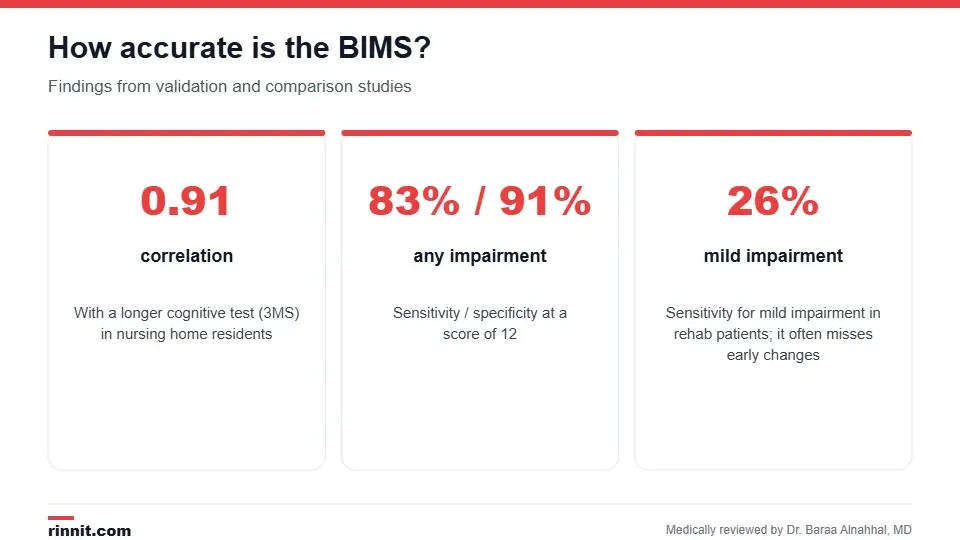
The BIMS is accurate for moderate to severe impairment.
In nursing homes, the BIMS performs about as well as longer tests for moderate and severe impairment, and it is easier for residents to complete. But it was not built to pick up subtle changes. In a rehabilitation study, it missed most cases of mild cognitive impairment that the MoCA detected. Sources: [2, 3]
Limitations
It is a screen and doesn't diagnose dementia or its cause.
It can miss mild cognitive impairment.
Results are affected by hearing, vision, language, education and acute illness.
People too ill, or with advanced dementia who can't respond, are assessed by observation instead. Sources: [1, 3]
What happens after a low score?
A low or falling score usually leads to a fuller evaluation: a mental status exam or longer test such as the MoCA, a review of medicines, blood tests to look for reversible causes, and sometimes brain imaging. Results shape the care plan, including help with daily activities, fall prevention and decisions about consent. Sources: [1]
Conclusion
The BIMS score is a quick, standardized way for nursing homes to track memory and thinking over time. It's good at flagging moderate to severe impairment, but a normal score doesn't rule out milder problems, and a low score always deserves a look for treatable causes.
Keep learning: read about vascular dementia and mild cognitive impairment.
Frequently asked questions
What does BIMS stand for?
Brief Interview for Mental Status.
What is a normal BIMS score?
13 to 15, meaning cognition is intact.
What does a score of 8 to 12 mean?
Moderate cognitive impairment.
What does a score of 0 to 7 mean?
Severe cognitive impairment.
How long does the BIMS take?
A few minutes; about 3 minutes on average.
Where is the BIMS used?
Mainly in U.S. nursing homes as part of the Minimum Data Set (MDS 3.0).
How often is it done?
At admission, then quarterly, annually and after a significant change in condition.
Can the BIMS diagnose dementia?
No. It's a screening tool; diagnosis needs a full evaluation.
Can the BIMS detect mild cognitive impairment?
Not reliably. Longer tests such as the MoCA are better for milder problems.
What if someone can't do the interview?
Staff use an observational assessment of memory and decision-making instead.
Related Reading
Mental Status Exam: What It Checks, What Happens and What the Results Mean a fuller bedside assessment of thinking and mood.
What Is Mild Cognitive Impairment? A Plain-Language Guide to the In-Between Stage of Memory Loss milder changes the BIMS can miss.
Alzheimer's Disease: Symptoms, Causes, Treatment & Complete Guide the most common cause of dementia.
Delirium: Causes, Symptoms, Diagnosis & Treatment — Complete Guide a sudden, often reversible cause of low scores.
Vascular Dementia (VCI): Symptoms, Causes, Diagnosis & Treatment — Complete Guide dementia caused by reduced blood flow to the brain.
References
Cleveland Clinic. BIMS Score: What It Is & How To Interpret It. Cleveland Clinic. Last updated September 9, 2025. https://my.clevelandclinic.org/health/diagnostics/bims-score
Saliba D, Buchanan J, Edelen MO, et al. MDS 3.0: brief interview for mental status. Journal of the American Medical Directors Association. 2012;13(7):611-617. PMID 22796362. https://doi.org/10.1016/j.jamda.2012.06.004
Harmon EY, Gillen RW. Comparison of the Brief Interview for Mental Status (BIMS) and Montreal Cognitive Assessment (MoCA) for identifying cognitive impairments and predicting rehabilitation outcomes in an inpatient rehabilitation facility. PM&R. 2023;15(9):1083-1091. PMID 36194649. https://doi.org/10.1002/pmrj.12908
Medical disclaimer
This article is for general education only and does not replace advice from a qualified healthcare professional. Talk to your doctor about your own diagnosis and treatment, and seek emergency care right away for severe or sudden symptoms.



Comments