Vascular Dementia (VCI): Symptoms, Causes, Diagnosis & Treatment — Complete Guide

Updated: 3 days ago
Medically reviewed by Dr. Baraa Alnahhal, MD · Last reviewed: October 2026
Quick Answer
Vascular dementia is a decline in thinking and memory caused by reduced blood flow to the brain, most commonly after a stroke. It often first affects thinking speed and problem-solving rather than memory and may appear suddenly or in step-like drops. There is no cure, but controlling blood pressure, cholesterol, diabetes and other vascular risk factors can slow its progression.
What the research says
About 1 in 10 people develop new dementia soon after a first stroke, and more than 1 in 3 after a recurrent stroke. A systematic review and meta-analysis of 30 cohorts (22 hospital-based and 8 population-based; 7,511 patients) found that about 10% of patients had dementia before their first stroke, about 10% developed new dementia soon after a first stroke, and more than a third had dementia after a recurrent stroke. Dementia rates within one year of stroke ranged from 7.4% to 41.3% depending on the study setting and which patients were included. (Pendlebury & Rothwell, Lancet Neurol, 2009) [3]
Diabetes, atrial fibrillation, and small-vessel changes on brain scans are treatable risk factors after a stroke. A systematic review and meta-analysis of 89 studies (160,783 stroke patients) found that diabetes (relative risk 1.38, 95% CI 1.10 to 1.72) and moderate or severe white matter hyperintensities on imaging (relative risk 1.55, 95% CI 1.01 to 2.38) were linked to higher risk of post-stroke dementia, and that diabetes (relative risk 1.29, 95% CI 1.14 to 1.45) and atrial fibrillation (relative risk 1.29, 95% CI 1.04 to 1.60) were linked to post-stroke cognitive impairment, independent of age and stroke severity. The authors noted substantial heterogeneity between studies and evidence of reporting bias. (Filler et al., Lancet Healthy Longev, 2024) [4]
Vascular Dementia at a Glance
Feature | What You Need to Know |
Definition | Cognitive decline caused by reduced blood flow to the brain |
Other name | Vascular cognitive impairment (VCI) — the term covers the full spectrum |
4 types | Multi-infarct, post-stroke, mixed, subcortical ischemic |
vs. Alzheimer's | Affects thinking speed and problem-solving first, not memory; may progress in steps |
Main causes | Stroke (clot or hemorrhage), narrowed/damaged brain blood vessels |
Biggest risk factors | High blood pressure, high cholesterol, diabetes, smoking, obesity, atrial fibrillation |
Prognosis | Cannot be reversed; progression may be slowed by managing vascular health |
Prevention | Control blood pressure, diabetes, and cholesterol; quit smoking; exercise regularly |
What Is Vascular Dementia?
Vascular cognitive impairment (VCI) describes the changes in thinking and memory that occur when there isn't enough blood flow to part of the brain — as can happen with a stroke. "Vascular" refers to blood flow and blood vessels; "cognitive impairment" refers to changes in the way you think. VCI can cause issues with language, decision-making, planning, and judgment.
The term vascular dementia is now used alongside vascular cognitive impairment to describe different points on the same spectrum:
Term | Severity | Effect on Daily Life |
Vascular cognitive impairment (mild VCI, VaMCI) | Milder symptoms | Mostly affects thinking skills, memory, focus, and language — daily living intact |
Vascular dementia (major VCI, VaD) | Significant dementia symptoms | Impairs daily living; symptoms may resemble Alzheimer's disease |
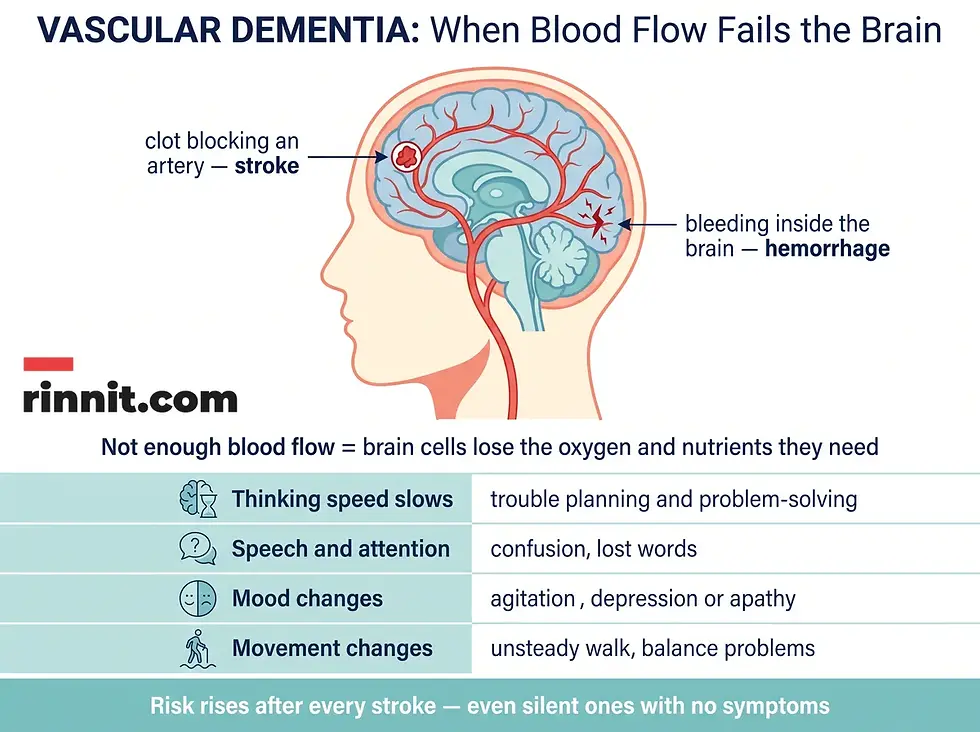
Both conditions can happen after a stroke, which occurs when a blood clot blocks an artery or a blood vessel bursts and causes bleeding inside the brain. Both events cut off the oxygen and nutrients brain cells need. Not every stroke leads to vascular cognitive impairment — it depends on how severe the stroke is and where in the brain it happens.
The 4 Types of Vascular Cognitive Impairment
Type | What Happens |
Multi-infarct dementia | Caused by several strokes, often in different parts of the brain; cumulative damage affects memory and thinking |
Post-stroke dementia | Dementia symptoms appear within six months after a stroke and do not go away |
Mixed dementia | Usually Alzheimer's disease plus a type of vascular dementia (any combination of dementias); more common in older adults |
Subcortical ischemic vascular dementia | Damage to small blood vessels and nerve fibers in the brain's white matter; common with vessel disease or high blood pressure; early symptoms affect attention, planning, and movement rather than memory |
Symptoms: How to Recognize the Changes
Symptoms vary depending on which brain area isn't getting enough blood flow, and they often overlap with other types of dementia — especially Alzheimer's disease. One important distinction: in contrast to Alzheimer's, early symptoms tend to affect the speed of thinking and problem-solving rather than memory loss.
There are no specific stages, but the condition tends to progress over time. Symptoms appear right after a stroke if stroke-caused, or slowly over time if caused by small blood vessel disease. Call 911 right away if someone has sudden stroke signs, such as face drooping, arm or leg weakness, trouble speaking, sudden confusion or sudden vision loss, because fast treatment can limit brain damage.
Thinking and Communication Changes
Confusion, trouble finding the right words, difficulty paying attention, trouble organizing thoughts or actions, difficulty planning and following through, slowed thinking, uncertainty about what to do next, and memory issues.
Behavior and Mood Changes
Restlessness or agitation, and depression or lack of interest (apathy).
Physical Changes
An unsteady walk or poor balance, and a sudden or frequent need to urinate or trouble controlling urine.
The Step-Wise Pattern
Sometimes symptoms follow a series of strokes or ministrokes (transient ischemic attacks), with thinking dropping in noticeable steps downward from the earlier level of function — unlike the gradual, steady decline typical of Alzheimer's disease. However, vascular cognitive impairment can also develop gradually like Alzheimer's, and the two often occur together: studies show many people with dementia and evidence of brain vascular disease also have Alzheimer's disease.
Causes: What Damages the Brain's Blood Vessels
Vascular cognitive impairment results from conditions that damage the brain's blood vessels. When these vessels are damaged, they can't supply the brain with enough nutrition and oxygen — and thinking suffers.
Stroke that blocks a brain artery. Such strokes usually cause a range of symptoms including vascular cognitive impairment, but some strokes cause no noticeable symptoms. These silent strokes still increase dementia risk — and risk rises with the number of strokes over time.
Brain hemorrhage. Often caused by high blood pressure weakening a blood vessel, leading to bleeding into the brain. Hemorrhage may also occur when protein builds up in small blood vessels with aging — a condition called cerebral amyloid angiopathy — weakening the vessels over time.
Narrowed or damaged brain blood vessels. Any condition that narrows or damages brain vessels can cause vascular cognitive impairment, including aging wear and tear, high blood pressure, diabetes, and atherosclerosis — the buildup of cholesterol and other substances in the arteries.
Risk Factors: The Heart-Brain Connection
The risk factors for vascular cognitive impairment are essentially the same as those for heart disease and stroke.
Category | Risk Factor | Why It Matters |
Can't change | Increasing age | Risk rises with age; rare before age 65 |
Can't change | Family history | The condition isn't inherited, but many risk factors (high blood pressure, diabetes) are |
Medical | Heart attacks, strokes, or ministrokes (TIAs) | Past events raise the risk of brain blood vessel problems |
Medical | Atherosclerosis | Plaques narrow arteries and reduce blood flow to the brain |
Medical | High cholesterol | High LDL ("bad") cholesterol increases risk |
Medical | High blood pressure | Stresses blood vessels everywhere, including in the brain |
Medical | Diabetes | High blood sugar damages brain blood vessels |
Medical | Atrial fibrillation | Irregular heartbeats form clots in the heart that can travel to the brain and cause stroke |
Can change | Smoking | Damages blood vessels; increases atherosclerosis and circulatory disease |
Can change | Obesity | A well-known risk factor for vascular diseases |
Prevention: Protect the Heart to Protect the Brain
Because brain blood vessel health is closely linked to overall heart health, the same steps that protect your heart may lower your vascular dementia risk:
Maintain a healthy blood pressure. High blood pressure strains brain blood vessels and raises stroke and cognitive decline risk.
Prevent or manage diabetes. Diet and exercise lower type 2 diabetes risk; managing blood sugar protects the brain's small vessels.
Quit smoking. Tobacco damages blood vessels everywhere in the body, including the brain.
Get physical exercise. Regular activity improves heart health, blood flow, and brain function.
Keep cholesterol in check. A healthy, low-fat diet — plus cholesterol-lowering medicines if needed — reduces plaque buildup inside brain arteries.
How Vascular Dementia Is Diagnosed
There is no specific test that confirms vascular cognitive impairment. Experts can nearly always determine that dementia is present, and the diagnosis builds on the information provided — including any history of stroke or heart and blood vessel issues.
Test | What It Checks |
Lab tests | Cholesterol and blood sugar levels; thyroid-stimulating hormone (to rule out thyroid problems); calcium, electrolytes, and creatinine; vitamin D and B12 (deficiencies can cause symptoms); signs of syphilis (a late-stage infection that can cause dementia) |
Neurological exam | Reflexes; muscle tone and strength (comparing both sides); ability to get up from a chair and walk across the room; sense of touch and sight; coordination; balance |
Brain imaging (MRI) | The preferred test — shows strokes, ministrokes, and blood vessel changes in more detail than CT; uses radio waves and a strong magnetic field, painless but noisy and confining |
Brain imaging (CT scan) | Brain structure, tissue shrinkage, and evidence of stroke, ministroke, vessel changes, or tumor; uses X-rays from various angles to create cross-sectional images |
Neuropsychological tests | Language (speak, write, understand), working with numbers, learning and remembering, planning and problem-solving, responding to situations. People with vascular cognitive impairment struggle to think through a problem and find a solution — while learning and remembering may be less impaired than in Alzheimer's unless memory-area vessels are affected |
One important reality of diagnosis: vascular cognitive impairment and Alzheimer's often overlap. Most people diagnosed with Alzheimer's have blood vessel and blood flow issues that contribute to the disease, and most people with vascular cognitive impairment have some brain changes associated with Alzheimer's.
Treatment: Managing the Vessels to Protect the Mind
There are no treatments to stop or cure vascular cognitive impairment, and it cannot be reversed. However, some underlying causes of dementia-like symptoms — such as an infection or a vitamin deficiency — can be reversed, which is why a thorough diagnosis matters.
Controlling the Contributing Conditions
Treatment focuses on managing the health conditions and risk factors that contribute to the disease. Managing conditions that affect the heart and blood vessels can sometimes slow the rate at which vascular cognitive impairment worsens. Medicines may be prescribed to:
Lower blood pressure.
Lower cholesterol levels.
Prevent blood clots and keep arteries clear.
Manage blood sugar if you have diabetes.
Cholinesterase Inhibitors
Some studies have shown benefit from cholinesterase inhibitors — medicines commonly prescribed for Alzheimer's symptoms — in vascular cognitive impairment. They are not FDA-approved for vascular cognitive impairment, but since the two conditions often occur together, they may be appropriate for some people.
For Mixed Dementia
People with mixed dementia — vascular cognitive impairment plus Alzheimer's disease or Lewy body dementia — may benefit from medicines used to treat those other types of dementia.

Self Care: Lifestyle Habits
Studies haven't shown that lifestyle changes such as exercise and a healthy diet can reverse or significantly improve existing symptoms. However, these habits are widely recommended because research suggests they may slow progression or delay onset — and regular physical activity may help prevent vascular dementia altogether:
Getting regular physical activity.
Eating a healthy diet.
Maintaining a healthy weight.
Taking part in social activities.
Challenging the brain with games, puzzles, and new activities (an art class, new music).
Limiting alcohol intake.
Coping and Support
People with any type of dementia experience a mixture of emotions — confusion, frustration, anger, fear, uncertainty, grief, and depression — and caregivers often share these feelings.
Strategies for Caregivers
Seek out support. Counseling and local support services help. A local Alzheimer's Association affiliate connects families to support groups, resources, home care agencies, residential care facilities, help lines, and educational seminars.
Prepare for what's ahead. While your loved one is in the earlier stages, talk with a lawyer about legal documents such as power of attorney, healthcare proxy, and advance directives.
Give encouragement. Listen, provide reassurance that life can still be enjoyed, and help the person retain dignity and self-respect.
Provide a calm environment. A calm, predictable setting with a daily routine of comfortable activities reduces worry and agitation.
Do activities together. Find shared activities you both enjoy — a painting class, a long walk.
Respect independence as often as is safe. The early stages can last years. When you and your loved one disagree about activities such as driving, ask the healthcare team for advice.
Caring for the Caregiver
Caregiving is physically and emotionally demanding — anger, guilt, frustration, discouragement, worry, grief, and social isolation are all common. Attending to your own needs is one of the most important things you can do:
Learn about the disease from the healthcare team and your local librarian.
Ask questions of specialists and social workers.
Call on friends and family for help when you need it.
Take a break every day.
Take care of your own health — scheduled checkups, healthy meals, exercise.
Make time for friends and consider joining a support group.
Preparing for the Appointment
If symptoms followed a stroke, first conversations usually happen in the hospital. For milder symptoms, the discussion takes place at a healthcare appointment about changes in thinking. You may start with a member of the healthcare team and then be referred to a neurologist — a doctor who specializes in the brain and nervous system.
Since appointments can be brief, preparation matters:
Check for restrictions — ask whether you need to fast for blood tests.
Write down all symptoms — examples of forgetfulness or poor judgment, when you first noticed something, and how symptoms have changed.
Bring a family member or friend — they can confirm the extent of symptoms and help recall the information shared.
List your other medical conditions — diabetes, high blood pressure, heart disease, past strokes.
List all medicines — prescription, over-the-counter, vitamins, and supplements.
Write down your questions so the biggest concerns aren't forgotten.
Frequently Asked Questions
What is vascular dementia?
Vascular dementia is a decline in thinking and memory caused by reduced blood flow to the brain, most often after a stroke. It affects language, decision-making, planning, and judgment, and ranges from mild vascular cognitive impairment to major vascular dementia that disrupts daily living.
How is vascular dementia different from Alzheimer's disease?
Vascular dementia typically affects the speed of thinking and problem-solving first, rather than memory, and may appear suddenly or in step-like drops after strokes. Alzheimer's usually causes a gradual, steady decline centered on memory. The two also frequently occur together.
What are the types of vascular dementia?
There are four main types: multi-infarct dementia (many strokes), post-stroke dementia (symptoms within six months of a stroke), mixed dementia (Alzheimer's plus vascular damage), and subcortical ischemic vascular dementia (damage to small vessels in the brain's white matter).
What causes vascular dementia?
Conditions that damage the brain's blood vessels — strokes (clots or hemorrhages), silent strokes, high blood pressure, diabetes, and atherosclerosis — reduce the oxygen and nutrients brain cells receive, impairing thinking over time.
Who is at risk of vascular dementia?
Risk rises with age (it is rare before 65) and with the same factors that drive heart disease and stroke: high blood pressure, high cholesterol, diabetes, atrial fibrillation, a history of strokes or heart attacks, smoking, and obesity.
Is vascular dementia reversible?
No — it cannot be stopped or reversed. However, some reversible causes of similar symptoms (infections, vitamin deficiencies) should be checked, and managing vascular health can slow the rate of decline.
Can vascular dementia be prevented?
You can lower your risk by maintaining healthy blood pressure, preventing or managing diabetes, quitting smoking, exercising regularly, keeping cholesterol in check, and eating a healthy diet — the same steps that protect your heart.
How is vascular dementia diagnosed?
There is no single test. A provider reviews health history, does a neurological exam and thinking tests, orders blood tests to rule out other causes, and usually uses an MRI to look for strokes or blood vessel damage.
What medicines are used for vascular dementia?
No medicine is FDA-approved to treat vascular dementia itself. Treatment focuses on medicines that control blood pressure, cholesterol, blood clots and blood sugar, and some people with mixed dementia may be offered Alzheimer's medicines such as cholinesterase inhibitors.
Can a mini-stroke (TIA) lead to vascular dementia?
Repeated ministrokes or silent strokes can add up and damage thinking over time. A TIA is also a warning that a bigger stroke may follow, so call 911 for sudden stroke signs even if they go away.
Conclusion
Vascular dementia is fundamentally a heart and blood vessel disease that shows up in the brain — and that framing is both its warning and its hope. Three lessons anchor this guide:
The cause is blood flow, not a single toxin or protein: every stroke — even silent ones — and every vessel-damaging condition adds to the risk.
The pattern differs from Alzheimer's: slowed thinking and problem-solving come first, and decline may come in visible steps after repeated strokes.
You have real leverage: blood pressure, cholesterol, blood sugar, smoking, and physical activity are all controllable — managing them can slow progression and may help prevent the disease.
Understanding how vascular dementia differs from other dementias helps you spot it earlier and protect brain health longer. For a side-by-side view of the most common form of dementia, read our complete guide to Alzheimer's disease.
Your Next Steps
Read a related guide — Compare forms of dementia with our Alzheimer's disease complete guide.
Share your thoughts — Have you supported a loved one with vascular dementia? Tell us in the comments — your experience may help another family.
Disclaimer: This article is for informational purposes only and is not a substitute for professional medical advice, diagnosis, or treatment. Always consult a qualified healthcare provider about any medical condition.
Related Reading
BIMS Score: What the Brief Interview for Mental Status Measures and How to Interpret It explains the 15-point memory screen used in nursing homes.
SAGE Test: How the Self-Administered Memory Screen Works and What Scores Mean explains the self-administered screening test for early memory and thinking problems.
References
Mayo Clinic Staff. Vascular cognitive impairment and vascular dementia - Symptoms & causes. Mayo Clinic. September 18, 2025. https://www.mayoclinic.org/diseases-conditions/vascular-dementia/symptoms-causes/syc-20378793
Mayo Clinic Staff. Vascular cognitive impairment and vascular dementia - Diagnosis & treatment. Mayo Clinic. September 18, 2025. https://www.mayoclinic.org/diseases-conditions/vascular-dementia/diagnosis-treatment/drc-20378798
Pendlebury ST, et al. Prevalence, incidence, and factors associated with pre-stroke and post-stroke dementia: a systematic review and meta-analysis. Lancet Neurol. 2009;8(11):1006-1018. PMID 19782001. https://doi.org/10.1016/S1474-4422(09)70236-4
Filler J, et al. Risk factors for cognitive impairment and dementia after stroke: a systematic review and meta-analysis. Lancet Healthy Longev. 2024;5(1):e31-e44. PMID 38101426. https://doi.org/10.1016/S2666-7568(23)00217-9



Comments