SAGE Test: How the Self-Administered Memory Screen Works and What Scores Mean

Updated: 2 days ago
Written and medically reviewed by Dr. Baraa Alnahhal, MD · Last reviewed: November 2026 · How we review
Quick Answer
The Self-Administered Gerocognitive Examination (SAGE) is a self-taken screening test for early signs of mild cognitive impairment and dementia. It has 12 questions and takes 10 to 15 minutes. Scores of 17 to 22 are normal, and 14 or lower suggests more serious problems. SAGE is a screening tool, not a diagnosis; a low score leads to further evaluation.
What the research says
SAGE detects early cognitive problems well: in the original validation study, 254 adults over 59 took SAGE and 63 had a full neurological and neuropsychological evaluation; SAGE identified cognitive impairment with 79% sensitivity and 95% specificity, better than the MMSE (71% and 90%) (Scharre DW et al., Alzheimer Disease & Associated Disorders, 2010) [2]
The digital version works too: a tablet-based version, eSAGE, closely matched the paper test and a full neuropsychological battery, detecting cognitive impairment with 71% sensitivity and 90% specificity using a cutoff of 16 (Scharre DW et al., Alzheimer's Research & Therapy, 2017) [3]
Key takeaways
A 12-question, self-administered screen for early memory and thinking problems.
Checks memory, orientation, language, reasoning, executive function and visuospatial skills.
Paper or tablet; no time limit; spelling doesn't count.
17–22 normal; 15–16 possible problems; 14 or less more concerning.
It's a screen, not a diagnosis; a low score leads to further testing.
What is the SAGE test?
SAGE was developed at The Ohio State University to make cognitive screening quick and easy. Because you take it on your own, it can be done in a waiting room or at home and brought to your provider, saving time during a visit. It has four interchangeable forms, so it can be repeated over time to track changes. Sources: [1, 2, 3]
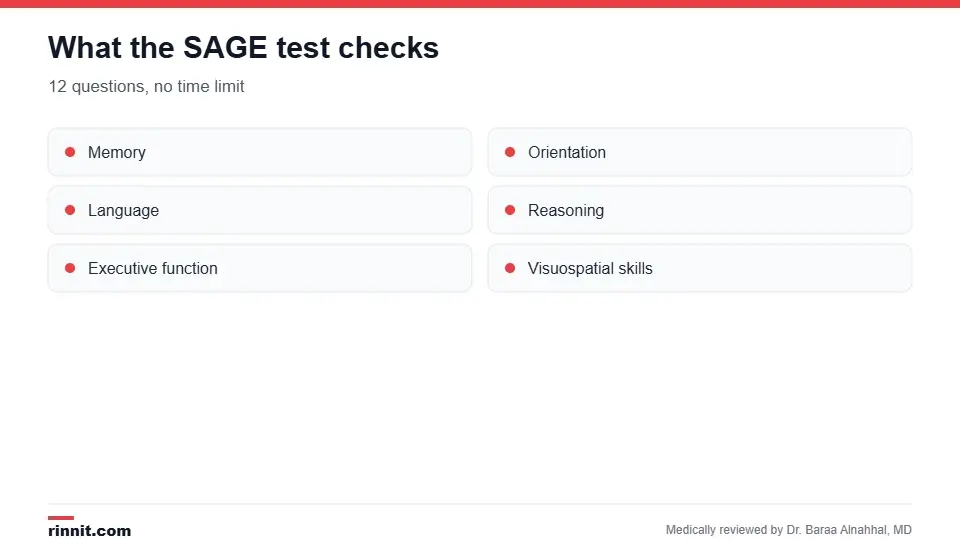
SAGE covers six areas of thinking.
Why is it done?
You or someone close to you has noticed memory or thinking changes.
As part of a routine checkup for adults over 65, especially with signs of mild cognitive impairment or dementia.
To get a baseline score to compare with later.
To track changes over time. Sources: [1]
How do I take it?

SAGE can be taken at home or in a clinic.
Get a paper form or the online version from your provider.
Answer all 12 questions on your own, without help from others, phones or calendars.
There's no time limit; most people finish in about 10–15 minutes.
Bring the completed test to your provider, who scores it and discusses the results. Sources: [1, 2]
No preparation is needed. You need to be able to read and write, but spelling mistakes don't affect your score. It's fine not to know some answers. Overpreparing or being very nervous can affect results. Sources: [1]
What do the scores mean?
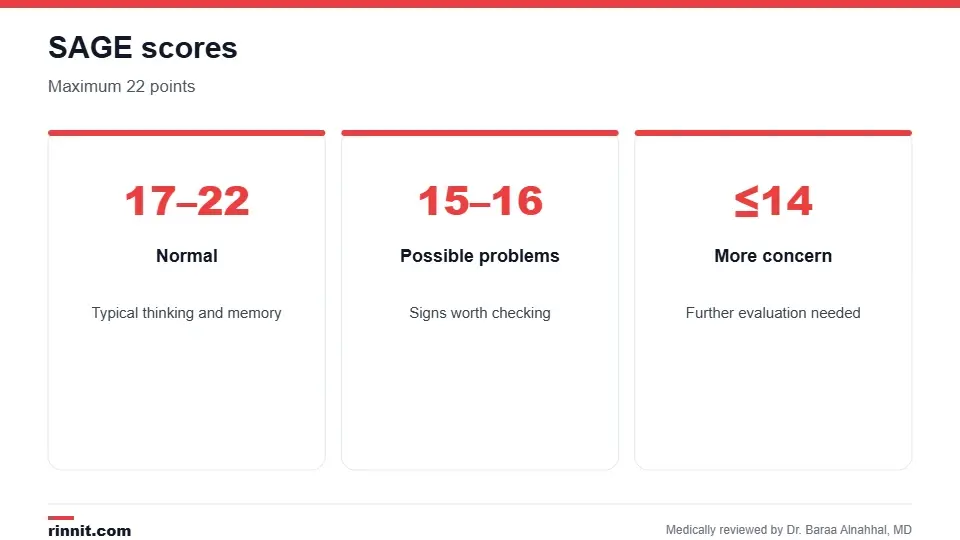
The maximum score is 22.
SAGE score | What it suggests |
17–22 | Normal thinking and memory |
15–16 | Signs of thinking and memory problems; further evaluation suggested |
14 or lower | Signs of more serious thinking and memory problems; further evaluation recommended |
Sources: [1]
Scores may be adjusted for age and education. SAGE can't tell you the cause of a low score. Problems can come from treatable conditions such as vitamin B12 deficiency, thyroid problems, depression, sleep problems or medicine side effects, as well as from Alzheimer's disease, vascular dementia or Lewy body dementia. Sources: [1, 2]
What happens after a low score?
A mental status exam and a fuller physical and neurological exam.
Detailed neuropsychological testing.
Blood tests, such as for vitamin B12 and thyroid function.
Brain imaging, such as a brain MRI.
Treatment of any cause found, plus planning and support. Sources: [1]
Limits
SAGE is a screening test, so it can miss early problems or flag people who turn out to be fine. Anxiety, poor vision, limited literacy or a language barrier can lower scores; your provider may offer a different test in those cases. Sources: [1, 2]
Conclusion
The SAGE test is a simple, private way to check your thinking and memory. A normal score is reassuring, and a low score is a reason to see your provider, not a diagnosis. Finding problems early gives you the best chance to treat reversible causes and plan ahead.
Keep learning: read about mild cognitive impairment and Alzheimer's disease.
Frequently asked questions
What does SAGE stand for?
Self-Administered Gerocognitive Examination.
What does the SAGE test check?
Memory, orientation, language, reasoning, executive function and visuospatial skills.
How long does SAGE take?
There's no time limit; most people take about 10–15 minutes.
What is a normal SAGE score?
17 to 22 out of 22.
Can I take SAGE at home?
Yes, then bring it to your provider to review.
Does spelling count?
No. Spelling mistakes don't affect your score.
Can SAGE diagnose dementia?
No. It's a screening test; diagnosis needs more evaluation.
What if my score is low?
Your provider will order more tests to find the cause.
Is there an online version?
Yes. A digital version can be taken on a tablet.
Can I retake SAGE?
Yes. Four forms allow repeat testing over time.
Related Reading
What Is Mild Cognitive Impairment? A Plain-Language Guide to the In-Between Stage of Memory Loss early memory and thinking problems SAGE screens for.
Alzheimer's Disease: Symptoms, Causes, Treatment & Complete Guide the most common cause of dementia.
Vascular Dementia (VCI): Symptoms, Causes, Diagnosis & Treatment — Complete Guide dementia caused by reduced blood flow to the brain.
Lewy Body Dementia (LBD): Symptoms, Causes, Diagnosis & Treatment — Complete Guide another common type of dementia.
Mental Status Exam: What It Checks, What Happens and What the Results Mean the clinician's exam of thinking and memory.
References
Cleveland Clinic. SAGE Test: What It Is, Purpose & Interpreting Results. Cleveland Clinic. Last updated September 29, 2025. https://my.clevelandclinic.org/health/diagnostics/sage-test
Scharre DW, Chang SI, Murden RA, et al. Self-administered Gerocognitive Examination (SAGE): a brief cognitive assessment instrument for mild cognitive impairment (MCI) and early dementia. Alzheimer Dis Assoc Disord. 2010;24(1):64-71. PMID 20220323. https://doi.org/10.1097/WAD.0b013e3181b03277
Scharre DW, Chang SI, Nagaraja HN, et al. Digitally translated Self-Administered Gerocognitive Examination (eSAGE): relationship with its validated paper version, neuropsychological evaluations, and clinical assessments. Alzheimers Res Ther. 2017;9(1):44. PMID 28655351. https://doi.org/10.1186/s13195-017-0269-3
Medical disclaimer
This article is for general education only and does not replace advice from a qualified healthcare professional. Talk to your doctor about your own diagnosis and treatment, and seek emergency care right away for severe or sudden symptoms.



Comments