Lewy Body Dementia (LBD): Symptoms, Causes, Diagnosis & Treatment — Complete Guide

Updated: 3 days ago
Medically reviewed by Dr. Baraa Alnahhal, MD · Last reviewed: October 17, 2026
Quick Answer
Lewy body dementia (LBD) is the second most common type of dementia after Alzheimer's disease, caused by abnormal protein deposits called Lewy bodies in brain cells that affect thinking, memory and movement. Hallmark signs include visual hallucinations, Parkinson's-like movement problems, fluctuating alertness and acting out dreams. There is no cure, but treatments improve many symptoms.
What the research says
Cholinesterase inhibitors modestly improve thinking in Lewy body and Parkinson's dementias. A meta-analysis of 10 trials in Parkinson's disease cognitive impairment, Parkinson's disease dementia, and dementia with Lewy bodies found that cholinesterase inhibitors improved Mini-Mental State Examination scores by about 1.04 to 2.57 points (95% CIs 0.43–1.65 and 0.90–4.23), while memantine did not significantly improve cognition; both gave small global benefits, and rivastigmine caused more mostly mild or moderate adverse events than placebo (risk ratio 1.19, 95% CI 1.04–1.36). (Wang et al., J Neurol Neurosurg Psychiatry, 2015) [3]
Acting out dreams can come years before the dementia. A meta-analysis of longitudinal studies found that the risk of developing a neurodegenerative disease in people with REM sleep behavior disorder was 33.5% at 5 years, 82.4% at 10.5 years, and 96.6% at 14 years; most converted to Parkinson's disease (43%), followed by dementia with Lewy bodies (25%). (Galbiati et al., Sleep Med Rev, 2018) [4]
Lewy body dementia carries a higher death risk than most other dementias. A meta-analysis of 78 studies (63,125 people with dementia and 152,353 controls) found the all-cause mortality hazard ratio was highest for Lewy body dementia (17.88, 95% CI 5.87–54.46), and survival from disease onset was about a year shorter for dementia with Lewy bodies than for Alzheimer's disease (mean difference −1.06 years, 95% CI −1.68 to −0.44). (Liang et al., Lancet Healthy Longev, 2021) [5]
Lewy Body Dementia at a Glance
Feature | What You Need to Know |
Definition | A progressive dementia caused by Lewy body protein deposits in brain cells |
Rank among dementias | Second most common after Alzheimer's disease |
Two forms | Dementia with Lewy bodies; Parkinson's disease dementia |
Key symptoms | Visual hallucinations, movement problems, fluctuating alertness, dream-enactment during sleep |
Autonomic effects | Blood pressure drops on standing, dizziness, bladder control loss, constipation |
Risk factors | Age over 60, male sex, family history of LBD or Parkinson's |
Prognosis | Progressive; on average 7–8 years from symptom onset to death |
Treatment | No cure, but medicines, environmental therapies, and caregiver strategies improve symptoms |
What Is Lewy Body Dementia?
Lewy body dementia, known as LBD, is the second most common type of dementia after Alzheimer's disease. The condition is caused by protein deposits called Lewy bodies that develop in nerve cells in the brain.
These deposits affect the brain regions involved in thinking, memory, and movement. Over time, LBD causes a decline in mental abilities that gradually gets worse.
There are two forms of LBD that cause cognitive symptoms:
Dementia with Lewy bodies
Parkinson's disease dementia
Both share the same underlying protein problem — the same protein associated with Parkinson's disease. People with Lewy bodies in their brains can also have the plaques and tangles linked to Alzheimer's disease.

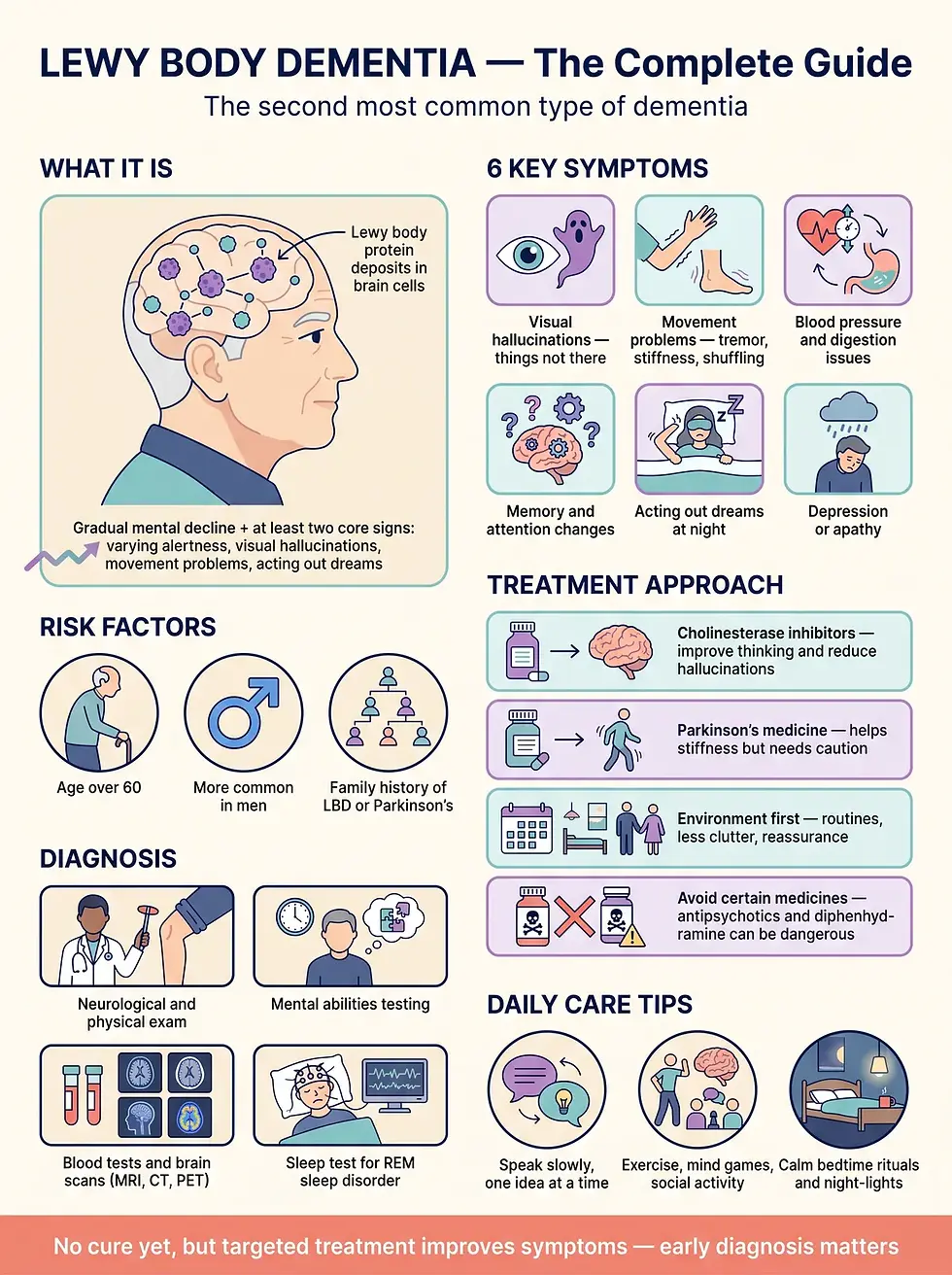
What are the six hallmark signs of Lewy body dementia?
LBD symptoms span the mind, the body, and sleep. Watching for these patterns helps families recognize the condition early.
1. Visual Hallucinations
Seeing things that aren't there may be one of the first symptoms of LBD. Hallucinations often occur regularly and may involve seeing shapes, animals, or people. Hallucinations involving sounds, smells, or touch are also possible.
2. Movement Symptoms
Signs of Parkinson's disease commonly appear: slowed movement, rigid muscles, tremor, or a shuffling walk. These movement problems can cause the person to fall.
3. Poor Regulation of Body Functions
LBD can affect the autonomic nervous system — the part that controls automatic body functions such as blood pressure, heart rate, sweating, and digestion. The results include sudden blood pressure drops when standing, dizziness, falls, loss of bladder control, and constipation.
4. Cognitive Changes
Thinking changes similar to Alzheimer's disease may appear, including confusion, poor attention, visual-spatial problems (trouble judging distance and space), and memory loss.
5. Sleep and Alertness Problems
Two patterns stand out. First, REM sleep behavior disorder causes people to physically act out their dreams — punching, kicking, yelling, or screaming while asleep. Second, attention varies from moment to moment: episodes of drowsiness, long periods of staring into space, long daytime naps, and disorganized speech.
6. Depression or Apathy
Some people with LBD develop depression or lose motivation, losing interest in activities they once enjoyed.
What causes Lewy body dementia, and who is at risk?
The cause of LBD is a buildup of proteins called Lewy bodies in brain nerve cells. The same protein is associated with Parkinson's disease, and people with Lewy bodies may also carry the plaques and tangles tied to Alzheimer's disease.
Three factors appear to raise the risk of developing LBD:
Risk Factor | Details |
Age | People older than 60 have a higher risk |
Sex | LBD affects more men than women |
Family history | Greater risk if a family member has LBD or Parkinson's disease |
What are the complications and outlook for Lewy body dementia?
LBD is progressive — it gradually gets worse over time. As symptoms advance, the disease can lead to:
Worsening dementia and thinking decline.
Aggressive behavior and depression.
Increased risk of falling and injury, driven by movement problems and blood pressure drops.
Worsening movement symptoms, such as tremors.
Death, on average about 7 to 8 years after symptoms start.
Early recognition and treatment planning help families prepare and keep quality of life as high as possible for as long as possible.
How is Lewy body dementia diagnosed?
No single test can diagnose LBD. Doctors build the diagnosis from symptoms and by ruling out other conditions.
The Diagnostic Criteria
A person is diagnosed with LBD when they show a gradual decline in thinking ability plus at least two of the following:
Varying alertness and thinking function.
Repeated visual hallucinations.
Movement symptoms.
REM sleep behavior disorder — acting out dreams during sleep.
Additional features that support the diagnosis include autonomic nervous system problems and unusual sensitivity to antipsychotic medicines (especially haloperidol). Because antipsychotics can make LBD symptoms worse, they are generally avoided.
The Tests Involved
Test | What It Checks |
Neurological and physical exam | Reflexes, strength, walking, muscle tone, eye movements, balance, sense of touch — looking for signs of Parkinson's disease, stroke, tumors, or other conditions |
Mental abilities test | A short form (under 10 minutes) detects cognitive impairment; longer multi-hour tests help identify LBD specifically |
Blood tests | Rule out physical causes of brain function changes, such as vitamin B-12 deficiency or an underactive thyroid |
Brain scans (MRI/CT) | Look for stroke, bleeding, or tumors; imaging can suggest whether someone has Alzheimer's or LBD |
PET or SPECT imaging | Used when the diagnosis is unclear; fluorodeoxyglucose PET assesses brain function, and reduced dopamine transporter uptake supports an LBD diagnosis |
Sleep test (polysomnogram) | Checks for REM sleep behavior disorder |
Autonomic function test | Confirms whether heart rate, blood pressure, and other automatic functions are unstable |
Emerging biomarkers | Tests detecting alpha-synuclein protein clumps in cerebrospinal fluid (via spinal tap) or skin samples; available but not yet widely used, with potential for earlier diagnosis |
How is Lewy body dementia treated?
There is no cure for Lewy body dementia, but many symptoms can improve with targeted treatments.
Part 1: Medicines
Cholinesterase inhibitors — medicines also used for Alzheimer's disease — increase levels of neurotransmitters, the brain's chemical messengers important for memory, thought, and judgment. Options include rivastigmine (Exelon), donepezil (Aricept, Adlarity), and galantamine (Zunveyl). They may improve alertness and thinking and reduce hallucinations and behavioral symptoms. Side effects can include stomach upset, muscle cramps, more frequent urination, and an increased risk of certain cardiac arrhythmias. For moderate or severe dementia, memantine (Namenda) may be added.
Parkinson's disease medicine — carbidopa-levodopa (Sinemet, Duopa) — can reduce rigid muscles and slow movement, but it may also increase confusion, hallucinations, and delusions.
Medicines to avoid matter enormously in LBD. Do not take sleep aids containing diphenhydramine (found in Advil PM, Aleve PM) or urinary urgency medicines such as oxybutynin (Oxytrol), which can worsen memory. Sedatives and sleeping medicines should be limited.
A critical safety warning: antipsychotic medicines can cause very bad confusion, movement symptoms, sedation, and sometimes death in people with LBD. Very rarely, certain second-generation antipsychotics (such as quetiapine or clozapine) are prescribed short-term at a low dose — and only if the benefits clearly outweigh the risks.
Part 2: Non-Medicine Therapies
Because antipsychotics are risky in LBD, other approaches are tried first:
Tolerate the behavior. Some people aren't distressed by their hallucinations — in that case, the side effects of treatment can be worse than the hallucinations themselves.
Modify the environment. Reducing clutter and noise makes daily function easier. Caregivers' responses sometimes worsen behavior: avoid correcting and quizzing the person, and offer reassurance and validation of their concerns instead.
Create daily routines and keep tasks simple. Break tasks into easier steps, focus on successes rather than failures, and lean on structure — it makes the day less confusing.
Part 3: Lifestyle and Daily Care
Caregivers and care partners can adapt the home to reduce symptoms:
Speak clearly and simply. Maintain eye contact, use slow simple sentences, present one idea or instruction at a time, and use gestures like pointing.
Encourage exercise. Exercise improves physical function, behavior, and depression, and some research suggests it might slow cognitive decline.
Provide mind stimulation. Games, crosswords, and thinking activities — plus creative outlets like painting, singing, or music — may help slow mental decline.
Create social opportunities. Conversations with friends and participation in religious services keep the person engaged.
Establish bedtime rituals. Behavior symptoms often worsen at night; build calming evening routines without TV or busy activity, and leave night-lights on to prevent disorientation.
Manage daytime habits. Limit caffeine, discourage daytime naps, and offer daytime activities to prevent nighttime restlessness.
Complementary approaches can also promote relaxation and ease frustration — including music therapy, pet therapy, aromatherapy, and massage therapy.
How can families cope with Lewy body dementia and find support?
People with LBD often experience a mixture of emotions: confusion, frustration, anger, fear, grief, and depression about the future. The best support is listening, offering assurance that life can still be enjoyable, and helping the person retain dignity and self-respect.
As a caregiver, watch the person closely for falls, loss of consciousness, and bad reactions to medicines, and provide reassurance during confusion, delusions, or hallucinations.
Looking After Yourself
Caregiving is exhausting, physically and emotionally — and burnout is real. Protect yourself by:
Asking friends and family for help when you need it; consider in-home health services.
Exercising regularly and eating a healthy diet.
Learning about the disease — ask healthcare professionals and social workers your questions.
Joining a support group. Local agencies on health or aging can connect you to support groups, resources, home care agencies, supervised living facilities, help lines, and educational seminars.
How should you prepare for a Lewy body dementia appointment?
Symptoms are usually discussed first with a primary healthcare professional, who may refer you to a neurologist — a doctor trained in brain and nervous system conditions — or another dementia specialist. When preparing, bring a complete list of medicines, a description of symptoms and when they began, and a family member who has observed the changes.
What are common questions about Lewy body dementia?
Common questions about Lewy body dementia cover what it is, its first signs, how it differs from Alzheimer's disease, its causes and how it is diagnosed.
What is Lewy body dementia?
Lewy body dementia (LBD) is the second most common type of dementia after Alzheimer's disease. It is caused by abnormal protein deposits called Lewy bodies that build up in brain nerve cells, affecting the regions involved in thinking, memory, and movement.
What are the first signs of Lewy body dementia?
Visual hallucinations — seeing shapes, animals, or people that aren't there — may be one of the first symptoms. Movement problems resembling Parkinson's disease, fluctuating alertness, and acting out dreams during sleep are also hallmark early signs.
How is Lewy body dementia different from Alzheimer's disease?
LBD typically presents with visual hallucinations, movement symptoms, fluctuating alertness, and REM sleep behavior disorder, while Alzheimer's primarily starts with memory loss. Some people with LBD also have the plaques and tangles associated with Alzheimer's.
What causes Lewy body dementia?
The cause is a buildup of proteins called Lewy bodies in brain nerve cells — the same protein associated with Parkinson's disease. Risk is higher in people over 60, in men, and in those with a family history of LBD or Parkinson's disease.
How is Lewy body dementia diagnosed?
There is no single test. Diagnosis requires a gradual decline in thinking plus at least two core signs — varying alertness, repeated visual hallucinations, movement symptoms, or REM sleep behavior disorder — supported by neurological exams, blood tests, brain scans, and sometimes sleep tests.
Is there a cure for Lewy body dementia?
No cure exists, but many symptoms improve with treatment. Cholinesterase inhibitors can sharpen thinking and reduce hallucinations, Parkinson's medicines ease movement problems, and environmental strategies reduce daily confusion.
Which medicines should people with LBD avoid?
Antipsychotic medicines can cause severe confusion, movement symptoms, sedation, and sometimes death in LBD and are generally avoided. Sleep aids containing diphenhydramine and certain urinary medicines such as oxybutynin can also worsen memory and should be discussed with a healthcare professional.
Conclusion
Lewy body dementia is a distinctive disease — part memory disorder, part movement disorder, part sleep disorder. Three lessons anchor this guide:
The symptoms are a pattern, not one event: visual hallucinations, Parkinson's-like movement problems, fluctuating alertness, and dream enactment together point to LBD rather than Alzheimer's.
Medicine choices demand extra care: antipsychotics can be dangerous in LBD, and even common over-the-counter sleep aids can worsen memory — always review medicines with a healthcare professional.
Families are part of the treatment: clear communication, daily routines, exercise, mind stimulation, calm evenings, and caregiver self-care all measurably improve daily life.
Because LBD is frequently confused with Alzheimer's or Parkinson's alone, an accurate diagnosis matters more here than almost anywhere. Our complete guide to Alzheimer's disease explains the most common form of dementia side by side with what you've learned here. Explore more condition guides at rinnit.com.
What are your next steps after reading about Lewy body dementia?
Read a related guide: Confused about how LBD compares with Alzheimer's? See our Alzheimer's disease complete guide.
Share your thoughts: Have you cared for someone with Lewy body dementia? Tell us in the comments — your experience may help another family.
Stay updated: Sign up on rinnit.com to get notified when new complete condition guides are published.
Disclaimer: This article is for informational purposes only and is not a substitute for professional medical advice, diagnosis, or treatment. Always consult a qualified healthcare provider about any medical condition.
Related Reading
SAGE Test: How the Self-Administered Memory Screen Works and What Scores Mean explains the self-administered screening test for early memory and thinking problems.
References
Mayo Clinic Staff. Lewy body dementia - Symptoms and causes. Mayo Clinic. June 21, 2025. https://www.mayoclinic.org/diseases-conditions/lewy-body-dementia/symptoms-causes/syc-20352025
Mayo Clinic Staff. Lewy body dementia - Diagnosis and treatment. Mayo Clinic. June 21, 2025. https://www.mayoclinic.org/diseases-conditions/lewy-body-dementia/diagnosis-treatment/drc-20352030
Wang HF, et al. Efficacy and safety of cholinesterase inhibitors and memantine in cognitive impairment in Parkinson's disease, Parkinson's disease dementia, and dementia with Lewy bodies: systematic review with meta-analysis and trial sequential analysis. J Neurol Neurosurg Psychiatry. 2015;86(2):135-43. PMID 24828899. https://doi.org/10.1136/jnnp-2014-307659
Galbiati A, et al. The risk of neurodegeneration in REM sleep behavior disorder: A systematic review and meta-analysis of longitudinal studies. Sleep Med Rev. 2018;43:37-46. PMID 30503716. https://doi.org/10.1016/j.smrv.2018.09.008
Liang CS, et al. Mortality rates in Alzheimer's disease and non-Alzheimer's dementias: a systematic review and meta-analysis. Lancet Healthy Longev. 2021;2(8):e479-e488. PMID 36097997. https://doi.org/10.1016/S2666-7568(21)00140-9



Comments