Neuropsychological Testing: What It Is, Why It's Done, What to Expect and Results

Updated: 2 days ago
Written and medically reviewed by Dr. Baraa Alnahhal, MD · Last reviewed: November 2026 · How we review
Quick Answer: What is neuropsychological testing?
Neuropsychological testing is a set of paper, puzzle and computer tasks that shows how well the brain handles thinking, memory, language, attention, mood and behavior. Providers use it to sort out the cause of memory or thinking problems and measure strengths and weaknesses after a brain injury or stroke. The tests take several hours, and you receive a written report.
What the research says
Thinking and memory tests can predict who with mild cognitive impairment will develop Alzheimer's-type dementia. A meta-analysis of 28 studies with 2,365 people tested 61 neuropsychological measures over an average of 31 months; many domains reached sensitivity and specificity of 0.7 or higher, and verbal memory tests and broad test batteries were among the most accurate. (Belleville et al., Neuropsychology Review, 2017) [2]
Testing before and after epilepsy surgery helps show what may change. A systematic review of 23 studies found verbal memory declined in 44% of people after left-sided temporal surgery, compared with 20% after right-sided surgery, while 27% of people with left-sided surgery improved in verbal fluency. (Sherman et al., Epilepsia, 2011) [3]
Digital memory tasks are showing promise as a screening add-on. In a meta-analysis of six studies with 510 participants, digital episodic memory tasks identified amnestic mild cognitive impairment with a pooled sensitivity of 0.78 and specificity of 0.79, though the authors say more validation is needed before routine use. (Moura et al., Neuroscience and Biobehavioral Reviews, 2026) [4]
Key takeaways
Neuropsychological testing measures many thinking skills, including memory, attention, language, reasoning, planning and visuospatial skills, along with mood and personality [1].
It does not diagnose a condition on its own, but it gives your care team information to help diagnose and manage conditions such as dementia, stroke, epilepsy and brain injury [1].
Testing usually takes several hours and involves answering questions, solving puzzles, drawing, writing and doing computer tasks [1].
No one fails these tests; the goal is to map your strengths and weaknesses, so giving your best effort leads to the most useful results [1].
Your scores are compared with people of the same age, and sometimes the same education level [1].
A written report with findings and recommendations usually arrives in about two weeks [1].
What is neuropsychological testing?
Neuropsychological testing is a group of tests that helps your healthcare providers understand how your brain is working [1].
A neuropsychologist is a psychologist with special training in how brain health connects to thinking, behavior and mood. This specialist interprets your results [1].
The tests look at everyday mental skills that can be hard to measure in a short office visit. Together, they create a detailed picture of how you think, learn and process information [1].
What skills does it test?
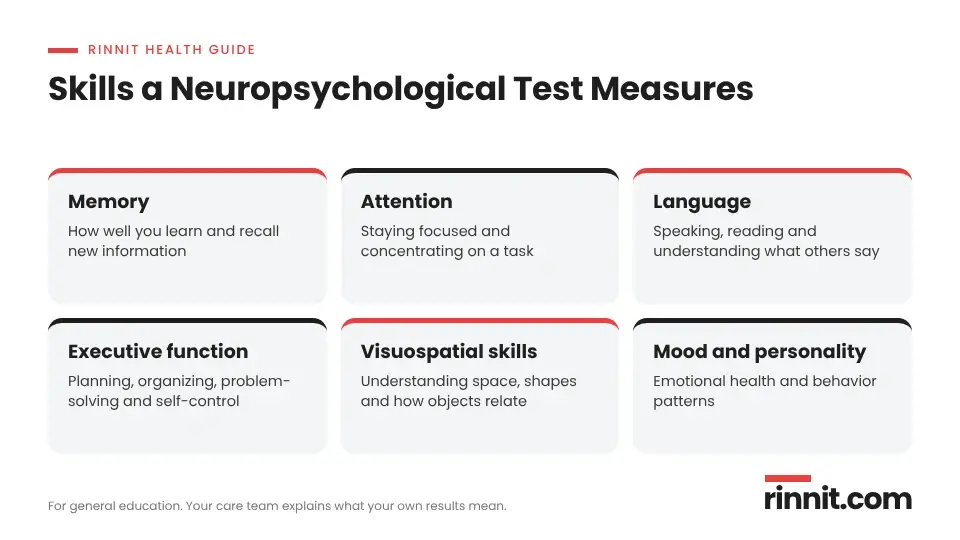
Testing covers a wide range of skills to build a full picture of brain function.
Testing can cover many areas of thinking. The table below shows the main skills and what each one involves [1].
Skill area | What it covers |
General intellect | Overall thinking ability |
Reading | Reading and understanding written text |
Language | Using words and understanding speech |
Attention and concentration | Staying focused on a task |
Processing speed | How quickly you take in and respond to information |
Learning and memory | Taking in, storing and recalling new information |
Reasoning | Thinking through problems logically |
Executive functions | Planning, organizing, time management, problem-solving, multitasking, judgment and self-control |
Visuospatial skills | Understanding space and how objects relate, such as when drawing |
Fine motor skills | Small, precise hand movements |
Mood and personality | Emotional health and behavior |
Sources: [1]
Why is neuropsychological testing done?
Providers use neuropsychological testing for several reasons [1]:
To help find a diagnosis. It can help tell the difference between normal aging and thinking changes caused by a neurological illness, depression, anxiety or another problem [1].
To find your strengths and weaknesses. This is helpful after a stroke or traumatic brain injury [1].
To set a baseline. People who play contact sports or have a family history of dementia may be tested so future results can be compared [1].
To assess risk before brain surgery. Some brain surgeries can affect thinking, and testing helps estimate that risk [1].
To plan treatment. Results can guide therapies such as occupational or speech therapy and suggest changes at school or work [1].
What conditions can it help with?
The testing itself does not diagnose a condition. Instead, it gives your care team information that helps them diagnose and manage problems such as [1]:
Who may need neuropsychological testing?
A neurologist or primary care provider may suggest testing if you or a loved one notices changes in thinking, memory or behavior [1].
Area of change | Examples |
Personality and mood | Unexplained personality changes, new or worse anxiety or depression, delusions or hallucinations |
Memory | Short-term memory changes, such as asking the same question again and again |
Communication | Trouble speaking, finding words, communicating or interacting with others |
Visual and spatial skills | Difficulty drawing or reading a map, getting lost often |
Daily tasks | Losing things often, new trouble managing bills or money, trouble staying organized or finishing tasks |
Thinking and judgment | Poor attention, concentration, judgment or decision-making |
Recognition | Trouble recognizing people you know well |
Sources: [1]
How should you prepare for neuropsychological testing?
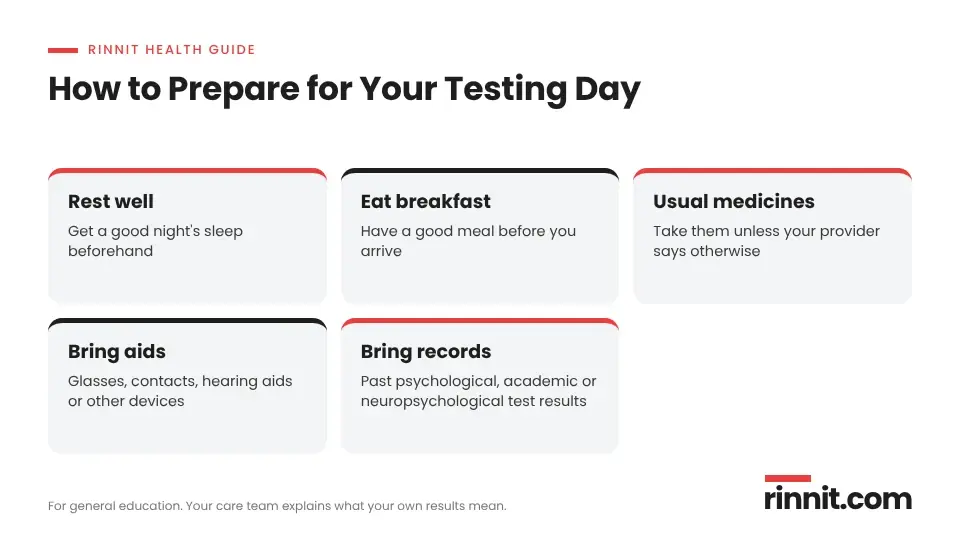
Simple steps before your appointment help your results reflect how you really think.
A little planning helps you do your best on testing day [1].
Get a good night's sleep before your appointment [1].
Eat a good breakfast [1].
Take your usual medicines unless your provider tells you otherwise [1].
Bring your glasses, contact lenses, hearing aids or any other assistive devices you use [1].
Bring records of any past neuropsychological, psychological or academic testing, such as intellectual, psychoeducational or multifactored evaluations [1].
If your child has an Individualized Education Program (IEP), bring a copy [1].
Before the appointment, the neuropsychologist may ask you to fill out surveys about your mood and any psychological symptoms. For a child, a parent or guardian usually completes questionnaires about the child's behavior [1].
What happens during neuropsychological testing?
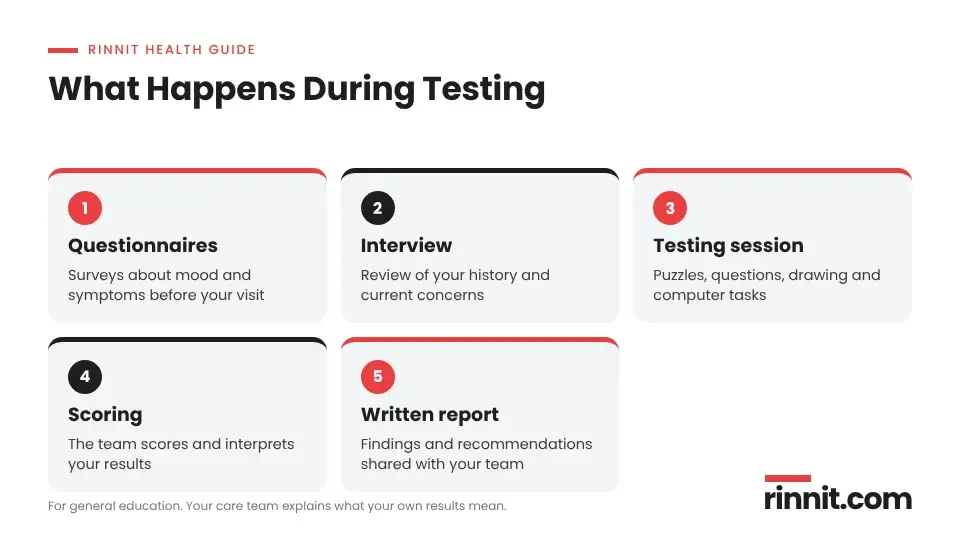
The process moves from talking about your concerns to testing, scoring and a detailed report.
Testing usually follows a few clear steps [1].
The intake interview
First, the provider talks with you about your concerns. They review your medical, psychological, school and work history [1].
With your permission, they may also talk with a family member. When a child is tested, the provider may interview both the child and a parent [1].
The testing session
A psychometrist, a trained technician who works under a neuropsychologist's supervision, gives you the tests [1].
The tests look at memory, thinking, verbal communication and motor skills. You may write or draw, solve puzzles, answer questions and respond to items shown on a computer [1].
Some tasks feel easy and others feel hard. You are not expected to get every answer right, and no one fails. Putting in your full effort gives the most accurate picture [1].
How long does it take?
Testing usually takes several hours [1].
After the session, the healthcare team scores and interprets your results [1].
What are the risks of neuropsychological testing?
Neuropsychological testing has essentially no risks [1].
Because testing often lasts several hours, you may feel tired, overstimulated or agitated afterward. It can help to plan an easy dinner for that evening [1].
Children may have less energy for the rest of the day [1].
What do neuropsychological test results mean?
Most of the tests are standardized, which means everyone takes them in the same way [1].
Your results are norm-referenced. This means your scores are compared with people of the same age, and sometimes people with similar education [1].
Your written report
The neuropsychologist writes a detailed report that describes [1]:
The neuropsychologist does not give a diagnosis. With your permission, the report goes to your healthcare team, who use it along with other information to guide your care [1].
When will you get results?
Scoring, interpreting and writing recommendations usually takes a couple of weeks [1].
What happens after neuropsychological testing?
Your healthcare team reviews the report with you and uses it to plan next steps, such as therapies or other interventions [1].
For a child, the results can help parents, teachers and providers better understand how the child thinks and behaves [1].
It is normal to feel worried while you wait for results. The information helps you and your care team decide what comes next [1].
Conclusion
Neuropsychological testing gives a detailed look at how your brain handles memory, attention, language, planning and mood. It can help your care team tell normal aging apart from other causes of thinking changes, and it can guide treatment after a stroke, brain injury or other condition.
The tests take several hours but carry essentially no risk. Getting good rest, bringing your usual aids and giving your best effort will help your results be as useful as possible.
Keep learning: Read our plain-language guide to mild cognitive impairment or our guide to Alzheimer's disease symptoms, causes and treatment. For more background, see the MedlinePlus dementia page.
FAQ
What is neuropsychological testing?
It is a group of tests that measures thinking skills such as memory, attention, language and problem-solving, along with mood and behavior, to show how well your brain is working.
Why would my doctor order neuropsychological testing?
Your provider may order it to find the cause of memory or thinking changes, measure skills after a stroke or brain injury, assess risk before brain surgery or plan treatment.
Does neuropsychological testing hurt?
No. Testing involves answering questions, solving puzzles, drawing, writing and using a computer. Nothing is painful, though the long session can feel tiring.
How long does neuropsychological testing take?
Testing usually takes several hours. Your provider will tell you how long to plan for, and you may get breaks during the session.
How do I prepare for neuropsychological testing?
Sleep well, eat breakfast, take your usual medicines unless told otherwise, and bring glasses, hearing aids and records of any past testing.
Can you fail a neuropsychological test?
No. No one fails. The tests are meant to show your strengths and weaknesses, so doing your best gives the most accurate results.
Who gives the tests?
A trained technician called a psychometrist usually gives the tests, under the supervision of a neuropsychologist who interprets the results.
How are the results scored?
Most tests are standardized, and your scores are compared with people your age and sometimes people with similar education.
Does neuropsychological testing diagnose dementia?
Not by itself. It gives your care team detailed information that they combine with other findings to diagnose and manage conditions such as dementia.
When will I get my results?
Results usually take a couple of weeks. You will receive a written report with your strengths, weaknesses and recommendations.
Related Reading
Alzheimer's Disease: Symptoms, Causes, Treatment & Complete Guide explains a common condition that neuropsychological testing helps identify and track.
What Is Mild Cognitive Impairment? A Plain-Language Guide to the In-Between Stage of Memory Loss covers the memory and thinking changes that often lead to a referral for testing.
ADHD: Complete Guide to Symptoms, Causes, Diagnosis & Treatment explains a condition where attention and executive function testing can support diagnosis.
Traumatic Brain Injury: Symptoms, Emergency Signs, Diagnosis and Recovery covers brain injuries where testing helps map strengths and weaknesses during recovery.
Concussion: What It Is, What It Feels Like, and How to Recover Safely explains why athletes in contact sports may get baseline testing.
Learning Disabilities: Identifying Signs, Types, and Support Strategies covers how testing results can shape school support for children.
Epilepsy: Seizures, Symptoms, Causes, and Treatment explains a condition where testing helps plan care and assess risk before brain surgery.
Wada Test: Finding Language and Memory Before Brain Surgery explains the test that shows which side of the brain controls language and memory.
References
Cleveland Clinic. Neuropsychological Testing: What It Is, Purpose & Procedure. Cleveland Clinic. Last updated November 21, 2023. https://my.clevelandclinic.org/health/diagnostics/4893-neuropsychological-testing-and-assessment
Belleville S, Fouquet C, Hudon C, et al. Neuropsychological Measures that Predict Progression from Mild Cognitive Impairment to Alzheimer's type dementia in Older Adults: a Systematic Review and Meta-Analysis. Neuropsychol Rev. 2017;27(4):328-353. PMID 29019061. https://doi.org/10.1007/s11065-017-9361-5
Sherman EM, Wiebe S, Fay-McClymont TB, et al. Neuropsychological outcomes after epilepsy surgery: systematic review and pooled estimates. Epilepsia. 2011;52(5):857-869. PMID 21426331. https://doi.org/10.1111/j.1528-1167.2011.03022.x
Moura AR, Magalhães D, Dos Santos C, et al. Digital episodic memory tools for the identification of amnestic mild cognitive impairment: A systematic review and an exploratory meta-analysis. Neurosci Biobehav Rev. 2026;187:106756. PMID 42190978. https://doi.org/10.1016/j.neubiorev.2026.106756
Medical disclaimer
This article is for general education only and does not replace advice from a qualified healthcare professional. Talk to your doctor about your own diagnosis and treatment, and seek emergency care right away for severe or sudden symptoms.



Comments