Wada Test: Finding Language and Memory Before Brain Surgery

Updated: 3 days ago
Written and medically reviewed by Dr. Baraa Alnahhal, MD · Last reviewed: November 2026 · How we review
Quick Answer
The Wada test (intracarotid amobarbital test) is a test done before epilepsy or brain tumor surgery to find out which side of the brain controls language and how much each side supports memory. Medicine injected through a catheter puts one side of the brain to sleep for a few minutes while you're tested. Serious complications are rare.
What the research says
fMRI often agrees with the Wada test: in 229 people with epilepsy who had both tests, language dominance on functional MRI matched the Wada test in 86% of cases, with disagreement most common in people with language on both sides of the brain (Janecek JK et al., Epilepsia, 2013) [2]
Serious complications are uncommon: in 431 people who had the Wada test at one center over more than 20 years, 2.1% had a complication such as a seizure or artery spasm, and none had lasting harm (Beimer NJ et al., Epilepsia, 2015) [3]
Key takeaways
Shows which side of the brain handles language and memory.
Done before epilepsy or brain tumor surgery.
Medicine temporarily puts one side of the brain to sleep.
You're awake; it takes about 3–4 hours.
Generally safe; most people go home the same day.
Why is it done?
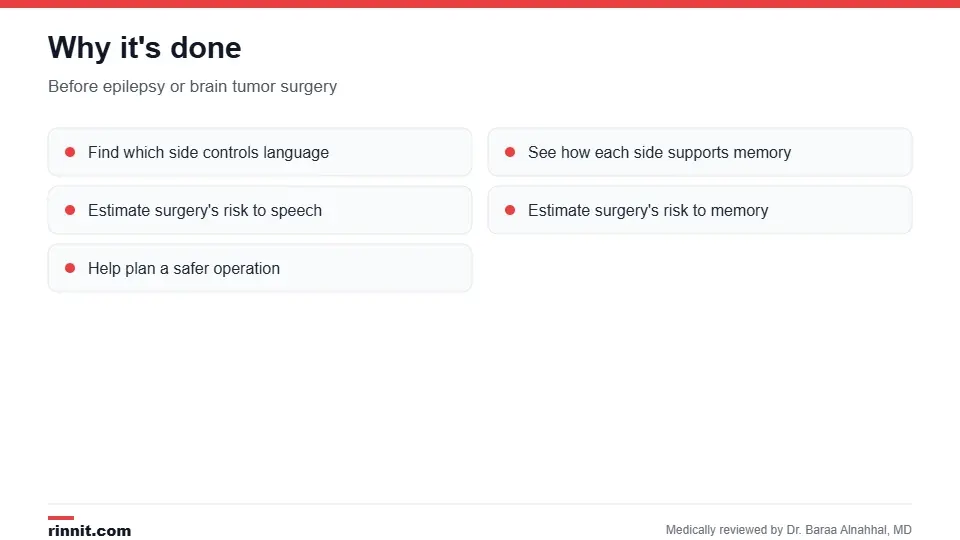
The Wada test helps protect speech and memory during surgery.
To find which hemisphere controls language. The left side does in most people, but not always, especially in left-handed people.
To see how much each side supports memory.
To help the surgeon judge whether epilepsy surgery, such as surgery for temporal lobe seizures, could affect speech or memory. Sources: [1, 2]
Alternatives include functional MRI, transcranial magnetic stimulation and neuropsychological testing. Other brain mapping tests include MEG. Sources: [1, 2]
How do I prepare?
You may need to stop aspirin, NSAIDs and blood thinners up to two weeks before.
Tell your team about medicine allergies.
On the day, you'll change into a gown, the groin is shaved and EEG electrodes are placed on your scalp. Sources: [1]
What happens during the test?
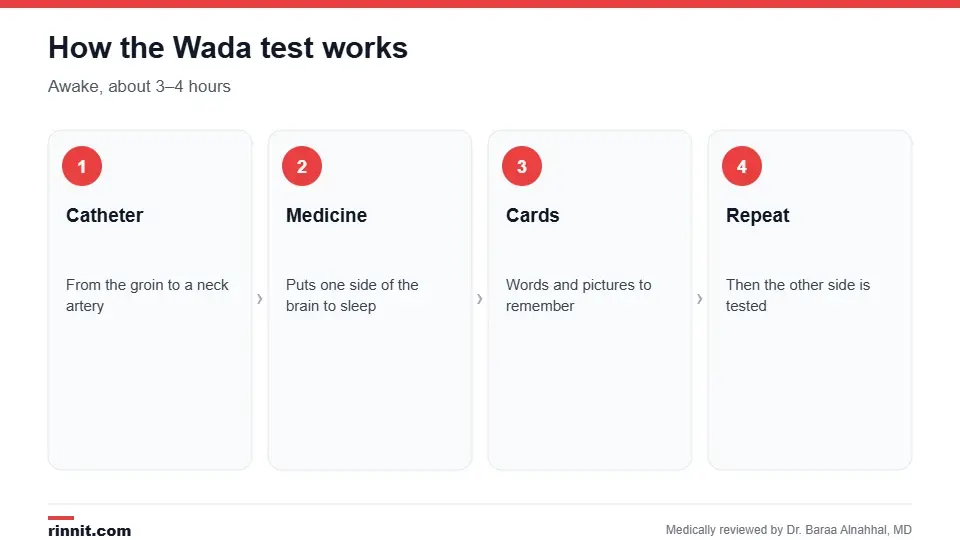
You're awake throughout the Wada test.
A cerebral angiogram checks blood flow first.
After numbing, a catheter is passed from a leg artery up to a carotid artery; you may feel warmth or a metallic taste.
Medicine is injected to put one side of the brain to sleep briefly; you may have weakness on the opposite side of your body or trouble speaking.
You're shown word and picture cards while EEG confirms that side is asleep.
When the medicine wears off, you're asked what you remember.
After a rest, the other side is tested the same way. Sources: [1]
A team including an epileptologist, an interventional neuroradiologist and a neuropsychologist carries out the test, which usually takes about three to four hours. Sources: [1]
Recovery and risks

Most people go home the same day.
Afterward, staff check your leg pulse, groin bandage and leg feeling. Most people go home the same day and avoid strenuous activity for 24–48 hours. The most common side effect is soreness at the catheter site. Rare complications include seizure, confusion (encephalopathy), stroke, bleeding and infection; risk is somewhat higher in people 65 or older or with artery disease. Sources: [1, 3]
The test may be less useful in children under 10, in people with an IQ below 70, or if seizures happen during testing. Sources: [1]
Understanding your results
Results show which side of your brain is dominant for language and which supports memory. Your team compares this with where your seizures start to decide whether surgery carries extra risk to speech or memory. Sources: [1, 2]
Conclusion
The Wada test helps make brain surgery safer by showing where language and memory live in your brain. Although it's invasive, it's generally safe and gives your surgical team important information.
Keep learning: read about epilepsy surgery and functional MRI.
Frequently asked questions
What is the Wada test?
A test that shows which side of the brain controls language and memory.
Why is it done?
To plan epilepsy or brain tumor surgery safely.
Am I awake during the test?
Yes.
Does it hurt?
The groin is numbed; you may feel warmth or pressure.
How long does it take?
About three to four hours.
Can I go home the same day?
Usually, yes.
What are the risks?
Groin soreness is common; seizure, stroke or bleeding are rare.
Is there an alternative?
Functional MRI or other mapping tests may be options.
Can children have it?
Yes, if they're old enough to talk and follow the test.
What happens after?
Avoid strenuous activity for 24–48 hours.
Related Reading
Epilepsy Surgery: Types, Tests, Risks, Recovery, and Success Rates surgery the Wada test helps plan.
Functional MRI (fMRI): What It Shows, How It Works and How to Prepare a noninvasive alternative for language mapping.
Temporal Lobe Seizures: Symptoms, Causes, Diagnosis, and Treatment seizures often treated with surgery.
Neuropsychological Testing: What It Is, Why It's Done, What to Expect and Results memory and thinking tests before surgery.
Cerebral Angiogram: What It Shows, How to Prepare, What to Expect, Risks and Recovery the artery imaging done during the test.
References
Cleveland Clinic. Wada Test: What It Is, Purpose, Procedure & Side Effects. Cleveland Clinic. Last updated March 8, 2024. https://my.clevelandclinic.org/health/diagnostics/17628-wada-test
Janecek JK, Swanson SJ, Sabsevitz DS, et al. Language lateralization by fMRI and Wada testing in 229 patients with epilepsy: rates and predictors of discordance. Epilepsia. 2013;54(2):314-322. PMID 23294162. https://doi.org/10.1111/epi.12068
Beimer NJ, Buchtel HA, Glynn SM. One center's experience with complications during the Wada test. Epilepsia. 2015;56(8):e110-e113. PMID 26046456. https://doi.org/10.1111/epi.13046
Medical disclaimer
This article is for general education only and does not replace advice from a qualified healthcare professional. Talk to your doctor about your own diagnosis and treatment, and seek emergency care right away for severe or sudden symptoms.



Comments