Epilepsy Surgery: Types, Tests, Risks, Recovery, and Success Rates

Updated: 6 days ago
Written and medically reviewed by Dr. Baraa Alnahhal, MD · Last reviewed: October 2026 · How we review
Quick Answer
Epilepsy surgery is brain surgery that stops or reduces seizures, or makes them less severe, when anti-seizure medicines and other treatments have not controlled them. Surgeons may remove, disconnect or destroy the brain tissue where seizures start, or implant a device that interrupts seizure signals. It does not cure epilepsy, but it may significantly improve quality of life. [1]
What the research says
Surgery improved daily life far more often than medicine alone. In a randomized trial of 80 people with temporal lobe epilepsy, 62% of the surgery group reached a meaningful quality-of-life improvement at 6 months, compared with 17% of the medicine-only group. Only two people needed surgery for one extra person to benefit. (Fiest et al., Epilepsia, 2014)
Laser ablation is gentler, while open surgery is slightly more likely to stop seizures. A review of 11 studies (389 laser and 557 open-surgery patients) found complete seizure freedom in 68.1% after open surgery and 53.7% after laser therapy, a difference that did not reach statistical significance. Laser patients had fewer complications (18.3% vs 30.0%) and half the hospital stay (3.4 vs 6.8 days). (Maroufi et al., Journal of Neurosurgery, 2026)
Evaluation should start after two medicines fail. A systematic review of 384 surgical studies recommends a surgical evaluation as soon as someone has not responded to two anti-seizure medicines, and says a low seizure frequency should not be a barrier. (Kwon et al., Epilepsy Research, 2016)
Key takeaways
Surgery is not the first treatment for epilepsy. It is considered when medicines, diet changes or other options have not worked, or when side effects outweigh benefits.
There are four main approaches: removing, disconnecting or destroying seizure tissue, or implanting a stimulating device.
Detailed testing comes first to find where seizures start and to protect speech, memory and movement.
Most people return to daily activities in 4 to 6 weeks and to work or school in 1 to 3 months. Full results take about 2 years.
Results vary. More than 85% of people who have temporal lobe resection see a large drop in seizures. [3]
What is epilepsy surgery?
Epilepsy surgery is brain surgery that aims to stop seizures or reduce how often they happen and how severe they are. [1]
Seizures are bursts of abnormal electrical activity between nerve cells in the brain. They can change your awareness, behavior, emotions, muscle control and sensations. [1]
Surgery does not cure epilepsy, and there is no guarantee of being seizure-free after waking up. Even so, it may significantly improve quality of life, and every person's outcome is different. [1]
Who is a candidate for epilepsy surgery?
Epilepsy surgery is considered for people whose seizures are not controlled by standard treatments or are caused by a fixable brain problem. [1] A doctor may suggest it when:
Situation | What it means |
Medicines do not control seizures | Anti-seizure medications have not stopped the seizures |
Side effects outweigh benefits | The medicine causes more harm than help |
Other treatments failed | Options like the ketogenic diet did not work |
A structural cause exists | A brain tumor or arteriovenous malformation is causing the seizures |
Daily life is affected | Frequent seizures make it hard to function day to day |
A surgeon may decide not to operate on a brain area that controls vital functions such as memory, movement or thinking. In that case, the team will look at other epilepsy treatments instead. [1]
What are the types of epilepsy surgery?
Epilepsy surgery comes in four main types, and the choice depends on where seizures start and what causes them. [1]
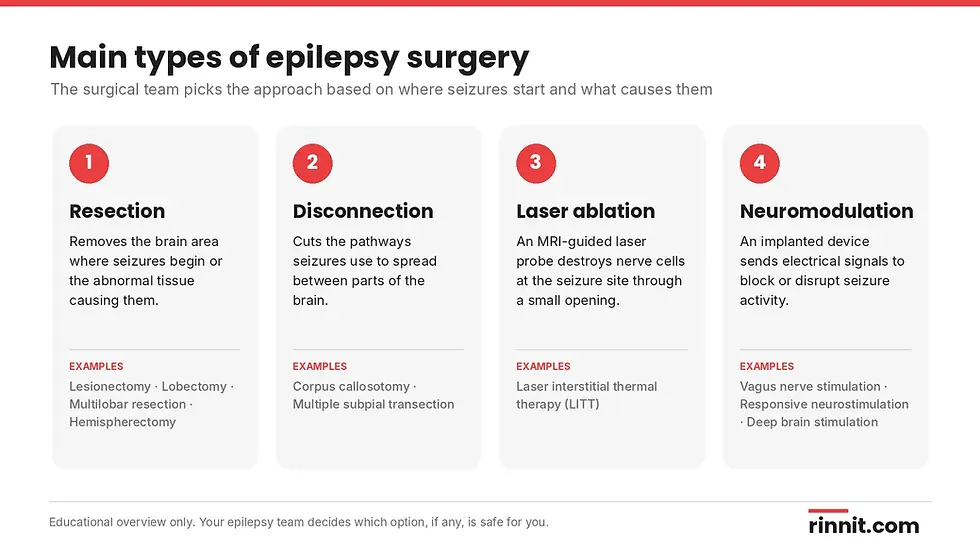
Type | How it works | Examples |
Surgical resection | Removes the brain area where seizures start, or abnormal tissue causing them | Lesionectomy, lobectomy, multilobar resection, hemispherectomy |
Surgical disconnection | Cuts the connections seizures use to spread | Corpus callosotomy, multiple subpial transection |
Laser interstitial thermal therapy (LITT) | An MRI-guided laser probe destroys nerve cells at the seizure site; less invasive than open surgery | Laser ablation |
Neuromodulation | An implanted device and electrodes send electrical signals that block or disrupt seizure activity | Vagus nerve stimulation, responsive neurostimulation, deep brain stimulation |
A fifth procedure, electrode implantation, is used to collect data rather than to treat. Electrodes are placed in or on the brain to record signals, which helps the surgeon plan the best approach. Examples include stereoelectroencephalography and subdural grid implantation. [1]
Hemispherectomy is often discussed for rare conditions such as Rasmussen's encephalitis, while resection is common in temporal lobe seizures. For a wider view of brain procedures, see our guide to brain surgery types and recovery.
What tests are done before epilepsy surgery?
Tests before epilepsy surgery locate where seizures begin, check whether that tissue can be safely treated, map nearby vital functions, and help predict the result. [1]
Testing usually happens in two levels. Phase I uses non-surgical tests, while Phase II needs surgery to place electrodes. [1]

Phase | Test | What it shows |
Phase I | Electroencephalogram (EEG) | Electrical activity in the brain; a hospital video EEG may record an actual seizure, sometimes with a SPECT scan |
Phase I | PET scan | Brain function in all areas; can find where seizures begin even between seizures |
Phase I | Neuropsychological evaluation | Verbal skills, memory and learning, as a baseline for comparison after surgery |
Phase I | Functional MRI | Which brain areas handle tasks like reading and memorizing |
Phase I | Wada test | Which side of the brain is dominant for different functions |
Phase II | Electrode placement | Direct monitoring of brain electrical activity |
Phase II | Stereo-EEG (SEEG) | Electrodes at different depths create a 3D view of seizure start and spread |
Phase II | Subdural grid | Flat electrodes on the brain surface record seizures and test motor or language function |
Phase II | Functional brain mapping | A map that identifies seizure-producing areas |
Most people do not need every test. The surgical team chooses the ones that fit each case. [1]
How should you prepare for epilepsy surgery?
Preparing for epilepsy surgery starts with a meeting where the neurosurgeon explains the procedure, its benefits, risks and recovery, and answers your questions. [1]
At the end of that visit, you sign an informed consent form giving permission for the surgery. Your surgeon will then give instructions that may include: [1]
Details about pre-surgical testing
Changes to current medicines, such as stopping one or starting a new one before surgery
Stopping or cutting back on smoking
Arranging help from loved ones during recovery
What happens during epilepsy surgery?
During epilepsy surgery, you are under general anesthesia while the surgeon opens a small area of the skull and treats the brain tissue where seizures begin. [1]
Preparation. Part of the head is shaved; the hair grows back after healing.
Anesthesia. You sleep through the procedure while the team monitors heart rate, blood oxygen and blood pressure.
Opening. The neurosurgeon removes a small piece of skull and sets it aside. An EEG during surgery may confirm the seizure source.
Awake mapping (sometimes). You may be woken briefly to answer questions, which helps map speech, hearing and movement areas. This step is not painful.
Treatment. After mapping, you go back to sleep and the surgeon treats the target area.
Closing. The bone is replaced and held with small titanium clips, which do not set off metal detectors or airport scanners. The skin is closed and the head bandaged. [1]
How long does epilepsy surgery take?
Epilepsy surgery takes several hours. The exact time depends on what the surgeon needs to do, so your surgeon will give you the best estimate. [1]
What happens after epilepsy surgery?
After epilepsy surgery, you are moved to a hospital area for close observation. You may spend one day in intensive care and three to five days in the hospital after open surgery. [1]
Swelling of the scalp and face, along with headaches, is expected. You will receive medicines for these symptoms, which should fade within a few weeks. Tell your provider if pain is severe or new symptoms appear. [1]
What are the benefits of epilepsy surgery?
The main benefits of epilepsy surgery are fewer seizures or none at all, and a better chance of returning to normal activities. [1]
Possible benefits | Possible risks |
Fewer seizures or becoming seizure-free | Reaction to anesthesia |
Lower dose or fewer anti-seizure medicines | Bleeding |
Better chance of returning to work, driving or activities | Infection |
Lower risk of life-threatening problems such as unexplained death or status epilepticus | Brain tissue damage causing weakness, speech problems or stroke |
Better mental health and emotional well-being | Hydrocephalus (fluid build-up in the brain) |
Slow healing at the surgical site |
What are the risks of epilepsy surgery?
Epilepsy surgery carries the usual risks of any operation, including bleeding and infection, plus risks specific to the brain. [1]
Brain surgery can affect memory, speech, vision and movement, and it may also affect mood. This is why extensive testing comes first: the team works to find exactly where seizures start and to protect the function of nearby brain areas. [1]
How long is recovery after epilepsy surgery?
Recovery after epilepsy surgery takes about four to six weeks for normal daily activities and one to three months before returning to work or school. [1]

Time after surgery | What to expect |
Day 1 | Possible stay in intensive care |
3 to 5 days | Typical hospital stay after open surgery |
A few weeks | Swelling and headaches fade |
4 to 6 weeks | Gradual return to normal daily activities |
1 to 3 months | Return to work or school |
1 year or more seizure-free | Doctor may slowly lower and then stop medicine |
About 2 years | Full results of surgery become clear |
You will keep taking anti-seizure medicines for some time. They protect the brain while it heals and lower the chance of later seizures. [1]
Rehabilitation therapy is usually not needed unless speech, memory or movement has been affected. [1]
What is the success rate of epilepsy surgery?
The success rate of epilepsy surgery depends on the type of surgery and the person, but some procedures produce large drops in seizures. [1]
Procedure | Reported result |
Temporal lobe resection | More than 85% have a large decrease in seizures [3] |
Vagus nerve stimulation | 40% to 50% have fewer seizures, often about half as many as before [2] |
Factors that shape your outcome include: [1]
The type of seizures you have
How often seizures happen and how severe they are
The brain area involved
The type of surgery
Your age
Other health conditions
Ask your neurosurgeon what result you can realistically expect in your situation.
When should you call a doctor after epilepsy surgery?
Call your doctor right away after epilepsy surgery if you develop a fever, or severe pain, swelling or bleeding at the incision site. [1]
Keep every follow-up visit. Regular checkups and imaging scans are needed to monitor healing. [1] If a seizure lasts longer than usual or you are unsure what to do, our guide to tonic-clonic seizure first aid explains when to call emergency services.
Epilepsy surgery at a glance
Question | Short answer |
Who is it for? | People whose seizures are not controlled by medicines or other treatments |
Main types | Resection, disconnection, laser ablation, neuromodulation |
Anesthesia | General; some people are woken briefly for brain mapping |
Surgery length | Several hours |
Hospital stay | About 3 to 5 days for open surgery |
Back to daily life | 4 to 6 weeks |
Back to work or school | 1 to 3 months |
Full results | About 2 years |
Is it a cure? | No, but it may greatly reduce seizures |
Conclusion
Epilepsy surgery is a major decision, but it can be a real turning point when medicines have not controlled seizures. Careful testing finds where seizures start, and the surgical team then chooses the safest approach, from removing tissue to implanting a device. Recovery takes weeks to months, and the full benefit becomes clear over about two years. Your care team stays with you at every step, so ask every question you have.
Next step: Bring these questions to your neurologist: Have I tried enough medicines to count as drug-resistant? Which tests would I need? Which type of surgery fits my seizures? To understand your condition better, explore our guides to epilepsy, focal seizures and frontal lobe seizures. For an independent overview, see the US national neurology institute's epilepsy guide.
FAQ
What is epilepsy surgery?
Epilepsy surgery is brain surgery that aims to stop seizures or reduce how often they happen and how severe they are. It is considered when medicines and other treatments have not worked.
Who qualifies for epilepsy surgery?
People whose seizures are not controlled by anti-seizure medicines, or whose medicine side effects outweigh the benefits, may qualify. Surgery is also considered when a brain tumor or blood vessel malformation causes seizures.
Does epilepsy surgery cure epilepsy?
No. Epilepsy surgery does not cure epilepsy, and being seizure-free is not guaranteed, but it may significantly improve quality of life.
What are the types of epilepsy surgery?
The main types are resection (removing seizure tissue), disconnection (cutting seizure pathways), laser interstitial thermal therapy, and neuromodulation with implanted devices such as vagus nerve stimulation.
How long does it take to recover from epilepsy surgery?
Most people return to normal daily activities in about four to six weeks and to work or school in one to three months. Full results usually take about two years.
Will I still need anti-seizure medicine after surgery?
Yes, at first. Medicines continue while the brain heals, and if you stay seizure-free for a year or more, your doctor may slowly lower and stop them.
What is the success rate of epilepsy surgery?
It depends on the procedure. More than 85% of people who have temporal lobe resection see a large drop in seizures, while 40% to 50% of people with vagus nerve stimulation have fewer seizures.
When should I call my doctor after epilepsy surgery?
Call right away for a fever, or for severe pain, swelling or bleeding at the incision site.
What tests are done before epilepsy surgery?
Tests often include video EEG monitoring, MRI and other brain scans, and memory and thinking tests. They help your team find where seizures start and check that surgery is safe.
What are the risks of epilepsy surgery?
Risks include infection, bleeding, stroke and changes in memory, language, mood or vision, depending on the brain area treated. Your team will explain your personal risks before surgery.
Related Reading
Functional MRI (fMRI): What It Shows, How It Works and How to Prepare explains how functional MRI maps important brain areas before surgery.
SEEG (Stereoelectroencephalography): Finding Where Seizures Start explains the deep-brain electrode test used to find where seizures start.
Magnetoencephalography (MEG): Mapping the Brain Before Epilepsy Surgery explains the magnetic brain scan used to find where seizures start.
Wada Test: Finding Language and Memory Before Brain Surgery explains the test that shows which side of the brain controls language and memory.
References
Cleveland Clinic. Epilepsy Surgery: Types, Procedures, Risks & Results. Cleveland Clinic. Last updated October 15, 2024. https://my.clevelandclinic.org/health/treatments/5015-epilepsy-surgery
American Association of Neurological Surgeons. Epilepsy. AANS Patient Resources. Accessed November 1, 2026. https://www.aans.org/patients/conditions-treatments/epilepsy/
Kiriakopoulos E, Cascino GD, Britton JW. Types of Epilepsy Surgery. Epilepsy Foundation. Last updated August 15, 2024. https://www.epilepsy.com/treatment/surgery/types
Fiest KM, Sajobi TT, Wiebe S. Epilepsy surgery and meaningful improvements in quality of life: results from a randomized controlled trial. Epilepsia. 2014;55(6):886-892. PMID 24735200. https://doi.org/10.1111/epi.12625
Maroufi SF, Fallahi MS, Amirkhani N, et al. Laser interstitial thermal therapy versus open resective surgery for nontumoral epilepsy: systematic review and meta-analysis of comparative studies. J Neurosurg. 2026;144(4):787-798. PMID 41576371. https://doi.org/10.3171/2025.8.JNS25496
Kwon CS, Neal J, Telléz-Zenteno J, et al. Resective focal epilepsy surgery - Has selection of candidates changed? A systematic review. Epilepsy Res. 2016;122:37-43. PMID 26921855. https://doi.org/10.1016/j.eplepsyres.2016.02.007
Medical disclaimer
This article is for general education and does not replace advice from a qualified healthcare professional. Decisions about epilepsy surgery must be made with your neurologist and neurosurgeon, who can assess your individual situation. If someone has a seizure lasting more than five minutes, repeated seizures without recovery, or trouble breathing, call your local emergency number.



Comments