Frontal Lobe Seizures: Symptoms, Causes, and How They're Treated When Medicine Isn't Enough

Updated: 2 days ago
Medically reviewed by Dr. Baraa Alnahhal, MD · Last reviewed: September 2026
Frontal lobe seizures (also called frontal lobe epilepsy) are a common form of epilepsy that begins in the frontal lobe, the brain's large front region that controls movement and thinking. They are caused by clusters of brain cells firing uncontrolled bursts of electrical signals. These seizures are brief — often under 30 seconds, sometimes with immediate recovery — and often happen during sleep, which is why they are frequently mistaken for night terrors or mental illness. Symptoms can include head and eye turning, lost speech, sudden laughing or screaming, fencing-like postures, and repetitive rocking or pedaling motions. Medicine controls many cases, though finding the right drug or combination can take trial and error; when medicine fails, surgery and implanted stimulation devices offer real options. A seizure lasting more than five minutes is a medical emergency — call 911.
Quick Answer
What are frontal lobe seizures? A common form of epilepsy in which electrical bursts start in the frontal lobe, the brain area that controls cognitive functions and voluntary movement.
What do they look like? Head and eye movement to one side, not responding or trouble speaking, explosive screams, laughter or swearing, fencing-like postures, and repetitive rocking, pedaling, or thrusting movements.
How long do they last? Often less than 30 seconds, and sometimes recovery is immediate.
Why are they hard to diagnose? They frequently happen during sleep (mistaken for night terrors or sleep disorders), and their unusual behaviors can resemble mental health conditions.
What causes them? Tumors, stroke, infection, or traumatic injury in the frontal lobes; a rare inherited form causes brief nighttime seizures; in about half of cases, no cause is ever found.
How are they treated? Antiseizure medicines first; if medicine doesn't work, surgery to remove or isolate the seizure's focal point, or implanted stimulation devices (VNS, DBS, or RNS).
When is it an emergency? Any seizure lasting longer than five minutes — call 911 or get emergency medical help immediately.
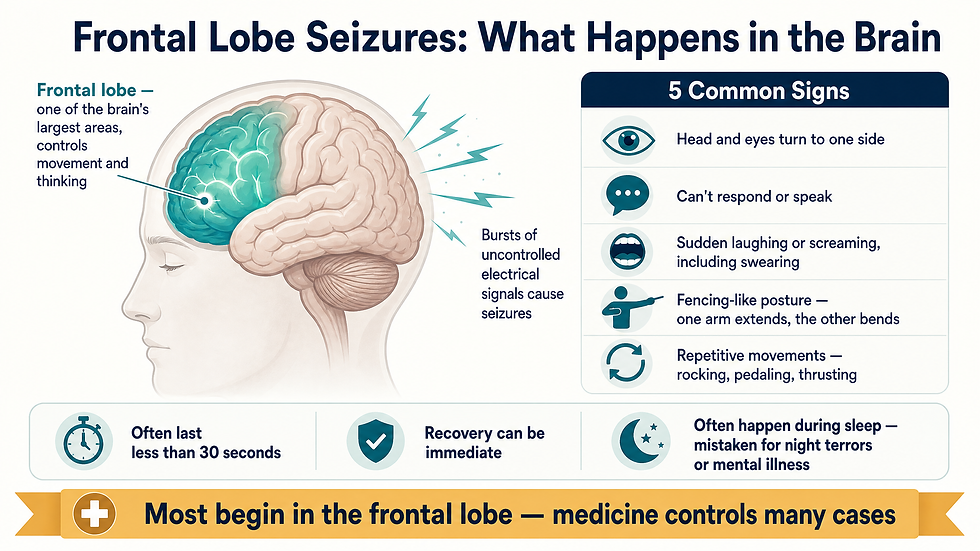
What are frontal lobe seizures?
Each side of the brain contains four lobes, each with a different job. The frontal lobe is important for cognitive functions and voluntary movement or activity. The parietal lobe processes temperature, taste, touch, and movement. The occipital lobe is primarily responsible for vision. The temporal lobe processes memories, integrating them with sensations of taste, sound, sight, and touch.
Frontal lobe seizures are a common form of epilepsy — also called frontal lobe epilepsy. Epilepsy is a brain condition in which clusters of brain cells send a burst of electrical signals. These electrical signals cause movements that can't be controlled, called seizures. Frontal lobe seizures begin in the front of the brain, one of the largest areas of the brain, which helps with many important tasks including movement.
One feature makes this type of seizure especially tricky: the symptoms can look strange. Frontal lobe seizures can produce uncontrollable laughing or screaming, and the symptoms may appear to be related to a mental illness. The seizures also can be mistaken for a sleep disorder because they often happen during sleep.
What do frontal lobe seizures look like?
Frontal lobe seizures often last less than 30 seconds, and sometimes recovery is immediate. Symptoms might include the head and eyes turning to one side, not responding to others or having trouble speaking, explosive screams including profanities or laughter, changing the body's posture such as extending one arm while the other flexes (a fencing-like pose), and repetitive movements such as rocking, bicycle pedaling, or pelvic thrusting.
The combination of short duration, nighttime timing, and unusual movements is exactly why family members so often misinterpret these episodes as bad dreams, night terrors, or even psychiatric problems. If you or someone you live with experiences brief, recurring episodes like these — especially during sleep — a medical evaluation is important.
What causes frontal lobe seizures?
Frontal lobe seizures can be caused by tumors, stroke, infection, or traumatic injuries in the brain's frontal lobes. They also are associated with a rare inherited form of epilepsy called autosomal dominant nocturnal frontal lobe epilepsy. This form causes brief seizures during sleep, and if a parent has it, there is a 50% chance a child will have it too.
Perhaps the most surprising fact: the cause is not known for about half of the people who have frontal lobe epilepsy. In other words, a "cause unknown" diagnosis is the norm, not the exception.
Who is at higher risk?
Risk factors of frontal lobe seizures include a family history of seizures or brain conditions, head injury from traumatic brain injuries, brain infections affecting brain tissue, brain tumors in the frontal lobes, unusual brain development (blood vessels or brain tissues that don't form in the typical way), and stroke, which interrupts blood flow to the brain.
What are the possible complications?
Frontal lobe seizures carry several potential complications, one of which is a true medical emergency.
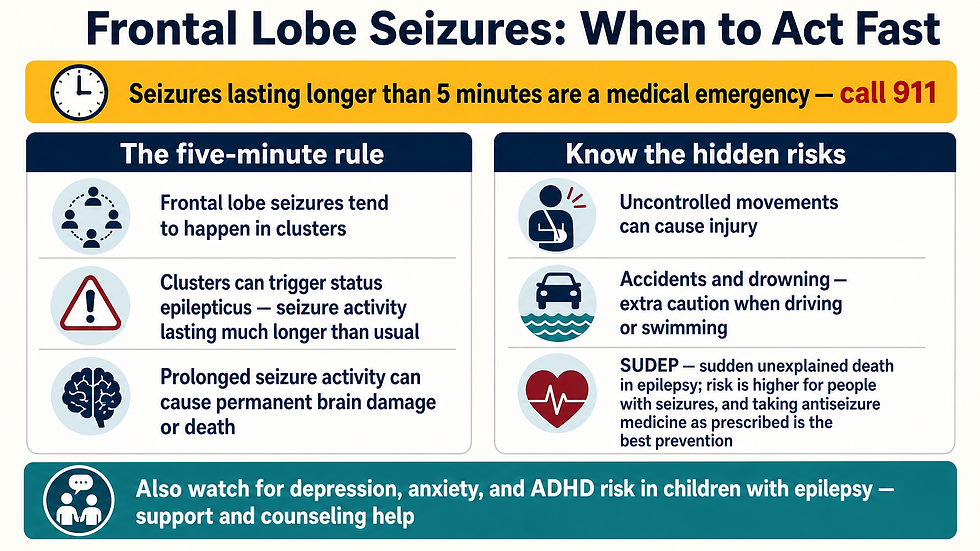
Seizures that last dangerously long
Frontal lobe seizures tend to happen in clusters. For this reason, they might provoke status epilepticus — a condition in which seizure activity lasts much longer than usual. If these seizures continue, they can cause permanent brain damage or death. Seizures that last longer than five minutes are medical emergencies. Call 911 or get medical help right away if you witness someone having a seizure for longer than five minutes.
Injury, accidents, and drowning
The uncontrolled motions that happen during frontal lobe seizures sometimes result in injury to the person having the seizure. Seizures also may result in accidents and drowning, such as while driving or swimming.
Sudden unexplained death in epilepsy (SUDEP)
People who have seizures have a greater risk than the average person of dying suddenly, a risk called SUDEP. The reasons for this are not known. Possible factors include heart or breathing issues, perhaps related to genetic changes. Managing seizures with medicines appears to be the best way to prevent SUDEP.
Mental health effects
Depression and anxiety are both common in people with epilepsy. Children also have a higher risk of ADHD (attention-deficit/hyperactivity disorder).
How are frontal lobe seizures diagnosed?
Frontal lobe epilepsy can be hard to diagnose. Its symptoms can be mistaken for mental health conditions or sleep disorders, such as night terrors. It is also possible that some symptoms result from seizures that begin in other parts of the brain.
To make a diagnosis, a health care professional reviews your symptoms and medical history. You may have a physical exam and blood tests to check for other health conditions that could be causing the seizures. A neurological exam tests your muscle strength, sensory skills, hearing and speech, vision, and coordination and balance.
Several tests help pinpoint the diagnosis. An EEG (electroencephalogram) uses small metal disks attached to the scalp to monitor the brain's electrical activity, though it may not identify frontal lobe epilepsy. A video EEG monitors you overnight at a sleep clinic, matching what happens during a seizure with the EEG readout. CT and MRI scans look for physical issues such as tumors and cysts, with a functional MRI showing how different brain areas are working. A PET scan shows chemical activity and metabolism levels in the brain, helping identify where a seizure started and ended.
How are frontal lobe seizures treated?
Over the past decade, treatment options for frontal lobe seizures have increased. There are several types of medicines, and a variety of surgical procedures may help if medicines don't work.
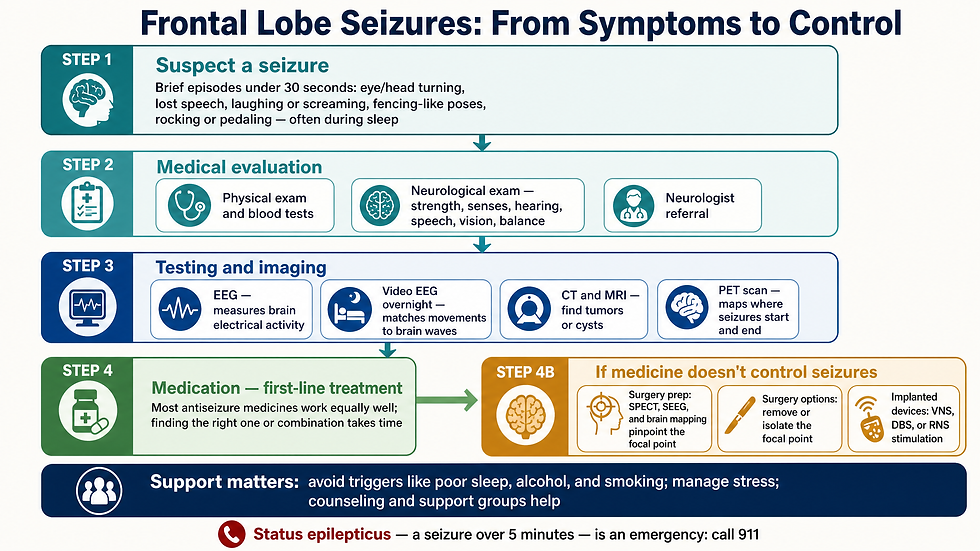
Medications
Most antiseizure medicines work equally well at controlling frontal lobe seizures. But not everyone becomes seizure-free on medicine. You may need to try different medicines, or a combination of medicines, to manage your seizures. Researchers continue to look for new and more effective medicines.
Finding the source before surgery
If medicine does not control your seizures, surgery might be an option — but first the care team must find the areas of the brain where your seizures happen. A SPECT scan uses a tracer injected into the blood to show blood flow during a seizure; scans done during and after the seizure are compared, since the seizure area has higher blood flow. SEEG (stereo EEG) surgically implants electrodes into the brain where seizures are happening, helping determine if you are a candidate for epilepsy surgery. Brain mapping implants electrodes into a brain area, then uses electrical stimulation to determine whether that area has an important function, ruling out surgery on certain areas.
Surgical options
If seizures always begin in one spot (the focal point), that small area of brain tissue may be removed, reducing or stopping seizures. If the seizure area is too vital to remove, surgeons make a series of cuts to isolate that section, preventing seizures from spreading. Vagus nerve stimulation (VNS) implants a pacemaker-like device under the chest skin that sends pulses to stimulate the vagus nerve, usually lowering seizure numbers. Deep brain stimulation (DBS) implants electrodes into brain tissue through small holes in the skull, connected to a device under the chest that sends signals to stop seizure-triggering activity. Responsive neurostimulation (RNS) implants an electrode where seizures likely start, connected to an EEG device that detects the start of a seizure and delivers a signal to stop it.
An important expectation to hold: if you have surgery for frontal lobe seizures, you'll likely still need antiseizure medicine afterward — but surgery may allow you to take a lower dose.
What about alternative medicine?
Some people with neurological conditions, including seizures, turn to complementary and alternative medicine such as herbs, acupuncture, psychotherapy, mind-body techniques, and homeopathy. Researchers are studying these therapies, but strong evidence that they effectively reduce seizures is limited.
A ketogenic diet — a strict high-fat, low-carbohydrate diet — has some evidence it might be effective for treating seizures, particularly in children. Herbs are often used, but evidence of effectiveness is thin, and some herbs can increase seizure risk. The FDA has approved Epidiolex, a purified cannabidiol (CBD) medicine, for two rare childhood epilepsies and seizures from tuberous sclerosis complex; CBD is not approved for any other epilepsy type, cannabis products have been reported to make seizures worse, and CBD can interact with antiseizure medicines.
The FDA doesn't currently regulate herbal products, and herbs can interact with antiseizure medicines. Talk to a health care professional before taking herbal or dietary supplements for your seizures.
Lifestyle and home remedies
You may find that certain things trigger seizures. Seizures can be triggered by alcohol intake, smoking, and — especially — lack of sleep. There is also evidence that severe stress can provoke seizures, and that seizures themselves can cause stress. Avoiding these triggers when possible might help improve seizure control.
Coping and support
Some people who have epilepsy are frustrated by their condition. Frontal lobe seizures can involve loud utterances or body movements that may make the person with epilepsy anxious. Parents of children with frontal lobe seizures can find information, resources, and emotional connections through support groups, which can also help children with epilepsy. Counseling can be very helpful. Adults with epilepsy can find support through in-person and online groups. Depression and anxiety are common companions of epilepsy, so mental health support is not a luxury here — it is part of good seizure care.
How to prepare for your appointment
You're likely to see a primary health care professional first, who may refer you to a neurologist — a specialist in nervous system conditions. Ask a family member or friend to come with you to help you remember the information you receive. Make a list of your symptoms (including those that seem unrelated, when they began, and how often they happen), all medicines, vitamins, and supplements you take, and the questions you want to ask — such as what is likely causing your symptoms, whether you'll have more or different types of seizures, what tests and treatments are available, whether surgery is a possibility, and whether you'll have activity or driving restrictions.
Expect your doctor to ask whether you noticed any unusual sensations before the seizures, how often they happen, how long they last, whether they happen in clusters, whether they all look the same, whether you've noticed triggers such as illness or lack of sleep, and whether anyone in your immediate family has ever had seizures. The cluster question matters specifically for frontal lobe seizures, because these seizures characteristically occur in clusters and can escalate to status epilepticus.
Bottom line
Frontal lobe seizures are one of the more misunderstood conditions in neurology. They are brief — often under 30 seconds — they strike during sleep, and their symptoms look so unusual that families often blame night terrors or mental illness instead of epilepsy. That misunderstanding has a real cost: delayed diagnosis.
The path to better control, however, is well established. Antiseizure medicines control many cases, and the past decade has added a genuine second tier for the people whose seizures resist medication: targeted surgery to remove or isolate the focal point, and implanted stimulation devices that interrupt seizures as they begin. Even after surgery, medicine usually continues — often at a lower dose. At home, the most effective self-care is trigger management: prioritize sleep above almost everything else, limit alcohol, avoid smoking, and find support for the stress-seizure-stress cycle through counseling and support groups.
One rule overrides everything else here: a seizure lasting longer than five minutes is a medical emergency. Call 911.
Your next step: If you or someone you live with has brief, repeated episodes — especially during sleep — write down what happens, how long it lasts, and how often, then see a health care professional. Bring a witness if you can; their description is often the most valuable diagnostic clue you have.
FAQ
What are frontal lobe seizures?
Frontal lobe seizures are a common form of epilepsy — also called frontal lobe epilepsy — in which clusters of brain cells in the frontal lobe fire bursts of uncontrolled electrical signals, causing movements that can't be controlled. The frontal lobe is one of the brain's largest areas and controls cognitive functions and voluntary movement.
How long do frontal lobe seizures last?
They often last less than 30 seconds, and sometimes recovery is immediate. Their brief duration, combined with their tendency to happen during sleep, is a big reason they are mistaken for night terrors or sleep disorders.
What causes them?
Tumors, stroke, infection, or traumatic injuries in the frontal lobes can cause them. A rare inherited form — autosomal dominant nocturnal frontal lobe epilepsy — causes brief seizures during sleep; a child has a 50% chance of inheriting it if a parent has it. In about half of all cases, no cause is ever found.
Are frontal lobe seizures dangerous?
They carry real risks. Because they happen in clusters, they can trigger status epilepticus — seizure activity lasting much longer than usual — which can cause permanent brain damage or death. A seizure lasting longer than five minutes is a medical emergency; call 911. Seizures also raise risks of injury, accidents, and drowning, and people with epilepsy face a higher risk of sudden unexplained death (SUDEP); taking antiseizure medicine as prescribed is the best-known prevention.
How are they treated if medicine doesn't work?
If medicine doesn't control seizures, surgery may help after imaging (SPECT, SEEG, brain mapping) pinpoints the seizure's focal point. Options include removing the focal point, isolating it with a series of cuts, or implanting stimulation devices — VNS, DBS, or RNS. Most people still need antiseizure medicine after surgery, though possibly at a lower dose.
What lifestyle changes help control frontal lobe seizures?
Avoiding known triggers: alcohol, smoking, and especially lack of sleep. Severe stress can provoke seizures, and seizures themselves cause stress, so managing stress through counseling and support groups also helps improve seizure control.
References
This article is for general informational purposes and is not a substitute for professional medical advice, diagnosis, or treatment. Always consult a qualified healthcare professional about any medical condition.
Comments