Brain Surgery: Types, Risks, Recovery Time & What to Expect

Updated: 6 days ago
Written and medically reviewed by Dr. Baraa Alnahhal, MD · Last reviewed: October 2026 · How we review
Quick Answer: What is brain surgery?
Brain surgery is a procedure that treats problems in or around the brain, such as tumors, aneurysms, bleeding, extra fluid and epilepsy. Some types open the skull, while others reach the brain through a tiny hole, the nose or mouth, or a blood vessel. Surgery usually takes 2 to 6 hours or more, and recovery ranges from weeks to months. [1]
What the research says
Waking the patient during tumor surgery can protect speech. A review of 10 studies with 833 patients found that awake surgery with brain mapping lowered the risk of long-term language problems by about 56% and neurological problems by about 51% compared with surgery under general anesthesia. It also allowed more of the tumor to be removed and shortened the hospital stay by about one day. (Bu et al., Neurosurgical Review, 2021)
Treating a burst aneurysm through a blood vessel can mean better survival without disability. In a trial of 2,143 patients with a ruptured brain aneurysm, 23.5% of those treated with a catheter (coiling) were dead or dependent on others after 1 year, compared with 30.9% after open surgery (clipping). Late rebleeding was slightly more common after coiling. (Molyneux et al., The Lancet, 2005)
Surgery can stop seizures when medicines fail. In a trial of 80 people with temporal-lobe epilepsy, 58% of those who had surgery were free of seizures that impair awareness after 1 year, compared with 8% of those who stayed on medicines alone. (Wiebe et al., New England Journal of Medicine, 2001)
Key takeaways
Brain surgery is not one operation. There are at least 7 common types.
Many procedures today need no cut on the head.
You may be awake for part of the surgery so the surgeon can protect speech and movement areas.
Recovery depends on the type: minimally invasive surgery heals faster with fewer risks.
Rehabilitation (physical, speech, and occupational therapy) often helps you regain lost function.
What is brain surgery?
Brain surgery is a procedure that treats abnormal areas in your brain and the tissues around it.
Your brain is part of your central nervous system. It controls how you speak, move, think, and remember. The goal of surgery is to treat the problem without disrupting these vital functions.
A surgeon may need to:
Remove a growth, such as a brain tumor
Remove part of the brain that triggers seizures
Relieve pressure caused by blood or excess fluid
Repair abnormal blood vessels, such as an aneurysm
A neurosurgeon performs brain surgery. They work with a trained surgical team and an anesthesiologist, who makes sure you don't feel pain.
What conditions does brain surgery treat?
Brain surgery treats conditions such as brain tumors, aneurysms, arteriovenous malformations, epilepsy, hydrocephalus, Parkinson's disease, stroke and traumatic brain injury.
Condition | What surgery does |
Removes the tumor or takes a sample to test it | |
Repairs the weak, bulging blood vessel | |
Removes or closes the tangled blood vessels | |
Removes or destroys the tissue that starts seizures | |
Relieves pressure from extra brain fluid | |
Parkinson's disease and tremors | Places electrodes for deep brain stimulation |
Stroke, blood clots, and brain bleeds | Removes clots or blood and relieves pressure |
Traumatic brain injury and skull fractures | Repairs damage and relieves pressure |
Nerve damage | Treats the affected nerve |
What are the types of brain surgery?
The seven common types of brain surgery are craniotomy, craniectomy, biopsy, laser ablation, deep brain stimulation, neuroendoscopy and endovascular surgery. The type you need depends on what is being treated and where it is in the brain.

Type | How the surgeon reaches the brain | Common uses |
Craniotomy | Removes a piece of skull, then puts it back at the end | Tumors, blood clots, AVMs, epileptic tissue |
Craniectomy | Removes a piece of skull and leaves it out because of swelling; it is replaced later in a surgery called a cranioplasty | Dangerous pressure on the brain |
Biopsy | Takes a small tissue or fluid sample, often with a computer-guided (stereotactic) needle | Checking whether a tumor is cancerous |
Laser ablation | Passes a laser probe through a tiny hole in the skull | Deep tumors or epileptic tissue too risky to reach by craniotomy |
Deep brain stimulation (DBS) | Places electrodes in the brain, controlled by a small device | Parkinson's disease, tremors, other movement conditions |
Neuroendoscopy | Inserts a thin, lighted camera tube through the nose or mouth | Removing certain tumors without cutting the skull |
Endovascular surgery | Threads a thin catheter from a small cut in the groin up to the brain | Removing clots (thrombectomy), repairing aneurysms |
Is radiosurgery a type of brain surgery?
No. Stereotactic radiosurgery, such as Gamma Knife, is a form of radiation therapy. Despite the name, there is no cut. Focused beams of radiation are aimed at the head to shrink or destroy tumors.
How do you prepare for brain surgery?
Preparing for brain surgery involves a physical exam, blood tests and brain imaging, plus any medicine and lifestyle changes your surgeon asks for. Your care team checks that you are healthy enough for anesthesia and surgery.
Tests before surgery:
Physical exam
Blood tests
Imaging, such as MRI, CT, PET scans, or angiography
These images show your brain tissue, nerves, and blood vessels in detail. They help your surgeon find the exact area to treat.
Changes your surgeon may ask you to make:
Step | Why it matters |
Stop smoking several weeks before | Smoking raises the risk of complications and slows healing |
Take steroids (if prescribed) | Lowers the risk of brain swelling |
Take antibiotics (if prescribed) | Lowers the risk of infection |
Take seizure-prevention medicine (if prescribed) | Lowers the risk of seizures |
Pause blood thinners a few days to a week before | Lowers the risk of bleeding |
Never stop or start a medicine on your own. Follow your surgeon's exact instructions.
What happens during brain surgery?
During open brain surgery (craniotomy), the surgeon removes a section of skull, treats the problem and puts the bone back, while other types reach the brain without opening the skull. During a craniotomy, you can expect:
The anesthesiologist gives you anesthesia.
Hair near the incision site is shaved and the skin is cleaned.
The surgeon makes a cut in the skin and gently moves tissue and muscle aside.
Small holes are drilled in the skull, and a section of bone is removed.
The surgeon treats the problem, such as removing a tumor, relieving pressure, or repairing a blood vessel.
The bone is put back and secured with small plates and screws.
Muscle and tissue are moved back, and the skin is closed.
With endovascular surgery or neuroendoscopy, there is no cut on the head and the skull is not opened. The surgeon uses special tools to reach the brain through the nose, mouth, or a blood vessel in the groin.
Will I be awake during brain surgery?
You may be awake for part of brain surgery, depending on whether your team uses general anesthesia, sedation or awake surgery.
Anesthesia type | What it means |
General anesthesia | You are fully asleep and unaware |
Sedation | You are partly asleep but can respond |
Awake surgery | Your scalp is numbed, you are lightly sedated, then woken during surgery |
Awake surgery is used for some tumors, epilepsy, and deep brain stimulation. The team may ask you to talk, move a body part, look at objects, or remember information. Your answers show the surgeon which areas to avoid. The brain itself does not feel pain, and the numbing medicine keeps the incision comfortable.
How long does brain surgery take?
Brain surgery usually takes 2 to 6 hours or more, depending on how complex it is.
What happens after brain surgery?
After brain surgery, you stay in the hospital for about 1 to 10 days, then have follow-up imaging, check-ups and, if needed, rehabilitation.

How long is the hospital stay after brain surgery?
Type of surgery | Typical hospital stay |
Less invasive (for example, endovascular) | 1 to 2 days |
Open surgery (craniotomy) | Up to 10 days |
After open surgery, you may spend the first night in intensive care so your team can closely watch your vital signs.
How will you feel after brain surgery?
It is normal to feel tired, sore, or have a headache. Your team gives you medicines to stay comfortable. You may continue some medicines you took before surgery to prevent complications.
What follow-up and rehabilitation will you need?
Regular brain imaging to check healing
Follow-up visits within days, weeks, and months
Rehabilitation, if needed, to restore strength, movement, or speech
Your rehab team may include a physical therapist, a speech-language pathologist, and an occupational therapist.
How long does it take to recover from brain surgery?
Recovery from brain surgery takes a few weeks after less invasive surgery and 6 weeks to several months after open surgery.
Type of surgery | Average recovery time |
Less invasive brain surgery | A few weeks |
Open brain surgery | 6 weeks to several months |
Ask your surgeon when it is safe to return to work, driving, and normal activities. Keep every follow-up appointment, even when you feel well.
What are the benefits of brain surgery?
Brain surgery can save your life, treat the underlying condition, remove a tumor, reduce pressure on the brain and repair abnormal areas of the brain.
Saving your life or preventing life-threatening complications
Treating the underlying condition
Removing a tumor
Reducing pressure on the brain
Repairing an abnormal area of the brain
Success depends on the type of procedure and your overall health. Advances in technology have made brain surgery safer than ever before.
What are the risks of brain surgery?
Brain surgery risks include bleeding, infection, reactions to anesthesia and changes in speech, movement or memory, and some complications can be life-threatening. Newer, less invasive procedures greatly reduce these risks.
Most common complications | Common short-term side effects | Possible long-term effects |
Bleeding | Difficulty speaking (aphasia) | Behavior changes |
Infection | Brain swelling | Brain damage |
Reaction to anesthesia | Confusion or delirium | Difficulty walking |
Headaches | Dizziness | Memory loss |
Movement or balance problems | Speech problems | |
Weakness in the arms or legs |
The biggest concern is loss of function, such as the ability to speak, walk, or think clearly. Rehabilitation can help many people regain these skills.
When should you call your doctor after brain surgery?
Call your surgeon after brain surgery for fever, a worsening headache, new weakness, confusion or other new symptoms, and call emergency services right away for difficulty breathing, a seizure or signs of a stroke. Feeling worse for a short time before you feel better is normal, but these symptoms are not.
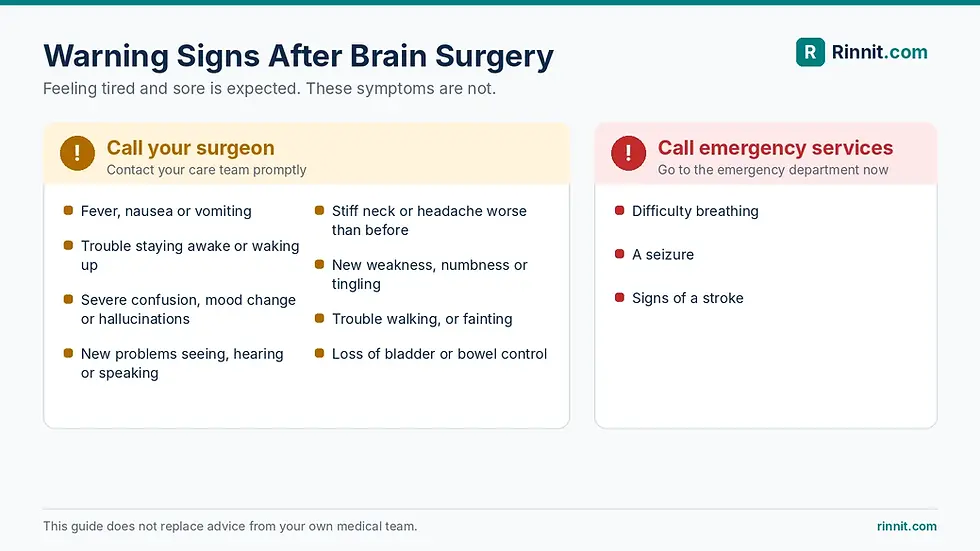
Contact your surgeon if you have:
Fever, nausea, or vomiting
Trouble staying awake or waking up
Severe confusion, major mood or behavior changes, or hallucinations
New problems with vision, hearing, or speech
A stiff neck or a headache worse than before
Numbness, tingling, or new weakness in the arms, legs, or face
Trouble walking or fainting
Trouble urinating, or loss of bladder or bowel control
Call emergency services right away if you have:
Difficulty breathing
A seizure
Signs of a stroke
Conclusion
Brain surgery covers a wide range of procedures, from open surgery to techniques that reach the brain through the nose or a blood vessel. Knowing the type you need, how long it takes, and what recovery looks like can make the process less frightening.
The most important steps are simple: follow your preparation instructions, keep every follow-up visit, take part in rehab if it is offered, and know the warning signs that need urgent care.
Have brain surgery coming up? Save or print this guide and bring it to your next appointment, so you can go through your questions with your neurosurgeon. For more clear, doctor-reviewed guides on brain health, explore Rinnit.com.
Frequently asked questions
Is brain surgery dangerous?
Brain surgery carries real risks, including bleeding, infection, and changes in speech, movement, or memory. Some complications can be life-threatening. Less invasive techniques have greatly reduced these risks, and your surgeon will explain your personal risks before you decide.
How long does brain surgery take?
Most brain surgeries take 2 to 6 hours or more, depending on how complex the procedure is.
Will they shave my head for brain surgery?
For open surgery, only the hair near the incision site is shaved. Procedures through the nose, mouth, or a blood vessel do not need a cut on the head.
Can you be awake during brain surgery?
Yes. Some surgeries for tumors, epilepsy, and deep brain stimulation are done with the patient awake for part of the procedure. Your scalp is numbed and you are lightly sedated, so you do not feel pain from the incision.
How long will I stay in the hospital after brain surgery?
About 1 to 2 days after less invasive procedures, such as endovascular surgery, and up to 10 days after an open craniotomy.
How long is recovery after brain surgery?
A few weeks for less invasive surgery, and 6 weeks to several months for open brain surgery.
Is it normal to have headaches after brain surgery?
Headaches, tiredness, and soreness are common after brain surgery. A headache that gets worse than before, especially with a stiff neck, needs a call to your surgeon.
What is the difference between a craniotomy and a craniectomy?
In a craniotomy, the piece of skull is put back at the end of surgery. In a craniectomy, it is left out because of pressure on the brain and replaced in a later surgery called a cranioplasty.
Is Gamma Knife brain surgery?
No. Gamma Knife is a type of stereotactic radiosurgery, which is radiation therapy. It uses focused radiation beams and involves no incision.
Will I need rehabilitation after brain surgery?
Many people do. Physical, speech, and occupational therapy can help you regain strength, movement, and speech affected by surgery.
Helpful external resources
Related Reading
Craniotomy: What It Is, Why It's Done, Types, Steps and Recovery explains how a craniotomy is done and what recovery looks like.
Gamma Knife Surgery (Stereotactic Radiosurgery): Uses, Procedure, and Recovery describes how Gamma Knife radiosurgery treats brain problems without an incision.
Brain Tumor: Symptoms, Causes, Diagnosis and Treatment — What You Need to Know covers brain tumor symptoms, diagnosis and treatment options.
Deep Brain Stimulation (DBS): Uses, Procedure and Recovery explains how implanted electrodes treat movement disorders like Parkinson's disease.
References
Cleveland Clinic. Brain Surgery: Purpose, Recovery, Risks & Types. Cleveland Clinic. Last updated May 31, 2023. https://my.clevelandclinic.org/health/treatments/16802-brain-surgery
Bu LH, Zhang J, Lu JF, Wu JS. Glioma surgery with awake language mapping versus generalized anesthesia: a systematic review. Neurosurgical Review. 2021;44(4):1997-2011. PMID: 33089447. https://doi.org/10.1007/s10143-020-01418-9
Molyneux AJ, Kerr RS, Yu LM, et al. International subarachnoid aneurysm trial (ISAT) of neurosurgical clipping versus endovascular coiling in 2143 patients with ruptured intracranial aneurysms: a randomised comparison of effects on survival, dependency, seizures, rebleeding, subgroups, and aneurysm occlusion. Lancet. 2005;366(9488):809-817. PMID: 16139655. https://doi.org/10.1016/S0140-6736(05)67214-5
Wiebe S, Blume WT, Girvin JP, Eliasziw M. A randomized, controlled trial of surgery for temporal-lobe epilepsy. New England Journal of Medicine. 2001;345(5):311-318. PMID: 11484687. https://doi.org/10.1056/NEJM200108023450501
Medical disclaimer
This article is for general educational purposes and is not a substitute for professional medical advice, diagnosis or treatment. Always talk with your neurosurgeon or care team about your condition, your surgery options and your recovery plan.



Comments