Deep Brain Stimulation (DBS): Uses, Procedure and Recovery

Updated: 2 days ago
Written and medically reviewed by Dr. Baraa Alnahhal, MD · Last reviewed: November 2026 · How we review
Quick Answer
Deep brain stimulation (DBS) is a treatment that uses a surgically implanted device to send mild electrical pulses to a specific area of the brain. It's FDA-approved for Parkinson's disease, essential tremor and medication-resistant epilepsy. It doesn't cure these conditions, but it can greatly ease symptoms and often allows lower medication doses. It's adjustable and reversible.
What the research says
DBS improved Parkinson's more than medicine alone: in 156 people with advanced Parkinson's disease, DBS plus medicine improved quality of life by 9.5 points and movement scores by 19.6 points at 6 months compared with medicine alone, though serious side effects were more common (13% vs. 4%) (Deuschl G et al., New England Journal of Medicine, 2006) [2]
Earlier DBS also helped: in the EARLYSTIM trial of 251 people with earlier-stage Parkinson's complications, quality of life improved by 7.8 points over 2 years with DBS but stayed about the same with medicine alone; 17.7% had serious side effects related to surgery or the device (Schuepbach WM et al., New England Journal of Medicine, 2013) [3]
Key takeaways
DBS sends mild electrical pulses to targeted areas of the brain.
It's FDA-approved for Parkinson's, essential tremor and epilepsy, and allowed for dystonia and OCD under a humanitarian exemption.
Leads go in the brain; a pulse generator goes under the skin of the chest.
Programming starts a few weeks after surgery.
DBS treats symptoms but isn't a cure.
What is deep brain stimulation?
DBS is a type of neuromodulation. The pulses change abnormal signals in the brain, though researchers still don't fully understand how it works. About 12,000 DBS procedures are done each year. Sources: [1]
Who it's for
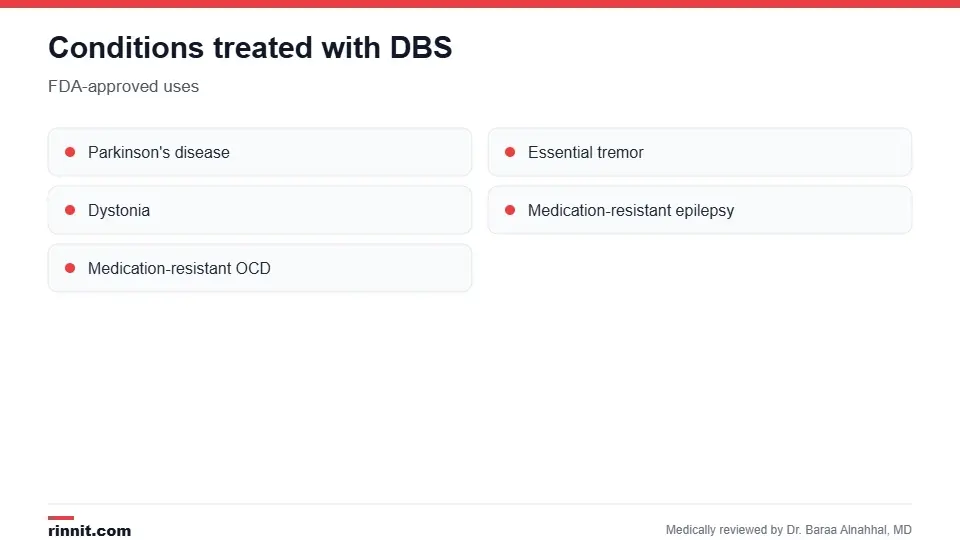
DBS is being studied for depression, Tourette syndrome and other conditions.
Parkinson's disease that's no longer well controlled with medicine.
Essential tremor.
Epilepsy that doesn't respond to medicine.
Obsessive-compulsive disorder (OCD) that doesn't respond to medicine. Sources: [1]
Researchers are also studying DBS for severe depression, Tourette syndrome, Alzheimer's disease, addiction, cluster headaches and chronic pain. Sources: [1]
How the device works
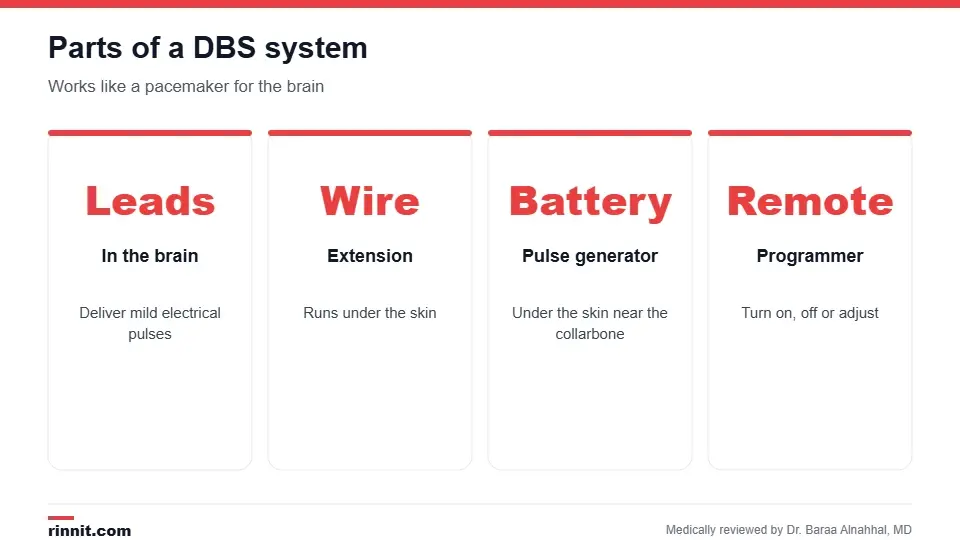
Your provider programs the device wirelessly.
Part | What it does |
Leads | Thin wires placed in one or both sides of the brain that deliver the pulses |
Extension wire | Runs under the skin to connect the leads to the generator |
Pulse generator | A battery-powered device under the skin near the collarbone |
Patient programmer | A handheld device to turn stimulation on or off or adjust it |
Standard batteries last about 3 to 5 years, and rechargeable ones about 9 years. Replacing a battery is a shorter, usually same-day surgery. Other brain stimulation options include vagus nerve stimulation and responsive neurostimulation. Sources: [1]
How to prepare
You'll have a detailed brain MRI and CT scan to plan where the leads go.
Your provider may tell you to stop certain medicines, such as blood thinners; don't stop any without asking.
You may be asked to use a special shampoo or skin cleanser.
Don't eat solid food for at least 8 hours or drink liquids for at least 2 hours before surgery. Sources: [1]
What happens during surgery
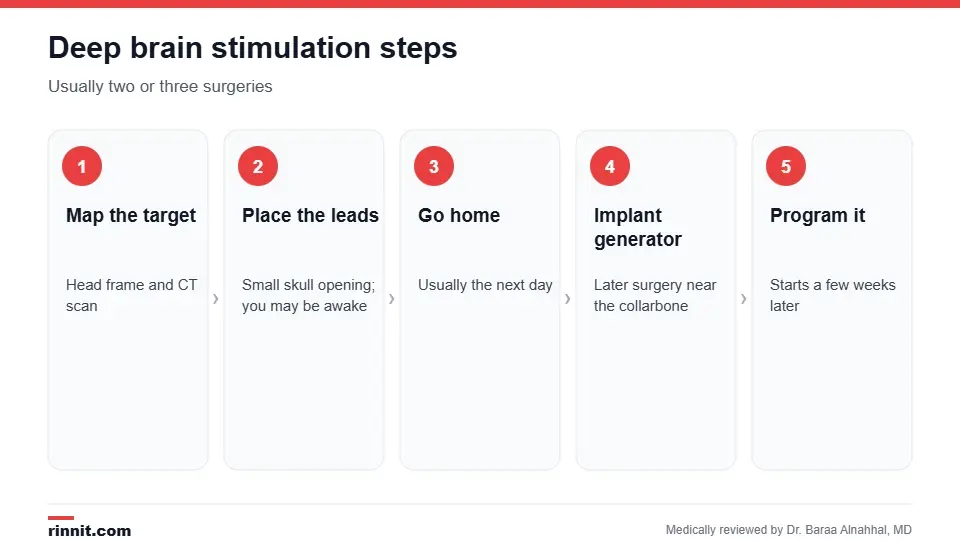
Most people go home the day after lead placement.
A frame is attached to your head, and a CT scan maps the target area.
Your scalp is numbed, and the surgeon makes a small opening in the skull.
The leads are placed; you may be awake so the team can test your response.
The lead ends are tucked under the skin, and most people go home the next day.
In a later surgery under general anesthesia, the pulse generator is placed below your collarbone.
The device is turned on and programmed a few weeks later, which may take several visits. Sources: [1]
Risks
Type | Possible problems |
Surgery | Infection, bleeding in the brain, stroke, brain swelling |
Device | Lead movement, device failure, pain around the generator |
Stimulation | Balance problems, confusion, double vision, memory problems, tingling, mood changes; often improve with programming adjustments |
Sources: [1, 2, 3]
Recovery
Avoid all activity, including chores and sex, for about 2 weeks after each surgery.
Don't lift more than 5 pounds (2.25 kg) at first.
Avoid moderate or intense exercise for at least 4 to 6 weeks.
Stitches or staples come out in about 10 to 14 days.
You can usually shower 2 days after surgery.
Avoid MRI scans unless your provider approves them, as well as diathermy and transcranial magnetic stimulation. Sources: [1]
When to call your provider
A sudden or severe headache that doesn't go away.
Bleeding, redness, swelling or warmth at the incisions.
Sudden vision changes.
A fever of 101°F (38.3°C) or higher. Sources: [1]
Conclusion
Deep brain stimulation can ease disabling symptoms of Parkinson's disease, tremor, dystonia and other conditions when medicines aren't enough. A specialized team helps decide whether you're a good candidate and fine-tunes the device over time.
Keep learning: read about Parkinson's disease and responsive neurostimulation.
Frequently asked questions
What is deep brain stimulation?
A treatment that sends mild electrical pulses to the brain through implanted leads.
What conditions does DBS treat?
Parkinson's disease, essential tremor, dystonia, epilepsy and OCD.
Is DBS brain surgery?
Yes. Leads are placed through small openings in the skull.
Will I be awake during surgery?
Sometimes, so the team can test the leads.
How long does the battery last?
About 3 to 5 years, or about 9 years if rechargeable.
Does DBS cure Parkinson's disease?
No. It eases symptoms.
Can DBS be turned off?
Yes. It's adjustable and reversible.
Can I have an MRI with DBS?
Only if your provider approves it.
How long is recovery?
Several weeks; avoid intense activity for 4 to 6 weeks.
Is DBS covered by insurance?
Many insurers cover it for FDA-approved uses.
Related Reading
Parkinson's Disease: Symptoms, Causes, and Treatment — A Clear Guide to Understanding and Managing the Condition the most common reason for DBS.
Dystonia: Symptoms, Causes, and What Treatment Can Actually Do a movement disorder treated with DBS.
Epilepsy: Seizures, Symptoms, Causes, and Treatment seizures that may be treated with DBS.
Vagus Nerve Stimulation (VNS): A Comprehensive Overview another type of nerve stimulation.
Responsive Neurostimulation (RNS) for Epilepsy: How It Works, Surgery and Results a device that detects and stops seizures.
References
Cleveland Clinic. Deep Brain Stimulation (DBS): What It Is, Purpose & Procedure. Cleveland Clinic. Last updated May 23, 2022. https://my.clevelandclinic.org/health/treatments/21088-deep-brain-stimulation
Deuschl G, Schade-Brittinger C, Krack P, et al. A randomized trial of deep-brain stimulation for Parkinson's disease. New England Journal of Medicine. 2006;355(9):896-908. PMID 16943402. https://doi.org/10.1056/NEJMoa060281
Schuepbach WM, Rau J, Knudsen K, et al. Neurostimulation for Parkinson's disease with early motor complications. New England Journal of Medicine. 2013;368(7):610-622. PMID 23406026. https://doi.org/10.1056/NEJMoa1205158
Medical disclaimer
This article is for general education only and does not replace advice from a qualified healthcare professional. Talk to your doctor about your own diagnosis and treatment, and seek emergency care right away for severe or sudden symptoms.



Comments