Gamma Knife Surgery (Stereotactic Radiosurgery): Uses, Procedure, and Recovery

Updated: 3 days ago
Medically reviewed by Dr. Baraa Alnahhal, MD · Last reviewed: October 2026
Source currency note: This guide reflects medical information reviewed in March 2024. Always confirm current guidance with your healthcare professional.
Quick Answer: What is Gamma Knife surgery?
Gamma Knife surgery is a painless, noninvasive, computer-guided form of radiation therapy that delivers highly focused beams to tumors or lesions in the brain and upper spine; it uses no knives. It treats small brain tumors, arteriovenous malformations and trigeminal neuralgia. Most people go home the same day, though full effects can take weeks, months or longer. [4]
What the research says
Gamma Knife gave long-term tumor control in meningioma. In 628 patients treated for a single intracranial meningioma, the overall tumor control rate was 95%, and 28 patients (4.4%) showed tumor recurrence. Peritumoral edema (swelling around the tumor) developed in 98 patients (15%) (Jang et al., Brain Tumor Research and Treatment, 2015).
It has an established role across several tumor types and can be combined with other treatments. A review from a Gamma Knife center that has treated 5,696 patients since 1997 describes an effective role for Gamma Knife radiosurgery in brain metastases, meningiomas, pituitary adenomas, and acoustic neuromas, used alone or together with open surgery, laser ablation, or newer medical therapies (Desai and Rich, Missouri Medicine, 2020).
Radiation necrosis, a rare late side effect of radiosurgery, can usually be managed. A systematic review of 21 articles on symptomatic radiation necrosis after stereotactic radiosurgery found that, in patients whose symptoms did not respond to steroids, bevacizumab gave a pooled symptom improvement or stability rate of 86% (95% CI 77% to 92%). The authors rated the overall evidence low in quality and called for head-to-head studies (Vellayappan et al., International Journal of Radiation Oncology, Biology, Physics, 2024).
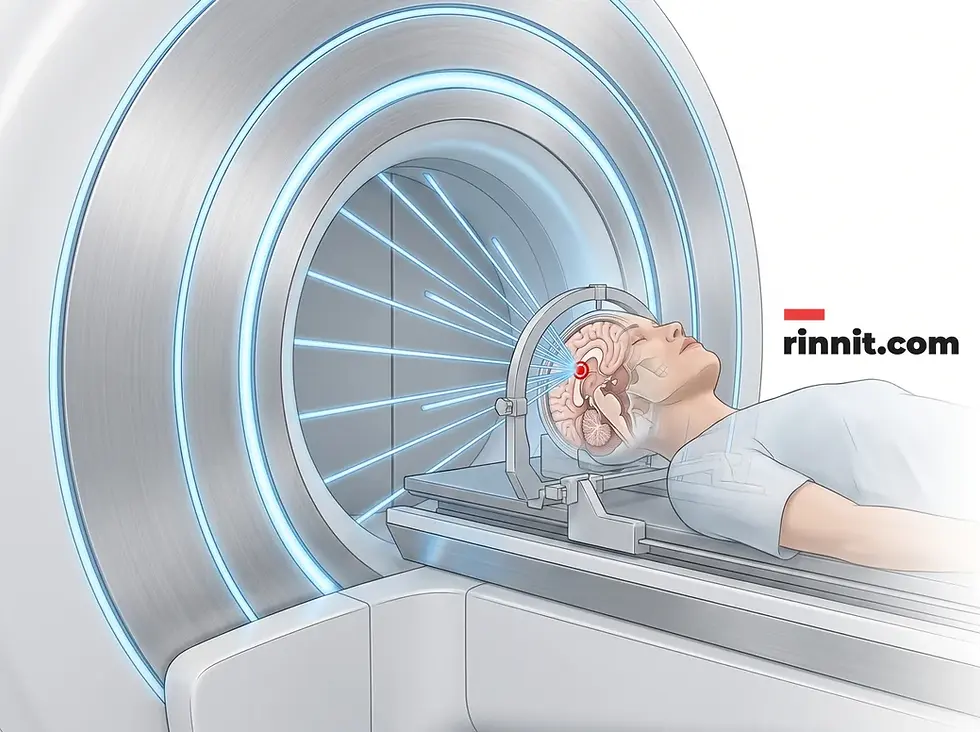
Understanding Gamma Knife Surgery
Gamma Knife surgery is a type of stereotactic radiosurgery, also known as Gamma Knife radiosurgery or Gamma Knife radiation. It delivers beams of highly focused energy to a specific treatment area while minimizing harm to the surrounding tissue. The goal is for the radiation to stabilize, shrink, or destroy a tumor or lesion.
It can be especially helpful when a brain lesion or tumor can't be reached with traditional surgical techniques, or when you are unable to have surgery for any reason. It can also be combined with traditional surgery to prevent a tumor from growing back.
Conditions Treated
Condition type | Examples |
Brain tumors | Acoustic neuromas (vestibular schwannomas), brain metastases, meningiomas, pituitary adenomas, gliomas, craniopharyngiomas, chordomas, chondrosarcomas, and paragangliomas |
Blood vessel abnormalities | Arteriovenous malformations (AVMs) |
Nerve disorders | Trigeminal neuralgia |
Functional conditions | Epilepsy, and symptoms of essential tremor or Parkinson's disease |
The Procedure
Preparing for Gamma Knife surgery
Before treatment, you will meet with a neurosurgeon and/or radiation oncologist for a physical exam. Tell them about any medical implants, such as a pacemaker, cochlear implant, or implanted medication pump, and about any allergies. You will also be asked whether you can lie flat on your back for 30 to 60 minutes, which is required. Your instructions will be specific to you, but in general they may include:
Not eating or drinking anything after midnight the night before
Taking your morning medications with sips of water and bringing all your medications, including inhalers
Washing your scalp the night before, wearing your hair loose, and not using clips, pins, or bands on the day
Wearing easy-to-remove shoes and loose, comfortable clothing, avoiding a shirt that goes over your head
Arranging for someone to drive you to and from the procedure
Frame or frameless
System | How it works |
Frame | A fitted metal (usually aluminum) band goes around your head to keep it still and help guide the gamma rays. A neurosurgeon numbs the area with four injections of local anesthetic before placing pins. Your head doesn't need to be shaved. |
Frameless | A thermoplastic mask rests over your face, or a net fits around your head, and it secures to a frame on the Gamma Knife table. No frame fitting is needed. |
What happens on the day
IV placement: an IV delivers a contrast dye for imaging and a small amount of sedative if needed. General anesthesia might be an option for children.
Imaging: a CT and/or MRI scan, usually about 30 minutes, shows the exact size and location of the target.
Planning: a neurosurgeon, radiation oncologist, medical physicist, and other team members plan the treatment on a computer, deciding the areas to treat and the radiation dose. This can take up to an hour.
Treatment: you lie on a table that moves into the Gamma Knife machine, which may shift your head and body slightly so the radiation reaches every target. You are monitored the whole time and can talk with your team through a microphone.
Finishing up: the frame or mask and the IV are removed.
The procedure doesn't hurt, produces no heat, and is silent. Treatment itself takes between 30 minutes and two hours depending on the size, shape, and location of the target, and you should plan to spend several hours, up to 12, at the treatment center.
Recovery and Results
Recovery is quick. You may feel a little groggy and drowsy afterward if you received relaxation medicine, and you can usually go home the same day. Most people can return to regular activities like work and school the next day, though your provider may ask you to limit strenuous activity for a few days. If a frame was used, instructions may include keeping your head elevated on a couple of pillows for one week, cleaning the pin sites twice a day for three to four days, washing your scalp 48 hours after the procedure, and using non-aspirin pain medicine for any discomfort.
Condition | When results appear |
Trigeminal neuralgia | Pain relief anywhere from one day to six months, with most people improving within one month |
Cancerous tumors | Typically become stable or get smaller over weeks to months |
Many noncancerous tumors | Often stop growing immediately but don't get smaller |
Arteriovenous malformations | May take two to three years to resolve |
Follow-up CT and/or MRI scans check treatment progress, and depending on the type and size of the tumor or lesion, you might need more than one treatment session.

Benefits and Risks
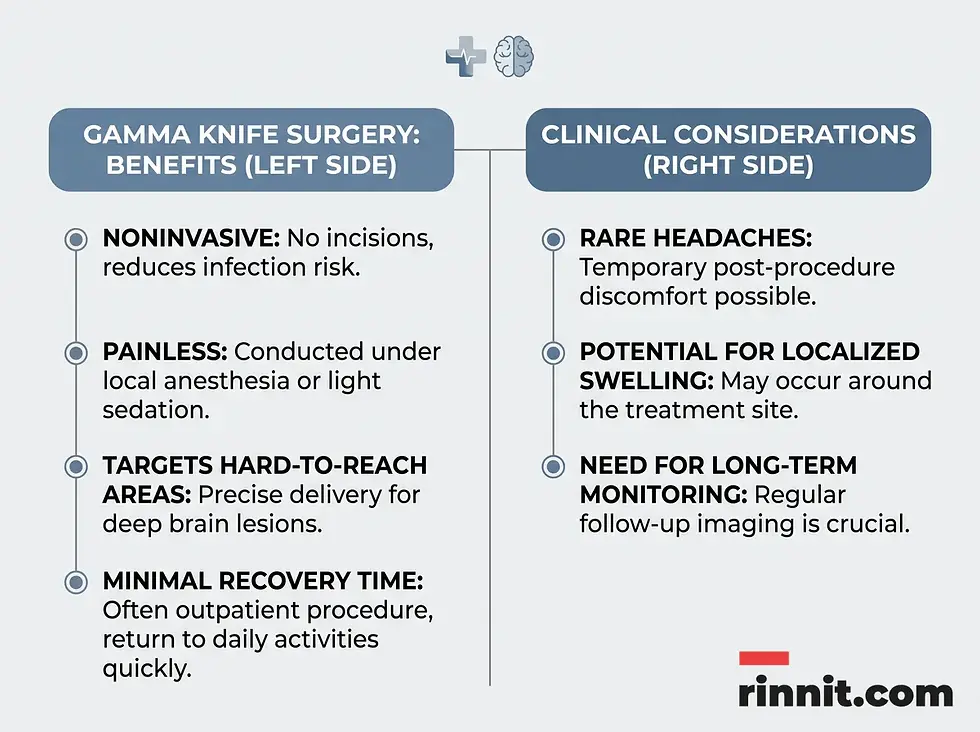
Benefits
No incisions
Safely reaches tumors or lesions deep in the brain that traditional surgery can't reach
Can target multiple tumors and lesions at the same time
Limits damage to surrounding tissue
Quick recovery
Possible side effects
Risks are typically low. Side effects may include nausea and vomiting, headache, tiredness, bruising and skin discoloration or numbness and tingling at the pin sites, and hair loss only if a tumor is close to the scalp. Severe but rare complications include brain swelling, seizures, bleeding in the brain, and breathing difficulty. Brain swelling can happen right after the procedure or months later, and your team may give you medicines before and after treatment to help prevent it. Call 911 or your local emergency number right away if you notice severe symptoms or have trouble breathing.
When to Call Your Healthcare Provider
Contact your provider if the pin sites feel hot to the touch, you have cloudy or foul-smelling drainage from the pin sites, or you have a fever. Contact your physician immediately or go to the nearest emergency room if you have nausea, vomiting, a severe headache, visual changes, difficulty speaking, a seizure, or any other symptom that is unusual for you.
Conclusion
Gamma Knife surgery is a highly effective treatment with minimal negative effects for many people with small brain tumors and other lesions. Because it stabilizes or shrinks the target without incisions, you might need only one treatment, although some conditions need more. Your care team will walk you through what to expect.
Clinical insight: Gamma Knife surgery is often combined with other treatments, such as traditional surgery, to prevent a tumor from growing back or to treat what remains.
Next step: If Gamma Knife surgery has been suggested for you or a family member, ask your care team about the type of system (frame or frameless), how many sessions to expect, and the follow-up imaging schedule.
Frequently Asked Questions
Is Gamma Knife surgery actually surgery?
No. Despite the name, it is a noninvasive form of radiation therapy with no incisions and no knives. It is named for the precision of gamma rays, which are as accurate as a surgical knife at targeting an area of the brain without cutting into the body.
Does the procedure hurt?
No. You won't feel any pain or discomfort during treatment, the machine doesn't produce heat, and you won't hear any noise. If a frame is used, your provider numbs the pin sites with four injections of local anesthetic, and you may feel light pressure as the pins tighten. Many people take a nap during the procedure.
How long do I stay at the hospital?
Most people go home the same day unless a provider recommends an overnight stay for monitoring. The treatment itself takes 30 minutes to two hours, and you should plan to spend several hours, up to 12, at the treatment center.
Will my head be shaved?
No. Your head doesn't need to be shaved to wear a frame.
Can children have Gamma Knife surgery?
Yes. General anesthesia might be an option for children so that they stay asleep during the procedure.
How soon will I see results?
It may take weeks, months, a year, or sometimes longer to see the full effects. Trigeminal neuralgia pain relief can occur anywhere from one day to six months after treatment, with most people improving within one month. Cancerous tumors typically become stable or smaller over weeks to months, many noncancerous tumors stop growing immediately but don't shrink, and arteriovenous malformations may take two to three years to resolve.
Can I drive myself home?
No. You will need someone to drive you to and from the procedure, and if a frame is used you may feel groggy and drowsy from the relaxation medicine.
What is the difference between a frame and a frameless system?
A frame is a fitted metal band, usually aluminum, around your head that keeps it from moving and helps guide the gamma rays. A frameless system uses a thermoplastic mask over your face, or a net around your head, that secures to a frame on the Gamma Knife table so your head stays completely still.
Are there long-term side effects?
Risks are typically low. Rare severe complications include brain swelling, seizures, and bleeding, and brain swelling can happen immediately after or months after the procedure. Your care team may give you medicines to help prevent it and will check your progress with follow-up CT or MRI scans.
What should I do the night before?
Follow your team's specific instructions. In general, don't eat or drink anything after midnight, take your morning medications with sips of water, wash your scalp, wear your hair loose without clips, pins, or bands, and arrange for someone to drive you.
When should I call my doctor after Gamma Knife surgery?
If you had a head frame, contact your provider if a pin site feels hot, has cloudy or foul-smelling drainage, or you develop a fever. [4] Contact your physician immediately or go to the nearest emergency room if you have nausea, vomiting, a severe headache, vision changes, difficulty speaking, a seizure or any unusual symptom. [4] Call 911 or your local emergency number right away for severe symptoms or trouble breathing. [4]
Related Reading
References
Jang CK, Jung HH, Chang JH, et al. Long-term results of gamma knife radiosurgery for intracranial meningioma. Brain Tumor Research and Treatment. 2015;3(2):103-107. PMID 26605265. https://doi.org/10.14791/btrt.2015.3.2.103
Desai R, Rich KM. Therapeutic role of Gamma Knife stereotactic radiosurgery in neuro-oncology. Missouri Medicine. 2020;117(1):33-38. PMID 32158047. https://pubmed.ncbi.nlm.nih.gov/32158047/
Vellayappan B, Lim-Fat MJ, Kotecha R, et al. A systematic review informing the management of symptomatic brain radiation necrosis after stereotactic radiosurgery and International Stereotactic Radiosurgery Society recommendations. International Journal of Radiation Oncology, Biology, Physics. 2024;118(1):14-28. PMID 37482137. https://doi.org/10.1016/j.ijrobp.2023.07.015
Cleveland Clinic. Gamma Knife surgery. Cleveland Clinic. March 7, 2024. https://my.clevelandclinic.org/health/procedures/16559-gamma-knife-surgery
Medical disclaimer
This article was prepared for general information only and is not a substitute for professional medical advice.



Comments