Trigeminal Neuralgia: What Causes the Facial Pain, and How Is It Treated?

Updated: 2 days ago
Medically reviewed by Dr. Baraa Alnahhal, MD · Last reviewed: September 2026
TL;DR
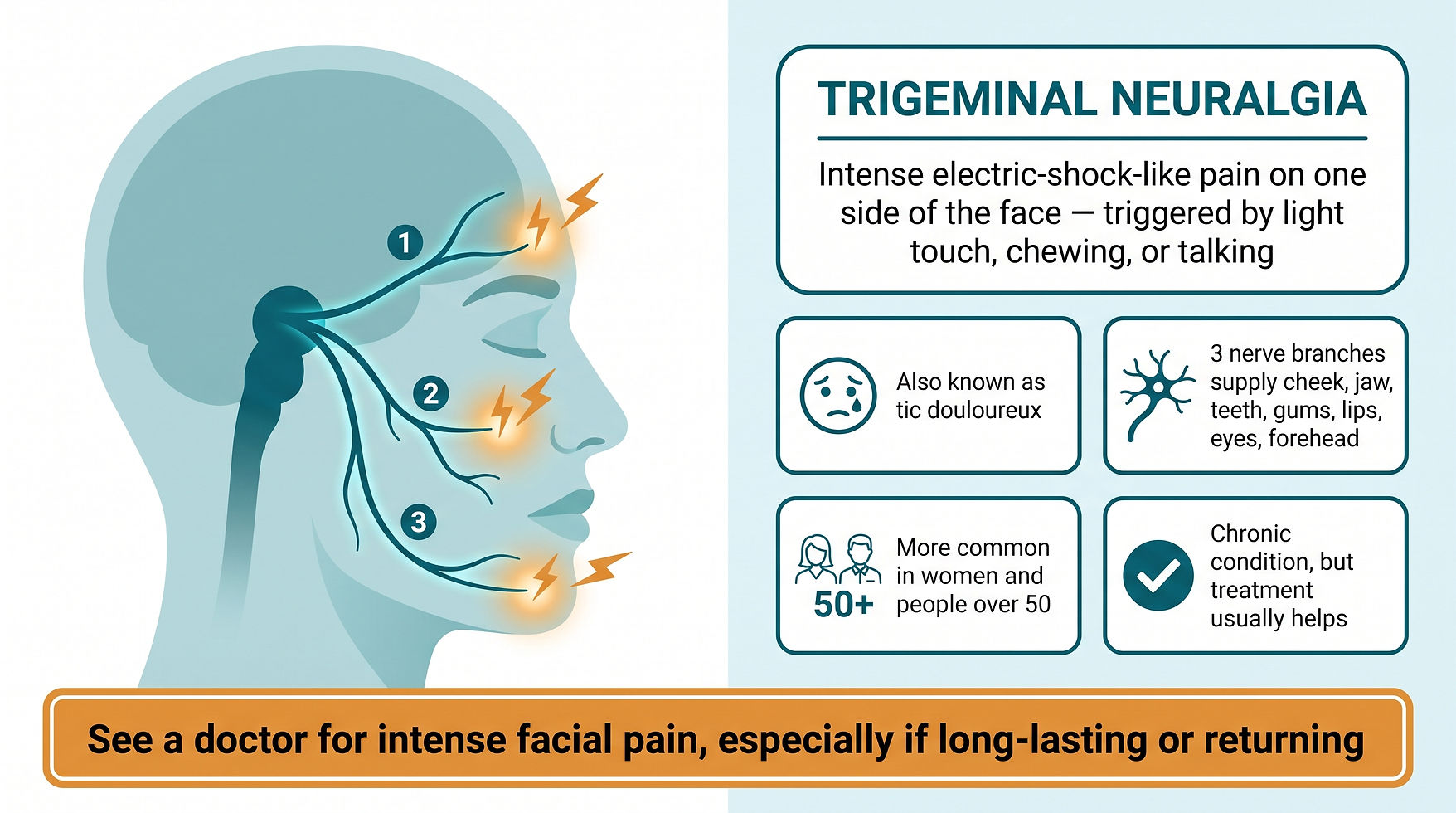
Trigeminal neuralgia causes intense, electric-shock-like pain on one side of the face, usually triggered by everyday actions such as brushing your teeth or talking. It affects the trigeminal nerve, which has three branches supplying feeling to the cheek, jaw, teeth, gums, lips, eyes, and forehead. The most common cause is a blood vessel pressing on the nerve. Medicines such as carbamazepine often control the pain, and procedures like microvascular decompression can provide relief lasting for years. The condition is more common in women and in people over 50, but treatment usually helps manage it.
Quick Answer
What is trigeminal neuralgia? Trigeminal neuralgia is a chronic pain condition that causes sudden, intense pain resembling an electric shock on one side of the face. The pain typically:
Lasts from a few seconds to up to two minutes per episode
Affects the cheek, jaw, teeth, gums, lips, or—less often—the eyes and forehead
Is triggered by light touch, chewing, speaking, brushing teeth, shaving, or even a light breeze
Occurs on one side of the face at a time, and rarely while sleeping
Is most often caused by a blood vessel pressing on the trigeminal nerve
Is usually treated first with antiseizure medicines such as carbamazepine
Can be managed long-term with surgery or procedures when medicines stop working
What Is Trigeminal Neuralgia?
Trigeminal neuralgia (try-JEM-ih-nul nu-RAL-juh) is a condition that causes intense pain similar to an electric shock on one side of the face. It affects the trigeminal nerve, the nerve that carries signals from the face to the brain. This nerve has three branches and supplies feeling to the cheek, jaw, teeth, gums, lips, eyes, and forehead.
Even light touch from brushing your teeth or putting on makeup may trigger a jolt of pain. The condition can be long-lasting, which is why it is known as a chronic pain condition—a pain condition that persists over a long period. People may have short, mild episodes at first, but the condition can get worse, causing longer periods of pain that happen more often. It is more common in women and in people older than 50.
Trigeminal neuralgia is also known as tic douloureux. Having the diagnosis does not mean living a life of pain—treatment usually can help manage the condition.
What Does Trigeminal Neuralgia Pain Feel Like?
Trigeminal neuralgia results in pain in an area of the face supplied by one or more of the three branches of the trigeminal nerve. The pain follows recognizable patterns. Episodes feel like intense shooting or jabbing pain that may resemble an electric shock. The pain is limited to areas the trigeminal nerve supplies: the cheek, jaw, teeth, gums, or lips, and less often the eyes and forehead.
Pain may strike suddenly or be triggered by touching the face, chewing, speaking, or brushing your teeth. It occurs on one side of the face at a time and may be focused in one spot or spread in a wider pattern.
Pain pattern | What it means |
Shooting or jabbing, electric-shock feeling | Sudden, intense bursts of nerve pain |
One side of the face at a time | Pain follows one or more of the three nerve branches |
Triggered by light touch, chewing, talking, brushing teeth | Everyday activities set off pain signals |
Lasts a few seconds to several minutes | Episodes are brief but can repeat |
One spot or a wider spread | Pain may be localized or cover a larger facial area |
The timing patterns also vary. Episodes can last from a few seconds to several minutes, and pain may come with facial spasms. Some people have episodes lasting days, weeks, or months, with pain-free periods in between. Pain rarely occurs while sleeping. Over time, episodes typically become more frequent and more intense.
When Should You See a Doctor?
See your healthcare team if you experience intense jolts of pain in your face, especially if the pain is long-lasting or comes back after going away. Also get medical attention if you have ongoing facial pain that does not go away with nonprescription pain medicine.
Situation | Recommended action |
Intense jolts of facial pain | Schedule a doctor's visit |
Pain that is long-lasting or returns after going away | See a healthcare professional promptly |
Ongoing pain that does not respond to nonprescription pain medicine | Get medical attention |
Facial pain with numbness, vision changes, or other new neurological symptoms | Seek evaluation to rule out other conditions |
What Causes Trigeminal Neuralgia?
Trigeminal neuralgia is caused by a disruption in the trigeminal nerve's function. The nerve does not work as it should, and this can happen for different reasons. There are three types of trigeminal neuralgia—classic, secondary, and idiopathic—and each type may have a different cause.
The Three Types
Type | Cause | Frequency |
Classic | A blood vessel (artery or vein) at the base of the brain presses on the trigeminal nerve; the pressure interrupts nerve function and causes pain | Most common |
Secondary | An underlying condition such as multiple sclerosis, which damages the myelin sheath (the protective covering of certain nerves); also injury to the nerve during surgery, a tumor pressing on the nerve, stroke, or facial trauma | Less common |
Idiopathic | No clear cause can be identified | Least common |
Common Triggers
Everyday activities can set off the pain. Known triggers include shaving, touching the face, eating, drinking, brushing your teeth, talking, putting on makeup, a light breeze blowing over the face, smiling, and washing the face.
Risk Factors
Research has identified several factors that raise the risk of developing trigeminal neuralgia.
Risk factor | Detail |
Sex assigned at birth | Women are more likely than men to develop trigeminal neuralgia |
Age | More common among people 50 and older |
Multiple sclerosis | A known risk factor; MS damages the nerve's protective myelin sheath |
Hypertension | High blood pressure is a known risk factor |
Migraine headaches | People with migraines may have a higher risk |
How Is Trigeminal Neuralgia Diagnosed?
A healthcare professional may diagnose trigeminal neuralgia mainly based on how you describe your pain. The care team asks about the type of pain—it is sudden, intense, and quick, may feel like an electric shock, and may last less than a second up to two minutes. They ask about the location, because where you feel pain in your face indicates whether the trigeminal nerve is involved. They also ask about triggers, since eating, talking, a light touch, or a cool breeze on the face can bring on the pain.
Tests Used in Diagnosis
Test | What it shows |
Neurological exam | Touching and checking parts of the face locates the pain and identifies which nerve branch is involved; reflex tests show whether pressure on the nerve or another condition causes symptoms |
MRI scan | Looks for possible causes; may reveal signs of multiple sclerosis or a tumor; a dye may be injected into a blood vessel to show blood flow through arteries and veins |
Other tests | Facial pain can come from many different conditions, so additional tests may be ordered to rule out other causes |
A correct diagnosis is important because facial pain can be caused by many different conditions. After your initial visit, you may see a neurologist—a doctor trained in brain and nervous system conditions.
How Is Trigeminal Neuralgia Treated?
Choosing the right treatment depends on the cause of your pain and several other factors, including medical history, side effects, risks, how quickly treatments relieve the pain, and how long pain relief lasts. There can be overlap in treatment options for the three types, but not all options suit everyone. Treatment options include medicines, surgery, injections, or other procedures. If another medical condition such as multiple sclerosis causes the pain, the underlying condition may need treatment as well.
Medicines
Medicines are often recommended as the first line of treatment, and sometimes no other treatment is needed. The following kinds of medicines are common choices to lessen or block the pain signals sent to the brain.
Medicine type | Examples | Notes |
Antiseizure medicines | Carbamazepine (Tegretol, Carbatrol), oxcarbazepine (Trileptal, Oxtellar XR); others include gabapentin, pregabalin, lamotrigine, phenytoin, topiramate | First choice; proven effective. Genetic testing may be recommended before starting carbamazepine because it can trigger a serious reaction in some people, mainly those of Asian descent |
Muscle relaxants | Baclofen (Gablofen, Fleqsuvy) | Used alone or with carbamazepine; side effects may include confusion, nausea, drowsiness |
Botox injections | OnabotulinumtoxinA | Small studies show reduced pain when medicines fail; more research needed before wider use |
Pain relievers | Lidocaine | Used during episodes alone or with other medicines; applied as a nasal or oral spray, injected into the painful area, or given intravenously (IV, into the bloodstream); often needs repeating |
Antiseizure medicine side effects may include dizziness, confusion, drowsiness, and nausea. If medicines become less effective over time, the care team may increase the dose or switch to another type.
Surgery
If medicines do not work and the pain is caused by a blood vessel pressing on the trigeminal nerve, surgery may be recommended. The main operation is microvascular decompression (MVD), shown to be most effective for long-term pain relief, although it may carry serious risks.
During MVD, the surgeon moves or removes blood vessels that touch the trigeminal nerve. An incision (a cut) is made behind the ear on the pain side, and a small hole is made in the skull in a procedure known as a craniotomy. Through this hole, the surgeon moves any arteries in contact with the nerve, then places a soft cushion between the nerve and the arteries. If a vein is pressing on the nerve, it may be removed. If no arteries are pressing on the nerve, part of the trigeminal nerve may be cut—a procedure known as a neurectomy.
MVD can stop or reduce pain for many years. Long-term relief depends on the location of the pain, the type of pain, and the person's age. Only a small number of people have pain return three to five years after surgery. Risks of MVD include hearing loss, stroke, facial weakness, numbness, or other complications, though most people have no facial numbness afterward.
Radiation
If MVD is not the right option, brain stereotactic radiosurgery, also known as Gamma Knife, may help. This is a noninvasive procedure, meaning it does not involve cutting into the body or making openings in the skin. The surgeon aims a focused dose of radiation at the root of the trigeminal nerve, and the radiation damages the nerve to reduce or stop the pain.
Pain relief may take up to a month to begin. Although the relief is slow to start, the procedure is successful at stopping pain for most people. Pain may return, often within three to five years, and the procedure can be repeated or a different procedure chosen. The most common side effect is facial numbness, which may occur months or years after the procedure.
Rhizotomy
Rhizotomy is a minimally invasive option—meaning only very small cuts are needed compared with regular surgery, often resulting in less pain and faster recovery. In a rhizotomy, the surgeon destroys nerve fibers to reduce pain, which can cause some facial numbness.
Rhizotomy type | How it works | Expected outcome |
Glycerol injection | A needle passes through the face into an opening at the skull base, guided to a small sac of spinal fluid around where the nerve divides into three branches; sterile glycerol (a clear, thick alcohol) is injected to damage the pain-signal part of the nerve | Often relieves pain, but pain may return in some people; many experience facial numbness or tingling afterward |
Balloon compression | A hollow needle guided through the face carries a catheter with a tiny balloon to the nerve at the skull base; the balloon inflates with enough pressure to damage the nerve and block pain signals | Controls pain in most people at least for a period; most have brief facial numbness |
Radiofrequency thermal lesioning | A hollow needle carries an electrode into the nerve; the person is briefly awakened to report tingling so the pain-causing fibers can be located; the electrode is then heated to damage those fibers, creating a lesion (an area of injury) | Usually brief facial numbness afterward; pain may return after three to four years |
Can Self-Care and Alternative Treatments Help?
New and alternative treatments for trigeminal neuralgia have not been studied as extensively as medicines or surgical procedures, and more research is often needed to support their use. However, some people have found improvement with treatments such as low-intensity pulsed ultrasound (LIPUS), acupuncture, biofeedback, chiropractic, laser therapy, and vitamin or nutritional therapy. These options are new or experimental, and results are still being studied. Check with your care team before trying an alternative therapy, because it may interact with your other treatments.
Your care team may also recommend self-care methods to support you through the pain. Although these techniques do not treat the nerve directly, they may offer some relief: relaxation training, mindfulness and meditation techniques, music, and cognitive therapy.
Coping and Support
Living with trigeminal neuralgia can be hard. It can affect your interactions with friends and family, your productivity at work, and your overall quality of life. You may find encouragement and understanding in a support group, where members often know about the latest treatments and share their own experiences. Your healthcare team may be able to recommend a group in your area.
Preparing for Your Appointment
Before your appointment, track your symptoms and how long they have been occurring, note any triggers that bring on facial pain, and make a list of your medical history, conditions, and all medicines, vitamins, and supplements with doses. If possible, bring a family member or friend along to remember details you might miss, and write down your questions in advance.
Questions to ask your doctor | Questions your doctor may ask you |
What is the most likely cause of my pain? | What are your symptoms and where are they located? |
Do I need any diagnostic tests? | When did you first develop these symptoms? |
What treatment approach do you recommend? | Have your symptoms worsened over time? |
What are the possible side effects of medicines? | What triggers the facial pain, and how often do pain periods occur? |
Will I need treatment for the rest of my life? | How long does facial pain typically last? |
How much improvement should I expect? | How much are symptoms affecting your quality of life? |
Is surgery an option? | Have you had dental or facial surgery, or facial trauma? |
Conclusion
Trigeminal neuralgia produces some of the most intense pain people experience—sudden, electric-shock jolts on one side of the face that ordinary activities like eating or brushing your teeth can set off. The good news is that the condition is identifiable and treatable: antiseizure medicines relieve pain for many people, and for those whose medicines stop working, surgical and minimally invasive options such as microvascular decompression, radiosurgery, and rhizotomy can deliver relief lasting for years.
If you have experienced repeated episodes of intense facial pain, do not wait for the condition to pass on its own. Talk to a healthcare professional about your symptoms, and explore the Rinnit guides on nerve pain and chronic pain conditions for more information.
Frequently Asked Questions (FAQ)
What does trigeminal neuralgia feel like? Trigeminal neuralgia feels like intense shooting or jabbing pain similar to an electric shock, usually on one side of the face. Episodes last from less than a second up to about two minutes and can be triggered by light touch, chewing, speaking, or brushing your teeth.
What is the main cause of trigeminal neuralgia? The most common cause is a blood vessel—an artery or a vein—at the base of the brain pressing on the trigeminal nerve. The pressure interrupts the nerve's function and produces pain. Less commonly, conditions such as multiple sclerosis, a tumor, stroke, or facial trauma cause the pain.
Can trigeminal neuralgia go away on its own? The condition usually does not resolve on its own. Episodes may come and go, with pain-free periods in between, but they typically become more frequent and intense over time. Treatment usually can help manage the condition.
What is the first-line treatment for trigeminal neuralgia? Medicines, most often antiseizure medicines such as carbamazepine or oxcarbazepine, are recommended as the first line of treatment. Sometimes medicines alone are all that is needed.
Is trigeminal neuralgia curable with surgery? Surgery such as microvascular decompression is shown to be most effective for long-term pain relief and can stop or reduce pain for many years, although a small number of people have pain return within three to five years.
Does trigeminal neuralgia cause facial numbness? The condition itself is characterized by pain, not numbness. However, several procedures used to treat it—radiosurgery, glycerol injection, balloon compression, and radiofrequency lesioning—can cause some facial numbness as a side effect.
How is trigeminal neuralgia diagnosed? Diagnosis is mainly based on how you describe the pain—its type, location, and triggers. A neurological exam and an MRI scan help confirm which branch of the nerve is involved and rule out other causes such as multiple sclerosis or a tumor.
Who is most at risk for trigeminal neuralgia? Women are more likely than men to develop the condition, and it is more common in people age 50 and older. Multiple sclerosis, hypertension, and migraine headaches are also associated with higher risk.
References
Trigeminal neuralgia — Symptoms & causes. https://www.mayoclinic.org/diseases-conditions/trigeminal-neuralgia/symptoms-causes/syc-20353344 (last reviewed July 03, 2026)
Trigeminal neuralgia — Diagnosis & treatment. https://www.mayoclinic.org/diseases-conditions/trigeminal-neuralgia/diagnosis-treatment/drc-20353347 (last reviewed July 03, 2026)
Source-currency note: Both reference pages were last reviewed on July 03, 2026. Content reflects the information available at that date.
Health information, not medical advice. This article is for general education and is not a substitute for professional diagnosis or treatment. Always consult a qualified healthcare provider about your own health, and seek emergency care for urgent symptoms.
Comments