
Grand Mal (Tonic-Clonic) Seizure: Complete Guide to Symptoms, Causes, Diagnosis, and Treatment

Updated: 51 minutes ago
Medically reviewed by Dr. Baraa Alnahhal, MD · Last reviewed: September 2026
A grand mal seizure — now called a tonic-clonic seizure — causes a loss of consciousness and violent muscle contractions in two stages: the tonic phase (about 10 to 20 seconds of stiffening and falling) and the clonic phase (1 to 2 minutes of jerking). It is usually caused by epilepsy, but other health problems can trigger it. Call 911 if a seizure lasts more than five minutes, and never put anything in the person’s mouth. Most seizures are controlled with daily anti-seizure medicines.
Quick Answer
What it is: The type of seizure most people picture — loss of consciousness with violent muscle contractions in two stages: stiffening, then rhythmic jerking that usually lasts 1 to 2 minutes.
Most common cause: Epilepsy, though high fevers or brain damage can also trigger it.
Emergency signs: Call 911 if a seizure lasts more than five minutes, breathing or consciousness doesn’t return, or a second seizure follows immediately.
First aid: Roll the person on their side, cushion the head, never put anything in the mouth, and don’t restrain them.
Treatment: Not everyone who has one needs treatment, but recurrent seizures usually require daily anti-seizure medicines; surgery and dietary changes are options when medicines aren’t enough.
What Is a Grand Mal Seizure?
A tonic-clonic seizure, previously known as a grand mal seizure, causes a loss of consciousness and violent muscle contractions. It’s the type of seizure most people picture when they think about seizures.
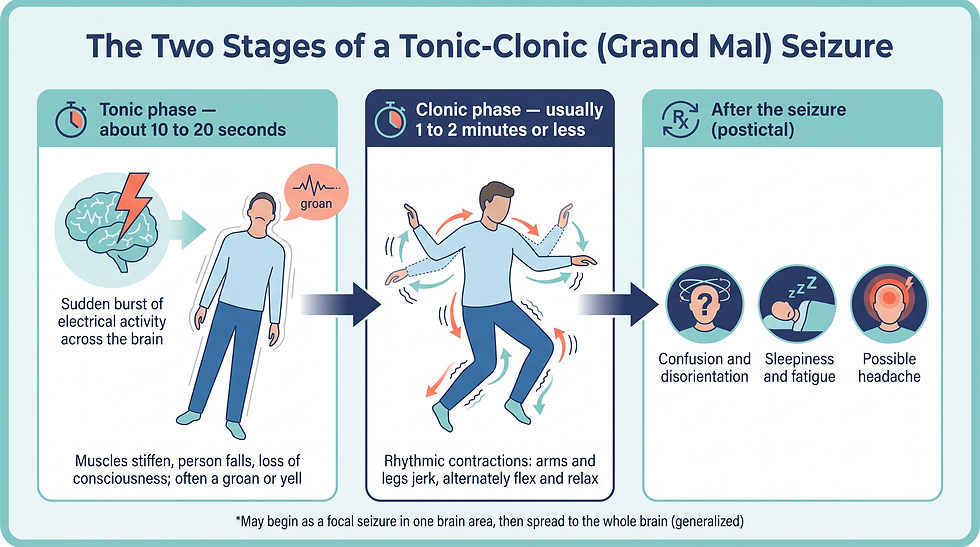
During a seizure, there’s a burst of electrical activity in the brain that causes changes in behavior and movements. Seizures can be focal, meaning the burst of electrical activity happens in one area of the brain. Or seizures can be generalized, in which they result in electrical activity in all areas of the brain. Tonic-clonic seizures may begin as focal seizures in a small area of the brain and spread to become generalized seizures that involve the whole brain.
In tonic-clonic seizures, the muscles become stiff, causing the person to fall. Then the muscles alternately flex and relax. Usually, a tonic-clonic seizure is caused by epilepsy. But sometimes this type of seizure can be triggered by other health problems, such as a high fever or damage to the brain.
Some people who have a tonic-clonic seizure don’t have another one and don’t need treatment. But someone who has recurrent seizures may need treatment with daily anti-seizure medicines to control and prevent future tonic-clonic seizures. Surgery and dietary changes also may be options to manage seizures.
Key Fact | Detail |
Name | Tonic-clonic seizure, previously called a grand mal seizure |
What happens | Loss of consciousness and violent muscle contractions |
Two stages | Tonic (stiffening, about 10–20 seconds) and clonic (jerking, 1–2 minutes) |
Most common cause | Epilepsy; sometimes triggered by high fever or brain damage |
One-time seizure | May not need treatment if there is no recurrence |
Recurrent seizures | Usually treated with daily anti-seizure medicines |
Other options | Surgery and dietary changes |
The Two Stages of a Tonic-Clonic Seizure
Tonic-clonic seizures have two stages, each with distinct features and timing.
Tonic phase. Often, someone in the tonic phase will make a sound, such as a groan or yell. The muscles suddenly get stiff and cause the person to fall down. Loss of consciousness occurs. This phase tends to last about 10 to 20 seconds.
Clonic phase. The muscles go into rhythmic contractions. The arms and legs often jerk. They alternately flex and relax. Convulsions usually last 1 to 2 minutes or less.
Stage | What Happens | How Long |
Tonic phase | A sound such as a groan or yell; muscles suddenly stiffen; the person falls; loss of consciousness | About 10 to 20 seconds |
Clonic phase | Rhythmic muscle contractions; arms and legs often jerk; muscles alternately flex and relax | Usually 1 to 2 minutes or less |
Other Symptoms That May Occur
The following symptoms occur in some but not all people with tonic-clonic seizures.
Loss of bowel and bladder function may happen during or following a seizure. The person may not become conscious for several minutes after convulsions have ended. Confusion is common afterward; the person is often disoriented after a tonic-clonic seizure, referred to as postictal confusion. Sleepiness is common after a tonic-clonic seizure, and headaches may occur as well.
Symptom After the Seizure | Details |
Loss of bowel and bladder function | May happen during or following a seizure |
Slow return to consciousness | May not become conscious for several minutes after convulsions end |
Confusion | Disorientation after the seizure, called postictal confusion |
Fatigue | Sleepiness is common after a tonic-clonic seizure |
Headache | Bad headaches may occur after the seizure |
When to Get Emergency Help
Call 911 or emergency medical help if the seizure lasts more than five minutes, breathing or consciousness doesn’t return after the seizure stops, a second seizure follows immediately, you have a high fever, you’re experiencing heat exhaustion, you’re pregnant, you have diabetes, or you’ve injured yourself during the seizure.
If you experience a seizure for the first time, see a healthcare professional. Also see a healthcare professional if you or your child experiences an increasing number of seizures for no apparent reason or notices new seizure symptoms.
What Causes a Grand Mal Seizure?
The brain’s nerve cells typically communicate by sending electrical and chemical signals across the synapses that connect the cells. A synapse is the area between cells that allows them to send messages. Tonic-clonic seizures occur when there’s a surge of electrical activity over the surface of the brain. Many nerve cells fire at once, much faster than usual. Exactly what causes these changes often is not known.
Usually, a tonic-clonic seizure is caused by epilepsy. But sometimes this type of seizure can be triggered by other health problems, such as a high fever or damage to the brain.
Type of Cause | Examples |
Injury or infection | Severe head injuries; infections such as encephalitis or meningitis, or having these infections in the past; stroke; dementias that cause degeneration in the brain, such as Alzheimer’s disease |
Congenital or developmental factors | Blood vessels that don’t form properly in the brain; brain tumors |
Metabolic issues | Very low blood levels of glucose, sodium, calcium, or magnesium |
Withdrawal syndromes | Using or withdrawing from drugs, including alcohol |

Risk Factors
Risk factors for tonic-clonic seizures include a family history of seizure disorders and any injury to the brain from trauma, a stroke, previous infection, and other causes. Sleep deprivation is a risk factor. Medical problems that affect the balance of minerals in the body also raise risk, as do illicit drug use and heavy alcohol use.
Risk Factor | Description |
Family history | A family history of seizure disorders |
Brain injury | Any injury to the brain from trauma, a stroke, previous infection, and other causes |
Sleep deprivation | Lack of sleep can trigger seizures |
Mineral imbalances | Medical problems that affect the balance of minerals in the body |
Substance use | Illicit drug use; heavy alcohol use |
Complications
Having a seizure at certain times can be dangerous for you or others. You might be at risk of falling, which can injure your head or break a bone. If you have a seizure while swimming or bathing, you’re at risk of accidental drowning. A seizure that causes either loss of awareness or control can be dangerous if you’re driving a car or operating other equipment.
Seizures during pregnancy pose dangers to both mother and baby. Certain anti-seizure medicines increase the risk of birth defects. If you have epilepsy and plan to become pregnant, talk with a healthcare professional; your medicines may need to be adjusted, and a healthcare professional likely will monitor your pregnancy.
People with seizures are more likely to have depression and anxiety. Children with seizures may be more likely to develop attention deficit hyperactivity disorder, also called ADHD. Emotional health issues may be a result of dealing with the condition itself or of medicine side effects.
Complication | Why It Happens |
Falling injuries | Falling during a seizure can injure the head or break a bone |
Drowning | A seizure while swimming or bathing risks accidental drowning |
Car accidents | Loss of awareness or control while driving or operating equipment |
Pregnancy complications | Dangers to mother and baby; certain medicines raise birth defect risk |
Emotional health issues | Higher rates of depression and anxiety; children may develop ADHD; from the condition itself or medicine side effects |
How Is a Grand Mal Seizure Diagnosed?
After a seizure, see a healthcare professional to thoroughly review your symptoms and medical history. You may need several tests to determine the cause of your seizure, and the tests can evaluate how likely it is that you’ll have another one.
A neurological exam tests your behavior, ability to move and control your muscles, and ability to think, understand, and solve problems. This helps determine if there’s a health issue with your brain or another part of your nervous system. A blood sample can check for signs of infections, blood sugar levels, or electrolyte imbalances. You may need a lumbar puncture, also known as a spinal tap, where a sample of cerebrospinal fluid is removed for testing if an infection might have caused the seizure.
An electroencephalogram (EEG) uses flat metal discs called electrodes attached to your scalp to record the electrical activity of your brain, which shows up as wavy lines on an EEG recording. The EEG may reveal a pattern that tells whether a seizure is likely to occur again. EEG testing also may help exclude other conditions that could cause a seizure.
A CT scan uses X-rays to obtain cross-sectional images of your brain, and CT scans can reveal tumors, bleeding, and cysts in the brain that might cause a seizure. An MRI uses powerful magnets and radio waves to create a detailed view of your brain, showing the structure of the brain to help determine what may be causing the seizures.
More detailed imaging may also be used. PET scans use a small amount of low-dose radioactive material injected into a vein to help visualize active areas of the brain, showing a healthcare professional where seizures are occurring. A SPECT test creates a detailed, 3D map of the blood flow activity in your brain that happens during a seizure. You may have a form of a SPECT test called subtraction ictal SPECT coregistered to magnetic resonance imaging, also called SISCOM, which can compare blood flow during a seizure to blood flow in between seizures.
Diagnostic Test | What It Checks |
Neurological exam | Behavior, movement, muscle control, thinking, and problem solving |
Blood tests | Signs of infections, blood sugar levels, electrolyte imbalances |
Lumbar puncture (spinal tap) | Cerebrospinal fluid tested if an infection might have caused the seizure |
EEG | Electrodes on the scalp record brain electrical activity; may show a pattern indicating whether another seizure is likely |
CT scan | X-ray cross-sections reveal tumors, bleeding, and cysts |
MRI | Magnets and radio waves show brain structure to help find the cause |
PET | Injected tracer visualizes active brain areas to locate where seizures occur |
SPECT / SISCOM | 3D map of blood flow during a seizure, compared to flow between seizures |
Treatment Options
Not everyone who has one seizure has another one. Because a seizure can be an isolated incident, you may not start treatment until you’ve had more than one. Treatment usually involves the use of anti-seizure medicines.
Anti-Seizure Medications
Many medicines are used in the treatment of epilepsy and seizures. These are usually taken daily by mouth to help prevent seizures. Different medicines may be prescribed based on factors such as your specific seizure type and how often you have them, and personal considerations such as your age and whether or not you’re pregnant.
Finding the right medicine and dosage can be challenging. A healthcare professional likely will prescribe a single medicine at a relatively low dosage, then may increase the dosage gradually until your seizures are well controlled. Many people with epilepsy are able to prevent seizures with just one medicine, but others need more than one. If you’ve tried two or more single-drug regimens without success, you may need to try a combination of medicines.
For the best seizure control possible, take medicines exactly as prescribed. Ask a healthcare professional before adding other medicines or stopping your medicine — this includes prescription medicines, medicines available without a prescription, or herbal remedies. Suddenly stopping medicines can cause seizures to return.
Mild side effects of anti-seizure medicines can include fatigue, dizziness, and weight gain. More-troubling side effects need to be brought to the attention of a healthcare professional right away, including mood changes, skin rashes, loss of coordination, speech problems, extreme fatigue, swollen lymph nodes, swelling of the face or eyes or painful sores in the mouth or around the eyes, trouble swallowing or breathing including during exercise, discoloration of the skin or eyes such as a yellowing, bruising and bleeding that’s not typical, and fever and muscle pain.
Side Effect Type | What to Watch For |
Mild side effects | Fatigue, dizziness, weight gain |
More-troubling side effects | Mood changes, skin rashes, loss of coordination, speech problems, extreme fatigue, swollen lymph nodes, facial or eye swelling, painful sores in the mouth or around the eyes, trouble swallowing or breathing, yellowing of skin or eyes, unusual bruising or bleeding, fever and muscle pain |
In rare cases, the medicine lamotrigine has been linked to an increased risk of aseptic meningitis — an inflammation of the protective membranes that cover the brain and spinal cord. The disease is similar to bacterial meningitis but isn’t caused by bacteria.
The U.S. Food and Drug Administration has warned that two anti-seizure medicines, levetiracetam and clobazam, can cause a serious reaction, although it happens rarely. They can cause inflammation and symptoms that include a rash, fever, swollen lymph nodes, and swelling of the face or eyes. Without quick treatment, the reaction can lead to organ damage, including to the liver, kidneys, lungs, heart, or pancreas, and it also can lead to death. These symptoms can begin 2 to 8 weeks after starting these medicines, but symptoms also may occur earlier or later. Get emergency medical attention if you take these medicines and experience a reaction or any of these serious symptoms. Talk to your healthcare professional before stopping these medicines, since suddenly stopping can cause seizures to return.
Surgery and Other Therapies
When anti-seizure medicines aren’t effective, other treatments may be an option.
Surgery. The goal of surgery is to stop seizures from happening. It may be an option if you have tried two different medicines and they don’t prevent your seizures. Surgeons locate and remove the area of your brain where seizures begin. Surgery works best for people who have seizures that originate in the same place in their brains.
Vagus nerve stimulation. A device placed underneath the skin of your chest stimulates the vagus nerve in your neck. This sends signals to your brain that stop seizures. With vagus nerve stimulation, you may still need to take medicine, but you may be able to lower the dose.
Responsive neurostimulation. During responsive neurostimulation, a device implanted on the surface of your brain or within brain tissue can detect seizure activity. The device can deliver an electrical stimulation to the detected area to stop the seizure.
Deep brain stimulation. For this therapy, a surgeon implants electrodes within certain areas of the brain. The electrodes produce electrical impulses that regulate brain activity. The electrodes attach to a pacemaker-like device placed under the skin of your chest. This device controls the amount of stimulation produced.
Dietary therapy. A diet that’s high in fat and protein and low in carbohydrates, known as a ketogenic diet, can improve seizure control. Variations on a ketogenic diet are less effective but may provide benefit; they include the low glycemic index diet and the modified Atkins diet.
Treatment | How It Works | When It’s Used |
Anti-seizure medicines | Taken daily by mouth to prevent seizures; started at a low dose and adjusted gradually | Standard treatment for recurrent seizures |
Surgery | Surgeons locate and remove the brain area where seizures begin | After two medicines fail to prevent seizures |
Vagus nerve stimulation | A chest device stimulates the vagus nerve in the neck, sending signals to the brain that stop seizures | When medicines aren’t effective |
Responsive neurostimulation | An implanted device detects seizure activity and delivers electrical stimulation to stop it | When medicines aren’t effective |
Deep brain stimulation | Electrodes in the brain produce impulses that regulate brain activity, controlled by a chest device | When medicines aren’t effective |
Dietary therapy | Ketogenic diet (high fat and protein, low carbs) improves seizure control; low glycemic index and modified Atkins diets are variations | As an additional management option |
Seizure First Aid: What to Do During a Seizure
It’s helpful to know what to do if you witness someone having a seizure. If you’re at risk of having seizures in the future, pass this information along to family, friends, and co-workers so that they know what to do.
To help someone during a seizure, carefully roll the person onto one side and place something soft under the person’s head. Loosen tight clothes from around the neck and remove eyeglasses. Don’t put your fingers or other objects in the person’s mouth, and don’t try to restrain someone having a seizure. Clear away dangerous objects if the person is moving. Stay with the person until medical personnel arrive. Observe the person closely so that you can provide details on what happened, and time the seizure. Check for a medical alert bracelet or ID, and stay calm.
First Aid Step | Do / Don’t |
Roll the person onto one side | Do |
Place something soft under the head | Do |
Loosen tight clothes and remove eyeglasses | Do |
Time the seizure and stay with the person | Do |
Stay calm and clear away dangerous objects | Do |
Put fingers or objects in the mouth | Don’t |
Restrain the person | Don’t |

Lifestyle and Home Care
Here are some steps you can take to help with seizure control. Take medicine correctly — don’t adjust the dosage before talking to a healthcare professional, and tell the professional if you feel your medicine should be changed. Get enough sleep, since lack of sleep can trigger seizures; be sure to get adequate rest every night. Wear a medical alert bracelet to help emergency personnel know how to treat you correctly if you have another seizure.
Personal safety steps help you stay safe if you have recurrent seizures. Take care near water: don’t swim alone or ride in a boat without someone nearby. Wear a helmet for protection during activities such as bike riding or sports. Take showers instead of baths unless someone is near you. Modify your furnishings by padding sharp corners, buying furniture with rounded edges, choosing chairs with arms to keep you from falling off, and considering carpet with thick padding to protect you if you fall. Display seizure first-aid tips in a place where people can easily see them, including important phone numbers.
Coping and Support
It can be stressful to live with a seizure disorder. Stress can affect your mental health, so it’s important to talk with a healthcare professional about your feelings. Your family can provide much-needed support — let them ask questions and share educational materials. At work, meet with your supervisor to discuss your seizure disorder and what you need if a seizure happens at work. Reach out to family and friends, ask your healthcare professional about local support groups, or join an online support community. Having a strong support system is important to living with any medical condition.
Pregnancy and Seizures
Women who’ve had previous seizures usually are able to have healthy pregnancies. Birth defects related to certain medicines can sometimes occur. In particular, valproic acid has been associated with cognitive deficits and neural tube defects, such as spina bifida. The American Academy of Neurology recommends that women don’t use valproic acid during pregnancy because of risks to the baby.
You may want to talk about these risks with a healthcare professional. Planning before getting pregnant is particularly important for women who’ve had seizures. In addition to the risk of birth defects, pregnancy can alter medicine levels. In some cases, it may be appropriate to change the dose of anti-seizure medicine before or during pregnancy, and in rare cases, your healthcare professional may consider changing your medicines.
It’s also important to know that some anti-seizure medicines can make oral contraceptives — a form of birth control — less effective. Also, some oral contraceptives can speed up the metabolism of anti-seizure medicines. Check with a healthcare professional to evaluate whether your medicine interacts with your oral contraceptive, and ask if other forms of contraception need to be considered.
Preparing for Your Appointment
Sometimes seizures need immediate medical attention, and there may not be time to prepare for an appointment. If your seizure wasn’t an emergency, make an appointment with a healthcare professional. You may be referred to a specialist, such as a doctor trained in brain and nervous system conditions, known as a neurologist, or a neurologist trained in epilepsy, known as an epileptologist.
When preparing, record information about the seizure — the time, location, symptoms you experienced, and how long it lasted, if you know these details. Seek input from anyone who may have seen the seizure. Write down any symptoms you or your child has experienced, even ones that seem unrelated. Make a list of all medicines, vitamins, and supplements you’re taking, including dosages and the reasons you stopped any medicines. Ask a family member to come with you, since an observer may be able to better describe the seizure. Write down your questions.
Do I have epilepsy?
Will I have more seizures?
What kinds of tests do I need, and do these tests require any special preparation?
What treatments are available and which do you recommend?
What types of side effects can I expect from treatment?
Are there any alternatives to the primary approach you’re suggesting?
Is there a generic alternative to the medicine you’re prescribing?
Do I need to restrict any activities?
Are there any brochures or other printed material I can take home? What websites do you recommend?
Conclusion
A grand mal seizure, now called a tonic-clonic seizure, is the seizure type most people picture: a loss of consciousness with violent muscle contractions that unfold in two stages — about 10 to 20 seconds of stiffening followed by 1 to 2 minutes of jerking. It is usually caused by epilepsy, though infections, injuries, metabolic imbalances, and withdrawal can also trigger it. An EEG, imaging scans, blood tests, and sometimes a spinal tap help doctors find the cause and gauge the risk of recurrence. Most people with recurrent seizures gain control with daily anti-seizure medicines, while surgery, nerve stimulation devices, and dietary therapy offer options when medicines fall short. Knowing first aid, protecting yourself in daily life, and getting enough sleep put you in the best position to live safely and confidently.
If you or someone you know has had a seizure, see a healthcare professional. Never stop anti-seizure medicine without guidance.
Frequently Asked Questions
What is a grand mal seizure?
A grand mal seizure, now called a tonic-clonic seizure, is a seizure that causes a loss of consciousness and violent muscle contractions. It is the type of seizure most people picture when they think about seizures.
What are the two stages of a tonic-clonic seizure?
The tonic phase, lasting about 10 to 20 seconds, involves muscles suddenly stiffening, causing the person to fall with loss of consciousness. The clonic phase, usually lasting 1 to 2 minutes or less, involves rhythmic contractions where the arms and legs jerk as they alternately flex and relax.
What causes a grand mal seizure?
A surge of electrical activity over the surface of the brain, where many nerve cells fire at once much faster than usual, causes the seizure. The exact cause often is not known. Seizures are usually caused by epilepsy but can be triggered by high fever, brain damage, infection, or metabolic imbalances.
When should you call 911 during a seizure?
Call 911 if the seizure lasts more than five minutes, breathing or consciousness doesn’t return after it stops, a second seizure follows immediately, there is a high fever, the person is experiencing heat exhaustion, is pregnant, has diabetes, or was injured during the seizure.
What should you do if someone is having a grand mal seizure?
Roll the person onto one side, place something soft under their head, loosen tight clothes, remove eyeglasses, clear away dangerous objects, and stay with them until medical personnel arrive. Don’t put anything in their mouth, don’t restrain them, time the seizure, and stay calm.
How is a tonic-clonic seizure diagnosed?
Diagnosis includes a neurological exam, blood tests, and an EEG that records the brain’s electrical activity through electrodes on the scalp. CT scans, MRIs, PET scans, and SPECT scans may image the brain’s structure and activity, and a lumbar puncture may test cerebrospinal fluid if infection is suspected.
How are grand mal seizures treated?
Treatment usually involves daily anti-seizure medicines, started at a low dose and adjusted gradually. When two medicines fail, surgery to remove the seizure origin area, vagus nerve stimulation, responsive neurostimulation, deep brain stimulation, or dietary therapy such as a ketogenic diet may be options.
What happens after a grand mal seizure?
The person may not regain consciousness for several minutes and is often disoriented afterward, known as postictal confusion. Fatigue and sleepiness are common, headaches may occur, and some people lose bowel and bladder function during or after the seizure.
External References
References
Health information, not medical advice. This article is for general education and is not a substitute for professional diagnosis or treatment. Always consult a qualified healthcare provider about your own health, and seek emergency care for urgent symptoms.
Comments