Concussion: What It Is, What It Feels Like, and How to Recover Safely

Updated: 3 days ago
Medically reviewed by Dr. Baraa Alnahhal, MD · Last reviewed: October 2026
Quick Answer
A concussion is a head injury in which the brain moves or twists inside the skull, a type of traumatic brain injury. Symptoms include headache, dizziness, nausea, fogginess and memory trouble [5] [6]. Only a healthcare provider can diagnose one, and CT or MRI scans cannot [5]. Rest is the most important treatment, avoiding screens, driving and exercise until cleared.

What the research says
According to PubMed, two 2023 systematic reviews and meta-analyses of sport-related concussion report the following:
Light activity early on can speed recovery, but strict rest until symptoms clear is not effective. A 2023 review of 46 studies found that physical activity and prescribed exercise shortened recovery by a mean of 4.64 days (95% CI 2.59 to 6.69 days; pooled from seven studies). Early light activity (the first 2 days), prescribed aerobic exercise (days 2 to 14), and reduced screen use (the first 2 days) were found to safely facilitate recovery, while sleep disturbance was linked to slower recovery. (Leddy et al., Br J Sports Med, 2023) 1
Most athletes are symptom free in about two weeks and back to sport in about three. A 2023 review of 278 studies found a mean of 14.0 days until symptom free (95% CI 12.7 to 15.4), 8.3 days until return to school or learning, and 19.8 days until return to sport (95% CI 18.8 to 20.7). Initial symptom burden was the strongest predictor of a longer recovery, and continuing to play or delayed access to a healthcare provider were linked to longer recovery. The studies varied widely, so these are averages. (Putukian et al., Br J Sports Med, 2023) 2
Study details are from PubMed abstracts.
What Is a Concussion?
A concussion is a head injury that happens when your brain moves or twists inside your skull [6]. Concussions are a type of traumatic brain injury, or TBI. They are some of the most common injuries people experience, and also some of the most commonly misunderstood.
Most people have heard of someone "getting their bell rung" or "seeing stars" after a hit. Those phrases can make concussions sound like no big deal. It is true that concussions are usually not life-threatening. But the effects can be serious and last for days, weeks, or even longer.
One concussion usually does not cause permanent brain damage. However, experiencing multiple concussions over a lifetime can change your brain's structure or how it works. This can lead to severe complications and increase your risk of developing serious health conditions [5].
How Common Are Concussions?
Fact | Detail |
Annual U.S. ER visits | Between 1 and 3 million people visit the emergency room with a concussion each year |
Children ages 5 to 18 | Concussions account for more than half of ER visits for kids in this age group every year |
Highest-risk group | Teens experience more concussions than any other age group |
What Are the Symptoms of a Concussion?
Concussions stretch and injure nerves and blood vessels in your brain. They also cause chemical changes that temporarily make your brain stop working the way it should. After an injury, your brain automatically redirects all of its energy to healing itself. It sends signals to your body to slow down and avoid activities. Those signals are where concussion symptoms come from.
Concussion symptoms can affect four areas: your physical body, your cognitive function (thinking and brain performance), your sleep, and your emotions. Symptoms may start right away, but some people do not notice them for hours or even days [6].
Physical Symptoms
Symptom | Notes |
Headache or head pressure | Almost everyone has a headache after a concussion |
Neck pain | Common after a blow or jolt |
Balance problems, dizziness, lightheadedness | May affect walking and coordination |
Nausea and vomiting | Can appear right away or later |
Double or blurred vision | Changes in how clearly you see |
Sensitivity to light or sound | Bright lights and loud noises feel overwhelming |
Ringing in the ears | Known medically as tinnitus |
Temporary loss of consciousness | Fainting or passing out, even briefly |
Cognitive Symptoms
Cognitive function is how well your brain works and controls the rest of your body. A concussion can interfere with normal brain function and cause confusion, feeling like you are in a fog or not like your usual self, trouble concentrating or focusing, and amnesia or short-term memory loss [5].
Sleep Symptoms
Your brain controls your body's natural sleep cycles, called your circadian rhythm. It tells your body when to feel sleepy and when to wake up. A concussion can disrupt those rhythms. This can make you feel drowsy or fatigued, give you trouble falling or staying asleep, or cause you to sleep more or less than usual [5].
Emotional Symptoms
A concussion is a physical injury that can affect your mental and emotional health. Emotional symptoms can include irritability, mood swings, depression or sadness, and new or increased anxiety or nervous feelings.
Concussion Symptoms in Babies and Young Children
Babies and young children who cannot talk about how they feel can still get concussions. Watch for fussing or crying more than usual, refusing to eat or nurse, a blank stare, unusual crankiness even after normal naps, and sudden changes in sleeping patterns such as not falling asleep at the usual time or being sleepy at unusual times.
What Does a Concussion Feel Like?
Everyone experiences concussion symptoms differently, but almost everyone has a headache afterward. You may feel dazed, stunned, or like you are in a fog. Thinking or concentrating may take effort in ways that usually feel easy. You may simply feel like something is "off." If you hit your head and do not quite feel like yourself, see a healthcare provider.
What Causes a Concussion?
Concussions happen when something jolts or shakes your body. If the force is strong enough, it can make your brain move back and forth or side to side inside your skull and damage it [6].
Your brain tissue is soft and squishy. It is surrounded by cerebrospinal fluid, which acts like a liquid cushion between the brain and the skull. Picture a glass bowl of gelatin. If you smack the bowl hard enough, the energy passes through the glass into the gelatin and makes it jiggle. That energy transfer is what happens during a concussion. A strong force hits your head, neck, or body, moves through your skull into your brain, and makes your brain shake or wiggle. This force can twist and damage the tiny nerves and blood vessels inside your brain.
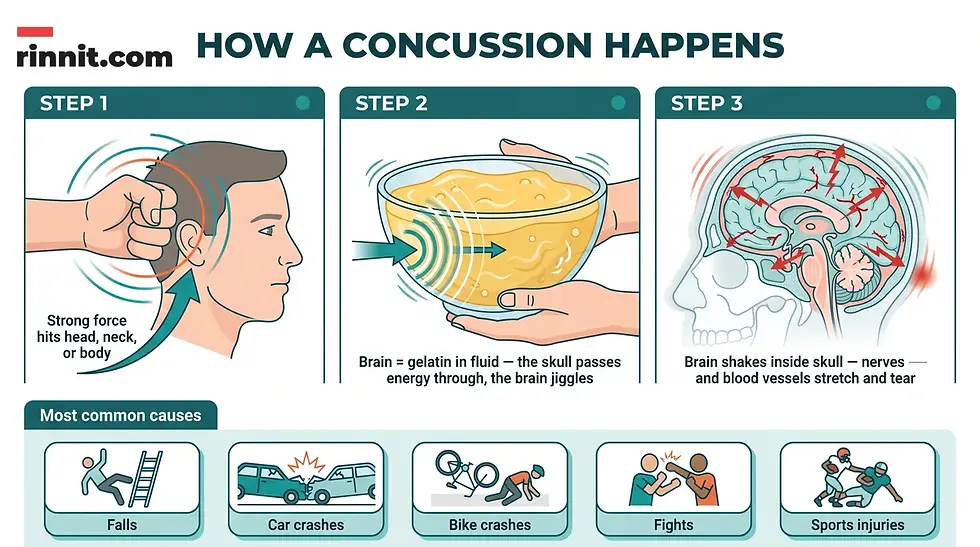
Common Causes
Cause | Examples |
Falls | The most common cause across all ages |
Motor vehicle accidents | Cars, trucks, motorcycles |
Bike accidents | Crashes and falls from bicycles |
Physical violence | Fights or assaults |
Sports injuries | Contact and collision sports |
What Are the Risk Factors?
Anyone can experience a concussion. Your risk is higher if you are older than 65 or younger than 4 (or have any increased risk of falling), work in a physically demanding job such as carpentry, landscaping, or construction, are a teen or adolescent, play physically demanding or contact sports, or have had a concussion in the past.
Teens experience more concussions than any other age group. Researchers believe this is because their brains and bodies are still developing, and they do not always have full control of their coordination.
How Is a Concussion Diagnosed?
Only a healthcare provider can diagnose a concussion. It is important to see a provider if you hit your head, experience an injury, or think you have any concussion symptoms.
Your provider will diagnose a concussion with a physical exam, a neurological exam, or a specific concussion test [6]. They will ask about your symptoms and when they first started. Tell them if you know the exact moment the injury happened and how long it took for symptoms to appear.
During the exam, your provider will check your reflexes, balance, coordination, and other neurological functions [6]. They will also check your vision, including your eye reflexes and your response and sensitivity to light, as well as your hearing, strength, and neck muscles.
You may be given tests or puzzles to evaluate your problem-solving skills, memory, and ability to concentrate. These tests may be written, verbal, or technology-based, such as on a computer or tablet. Tell your provider if any part of the exam feels unusually hard or makes your symptoms worse. You know your mind and body better than anyone.
Can a CT Scan or MRI Diagnose a Concussion?
Imaging tests cannot diagnose a concussion [5]. However, your provider may order a CT scan (computed tomography scan) or an MRI (magnetic resonance imaging) to look for serious complications like bleeding in or around your brain [5] [6].
How Is a Concussion Treated?
Rest is the most important part of treating a concussion, especially at first [6]. Your brain and body need time to heal. You will need to take a break from all intense physical exercise, especially the sport or activity that caused the concussion.
Most people need at least a few days of little or no activity. Everyone's needs are different, and everyone's brain heals at a different rate. Your provider will recommend how long to rest and when it is safe to slowly resume physical or mentally challenging activities.
Learn to recognize the triggers that bring on concussion symptoms. Start adding activities back to your daily routine slowly, in small amounts [5] [6]. When symptoms occur, back off and rest. Once you feel better, you can try the activity again, but be prepared to take another break if the symptoms return. Pace yourself. Do not push your body to do things that make you feel worse. It is OK to take the time you need to rest and heal.

What Should You NOT Do After a Concussion?
Any activity that takes a lot of concentration may trigger concussion symptoms [6]. For the first day or two especially, you may need to avoid using your phone, watching TV, playing video games, reading, studying, working, and physical activity or exercise.
You may also need to avoid driving, traveling or taking public transportation, doing certain chores around your home or yard, and drinking alcohol. Your provider may recommend time off work, or that your child stay home from school for a few days. They will tell you when it is okay to gradually ease back into work or schoolwork based on how your symptoms improve.
Can You Sleep With a Concussion?
Yes. Sleep is an extremely important part of recovering from a concussion [1]. It is a common myth that you should not let someone with a concussion fall asleep or stay asleep. Another common myth is that you must wake them up every few hours to make sure they are OK. Both of these are outdated assumptions and are not true or necessary.
Sleep as often and as long as you naturally need to. If you are caring for someone with a concussion, it is fine to check on them every few hours to make sure they are breathing normally and not tossing and turning restlessly. You do not need to forcibly wake them up.
Can You Take Medication After a Concussion?
You should not take any over-the-counter (OTC) pain medications if you think you have a concussion before you see a healthcare provider. Many of these medications thin your blood, which can be extremely dangerous if you have a brain bleed.
Your provider will tell you which medications are safe. You may need to avoid NSAIDs like naproxen or ibuprofen, but it may be safe to take acetaminophen [5]. Tell your provider about any prescription medications and over-the-counter supplements you use.
How Long Does a Concussion Last?
Concussions usually last a few weeks, up to a month [2] [5]. But everyone's body responds differently. Some people heal faster and others take more time. This does not usually mean you are more or less likely to have complications.
How long your brain takes to heal depends on what caused the concussion, whether you had any other injuries, whether you develop any complications, and how severe your symptoms are.
Talk to your provider before resuming your usual daily routine. Do not return to exercise, training, or playing sports until your provider says it is safe [5] [6]. Giving your body the time it needs to heal does not mean you are weak. And rushing your recovery to get back to practice, games, or training does not mean you are extra tough. Your brain will heal at its own pace, and the only thing you can do to help it along is rest.
What Are the Complications of a Concussion?
Concussions, especially repeated ones, can cause serious complications.
Complication | What It Is |
Post-concussion syndrome (PCS) | Recovery takes an unusually long time; symptoms last four months, a year, or even longer |
Intracranial hemorrhage | Bleeding inside your skull or brain |
Cerebral edema | Swelling in your brain |
Midline shift | Your brain moving off-center inside your skull |
Skull fractures | Breaks in the bones of the skull |
Second-impact syndrome (SIS) | A second, more serious concussion after returning to activities too soon; can be fatal |
Chronic traumatic encephalopathy (CTE) | Damage to how brain areas function and communicate, linked to repeated head injuries |
People who have had one concussion have an increased risk of another, more serious concussion if they return to physical activities or sports too soon [5]. Providers call this second-impact syndrome, or SIS. SIS increases your risk of severe complications like brain swelling and bleeding, and it can be fatal [5].
Experiencing multiple concussions and other head injuries also increases your risk of chronic traumatic encephalopathy (CTE) [5], which affects how areas of your brain function, communicate, and work with each other. Repeated concussions may also increase your risk of depression or other mental health conditions, dementia, and memory loss.
How Can You Prevent a Concussion?
Concussions happen suddenly, so you cannot always prevent one, but general safety tips can reduce your risk. These general safety tips can reduce your risk:
Prevention Step | How It Helps |
Wear the right protective equipment | Helmets or protective headwear for all activities and sports |
Always wear your seatbelt | Protects you in motor vehicle crashes |
Keep spaces clutter-free | Removes trip hazards at home and in your workspace |
Use proper reaching tools |
When Should You Go to the Emergency Room?
Go to the emergency room if you experience a head injury and have any concussion symptoms, even if they do not start for hours or days.
Go to the ER or call 911 (or your local emergency services number) right away if you experience any of the following [5] [6]:
Emergency Sign | Why It Matters |
Severe headache that keeps getting worse | Possible brain bleed |
Seizures | Sign of serious brain complication |
Loss of consciousness | Needs immediate evaluation |
Severe dizziness, loss of balance, or trouble walking | Sign of a severe complication |
Vomiting more than once | Possible brain bleed |
Severe confusion, trouble recognizing people or places | Possible brain bleed |
Clear, watery discharge from your nose or ears | Possible skull fracture or fluid leak |
Bleeding from your ears | Sign of a severe complication |
Numbness, weakness, or tingling in arms or legs | Possible nerve or brain injury |
Slurred speech | Possible brain bleed |
One pupil bigger than the other (anisocoria) | Sign of a severe complication |
These symptoms can all be signs of a severe complication like a brain bleed. Do not wait them out.
What Questions Should I Ask My Doctor?
Good questions to ask your provider include: Which tests will I need? What is my risk of complications? Which symptoms should I keep an eye out for? How long should I rest? What activities are safe for me while I recover?
Outlook: What Happens After a Concussion?
Your brain and body are totally unique to you, and that means how you experience and recover from a concussion will be too. Recovery does not always happen the way we expect, and it might take more or less time at certain stages. Be honest with yourself and your healthcare providers as you recover.
It is scary to think about having a brain injury, especially if your child gets a concussion. But most people recover with no long-term effects or complications [5] [6]. The key is not rushing your recovery. The best thing for your brain is to give it all the time it naturally needs to heal itself.
Conclusion
A concussion is a common but real brain injury. It happens when the brain moves or twists inside the skull, stretching and injuring nerves and blood vessels. Most people recover fully within a few weeks to a month [2] [5], and the best treatment is simple: rest, patience, and a careful, gradual return to normal activities. The biggest dangers come from rushing back too soon: returning to sports or work before your provider clears you raises the risk of second-impact syndrome and long-term brain problems [5]. Listen to your body, watch for the emergency warning signs, and let your provider guide your recovery.
If you or someone you care about is dealing with a concussion and you want clear, reliable guidance on recovery, visit Rinnit.com for more easy-to-understand health resources.
Frequently Asked Questions
What is a concussion?
A concussion is a head injury that happens when your brain moves or twists inside your skull. It is a type of traumatic brain injury (TBI). It is one of the most common, and most commonly misunderstood, injuries people experience.
Is a concussion the same as a traumatic brain injury?
A concussion is a type of traumatic brain injury. All concussions are TBIs, but not all TBIs are concussions. Concussions are generally the milder form of TBI.
Is a concussion life-threatening?
Concussions are usually not life-threatening. But their effects can be serious and last for days, weeks, or even longer, so every concussion should be taken seriously.
Does one concussion cause permanent brain damage?
Usually not. One concussion usually does not cause permanent brain damage. However, multiple concussions over a lifetime can change your brain's structure or how it works and can increase your risk of serious health conditions.
How common are concussions?
Very common. Experts estimate that between 1 and 3 million people visit the emergency room with a concussion in the U.S. each year. Concussions account for more than half of ER visits for kids ages 5 to 18 every year.
Who is most likely to get a concussion?
Teens experience more concussions than any other age group. People at higher risk also include adults over 65, children under 4, people with physically demanding jobs, contact-sport athletes, and anyone who has had a concussion before.
What causes a concussion?
Anything that strongly jolts or shakes your body can cause one. The most common causes are falls, motor vehicle accidents, bike accidents, physical violence, and sports injuries.
Why does the brain get damaged without a direct hit?
A strong force hitting your head, neck, or body passes through your skull into your brain and makes your brain shake or wiggle. This can twist and damage the tiny nerves and blood vessels in your brain. Think of a bowl of gelatin: smack the bowl and the gelatin jiggles.
What are the physical symptoms of a concussion?
Physical symptoms can include headache or head pressure, neck pain, balance problems and dizziness, lightheadedness, nausea and vomiting, double or blurred vision, sensitivity to light or sound, ringing in the ears, and temporary loss of consciousness.
What are the cognitive symptoms of a concussion?
Cognitive symptoms can include confusion, feeling like you are in a fog or not your usual self, trouble concentrating or focusing, and amnesia or short-term memory loss.
Can a concussion affect sleep?
Yes. A concussion can disrupt your circadian rhythm, the body's natural sleep cycle. You may feel drowsy or fatigued, have trouble falling or staying asleep, or sleep more or less than usual.
Can a concussion affect mood?
Yes. Emotional symptoms can include irritability, mood swings, depression or sadness, and new or increased anxiety or nervousness.
When do concussion symptoms start?
Symptoms may start right away, but some people do not notice them for hours or even days after the injury.
How can I tell if a baby has a concussion?
Watch for fussing or crying more than usual, refusing to eat or nurse, a blank stare, unusual crankiness even after normal naps, and sudden changes in sleeping patterns.
Can imaging tests diagnose a concussion?
No. CT scans and MRIs cannot diagnose a concussion. They may be ordered to look for serious complications like bleeding in or around the brain. Only a healthcare provider can diagnose a concussion through a physical exam, neurological exam, or concussion test.
What is the best treatment for a concussion?
Rest is the most important part of treating a concussion, especially at first. Your brain and body need time to heal. Your provider will advise how long to rest and when it is safe to slowly resume activities.
How long should I rest after a concussion?
Most people need at least a few days of little or no activity. Everyone's brain heals at a different rate, so follow your provider's guidance on how long to rest and when to ease back into activities.
Should I avoid screens after a concussion?
Yes, especially for the first day or two. Activities that take a lot of concentration, like using your phone, watching TV, playing video games, reading, studying, or working, may trigger symptoms. Ease back in slowly in small amounts.
Is it safe to sleep after a concussion?
Yes. Sleep is extremely important to recovery. The old advice to keep someone awake or wake them every few hours is a myth and is not true or necessary.
Can I take pain medication after a concussion?
Do not take any over-the-counter pain medication before seeing a healthcare provider, because many thin your blood and can be dangerous if you have a brain bleed. Your provider will tell you what is safe; acetaminophen may be okay, while NSAIDs like ibuprofen may need to be avoided.
How long does a concussion last?
Concussions usually last a few weeks, up to a month. Healing time depends on what caused the concussion, whether you had other injuries, whether complications develop, and how severe your symptoms are.
What is post-concussion syndrome?
Post-concussion syndrome (PCS) happens when recovering from a concussion takes an unusually long time. Symptoms can last four months, a year, or even longer after the original injury.
What is second-impact syndrome?
Second-impact syndrome (SIS) is when someone who has had one concussion gets another, more serious concussion because they returned to physical activities or sports too soon. It increases the risk of severe complications like brain swelling and bleeding and can be fatal.
Can repeated concussions cause long-term problems?
Yes. Multiple concussions and head injuries increase your risk of chronic traumatic encephalopathy (CTE), as well as depression or other mental health conditions, dementia, and memory loss.
How can I prevent a concussion?
You cannot always prevent one since they happen suddenly, but you can reduce your risk by wearing helmets or protective headwear, always wearing your seatbelt, keeping your home and workspace free of trip clutter, and never standing on chairs, tables, or countertops to reach things.
When should I go to the ER for a concussion?
Go to the ER or call 911 right away for a severe headache that keeps getting worse, seizures, loss of consciousness, severe dizziness or balance loss, vomiting more than once, severe confusion, clear watery discharge from your nose or ears, bleeding from your ears, numbness or weakness in your arms or legs, slurred speech, or one pupil bigger than the other.
Can I play sports after a concussion?
Not until your provider says it is safe. Returning to exercise, training, or sports too soon raises the risk of a second, more serious concussion. There is no shortcut: rest is the only way to help your brain heal.
Related Reading
Learn more in our guide to Glasgow Coma Scale (GCS): Scoring Chart, What Scores Mean and GCS-P.
Neuropsychological Testing: What It Is, Why It's Done, What to Expect and Results explains how neuropsychological testing measures memory, attention, language and other thinking skills.
Learn more in our guide to Concussion Test: Types, What It Checks and What Results Mean.
References
Leddy JJ, Burma JS, Toomey CM, et al. Rest and exercise early after sport-related concussion: a systematic review and meta-analysis. Br J Sports Med. 2023;57(12):762-770. PMID 37316185. https://doi.org/10.1136/bjsports-2022-106676
Putukian M, Purcell L, Schneider KJ, et al. Clinical recovery from concussion-return to school and sport: a systematic review and meta-analysis. Br J Sports Med. 2023;57(12):798-809. PMID 37316183. https://doi.org/10.1136/bjsports-2022-106682
Broglio SP, Register-Mihalik JK, Guskiewicz KM, et al. National Athletic Trainers' Association Bridge Statement: Management of Sport-Related Concussion. J Athl Train. 2024;59(3):225-242. PMID 38530653. https://doi.org/10.4085/1062-6050-0046.22
Ferry B, DeCastro A. Concussion. StatPearls (NCBI Bookshelf). Last update January 9, 2023. PMID 30725702. https://www.ncbi.nlm.nih.gov/books/NBK537017/
Mao G. Sports-Related Concussion. Merck Manual Professional Version. Full review October 2024. https://www.merckmanuals.com/professional/injuries-poisoning/traumatic-brain-injury-tbi/sports-related-concussion
National Library of Medicine. Concussion. MedlinePlus. Last updated November 24, 2025. https://medlineplus.gov/concussion.html
Medical disclaimer
This article is for general informational purposes only and is not a substitute for professional medical advice, diagnosis, or treatment. Always seek the advice of a qualified healthcare provider with any questions you may have about a medical condition. If you experience a head injury with any emergency symptoms, such as a worsening severe headache, seizures, loss of consciousness, or vomiting more than once, go to the nearest emergency room or call 911 immediately. Never ignore professional medical advice or delay seeking it because of something you have read in this article.



Comments