Concussion Test: Types, What It Checks and What Results Mean

Updated: 2 days ago
Written and medically reviewed by Dr. Baraa Alnahhal, MD · Last reviewed: November 2026 · How we review
Quick Answer: What is a concussion test?
A concussion test is a set of questions, symptom checklists and simple tasks that check how the brain is working after a bump, blow or jolt to the head. It looks at alertness, memory, attention, vision, balance and coordination. It's only one part of the diagnosis: a provider also does a full exam and may order imaging. [1]
What the research says
A blood test can help rule out bleeding in the brain. In 1,959 adults seen in emergency departments with a suspected head injury, a test combining two brain proteins (UCH-L1 and GFAP) picked up 97.6% of the injuries later seen on a head CT scan, and a negative result was correct 99.6% of the time. (Bazarian et al., The Lancet Neurology, 2018) [2]
Sideline eye-movement tests help, but shouldn't be used alone. A meta-analysis of the King-Devick test in adult athletes found a pooled sensitivity of 77% and specificity of 82%. The evidence was rated very low certainty, so the authors advise using it together with tools such as the SCAT. (Harris et al., The American Journal of Sports Medicine, 2022) [3]
A slower reading time can signal head trauma. In 39 boxers and mixed martial arts fighters, those who took head blows during a fight were much slower on the King-Devick test afterward (59.1 vs 41.0 seconds). A drop of 5 seconds or more was seen only in fighters with head trauma. (Galetta et al., Neurology, 2011) [4]
Key takeaways
A concussion test checks brain function after a head injury, including memory, attention, thinking speed, vision and balance. [1]
Most concussion tests are questionnaires or symptom checklists, and each has its own scoring system. [1]
Common tests include the SAC, SCAT5, King-Devick test, BESS balance test, PCSS and ImPACT. [1]
Most people with a concussion never lose consciousness, so every head injury should be checked. [1]
A concussion test doesn't replace a medical exam; your provider may also order an MRI, CT scan or a blood test. [1]
An athlete with a suspected concussion should never return to play the same day. [1]
What is a concussion?
A concussion is a mild traumatic brain injury caused by a bump, violent jolt or blow to the head. A strong hit to the body that jerks your head forward, backward or to the side can cause one too. The injury disrupts normal brain function. [1]
A common myth is that you only have a concussion if you pass out. In fact, most people who have a concussion never lose consciousness, and some don't even know they've had one. That's why it's important to get checked even if the knock to the head doesn't seem serious. [1]
Concussion symptoms to watch for
The most common symptoms of a concussion include: [1]
Headache, the most common symptom
Nausea or vomiting
Confusion
Temporary loss of consciousness
Balance problems, dizziness or lightheadedness
Double vision or blurry vision
Ringing in the ears
Sensitivity to light and noise
Feeling tired or drowsy
Sleeping much more or less than usual, or not being able to sleep
Trouble understanding or concentrating
Feeling sad, irritable, nervous or anxious
Feeling "just not right" or in a fog, with trouble paying attention or remembering things
When should you get a concussion test?
Anyone who has a hit to the head or a whiplash-like head movement should be checked for a concussion. Concussion testing checks your cognition, which is your brain's ability to think and process information, after a head injury. [1]
Testing helps your provider make an early diagnosis, which allows earlier planning and care. Repeating the test over time also shows how well your brain is recovering. [1]
What does a concussion test check?
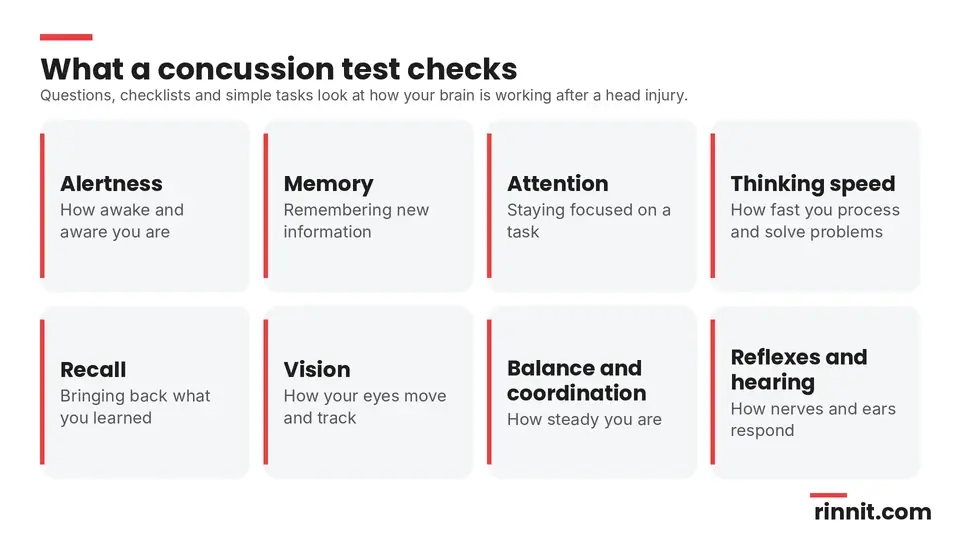
Concussion tests range from very simple checks, usually done by people who aren't healthcare professionals, to very detailed exams done by healthcare providers. They use spoken, written or computerized tasks to check: [1]
Brain function | What the test looks at |
Alertness | How awake and aware you are |
Memory | Remembering new and recent information |
Attention and concentration | Staying focused on a task |
Speed of thinking | How quickly you process information and solve problems |
Recall | Bringing back information you learned earlier |
Vision | How your eyes move, focus and track |
Balance and coordination | How steady you are and how well your body moves together |
Reflexes and hearing | How your nerves and ears respond |
Sources: [1]
Types of concussion tests
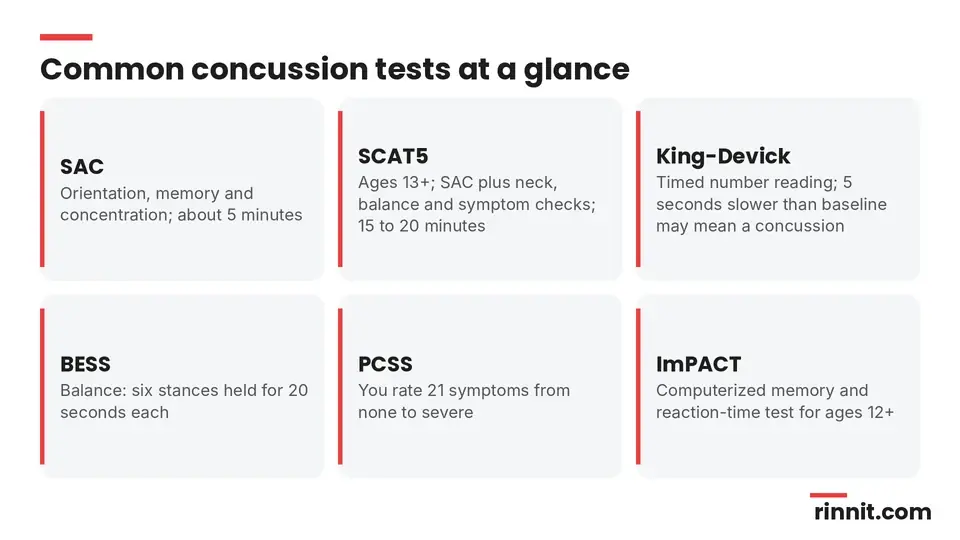
There are many named concussion tests. Some are given by athletic trainers, coaches or sports medicine physicians, some are self-reported checklists you fill in yourself, and others are tools used by healthcare providers such as neurologists. [1]
Test | What it checks | Key details |
SAC (Standardized Assessment of Concussion) | Orientation, immediate memory, concentration and delayed memory | Used on the sidelines and in the emergency room; takes about 5 minutes |
SCAT5 (Sport Concussion Assessment Tool 5) | The SAC plus a neck exam, balance test and yes/no symptom checklist | For ages 13 and older; takes 15 to 20 minutes; a child version covers ages 6 to 12 |
MACE (Military Acute Concussion Evaluation) | Details of the injury event and concussion signs and symptoms | Includes a version of the SAC test |
King-Devick test | How fast you read random numbers on three cards | Timed before the season; finishing 5 seconds slower after a hit may mean a concussion |
BESS (Balance Error Scoring System) | Balance | Six stances, each held for 20 seconds with eyes closed and hands on hips |
ACE (Acute Concussion Evaluation) | Concussion features, a 22-symptom checklist and risk factors that may lengthen recovery | Used by healthcare providers |
PCSS (Post-Concussion Symptom Scale) | 21 symptoms ranked from none to severe | Self-reported at baseline and at later time points |
ImPACT | History, a 22-symptom checklist, memory, reaction time and visual processing speed | Computerized test for ages 12 and up, with a pediatric version |
Sources: [1]
What the SAC test asks
The SAC checks an athlete's immediate mental state. Typical questions include: [1]
Stating the date, month, year, day of the week and the current time
Memorizing a list of words and then recalling them
Repeating a sequence of numbers backward
Saying the months of the year in reverse order
How the BESS balance test works
The BESS uses six stances: three on a firm surface and the same three on an unstable surface, such as medium-density foam. The stances are feet shoulder-width apart, one foot in front of the other, and standing on your non-dominant leg. You keep your eyes closed and your hands on your hips, and you hold each stance for 20 seconds. [1]
What the ACE form covers
The ACE collects details that help your provider plan care, including the cause of the concussion, early signs, memory problems, loss of consciousness, past concussions and headaches, learning disabilities or ADHD, mental health history such as anxiety, depression or sleep problems, emergency symptoms, and the diagnosis and follow-up plan. [1]
Baseline and sideline concussion tests
Student athletes in contact sports often take a baseline test before their season starts. It measures normal brain function, including memory, speed of thinking and attention, and computerized versions can feel a bit like playing a video game. If the athlete has a head injury during the season, they're removed from play and retested, and the new results are compared with the preseason results. [1]
A sideline evaluation is a quick check for an athlete who may have a concussion. Typical questions include: [1]
Naming the opponent and stating the score, which tests short-term memory
Saying your name and date of birth, which tests long-term memory
Naming the months of the year in reverse order, which is a complex task
Important: A player who has taken a blow to the head or may have a concussion should never return to the game. No athlete under 18 with a suspected concussion should return to sport the same day, and all 50 US states have laws that keep young athletes with a suspected concussion out of practice or games until a medical professional assesses and clears them. [1]
How doctors diagnose a concussion
Concussion screening tools don't replace a medical evaluation. If a medical professional didn't give the test, you should still see your healthcare provider. Your provider or neurology team will do a complete exam, including balance and vision checks, and may order: [1]
Cleveland Clinic has also developed its own concussion app, C3 Logix, which compares measurements after an injury with an athlete's baseline for balance, information processing, reaction time, coordination and vision. [1]
The concussion eye test
Your pupils (the black part of your eyes) should be round and about the same size, and they should quickly get smaller when light shines on them. One simple check is shining a low-beam flashlight from the outer edge of each eye inward. A slow pupil response may be a sign of brain injury with raised pressure inside the skull. Pupils that don't react to light at all may mean a severe rise in pressure or severe brain damage, and an oval pupil can also be a sign of raised pressure. [1]
Quick checks you can do at home

Only medical professionals can examine someone and diagnose a concussion. But if you're with a parent, child or friend when they fall and hit their head, a few simple questions can give their provider useful information. Ask your loved one to: [1]
State their name, where they are, the time and date, and what just happened
Spell the word "world" backward
Tell you if they have a headache or feel dizzy or nauseous
Follow your finger with both eyes as you draw a large "x" in front of them
Tell you if they feel weakness, numbness or tingling anywhere in their body
Also notice whether their speech is normal or slurred, whether their pupils are the same size, whether light or sound bothers them, and whether they're becoming more restless, agitated or confused. If anything changes, call their healthcare provider right away. No head injury is too small to be checked. [1]
What do concussion test results mean?
Each concussion test has its own scoring system, and you may take more than one. If your test results and other findings show a concussion, your provider will make a recovery plan with you. The plan usually includes: [1]
Getting more rest and sleep than normal, but not too much, because too much mental rest can lengthen recovery
Learning which activities trigger your symptoms, and backing off to rest when they appear
Adding activities back into your day as your symptoms improve
A return-to-school plan to share with teachers, school nurses, counselors or psychologists
Following the school's or team's concussion protocol with athletic trainers and others involved in care
Early diagnosis and management of a concussion can help you recover faster and may prevent further injury. [1]
When to get emergency care
Get emergency care right away if someone has a seizure, a headache that keeps getting worse, slurred speech, or weakness or numbness after a head injury. Also call 911 or go to the ER for repeated vomiting, one pupil larger than the other, being very drowsy or hard to wake, growing confusion or agitation, or any loss of consciousness. [1]
Questions to ask your provider
Which concussion test did I have, and what did my score show?
Do I need a CT scan, MRI or blood test?
Which activities should I limit, and for how long?
When can I go back to school, work or sports?
Which symptoms mean I should come back right away?
Conclusion
A concussion test is a quick, simple way to check memory, attention, thinking speed, vision and balance after a blow to the head. It helps your provider spot a concussion early and track your recovery, but it's never the whole picture. A full exam, and sometimes imaging or a blood test, completes the diagnosis.
If you or someone you care for hits their head, get checked, even without passing out. Athletes should never return to play the same day without clearance from a medical professional.
Keep learning: Read our guides to the Glasgow Coma Scale, the CT scan, MRI and the eye exam.
FAQ
What is a concussion test?
A concussion test is a set of questions, symptom checklists and simple tasks that check brain function after a head injury, including memory, attention, thinking speed, vision and balance. [1]
Can a concussion test diagnose a concussion on its own?
No. It's one tool. A healthcare provider also does a complete exam and may order imaging or a blood test. [1]
What is the SCAT5?
The Sport Concussion Assessment Tool 5 is a 15- to 20-minute evaluation for people 13 and older that includes the SAC, a neck and balance exam and a symptom checklist. [1]
How long does the SAC test take?
The SAC takes about five minutes. [1]
What is the King-Devick test?
It's a timed test of reading numbers on three cards. Finishing 5 seconds slower than your baseline after a hit may mean a concussion. [1]
What is a baseline concussion test?
It's a preseason test that records your normal memory, thinking speed and attention so results after an injury can be compared with it. [1]
Can I check for a concussion at home?
Only a medical professional can diagnose a concussion, but simple questions about name, place, time and symptoms can give the provider useful information. [1]
Do you have to pass out to have a concussion?
No. Most people who have a concussion never lose consciousness. [1]
Is there a blood test for concussion?
Yes. The brain trauma indicator measures proteins released into the blood after a mild traumatic brain injury and may point to bleeding in the brain. [1]
When can an athlete return to play after a concussion?
Never the same day. A medical professional must assess the athlete and clear them first. [1]
Related Reading
PERRLA Eye Exam: What It Means and What Pupil Changes Can Show explains the quick pupil check used in eye and neurological exams.
Learn more in our guide to Concussion: What It Is, What It Feels Like, and How to Recover Safely.
Learn more in our guide to Post-Concussion Syndrome: Symptoms, Causes, and Treatment — What to Do When Concussion Symptoms Last.
Learn more in our guide to Traumatic Brain Injury: Symptoms, Emergency Signs, Diagnosis and Recovery.
References
Cleveland Clinic. Concussion Test: Assessment Types & How to Interpret Results. Cleveland Clinic. Last updated January 12, 2022. https://my.clevelandclinic.org/health/diagnostics/22267-concussion-test
Bazarian JJ, Biberthaler P, Welch RD, et al. Serum GFAP and UCH-L1 for prediction of absence of intracranial injuries on head CT (ALERT-TBI): a multicentre observational study. Lancet Neurol. 2018;17(9):782-789. PMID 30054151. https://doi.org/10.1016/S1474-4422(18)30231-X
Harris SA, Dempsey AR, Mackie K, et al. Do Sideline Tests of Vestibular and Oculomotor Function Accurately Diagnose Sports-Related Concussion in Adults? A Systematic Review and Meta-analysis. Am J Sports Med. 2022;50(9):2542-2551. PMID 34432554. https://doi.org/10.1177/03635465211027946
Galetta KM, Barrett J, Allen M, et al. The King-Devick test as a determinant of head trauma and concussion in boxers and MMA fighters. Neurology. 2011;76(17):1456-1462. PMID 21288984. https://doi.org/10.1212/WNL.0b013e31821184c9
Medical disclaimer
This article is for general education only and does not replace advice from a qualified healthcare professional. Talk to your doctor about your own diagnosis and treatment, and seek emergency care right away for severe or sudden symptoms.



Comments