PERRLA Eye Exam: What It Means and What Pupil Changes Can Show

Updated: 3 days ago
Written and medically reviewed by Dr. Baraa Alnahhal, MD · Last reviewed: November 2026 · How we review
Quick Answer
PERRLA is a quick eye check that stands for pupils equal, round, reactive to light and accommodation. A provider uses a light and a target to see whether the pupils are the same size, round, shrink in light and adjust when you focus near and far. Abnormal findings can point to eye problems or brain problems such as stroke.
What the research says
A small pupil difference is often normal: in 128 healthy people photographed repeatedly over five days, about 19% had unequal pupils of 0.4 mm or more at any single exam, and 41% had it at some point (Lam BL et al., American Journal of Ophthalmology, 1987) [2]
Pupil reactions matter after head injury: in 8,721 people with moderate or severe traumatic brain injury, one or both unreactive pupils were strongly linked to a worse outcome at 6 months (Marmarou A et al., Journal of Neurotrauma, 2007) [3]
Key takeaways
PERRLA checks the size, shape and reactions of your pupils.
It takes a few minutes and is painless.
The swinging light test compares how each eye reacts.
Most results are normal and shared right away.
Abnormal results usually lead to more tests.
What PERRLA means
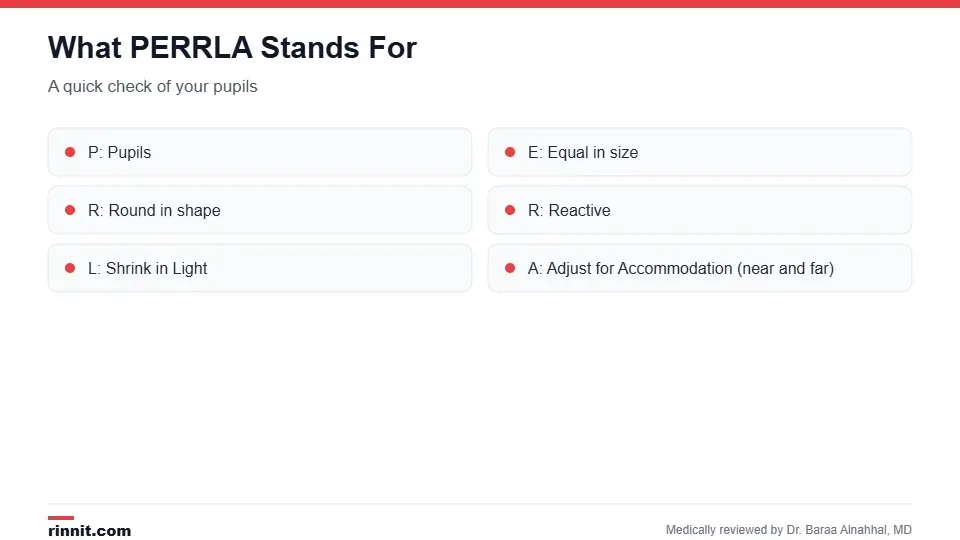
Each letter is one part of the check.
Letter | Stands for | What's checked |
P | Pupils | The black centers of the eyes |
E | Equal | Both pupils are about the same size |
R | Round | Each pupil is a smooth, even circle |
R | Reactive | Pupils change size in response to stimuli |
L | Light | Pupils shrink when light shines in |
A | Accommodation | Pupils shrink for near objects and widen for distant ones |
Sources: [1]
Why it's done
As part of a routine eye exam or physical.
During a neurological exam.
In emergencies, especially after a head injury.
After an eye injury or with new vision or neurological symptoms. Sources: [1]
Your pupils are controlled by nerves that run between your eyes and brain, so how they react can reveal problems along those pathways. Sources: [1]
How the test is done
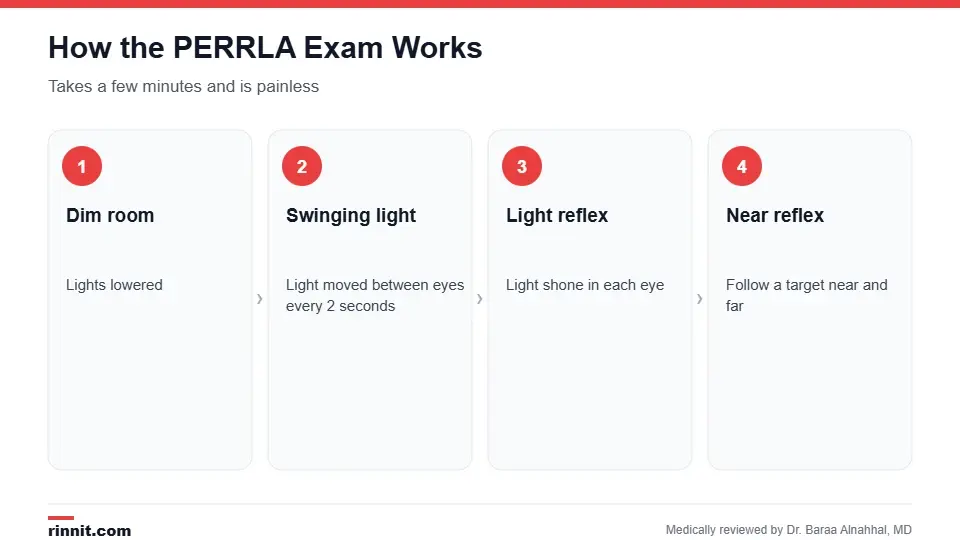
The check takes only a few minutes.
The room lights are dimmed.
Swinging light test: your provider moves a small light back and forth between your eyes about every two seconds to compare their reactions.
Light reflex test: light is shone into each eye in turn to see whether the pupils shrink.
Near reflex (accommodation) test: you follow a target as it moves far away, close in and side to side while your provider watches your pupils. Sources: [1]
What abnormal results may mean

More tests are needed to find the cause.
Category | Possible causes |
Eye and nerve | Anisocoria (unequal pupils), Adie's pupil, Argyll Robertson pupils (a sign of late-stage syphilis), eye injury, glaucoma, Horner syndrome, optic neuritis |
Brain | Aneurysm, brain lesion or tumor, concussion, seizure, stroke |
A small difference in pupil size can be normal in some people. An abnormal result doesn't give a diagnosis by itself, so your provider may order more eye tests or brain imaging. Sources: [1]
Results
Results are usually shared right away. If something looks unusual, you may be referred to an ophthalmologist or neurologist. Sudden changes in pupil size, especially with headache, confusion, weakness or after a head injury, need emergency care. Sources: [1]
Conclusion
PERRLA is a simple, fast way to check that your pupils look and work normally. Because the pupils are linked to the brain, this small check can give important early clues about eye, nerve and brain health.
Keep learning: read about the eye exam and anisocoria.
Frequently asked questions
What does PERRLA stand for?
Pupils equal, round, reactive to light and accommodation.
Why is the PERRLA test done?
To check that your pupils look and work normally.
Does the PERRLA test hurt?
No. It's quick and painless.
How long does it take?
A few minutes.
What is the swinging light test?
A light moved between your eyes to compare how each pupil reacts.
What is accommodation?
How your pupils change when you focus near and far.
Is a small difference in pupil size normal?
It can be in some people.
What can abnormal results mean?
Eye, nerve or brain problems that need more testing.
Is PERRLA used after head injuries?
Yes. It's a key part of emergency checks.
When will I get results?
Usually right away.
Related Reading
Eye Exam: What Happens, Tests Included and How Often to Go the full exam where PERRLA is often done.
Anisocoria (Unequal Pupil Size): Causes, Symptoms, and When It's an Emergency when pupils are different sizes.
Horner Syndrome: Symptoms, Causes, and How It Is Diagnosed a nerve condition that affects the pupil.
Pupil of the Eye: Function, Anatomy, Conditions and Care how the pupil works.
Concussion Test: Types, What It Checks and What Results Mean other checks used after head injuries.
References
Cleveland Clinic. PERRLA Eye Exam. Cleveland Clinic. Last updated October 25, 2023. https://my.clevelandclinic.org/health/diagnostics/perrla-eye-exam
Lam BL, Thompson HS, Corbett JJ. The prevalence of simple anisocoria. American Journal of Ophthalmology. 1987;104(1):69-73. PMID 3605282. https://doi.org/10.1016/0002-9394(87)90296-0
Marmarou A, Lu J, Butcher I, et al. Prognostic value of the Glasgow Coma Scale and pupil reactivity in traumatic brain injury assessed pre-hospital and on enrollment: an IMPACT analysis. Journal of Neurotrauma. 2007;24(2):270-280. PMID 17375991. https://doi.org/10.1089/neu.2006.0029
Medical disclaimer
This article is for general education only and does not replace advice from a qualified healthcare professional. Talk to your doctor about your own diagnosis and treatment, and seek emergency care right away for severe or sudden symptoms.



Comments