Anisocoria (Unequal Pupil Size): Causes, Symptoms, and When It's an Emergency

Updated: 2 days ago
Medically reviewed by Dr. Baraa Alnahhal, MD · Last reviewed: September 2026
TL;DR
Anisocoria is the medical term for having one pupil noticeably bigger than the other. It affects about 15% of people at some point in life and is often a temporary reaction to things like migraines, medications, or eye injuries. However, because unequal pupils can also be the first sign of a stroke, brain aneurysm, or serious infection, any sudden change in pupil size requires prompt medical evaluation — and emergency care if it comes with eye pain or vision changes.
Quick Answer
What it is: Anisocoria means one pupil is stuck noticeably larger than the other, while the other pupil responds to light normally. It may be visible in a mirror or a selfie.
How common: Roughly 15% of people experience anisocoria at some point in their lives; some babies are born with it.
Is it an emergency: Unequal pupils on their own are usually temporary, but if they appear suddenly alongside eye pain, blurry or double vision, light sensitivity, or sudden vision loss, go to the emergency room right away.
How it's handled: There is no treatment for the pupils themselves — doctors diagnose and treat the underlying cause, and most people's pupils return to normal size once that cause is resolved.
What Is Anisocoria?
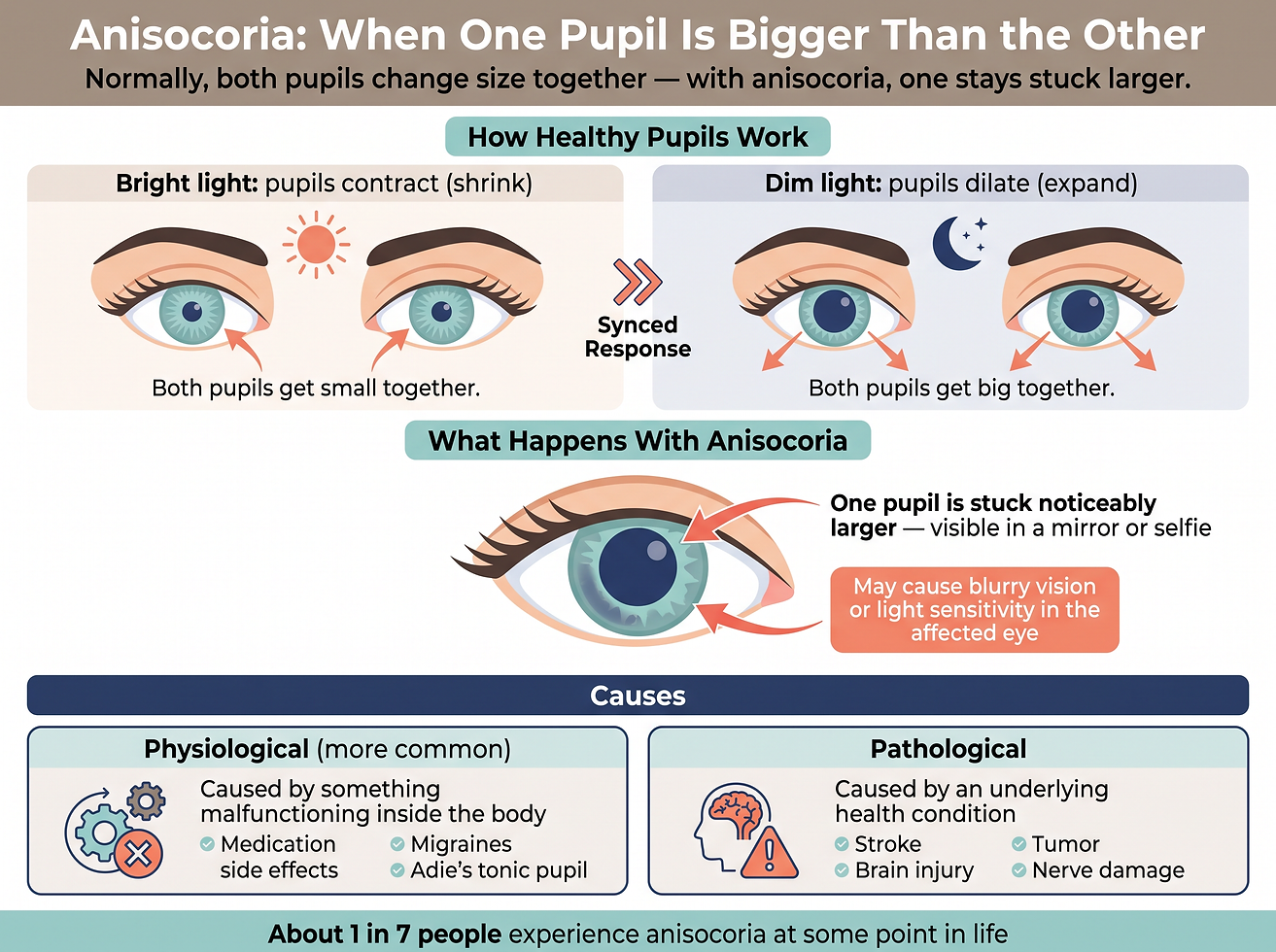
The pupil is the black center of the eye. It acts like a camera aperture, changing size automatically throughout the day to help you see in different amounts of light. In bright light, the pupil contracts (shrinks); in dim light, it dilates (expands). Normally, both pupils do this together, in sync.
With anisocoria, that sync breaks. One pupil stays stuck noticeably larger than the other, and the difference is visible in a mirror or a selfie. Because one pupil can no longer adjust to light properly, some people also notice trouble seeing clearly or light sensitivity in the affected eye.
Anisocoria itself is not a disease — it is a sign that something else is going on, ranging from harmless to life-threatening. The condition is classified in two ways:
| Type | What It Means | How Common | | --- | --- | --- | | Physiological anisocoria | Caused by something temporarily malfunctioning inside the body, such as a medication reaction or migraine | More common | | Pathological anisocoria | Caused by an underlying health condition, such as a stroke, aneurysm, or infection | Less common but more serious |
Interestingly, doctors say the distinction between these two types matters less than getting evaluated right away. Because a doctor cannot always tell a benign cause from a dangerous one on appearance alone, every new case of unequal pupils deserves a proper exam.
How Common Is Anisocoria?
About 15% of people — roughly 1 in 7 — experience anisocoria at some point in their lives. Some babies are born with unequal pupils, a form called congenital anisocoria, but this also usually traces back to a health condition or another issue affecting the eyes.
| Fact | Detail | | --- | --- | | Lifetime prevalence | About 15% of people (roughly 1 in 7) | | Congenital form | Some babies are born with it; usually linked to a health condition | | Typical course | Often temporary; can resolve on its own once the cause is treated | | Emergency potential | Can be the first sign of stroke, aneurysm, or infection |
What Does Anisocoria Look and Feel Like?
The most obvious symptom is also the defining one: one pupil is noticeably bigger (more dilated) than the other. Beyond that, some people experience no other symptoms at all — and even then, a visit to an eye care specialist is still the right move.
The real urgency comes from the symptoms that accompany the size difference. Go to the emergency room immediately if one pupil is bigger and you have any of the following:
| Emergency Symptom | Medical Term | Why It Matters | | --- | --- | --- | | Eye pain | — | Signals possible acute pressure or nerve involvement | | Blurry vision | — | The affected pupil cannot regulate light properly | | Double vision | Diplopia | Suggests nerve or brain involvement | | Light sensitivity | Photophobia | The dilated pupil cannot constrict to protect the eye | | Sudden vision loss | — | A major red flag requiring immediate emergency care |
Other accompanying symptoms that warrant urgent (same-day) medical attention include fever, headaches, nausea or vomiting, and neck pain or stiffness — the last two in particular can point toward meningitis, a serious infection.
What Causes Anisocoria?
Because the pupil is controlled by nerves, blood vessels, and muscles, many different systems can cause it to get stuck. The causes fall into two broad tiers.
Most Common Causes
| Common Cause | How It Triggers Anisocoria | | --- | --- | | Migraine headaches | Nerve signals around the eye misfire during an attack | | Surgery side effects | Anesthesia, positioning, or post-operative medications affect pupil control | | Medicines | Eye drops, scopolamine skin patches, and some other drugs dilate one pupil | | Eye injuries and trauma | Damage to the head, eye, or the arteries supplying blood to them disrupts pupil control | | No known cause | Sometimes called idiopathic anisocoria — it happens without an identifiable trigger |
Serious, Potentially Fatal Causes
| Serious Cause | What Happens | | --- | --- | | Brain aneurysm | A bulging blood vessel presses on the nerves controlling the pupil | | Stroke | Interrupted blood flow damages brain regions that regulate the eyes | | Brain tumors | A growing mass compresses the nerves or pathways controlling pupil size | | Infections | Conditions like meningitis inflame tissues around the brain and nerves | | Certain cancers | Some cancers affect the nerves or structures around the eyes |
This is exactly why anisocoria is treated as a symptom to investigate rather than a condition to ignore. The same outward sign — one big pupil — can come from a harmless medication side effect or from a rupturing aneurysm. Only an exam can tell the difference.
How Is Anisocoria Diagnosed?
Diagnosis starts with an eye exam performed by an eye care specialist or another healthcare provider, along with a physical exam to check for other symptoms. Drops may be given during the exam to help the provider see inside the eye more easily.
| Diagnostic Step | Purpose | | --- | --- | | Eye exam | Confirms the pupil difference and checks eye health | | Physical exam | Looks for other symptoms that point to a cause | | Eye drops | Make the internal exam easier to perform | | MRI (magnetic resonance imaging) | Imaging to find structural causes in the brain | | CT scan (computed tomography) | Imaging to detect bleeding, tumors, or other abnormalities | | X-ray | Imaging test as part of the workup | | Blood tests or lumbar puncture | Ordered if an infection like meningitis is suspected |
Imaging tests are the key tool for finding the cause. If the imaging is clear and no other symptoms exist, the anisocoria is likely benign. If something shows up, treatment begins immediately.
How Is Anisocoria Treated?
Here is the crucial point about anisocoria treatment: doctors treat the cause, not the pupils. There is no treatment to "fix" unequal pupil size directly — the goal is to find and treat whatever is producing it.
| Scenario | Typical Approach | | --- | --- | | No other symptoms; serious conditions ruled out | No treatment needed; pupils may return to their usual size over time | | First sign of a serious condition | Treatment depends entirely on the cause (e.g., aneurysm repair, stroke treatment, infection treatment) | | Medication reaction | Removing or adjusting the drug typically resolves the pupil difference | | Migraine-related | The anisocoria usually goes away as the migraine resolves |
What Is the Outlook?
The outlook depends entirely on the cause. If the anisocoria comes from a migraine or a medication reaction, it often goes away on its own. If it is the first sign of an aneurysm or a stroke, it may mark the beginning of a condition that permanently changes a person's life.
For most people, though, anisocoria is a minor part of a larger health issue. As the underlying condition is treated, the pupils return to their usual size.
| Cause Category | Typical Outlook | | --- | --- | | Migraines, medication reactions | Resolve on their own | | Most other conditions | Pupils return to normal as the underlying condition is treated | | Aneurysm, stroke | May cause permanent changes to vision or life |
Can Anisocoria Be Prevented?
There is no surefire prevention, because so many different conditions and injuries can cause it — from migraines to accidents. The best protection is awareness and routine care: regular eye exams and yearly health checkups help catch issues before they damage the eyes and body. Maintaining overall health is the closest thing to prevention.
| Prevention Step | Why It Helps | | --- | --- | | Regular eye exams | Catches eye-related causes early | | Yearly health checkups | Catches systemic causes before they escalate | | Overall health maintenance | Reduces risk of conditions that can affect the eyes |
When Should You See a Healthcare Provider?
Visit an eye care specialist as soon as you notice any change in your eyes or vision — even if you feel fine otherwise. Painless unequal pupils still need evaluation, because a serious cause cannot be ruled out by appearance alone.
Go to the emergency room right away if unequal pupils appear suddenly alongside eye pain, vision loss, or other symptoms. The provider's own guidance is blunt: usually a temporary issue, but it can signal something seriously wrong. Always take changes in your eyes seriously and have them checked right away.
When to act: Unequal pupils alone = see an eye care specialist promptly. Unequal pupils plus eye pain, blurry or double vision, light sensitivity, or sudden vision loss = go to the emergency room immediately.
Which Doctor Treats Anisocoria?
The treating doctor depends on the cause. Usually an eye care specialist (optometrist or ophthalmologist) diagnoses and treats it. Depending on findings, you may also need a neurologist (for nerve, brain, or stroke-related causes) or a cardiologist (for blood-vessel causes like an aneurysm).
Questions to Ask Your Provider
If you are being evaluated for unequal pupils, consider asking:
What is causing my anisocoria?
Which tests will I need?
What is the best treatment for my situation?
How long will recovery take?
Conclusion
Anisocoria — one pupil noticeably bigger than the other — touches about 15% of people at some point, and in most cases it is a temporary response to something like a migraine, a medication, or a recent surgery. The condition is benign on its own, but it can also be the opening warning sign of a stroke, brain aneurysm, tumor, or infection like meningitis.
Because no one can tell a harmless cause from a dangerous one by looking in a mirror, the rule is simple: any sudden change in pupil size deserves a professional eye exam, and any sudden change paired with eye pain or vision loss means the emergency room, right away. For most people, once the underlying cause is found and treated, the pupils return to their normal, matched size.
Ready to take action? If you have noticed that one pupil looks bigger than the other — even once, even briefly — book an appointment with an eye care specialist this week. And keep this page handy: sudden unequal pupils plus eye pain or vision loss is an emergency-room situation, not a "wait and see" situation.
Frequently Asked Questions
What is anisocoria?
Anisocoria is the medical term for one pupil being noticeably bigger than the other. The pupil normally contracts in bright light and dilates in dim light; with anisocoria, one pupil stays stuck larger. About 15% of people experience it at some point, and it is usually temporary, though it can signal a serious underlying condition.
Is having one pupil bigger than the other always dangerous?
No. Anisocoria is often a temporary reaction to a migraine, medication (like certain eye drops or scopolamine patches), surgery, or an eye injury, and it can also occur with no known cause. However, because it can also be the first sign of a stroke, brain aneurysm, or infection, it should always be evaluated by a healthcare provider.
When should I go to the emergency room for unequal pupils?
Go to the emergency room right away if your pupils are different sizes and you also have eye pain, blurry vision, double vision, light sensitivity, sudden vision loss, fever, headache, nausea or vomiting, or neck pain or stiffness. These combinations can indicate a life-threatening condition.
Can unequal pupils be caused by medication?
Yes. Eye drops, scopolamine skin patches, and some other medicines are among the most common causes of anisocoria. When a medication reaction is the cause, the pupil difference typically resolves once the drug is removed or adjusted.
How is anisocoria diagnosed?
A healthcare provider — usually an eye care specialist — performs an eye exam and physical exam, sometimes using eye drops to assist the exam. Imaging tests such as an MRI, CT scan, or X-ray are then used to find the underlying cause, along with blood tests or a lumbar puncture if an infection is suspected.
Does anisocoria need treatment?
The pupils themselves are not treated — the underlying cause is. If no serious condition is found and there are no other symptoms, no treatment is usually needed and the pupils may return to their usual size over time. If a serious condition is found, treatment depends on that cause.
Will my pupils go back to normal?
For most people, yes. As the underlying condition is treated, the pupils return to their usual size. However, if the anisocoria was caused by an aneurysm or stroke, it may mark a condition that causes lasting changes.
Can babies be born with anisocoria?
Yes. Some babies are born with unequal pupils, called congenital anisocoria, though this also usually relates to a health condition or another issue affecting the eyes and should be evaluated.
Related Reading
References
Medical disclaimer: This article is for general educational purposes only and is not a substitute for professional medical advice, diagnosis, or treatment. Always seek the advice of a qualified healthcare provider with any questions you may have regarding a medical condition. If you notice sudden unequal pupils accompanied by eye pain or vision changes, seek emergency medical care immediately.
Comments