Glasgow Coma Scale (GCS): Scoring Chart, What Scores Mean and GCS-P

Updated: 2 days ago
Written and medically reviewed by Dr. Baraa Alnahhal, MD · Last reviewed: November 2026 · How we review
Quick Answer: What is the Glasgow Coma Scale?
The Glasgow Coma Scale (GCS) is a bedside tool used to measure how conscious a person is. It scores eye opening (1 to 4), verbal response (1 to 5) and motor response (1 to 6), for a total of 3 to 15. A score of 15 means fully awake and oriented, while 8 or lower generally means a coma. [1]
What the research says
The GCS has stayed the standard for 40 years, but its parts matter more than the total. A 40-year review by the scale's creators and colleagues found strong links between GCS findings and outcome after brain injury. They advise describing an individual patient by the three separate responses, using the total mainly for groups, and making predictions only alongside other factors. (Teasdale et al., The Lancet Neurology, 2014) [2]
Adding pupil reactions sharpens the picture of severe injury. Pooling data from 15,900 people with traumatic brain injury, researchers found that the simple GCS-Pupils score extended the scale's range. Mortality was 51% at a GCS of 3 but 74% at a GCS-P of 1, and unfavorable outcomes rose from 70% to 90%. (Brennan et al., Journal of Neurosurgery, 2018) [3]
Key takeaways
The GCS measures consciousness by scoring eye, verbal and motor responses; totals range from 3 (deepest coma) to 15 (fully alert). [1]
A total of 8 or lower generally means a coma, and the lower the score, the deeper the coma. [1]
After a head injury, 13 to 15 is mild (concussion), 9 to 12 moderate and 3 to 8 severe traumatic brain injury. [1]
The GCS-P subtracts a pupil score (0 to 2) for a range of 1 to 15. [1] [3]
A GCS score is one piece of a full neurological exam and isn't used on its own to predict outcome. [1] [2]
What is the Glasgow Coma Scale?
The Glasgow Coma Scale is a system for scoring how conscious you are. It gives numbered scores for how awake you are, how aware you are and how you respond to simple instructions. Experts at the University of Glasgow in Scotland developed it in 1974, and despite its name, it's now the most commonly used scale for measuring any decrease in consciousness, not only coma. [1]
What counts as being conscious?
In medicine, being conscious requires three things: [1]
Awake: you can wake up in response to voice or touch, which is what separates a coma from sleep.
Alert: you respond to people talking to you and understand what's happening around you.
Oriented: you know who you are, where you are, what day it is and other details about the here and now.
When is the Glasgow Coma Scale used?
Providers use the GCS as part of a neurological exam and whenever someone may have reduced consciousness. That includes injuries such as concussions and traumatic brain injuries, and conditions that don't involve an injury, such as low blood sugar (hypoglycemia), poisoning or the period after a seizure. [1]
What does the Glasgow Coma Scale measure?
The scale has three categories that reflect how your brain, spinal cord and nerves are working: [1]
Eye response: how awake and alert you are.
Verbal response: thinking, memory, attention and awareness of your surroundings.
Motor response: how well your brain controls movement and whether the connections between your brain and body are working.
How is the Glasgow Coma Scale scored?
A provider tests each category in more than one way, for example by asking what day it is or what city you're in, then adds the three scores together. Because one of the scale's best uses is tracking change, providers often repeat the exam at set intervals and record each score. [1]
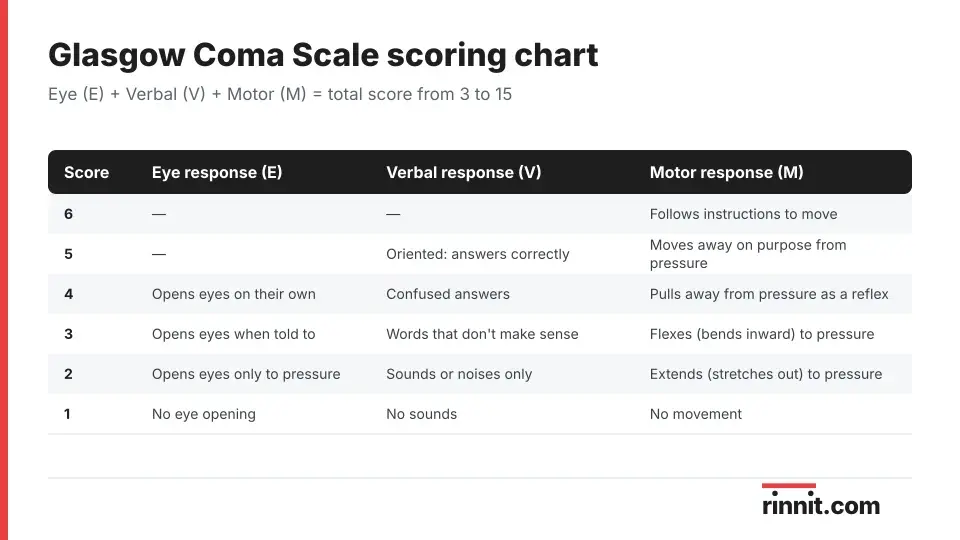
Eye response (E): 1 to 4
Score | What it means |
4 | Opens eyes and keeps them open on their own |
3 | Opens eyes only when told to; otherwise they stay closed |
2 | Opens eyes only in response to pressure |
1 | Eyes don't open for any reason |
Sources: [1]
Verbal response (V): 1 to 5
Score | What it means |
5 | Oriented: correctly answers who and where they are, the day or year |
4 | Confused: can answer, but answers show they're not fully aware |
3 | Words can be understood, but answers don't make sense |
2 | Can't talk; makes only sounds or noises |
1 | Can't speak or make sounds |
Sources: [1]
Motor response (M): 1 to 6
Score | What it means |
6 | Follows instructions on how and when to move |
5 | Moves away on purpose from something pressing on them |
4 | Moves away from pressure only as a reflex |
3 | Flexes muscles (pulls inward) in response to pressure |
2 | Extends muscles (stretches outward) in response to pressure |
1 | No movement in response to pressure |
Sources: [1]
Does the test involve pain?
Older descriptions used the word "pain," but newer guidelines use "pressure," such as a pinch or poke that causes brief, minor discomfort without injury. Providers press on standard points: the nail beds, the trapezius muscle between the neck and shoulder, and the supraorbital notch, a small groove in the bone just below the eyebrow. [1]
What do Glasgow Coma Scale results mean?
The highest score is 15 and the lowest is 3. A score of 15 means you're fully awake, responsive and have no problems with thinking or memory. Generally, a score of 8 or lower means a coma, and the lower the score, the deeper the coma. Providers often write the score by category, so 15 is recorded as E4V5M6 and 3 as E1V1M1. [1]
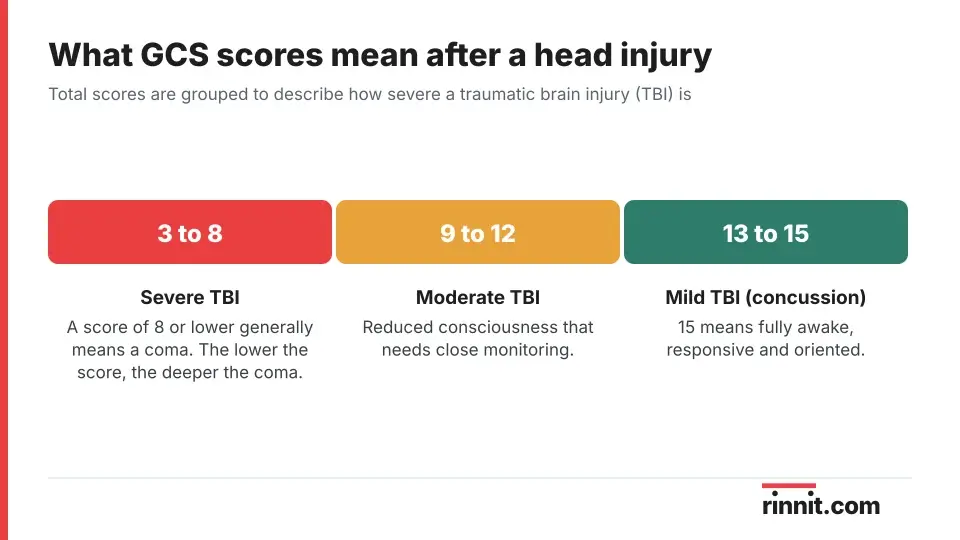
GCS ranges for head injuries
GCS score | Severity of traumatic brain injury (TBI) |
13 to 15 | Mild TBI, also called a concussion |
9 to 12 | Moderate TBI |
3 to 8 | Severe TBI |
Sources: [1]
What is the GCS-P score?
In 2018, a team that included one of the original creators of the GCS published an updated version called the GCS-P, where P stands for pupils. Pupil reaction to light is an important sign of brain function, and pupils that don't react point to a serious problem affecting the brain. [1] [3]
The pupil score ranges from 0 to 2 and is subtracted from the GCS score, giving a GCS-P range of 1 to 15. A GCS-P of 8 or lower still means a coma. For example, a GCS of 3 with a pupil score of 2 gives a GCS-P of 1, a very deep coma with no pupil reaction in either eye. [1]
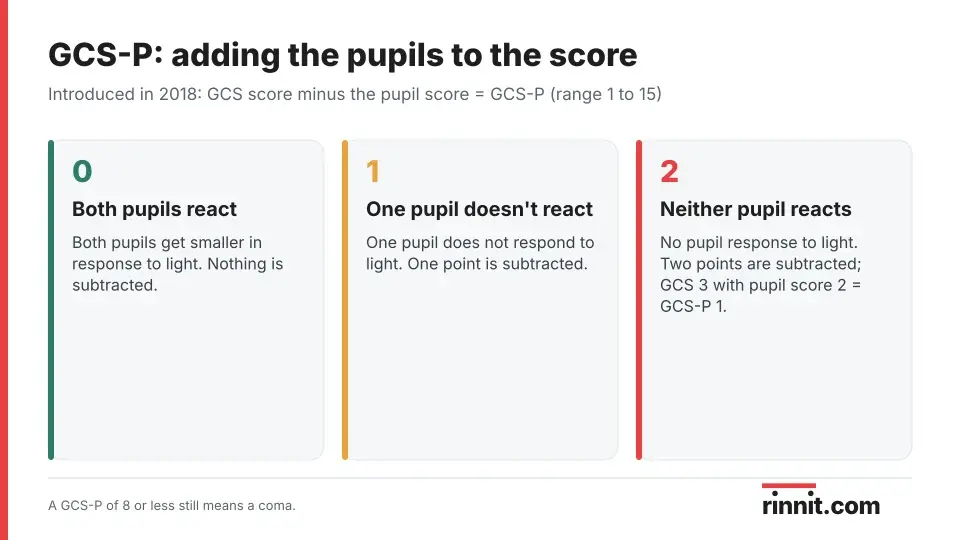
Pupil score | What it means |
0 | Both pupils react to light |
1 | One pupil doesn't react to light |
2 | Neither pupil reacts to light |
Sources: [1]
What are the limits of the Glasgow Coma Scale?
If someone you love has a GCS score, keep these points in mind: [1]
The number is a summary. A neurological exam includes much more than the total score, so ask the care team to explain your loved one's condition.
The scale has limits. It may not work well when someone is on a ventilator, doesn't speak the same language as the provider, or has vision or hearing loss.
It isn't the only guide to outlook. Providers use the GCS to help predict outcomes, but they also weigh many other factors. [1] [2]
Questions to ask the care team
What is the current GCS score, and what are the eye, verbal and motor parts?
Has the score changed since admission?
How often will the score be checked?
Are the pupils reacting to light?
What other tests are being used to understand the brain injury?
Conclusion
The Glasgow Coma Scale gives providers a fast, shared way to describe consciousness by scoring eye, verbal and motor responses from 3 to 15. Lower scores mean deeper loss of consciousness, and after a head injury the total helps grade the injury as mild, moderate or severe. [1]
Its real strength is tracking change over time, and adding pupil reactions in the GCS-P adds further detail for the most severe injuries. [1] [3]
Keep learning: Read our guides to coma, traumatic brain injury and concussion. For more detail, see the official Glasgow Coma Scale website.
FAQ
What is the Glasgow Coma Scale?
The Glasgow Coma Scale (GCS) is a tool providers use to measure consciousness by scoring eye, verbal and motor responses, for a total of 3 to 15. [1]
What is a normal GCS score?
A score of 15 is normal. It means a person is fully awake, responsive and has no problems with thinking or memory. [1]
What GCS score means a coma?
Generally, a GCS score of 8 or lower means a coma, and the lower the score, the deeper the coma. [1]
What is the lowest GCS score?
The lowest possible GCS score is 3, written E1V1M1, which means no eye, verbal or motor response. [1]
What GCS score is a mild, moderate or severe brain injury?
After a head injury, 13 to 15 is mild (a concussion), 9 to 12 is moderate and 3 to 8 is severe traumatic brain injury. [1]
What does E4V5M6 mean?
It is a GCS score of 15 written by category: eye response 4, verbal response 5 and motor response 6. [1]
What is the GCS-P?
The GCS-P subtracts a pupil score of 0 to 2 from the GCS, giving a range of 1 to 15. It adds information about how severe a brain injury is. [1] [3]
Does the Glasgow Coma Scale test hurt?
Providers use brief pressure, such as a pinch on a nail bed, to test reflexes. It may cause minor, momentary discomfort but no injury. [1]
Who developed the Glasgow Coma Scale?
Experts at the University of Glasgow in Scotland developed the GCS in 1974. [1]
Can the GCS predict recovery?
The GCS is linked with outcome, but providers use it together with other factors rather than on its own to predict recovery. [1] [2]
Related Reading
Learn more in our guide to What Is a Coma? Symptoms, Causes, Diagnosis and Treatment.
Learn more in our guide to Traumatic Brain Injury: Symptoms, Emergency Signs, Diagnosis and Recovery.
Learn more in our guide to Concussion: What It Is, What It Feels Like, and How to Recover Safely.
Learn more in our guide to Head Injury: Understanding Types, Symptoms, and Recovery.
Neurological Exam: What It Checks, What to Expect and What Happens Next explains the hands-on exam of the brain, spinal cord and nerves.
References
Cleveland Clinic. Glasgow Coma Scale (GCS): What It Is, Interpretation & Chart. Cleveland Clinic. Last updated March 26, 2023. https://my.clevelandclinic.org/health/diagnostics/24848-glasgow-coma-scale-gcs
Teasdale G, Maas A, Lecky F, et al. The Glasgow Coma Scale at 40 years: standing the test of time. Lancet Neurol. 2014;13(8):844-54. PMID 25030516. https://doi.org/10.1016/S1474-4422(14)70120-6
Brennan PM, Murray GD, Teasdale GM. Simplifying the use of prognostic information in traumatic brain injury. Part 1: The GCS-Pupils score: an extended index of clinical severity. J Neurosurg. 2018;128(6):1612-1620. PMID 29631516. https://doi.org/10.3171/2017.12.JNS172780
Medical disclaimer
This article is for general education only and does not replace advice from a qualified healthcare professional. Talk to your doctor about your own diagnosis and treatment, and seek emergency care right away for severe or sudden symptoms.



Comments