Generalized Anxiety Disorder: Symptoms, Causes, Treatment & Complete Guide

Updated: 2 days ago
Medically reviewed by Dr. Baraa Alnahhal, MD · Last reviewed: October 17, 2026
Quick Answer
Generalized anxiety disorder (GAD) is excessive, ongoing worry that is hard to control and interferes with daily activities. It affects the mind, causing overthinking and restlessness, and the body, causing fatigue, sleep trouble and muscle tension. In most cases it improves with psychotherapy, especially CBT, and/or SSRI or SNRI medications, along with lifestyle changes such as exercise.
What the research says
Several medicines outperformed placebo in adults with GAD. A network meta-analysis of 89 randomized trials (25,441 patients) found that duloxetine (mean difference in Hamilton Anxiety Scale change −3.13, 95% credible interval −4.13 to −2.13), pregabalin (−2.79), venlafaxine (−2.69), and escitalopram (−2.45) were more efficacious than placebo with relatively good acceptability; the authors note that failure of an initial drug may not be a reason to abandon drug treatment. (Slee et al., Lancet, 2019) [3]
Individual and group CBT beat waiting lists for GAD; remote CBT did not. A systematic review of 52 trials (4,361 patients), with a network meta-analysis of 30 of them, found individual CBT was superior to waiting list (standardized mean difference 1.62; 95% CI 1.03 to 2.22) and to treatment as usual (1.12; 95% CI 0.24 to 2.00), group CBT was more efficacious than waiting list (1.65; 95% CI 0.47 to 2.84), and remote CBT was not superior to treatment as usual or waiting list. (Liu et al., Transl Psychiatry, 2025) [4]
CBT shows moderate-to-large effects across anxiety disorders. A unified series of meta-analyses covering 375 trials (32,968 patients) with disorders ranging from anxiety to depression, PTSD, and eating disorders reported effect sizes between 0.5 and 1.0 for generalized anxiety disorder, panic disorder, social anxiety disorder, depression, and OCD, with larger effects in waitlist-controlled trials and more modest ones against care as usual. (Cuijpers et al., JAMA Psychiatry, 2025) [5]
At a Glance
Aspect | Summary |
Definition | Excessive, ongoing anxiety and worry that are difficult to control and interfere with daily life |
Onset | Childhood or adulthood |
Core mental symptoms | Overthinking worst cases, fear of uncertainty, restlessness, mind “going blank” |
Core physical symptoms | Fatigue, trouble sleeping, muscle tension, trembling, sweating, stomach problems |
Causes | Brain chemistry and function, genetics, threat perception, development and personality |
Key risk factors | Female sex, timid or negative temperament, family history, childhood trauma, chronic illness |
First-line treatment | Cognitive behavioral therapy; SSRI/SNRI antidepressants |
Lifestyle support | Exercise, sleep, relaxation techniques, healthy eating, quitting smoking, cutting caffeine |
Outlook | Long-term but usually improves with psychotherapy, medications, and coping skills |
What Is Generalized Anxiety Disorder?
It is common to feel anxious from time to time — especially when life is stressful. Generalized anxiety disorder is different. It is excessive, ongoing anxiety and worry that are difficult to control and interfere with day-to-day activities.
GAD can develop as a child or an adult. Its symptoms resemble panic disorder, obsessive-compulsive disorder, and other anxiety types, but they are all different conditions. Living with GAD can be a long-term challenge, and in many cases it occurs along with other anxiety or mood disorders. The hopeful news: in most cases, GAD improves with psychotherapy or medications, and lifestyle changes, coping skills, and relaxation techniques also help.
Generalized Anxiety Disorder Symptoms
The Mental Side: Persistent Worry
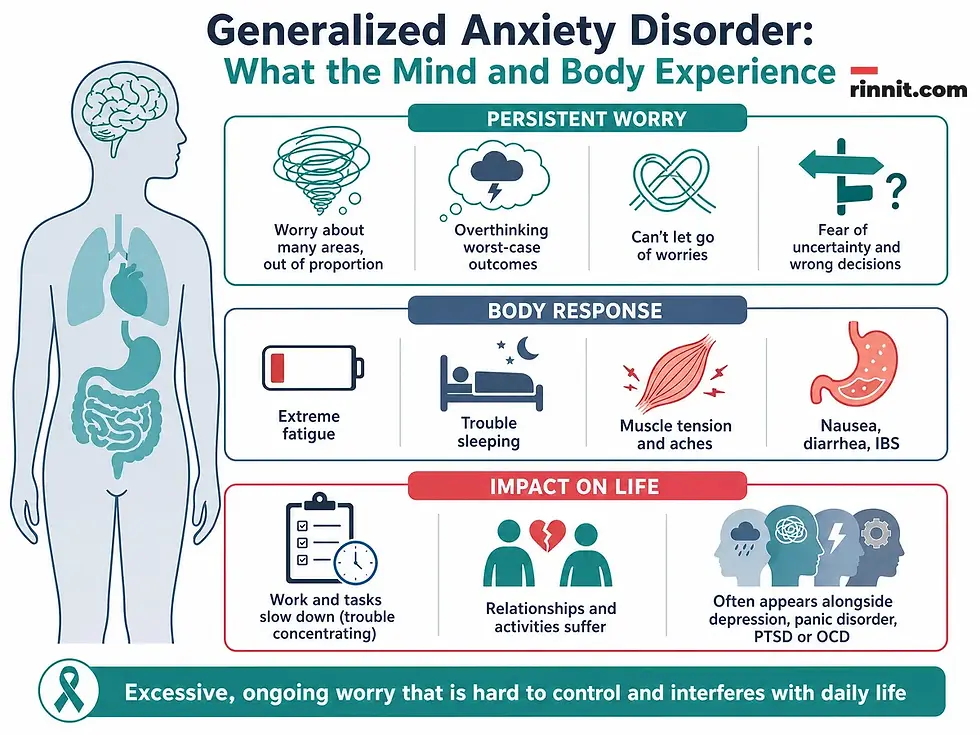
The hallmark of GAD is worry that spreads across many areas of life and is out of proportion to the impact of the events. The mental pattern typically includes:
Overthinking plans and solutions to all possible worst-case outcomes
Perceiving situations and events as threatening, even when they aren't
Difficulty handling uncertainty
Indecisiveness and fear of making the wrong decision
Inability to set aside or let go of a worry
Inability to relax — feeling restless, keyed up, or on edge
Difficulty concentrating, or the feeling that your mind “goes blank”
Staying away from situations that cause anxiety
Seeking reassurance from others when feeling anxious
There may be times when worries don't completely consume you — but you still feel anxious even when there's no apparent reason. For example, intense worry about your safety or that of your loved ones, or a general sense that something bad is about to happen.
The Physical Side: What the Body Feels
Anxiety is not only mental. Physical signs and symptoms may include:
Being very tired
Trouble sleeping
Muscle tension or muscle aches
Trembling, feeling twitchy
Nervousness or being easily startled
Sweating
Nausea, diarrhea or irritable bowel syndrome
Irritability
Your anxiety, worry, or physical symptoms cause significant distress in social, work, or other areas of life. Worries can shift from one concern to another and may change with time and age.
Symptoms in Children and Teenagers
Children and teenagers may have similar worries to adults, but also carry excessive worries about:
Performance at school or sporting events
Family members' safety
Earthquakes, nuclear war or other catastrophic events
A child or teen with excessive worry may also:
Feel overly anxious to fit in
Be a perfectionist
Redo tasks because they aren't perfect the first time
Spend excessive time doing homework
Lack confidence
Strive for approval
Require a lot of reassurance about performance
Have frequent stomachaches or other physical complaints
Avoid going to school or avoid social situations
When to See a Doctor
Anxiety is common — but see your healthcare professional if:
You feel like you're worrying too much, and it's interfering with your work, relationships or other parts of your life
You feel depressed or irritable, have trouble with drinking or drugs, or you have other mental health concerns along with anxiety
You have suicidal thoughts or behaviors — seek emergency treatment immediately
Your worries are unlikely to simply go away on their own, and they may actually get worse over time. Try to seek professional help before your anxiety becomes severe — it may be easier to treat early on.
What Causes Generalized Anxiety Disorder?
As with many mental health conditions, the cause of GAD likely arises from a complex interaction of biological and environmental factors, which may include:
Differences in brain chemistry and function
Genetics
Differences in the way threats are perceived
Development and personality
Risk Factors
Women are diagnosed with GAD somewhat more often than men. The following factors may increase risk:
Risk Factor | How It Raises Risk |
Personality | A timid or negative temperament, or someone who avoids anything dangerous, may be more prone to GAD |
Genetics | GAD may run in families |
Experiences | Significant life changes, traumatic or negative childhood experiences, or a recent traumatic or negative event; chronic medical illnesses or other mental health disorders may also increase risk |
Complications of Untreated GAD
Having generalized anxiety disorder can be disabling. It can:
Impair your ability to perform tasks quickly and efficiently because you have trouble concentrating
Take your time and focus from other activities
Sap your energy
Increase your risk of depression
GAD can also lead to or worsen other physical health conditions, such as:
Digestive or bowel problems, such as irritable bowel syndrome or ulcers
Headaches and migraines
Chronic pain and illness
Sleep problems and insomnia
Heart-health issues
GAD often occurs along with other mental health problems, which can make diagnosis and treatment more challenging. Conditions that often occur with GAD include:
Phobias
Panic disorder
Post-traumatic stress disorder (PTSD)
Obsessive-compulsive disorder (OCD)
Depression
Suicidal thoughts or suicide
Alcohol or drug misuse
Prevention: Reducing the Impact of Symptoms
There's no way to predict for certain what will cause someone to develop GAD, but you can take steps to reduce the impact of symptoms if you experience anxiety:
Get help early. Anxiety, like many other mental health conditions, can be harder to treat if you wait.
Keep a journal. Keeping track of your personal life can help you and your mental health professional identify what's causing you stress and what seems to help you feel better.
Prioritize issues in your life. You can reduce anxiety by carefully managing your time and energy.
Avoid unhealthy substance use. Alcohol, drug use, and even nicotine or caffeine can cause or worsen anxiety. If you're addicted to any of these substances, quitting can make you anxious — see your doctor or find a treatment program or support group if you can't quit on your own.
How Generalized Anxiety Disorder Is Diagnosed
To help diagnose GAD, your doctor or mental health professional may:
Do a physical exam to look for signs that your anxiety might be linked to medications or an underlying medical condition
Order blood or urine tests or other tests, if a medical condition is suspected
Ask detailed questions about your symptoms and medical history
Use psychological questionnaires to help determine a diagnosis
Treatment Options
Treatment decisions are based on how significantly GAD is affecting your ability to function in daily life. The two main treatments are psychotherapy and medications — you may benefit most from a combination of the two. It may take some trial and error to discover which treatments work best for you.
Psychotherapy (Talk Therapy)
Cognitive behavioral therapy (CBT) is the most effective form of psychotherapy for GAD. Generally a short-term treatment, CBT focuses on teaching you specific skills to directly manage your worries and help you gradually return to the activities you've avoided because of anxiety. Through this process, your symptoms improve as you build on your initial success.
Medications
Several types of medications are used to treat GAD:
Medication Type | How It's Used | Key Notes |
Antidepressants (SSRI/SNRI) | First-line treatment | Examples: escitalopram (Lexapro), duloxetine (Cymbalta), venlafaxine (Effexor XR), paroxetine (Paxil, Pexeva); other antidepressants may also be recommended |
Buspirone | Used on an ongoing basis | Typically takes up to several weeks to become fully effective |
Benzodiazepines | Limited circumstances, short-term relief of acute anxiety | Sedatives that can be habit-forming — not a good choice if you have or had problems with alcohol or drug abuse |
Alternative Medicine
Several herbal remedies have been studied as treatments for anxiety. Results tend to be mixed, and in several studies people report no benefits. Some herbal supplements, such as kava and valerian, increase the risk of serious liver damage. Others, such as passionflower or theanine, may have a calming effect but are often combined with other products, so it's hard to tell whether they help — and they should not be used during pregnancy. Before taking any herbal remedies or supplements, talk with your doctor to make sure they're safe and won't interact with your medications.
Lifestyle and Home Remedies
While most people with anxiety disorders need psychotherapy or medications to get anxiety under control, lifestyle changes also make a difference:
Keep physically active. Develop a routine so you're active most days of the week — exercise is a powerful stress reducer that improves mood. Start out slowly and gradually increase amount and intensity.
Make sleep a priority. Get enough sleep to feel rested; if you aren't sleeping well, see your doctor.
Use relaxation techniques. Visualization, meditation, and yoga can ease anxiety.
Eat healthy. Focusing on vegetables, fruits, whole grains and fish may be linked to reduced anxiety (more research is needed).
Avoid alcohol and recreational drugs. These substances can worsen anxiety.
Quit smoking and cut back or quit coffee. Both nicotine and caffeine can worsen anxiety.
Coping and Support
To cope with generalized anxiety disorder, here's what you can do:
Stick to your treatment plan. Take medications as directed, keep therapy appointments, and practice the skills you learn in psychotherapy — consistency matters, especially with medication.
Take action. Work with your mental health professional to figure out what's making you anxious and address it.
Let it go. Don't dwell on past concerns — change what you can in the present moment and let the rest take its course.
Break the cycle. When you feel anxious, take a brisk walk or delve into a hobby to refocus your mind away from your worries.
Socialize. Don't let worries isolate you from loved ones or enjoyable activities — social interaction and caring relationships can lessen your worries.
Join a support group for people with anxiety. You'll find compassion, understanding, and shared experiences — in your community or online, for example through the National Alliance on Mental Illness (NAMI).
Preparing for Your Appointment
You may see your primary care doctor, or your doctor may refer you to a mental health professional.
What You Can Do
Before your appointment, make a list of:
Any symptoms you've been experiencing, including when they occur, what seems to make them better or worse, and how much they affect your day-to-day activities (work, school, relationships)
Key personal information, including major life changes or stressful events you've dealt with recently and any traumatic experiences you've had in the past
Medical information, including other physical or mental health conditions you've been diagnosed with
Any medications, vitamins, herbs or other supplements you're taking, including dosages
Questions to ask your doctor
Some questions to ask include:
What's the most likely cause of my symptoms?
Are there other possible issues or physical health problems that could be causing or worsening my anxiety?
Do I need any tests?
What treatment do you recommend?
Should I see a psychiatrist, psychologist, or other mental health professional?
Would medication help? Is there a generic alternative to the medicine you're prescribing?
Are there any brochures or other printed material I can have? What websites do you recommend?
What to Expect From Your Doctor
Your doctor or mental health professional will likely ask a number of questions. Be ready to answer them to reserve time for your own points:
What are your symptoms?
What things do you tend to worry about?
Do your symptoms interfere with your daily activities?
Do you avoid anything because of your anxiety?
Have your feelings of anxiety been occasional or continuous?
When did you first begin noticing your anxiety?
Does anything in particular seem to trigger your anxiety or make it worse?
What, if anything, seems to improve your feelings of anxiety?
What, if any, physical or mental health conditions do you have?
What traumatic experiences have you had recently or in the past?
Do you regularly drink alcohol or use recreational drugs?
Do you have any blood relatives with anxiety or other mental health conditions, such as depression?

FAQ: Generalized Anxiety Disorder
What is the difference between normal worry and generalized anxiety disorder?
It's common to feel anxious from time to time, especially when life is stressful. GAD is different: the anxiety and worry are excessive, ongoing, difficult to control, and interfere with day-to-day activities. Normal worry stays tied to real events; GAD worry spreads across many areas and is out of proportion to what's actually happening.
What does generalized anxiety disorder feel like?
Mentally, it feels like overthinking worst-case outcomes, fear of uncertainty, indecisiveness, restlessness, and a mind that “goes blank.” Physically, it can cause fatigue, trouble sleeping, muscle tension, trembling, sweating, nausea or diarrhea, and irritability — even when there is no apparent reason to feel anxious.
Can generalized anxiety disorder start in childhood?
Yes. GAD can develop as a child or an adult. Children and teens may worry excessively about school performance, family members' safety, or catastrophic events — and they may also be perfectionists who redo tasks, spend excessive time on homework, or avoid school and social situations.
Is generalized anxiety disorder genetic?
Genetics likely play a role: GAD may run in families, and it arises from a complex interaction of biological and environmental factors that also include brain chemistry, differences in how threats are perceived, and development and personality.
What is the most effective treatment for generalized anxiety disorder?
Cognitive behavioral therapy (CBT) is the most effective form of psychotherapy for GAD — it teaches specific skills to manage worries and gradually return to avoided activities. Antidepressants in the SSRI and SNRI classes are the first-line medications, and buspirone is another option; a combination of therapy and medication often works best.
Can lifestyle changes actually help with anxiety?
Yes. Regular physical activity, prioritizing sleep, relaxation techniques such as meditation and yoga, healthy eating, avoiding alcohol and recreational drugs, and cutting back on nicotine and caffeine can all reduce anxiety — though most people still benefit from psychotherapy or medications to get it under control.
Will generalized anxiety disorder go away on its own?
Worries are unlikely to simply go away on their own and may actually worsen over time. Seeking professional help before anxiety becomes severe makes it easier to treat — and in most cases, GAD improves with psychotherapy, medications, and coping skills.
Conclusion
Generalized anxiety disorder is a real, treatable condition — not a personality flaw or something to simply “get over.” Three lessons stand out from this guide:
Excessive, hard-to-control worry that disrupts daily life is the core signal of GAD, and it shows up in both the mind and the body.
It often hides in plain sight — fatigue, muscle tension, sleep trouble, and stomach problems may be the loudest symptoms, and in children it can look like perfectionism or school avoidance.
Most cases improve with treatment. CBT, antidepressants, lifestyle changes, and support work together — and early help is easier help.
This guide gave you the full picture: symptoms across ages, causes and risk factors, the complications of leaving it untreated, and the complete path from diagnosis to coping. If constant worry is familiar to you or someone you love, start the conversation with a doctor — it may be the most important step you take this year.
Continue building your understanding: explore our guide on antisocial personality disorder or browse more mental health and wellness content at rinnit.com.
Disclaimer: This article is for general informational purposes only and does not constitute medical advice. Always consult a qualified healthcare professional for diagnosis and treatment of any health condition. Never disregard professional medical advice or delay seeking it because of something you have read here.
Related Reading
Resilience Training: How It Works, Skills and Benefits explains resilience training.
Stress Management: Techniques, Benefits and When to Get Help explains practical ways to manage stress.
Benzodiazepines (Benzos): Uses, Side Effects and Risks explains what benzodiazepines treat and their risks.
Mental Status Exam: What It Checks, What Happens and What the Results Mean explains how providers check thinking, mood, behavior and memory, and what abnormal results can mean.
References
Mayo Clinic Staff. Generalized anxiety disorder - Symptoms and causes. Mayo Clinic. May 27, 2026. https://www.mayoclinic.org/diseases-conditions/generalized-anxiety-disorder/symptoms-causes/syc-20360803
Mayo Clinic Staff. Generalized anxiety disorder - Diagnosis and treatment. Mayo Clinic. May 27, 2026. https://www.mayoclinic.org/diseases-conditions/generalized-anxiety-disorder/diagnosis-treatment/drc-20361045
Slee A, et al. Pharmacological treatments for generalised anxiety disorder: a systematic review and network meta-analysis. Lancet. 2019;393(10173):768-777. PMID 30712879. https://doi.org/10.1016/S0140-6736(18)31793-8
Liu S, et al. CBT treatment delivery formats for generalized anxiety disorder: a systematic review and network meta-analysis of randomized controlled trials. Transl Psychiatry. 2025;15(1):197. PMID 40506439. https://doi.org/10.1038/s41398-025-03414-3
Cuijpers P, et al. Cognitive Behavior Therapy for Mental Disorders in Adults: A Unified Series of Meta-Analyses. JAMA Psychiatry. 2025;82(6):563-571. PMID 40238104. https://doi.org/10.1001/jamapsychiatry.2025.0482



Comments