Stress Management: Techniques, Benefits and When to Get Help

Updated: 2 days ago
Written and medically reviewed by Dr. Baraa Alnahhal, MD · Last reviewed: November 2026 · How we review
Quick Answer
Stress management is the use of techniques that change how you respond to stress, so it does less harm to your body and mind. Proven methods include deep breathing, meditation, mindfulness, regular physical activity, healthy eating and sleep habits, and therapy such as CBT. Get help right away if stress leads to thoughts of suicide.
What the research says
Mindfulness training lowers stress: in 29 studies of 2,668 healthy adults, mindfulness-based stress reduction (MBSR) had a moderate overall benefit and large effects on stress, which lasted at about 19 weeks of follow-up (Khoury B et al., J Psychosom Res, 2015) [2]
Meditation eases anxiety and depression: in 47 randomized trials with 3,515 adults, mindfulness meditation programs brought small-to-moderate improvements in anxiety, depression and pain, though not better than other active treatments such as exercise or medicine (Goyal M et al., JAMA Intern Med, 2014) [3]
Key takeaways
Stress is a normal reaction, but long-term stress harms your health.
Start by identifying what causes your stress.
Relaxation, exercise, sleep and healthy eating all help.
Mindfulness and meditation have moderate research support for anxiety, depression and pain.
Seek help for anxiety, depression, chest pain or thoughts of suicide.
What is stress?
Stress is your body's physical and mental response to changes or challenges, called stressors. Big events, such as a move, a new job or a divorce, can cause stress, and so can small daily hassles. Your body releases hormones such as cortisol, which can raise your heart rate and blood pressure. Stress management doesn't remove stress; it changes how you respond. Sources: [1]
How stress affects your health
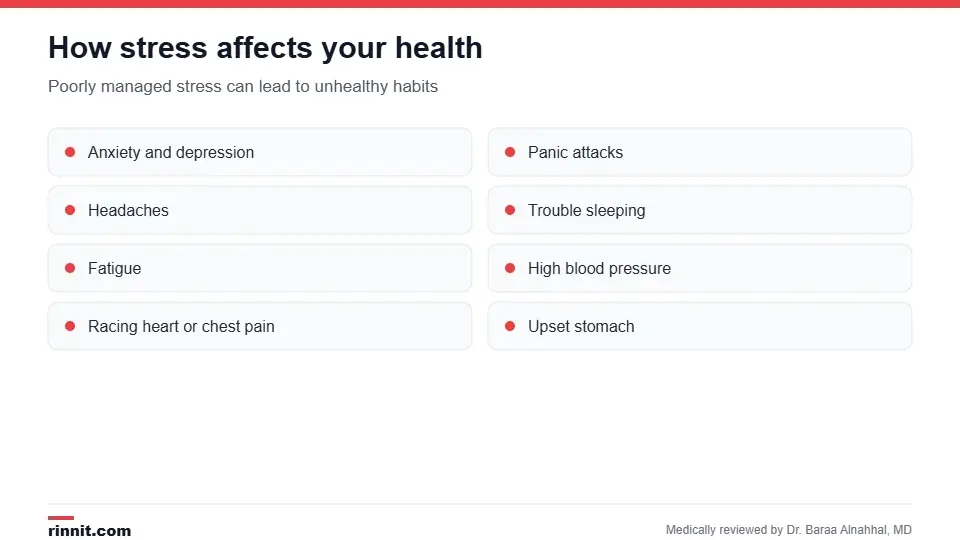
Poorly managed stress can also lead to unhealthy habits.
Anxiety, depression and panic attacks.
Headaches, fatigue and trouble sleeping.
A racing heart, chest pain and high blood pressure.
An upset stomach or indigestion. Sources: [1]
Stress that isn't managed well can lead to unhealthy coping, such as drinking alcohol, smoking, overeating or using drugs. Sources: [1]
Step 1: Find your stressors
Keep a journal for a week or longer. Each time you feel stressed, write down the cause, how you felt physically and emotionally, and how you reacted. Patterns help you see what to change. Sources: [1]
Ways to manage stress
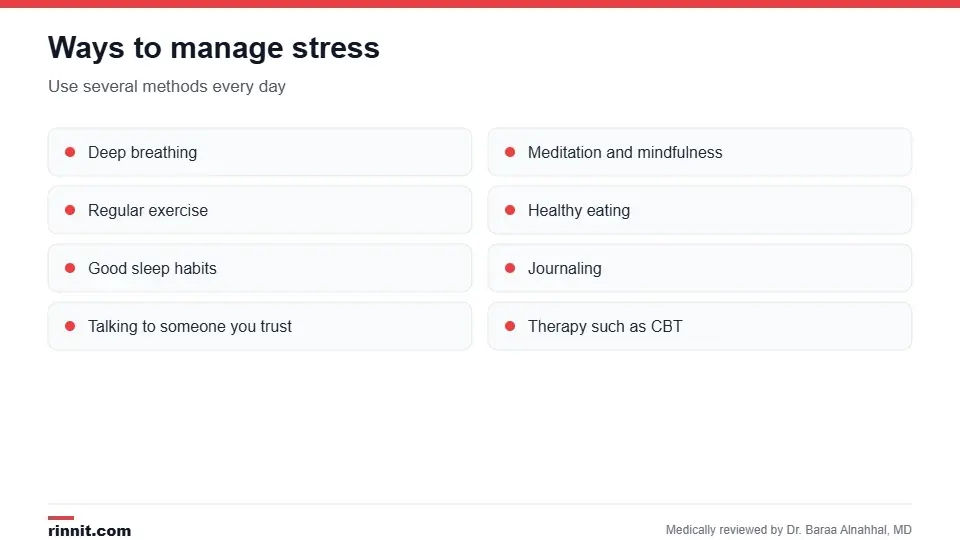
Use several methods every day, not only when stress builds up.
Approach | Examples |
Relax your mind | Deep breathing, meditation, mindfulness, massage, soothing music, laughing more |
Move your body | Walks outside, yoga, tai chi, exercising with friends |
Eat well | More fruits and vegetables; less fat, sugar and caffeine |
Sleep well | Turn off screens, create a calm setting, read or take a warm bath before bed |
Cut harmful habits | Quit smoking and limit alcohol |
Change your thinking | Journal what you're grateful for, make time for yourself every day, plan tomorrow the evening before, learn to say no |
Connect | Share your feelings with a trusted friend or family member |
Sources: [1, 2, 3]
Therapy for stress
A mental health professional can teach skills to handle stress. Cognitive behavioral therapy (CBT) is a proven approach that helps you notice and change unhelpful thoughts and reactions. Sources: [1]
Daily stress plan
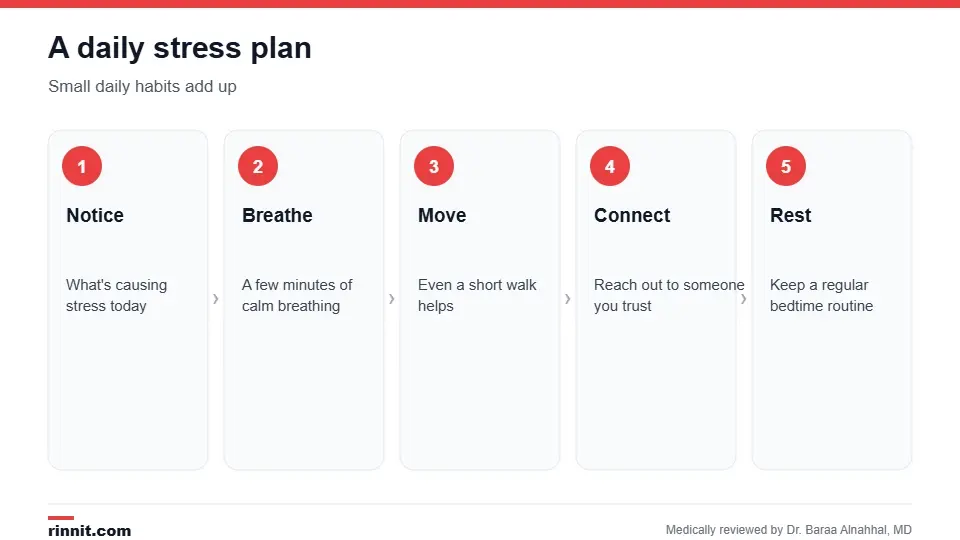
Small daily habits add up.
Notice what's causing you stress today.
Take a few minutes for deep breathing, meditation or mindfulness.
Move your body, even with a short walk.
Do at least one thing just for yourself.
Reach out to someone you trust.
Wind down with a regular bedtime routine. Sources: [1]
When to get help
You have ongoing anxiety or depression.
You have chest pain; get emergency care, since it can be a heart problem.
You're using alcohol or drugs to cope.
You have thoughts of suicide: call or text 988 to reach the Suicide and Crisis Lifeline, available 24/7 in the U.S. Sources: [1]
For help with alcohol or drug use, the SAMHSA National Helpline is available at 1-800-662-4357. Sources: [1]
Conclusion
Stress is part of life, but you can change how it affects you. Combining relaxation, activity, good sleep and support from others every day builds resilience, and a professional can help when stress feels like too much.
Keep learning: read about transcendental meditation and generalized anxiety disorder.
Frequently asked questions
What is stress management?
Using techniques to change how you respond to stress.
What are the signs of too much stress?
Anxiety, headaches, trouble sleeping, an upset stomach, a racing heart and fatigue.
What is the fastest way to calm down?
Slow, deep breathing can help lower your heart rate.
Does exercise help with stress?
Yes. Walking, yoga and tai chi all help.
Does meditation really work?
Studies show mindfulness and meditation reduce stress and anxiety.
How can I find out what's stressing me?
Keep a stress journal for a week or more.
Can diet affect stress?
Yes. Eat more fruits and vegetables and less sugar and caffeine.
Is therapy helpful for stress?
Yes. Cognitive behavioral therapy is a proven approach.
Can stress be completely eliminated?
No, but you can change how you respond to it.
When should I get help?
For ongoing anxiety or depression, chest pain, substance use or thoughts of suicide.
Related Reading
Resilience Training: How It Works, Skills and Benefits explains resilience training.
Anxiety Disorders: Symptoms, Types, Causes, Treatment & Complete Guide when worry becomes a medical condition.
Generalized Anxiety Disorder: Symptoms, Causes, Treatment & Complete Guide long-lasting, hard-to-control worry.
Transcendental Meditation (TM): How It Works, Benefits and How to Learn It a meditation technique for stress.
Post-Traumatic Stress Disorder (PTSD): Symptoms, Causes, and Treatment stress after a traumatic event.
Cortisol Test: Blood, Saliva and Urine Tests, Normal Levels and What Results Mean a test of the main stress hormone.
References
Cleveland Clinic. Stress Management: Meditation, Relaxation, Health Benefits. Cleveland Clinic. Last updated April 27, 2021. https://my.clevelandclinic.org/health/treatments/6409-stress-management-and-emotional-health
Khoury B, Sharma M, Rush SE, et al. Mindfulness-based stress reduction for healthy individuals: a meta-analysis. J Psychosom Res. 2015;78(6):519-528. PMID 25818837. https://doi.org/10.1016/j.jpsychores.2015.03.009
Goyal M, Singh S, Sibinga EM, et al. Meditation programs for psychological stress and well-being: a systematic review and meta-analysis. JAMA Intern Med. 2014;174(3):357-368. PMID 24395196. https://doi.org/10.1001/jamainternmed.2013.13018
Medical disclaimer
This article is for general education only and does not replace advice from a qualified healthcare professional. Talk to your doctor about your own diagnosis and treatment, and seek emergency care right away for severe or sudden symptoms.



Comments