Cortisol Test: Blood, Saliva and Urine Tests, Normal Levels and What Results Mean

Updated: 2 days ago
Written and medically reviewed by Dr. Baraa Alnahhal, MD · Last reviewed: November 2026 · How we review
Quick Answer: What is a cortisol test?
A cortisol test measures the level of cortisol, a hormone made by your adrenal glands, in your blood, urine or saliva. It checks whether you have too much or too little, which helps providers diagnose conditions like Cushing syndrome, Addison's disease and certain tumors. Because cortisol rises and falls through the day, you may need more than one test. [1]
What the research says
Standard screening tests for Cushing syndrome are accurate in specialist settings. Across 27 studies (8,631 patients), the 1-mg overnight dexamethasone suppression test had a positive likelihood ratio of 16.4 and negative of 0.06, late-night saliva cortisol 8.8 and 0.07, and 24-hour urine free cortisol 10.6 and 0.16. (Elamin et al., The Journal of Clinical Endocrinology & Metabolism, 2008) [2]
The ACTH stimulation test reliably confirms primary adrenal insufficiency. In a meta-analysis, the high-dose (250 mcg) ACTH stimulation test detected 92% of primary adrenal insufficiency, and both high- and low-dose tests were good at ruling in, but not ruling out, secondary adrenal insufficiency. (Ospina et al., The Journal of Clinical Endocrinology & Metabolism, 2016) [3]
Key takeaways
A cortisol test can use blood, saliva, urine or a combination. [1]
It helps diagnose Addison's disease (too little cortisol), Cushing syndrome (too much) and certain tumors. [1]
Cortisol is highest in the early morning and lowest around midnight, so timing matters. [1]
Typical blood levels are 10 to 20 mcg/dL at 6 to 8 a.m. and 3 to 10 mcg/dL around 4 p.m., though ranges vary by lab. [1]
Stress, exercise, illness, temperature, sleep timing and some medicines can affect results. [1]
What is a cortisol test?
A cortisol test measures the level of cortisol in your body. Cortisol is a hormone your adrenal glands make, and the test checks whether you have too much or too little of it. Other names include free cortisol, salivary cortisol and urinary cortisol. [1]
Why is a cortisol test done?
Your provider may recommend a cortisol test if you have symptoms of certain conditions. The results can help diagnose: [1]
Addison's disease, when your body doesn't have enough cortisol
Cushing syndrome, when your body has too much cortisol
Certain tumors that can cause high cortisol levels
How do you test cortisol levels?
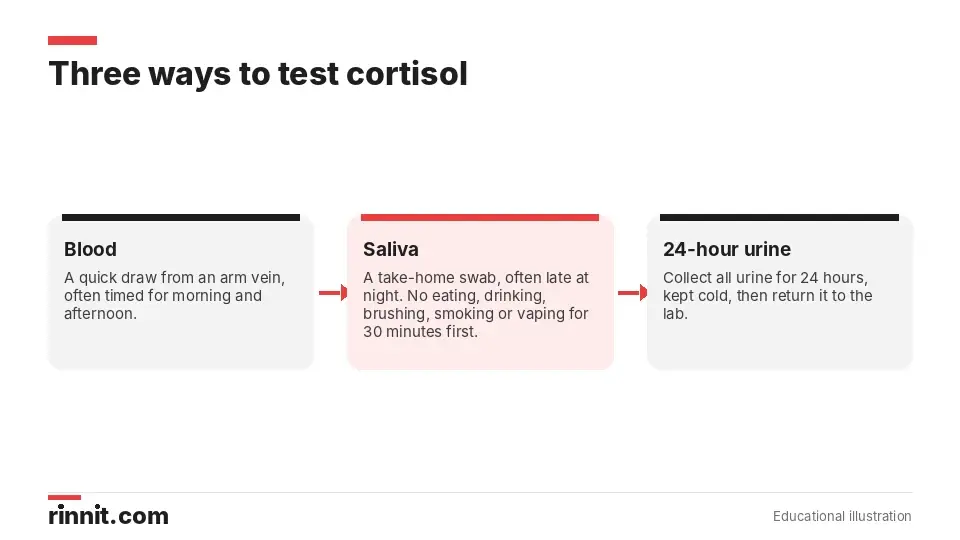
Your provider picks the sample type, and sometimes the time of day, based on what they're looking for.
Tests can measure cortisol in your blood, urine, saliva or a combination. Because cortisol varies over 24 hours, you may need testing twice in one day or several times over several days. [1]
Cortisol blood test
You sit in a chair while a phlebotomist finds a vein, usually on the inside of your arm opposite your elbow.
They clean and disinfect the area.
They insert a small needle into the vein, which may feel like a small pinch.
A small amount of blood collects in a test tube.
They remove the needle, hold gauze on the site and place a bandage.
The whole draw usually takes fewer than five minutes. [1]
Cortisol saliva test
This is usually a take-home test, because you may need to do it right when you wake up or late at night. Your kit has specific instructions, but in general you: [1]
Don't eat, drink, brush or floss your teeth, smoke or vape for 30 minutes beforehand.
Drop the swab into your mouth without touching it and wait a couple of minutes until it's soaked with saliva.
Spit the swab into the test container, again without touching it.
Return the sample as instructed.
Cortisol urine test
Most urine cortisol tests require collecting all the urine you make in 24 hours, using a container your provider gives you: [1]
Pee as usual the first time in the morning without collecting it, and write down the time as your start time.
Collect all urine after that in the container, keeping out stool and toilet paper. Store it in the fridge or a cooler.
Collect for the last time as close as possible to 24 hours after your start time.
Label the container with your name, start time, end time and other required details.
Drop it off at the lab as soon as possible.
How do you prepare for a cortisol test?
Your provider will give you instructions for your specific test. For example, you shouldn't eat, drink or brush your teeth before a saliva test, and you may need to rest beforehand so stress doesn't affect the results. [1]
What are normal cortisol levels?

Cortisol follows a daily rhythm: highest in the morning, lowest around midnight.
For most blood cortisol tests, typical ranges are: [1]
Time of day | Typical blood cortisol range |
6 a.m. to 8 a.m. | 10 to 20 micrograms per deciliter (mcg/dL) |
Around 4 p.m. | 3 to 10 mcg/dL |
Around midnight | Lowest level of the day |
Sources: [1]
Cortisol in your blood, urine and saliva is usually highest in the early morning and declines through the day. This pattern can shift if you work night shifts. Normal ranges vary between labs, times and people, so your provider will interpret your results. [1]
What do cortisol test results mean?

An abnormal cortisol result usually leads to more targeted testing rather than an instant diagnosis.
Result | Possible causes |
High cortisol | Large doses of medicines such as corticosteroids; a pituitary tumor making ACTH (adrenocorticotropic hormone); an adrenal tumor making too much cortisol; a tumor elsewhere, such as small cell lung cancer |
Low cortisol | A pituitary tumor that slows ACTH production; underactive or damaged adrenal glands; an underactive pituitary gland |
Sources: [1]
What affects cortisol results?
An abnormal result doesn't necessarily mean you have a condition that needs treatment. Several factors can change cortisol levels: [1]
Stress
Physical activity
Serious illness
Hot and cold temperatures
Certain medicines
When you sleep
What are the next steps after an abnormal result?
Your provider will consider your symptoms and medical history. If more testing is needed, they may recommend: [1]
How long do results take?
It may take one to five days to get your results, depending on your provider and lab. [1]
Conclusion
A cortisol test checks whether your adrenal glands are making too much or too little of this key stress hormone. Because levels swing through the day, timing and preparation matter as much as the test itself. [1]
If your result is abnormal, try not to worry: stress, sleep and medicines can all shift cortisol. Your provider will tell you whether follow-up tests like an ACTH stimulation or dexamethasone suppression test are needed. [1] [2] [3]
Keep learning: Read our Cushing syndrome guide or our Addison's disease guide. For more background, see the MedlinePlus page on the cortisol test.
FAQ
What is a cortisol test?
A test that measures cortisol, a hormone made by your adrenal glands, in your blood, saliva or urine. [1]
Why would a doctor order a cortisol test?
To help diagnose Addison's disease, Cushing syndrome or tumors that affect cortisol levels. [1]
What is a normal cortisol level?
For most blood tests, 10 to 20 mcg/dL at 6 to 8 a.m. and 3 to 10 mcg/dL around 4 p.m. Ranges vary by lab. [1]
When is the best time to test cortisol?
It depends on the test. Cortisol is highest in the early morning and lowest around midnight, so your provider will set the time. [1]
How do I prepare for a cortisol saliva test?
Don't eat, drink, brush or floss your teeth, smoke or vape for 30 minutes before the test. [1]
How does a 24-hour urine cortisol test work?
You collect all your urine for 24 hours in a container kept cold, then take it to the lab. [1]
What causes high cortisol?
Corticosteroid medicines, a pituitary tumor making ACTH, an adrenal tumor or a tumor elsewhere, such as small cell lung cancer. [1]
What causes low cortisol?
Underactive or damaged adrenal glands, an underactive pituitary gland or a pituitary tumor that slows ACTH. [1]
Can stress affect a cortisol test?
Yes. Stress, exercise, illness, temperature, sleep timing and some medicines can change results. [1]
How long do cortisol test results take?
Usually one to five days, depending on the lab. [1]
Related Reading
Stress Management: Techniques, Benefits and When to Get Help explains practical ways to manage stress.
Cushing Syndrome: What High Cortisol Does to Your Body and How It Is Treated explains the condition caused by too much cortisol.
Addison's Disease: Complete Guide to Adrenal Insufficiency Symptoms, Causes & Treatment covers the condition caused by too little cortisol.
Pituitary Tumors and Adenomas: Types, Symptoms, and Treatment Guide explains tumors that can push cortisol too high or too low.
References
Cleveland Clinic. Cortisol Test: What It Is, Purpose, Types & Results. Cleveland Clinic. Last updated April 28, 2025. https://my.clevelandclinic.org/health/diagnostics/22417-cortisol-test
Elamin MB, Murad MH, Mullan R, et al. Accuracy of diagnostic tests for Cushing's syndrome: a systematic review and metaanalyses. J Clin Endocrinol Metab. 2008;93(5):1553-1562. PMID 18334594. https://doi.org/10.1210/jc.2008-0139
Ospina NS, Al Nofal A, Bancos I, et al. ACTH Stimulation Tests for the Diagnosis of Adrenal Insufficiency: Systematic Review and Meta-Analysis. J Clin Endocrinol Metab. 2016;101(2):427-434. PMID 26649617. https://doi.org/10.1210/jc.2015-1700
Medical disclaimer
This article is for general education only and does not replace advice from a qualified healthcare professional. Talk to your doctor about your own diagnosis and treatment, and seek emergency care right away for severe or sudden symptoms.



Comments