Resilience Training: How It Works, Skills and Benefits

Updated: 2 days ago
Written and medically reviewed by Dr. Baraa Alnahhal, MD · Last reviewed: November 2026 · How we review
Quick Answer
Resilience training is a set of programs that help you cope with stress, setbacks and serious life challenges, and grow from them. Programs build skills like stress management, flexible thinking and coping, using methods such as cognitive behavioral therapy and mindfulness. Sessions usually run weekly for several weeks to months. Studies show it can boost resilience and lower stress.
What the research says
Resilience programs boosted resilience: a review of 11 trials found resilience programs based on CBT, mindfulness or both had a moderate positive effect on personal resilience (effect size 0.44) (Joyce S et al., BMJ Open, 2018) [2]
Training helped healthcare workers: a Cochrane review of 44 trials in healthcare professionals found resilience training was linked to higher resilience, less depression and less stress right after training, though the evidence was very low certainty (Kunzler AM et al., Cochrane Database of Systematic Reviews, 2020) [3]
Key takeaways
Resilience training helps you adapt to stress and hardship.
It's common for first responders, healthcare workers and caregivers.
It teaches coping, stress management and flexible thinking.
Sessions are usually weekly for weeks to months.
It works best with practice outside sessions.
What is resilience training?
Resilience is your ability to adapt and recover when life gets hard. Training is mainly meant to prepare you before stress, but it can help during and after, too. It often draws on cognitive behavioral therapy and stress management. Sources: [1]
Who it helps
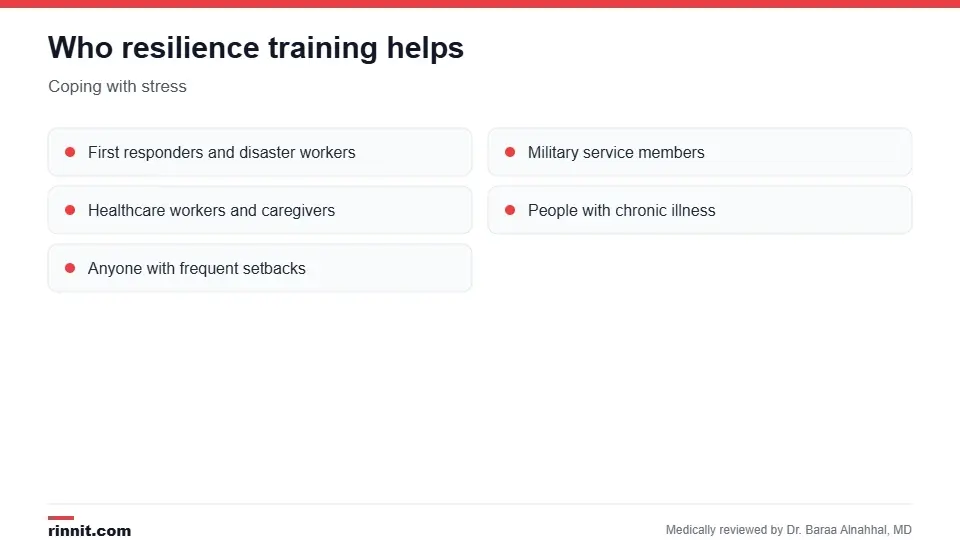
It can help with everyday setbacks too.
First responders and disaster workers.
Military service members.
Healthcare providers and caregivers.
People with chronic health conditions.
Anyone with frequent stress or setbacks. Sources: [1]
Signs you may benefit
Anxiety, fear or more stress.
Sleep problems or daytime tiredness.
Trouble focusing or making decisions.
Stomach upset or appetite changes.
Sadness, grief or mood changes.
Pulling away from others or using more alcohol or drugs. Sources: [1]
Talk to a provider if these last more than two weeks or get worse. Sources: [1]
Goals and methods
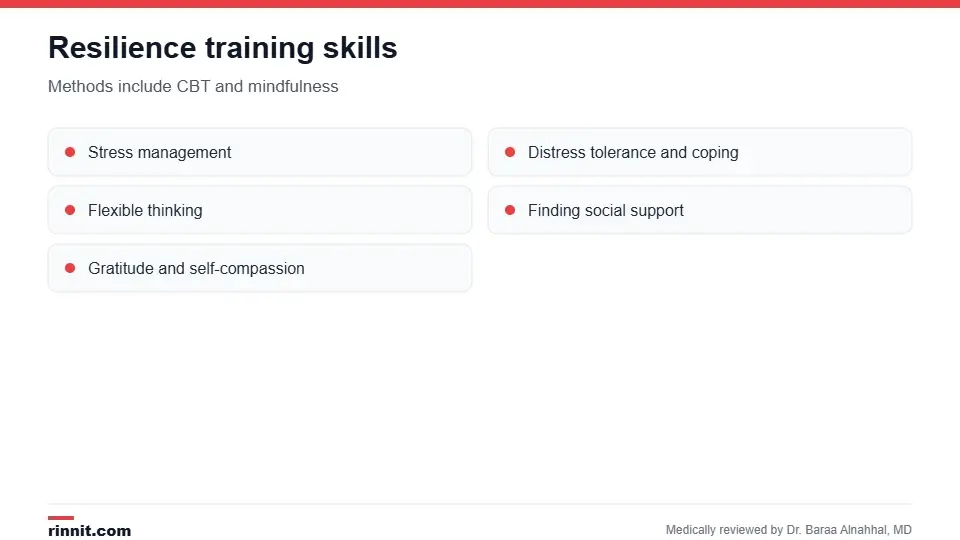
Programs are tailored to the group.
Goals | Methods |
Distress tolerance and coping skills | Cognitive behavioral therapy |
Stress management | Relaxation practice and mindfulness |
Flexible thinking | Emotional regulation training |
Positive emotions and meaning | Self-compassion and gratitude skills |
Social support | Psychological education |
Sources: [1, 2]
What to expect

Some sessions are virtual.
Find a program through your employer, a community group or your doctor.
Attend 60- to 90-minute sessions, usually weekly, in person or online.
Practice skills between sessions.
Attend follow-ups, sometimes six months after finishing. Sources: [1]
Everyday resilience tips
Before stress: learn about the situation, stay connected and plan ahead.
During and after: eat well, take breaks and use relaxation skills.
Use a buddy system.
Set boundaries and share only what you're comfortable with.
Talk with a mental health professional if you need to. Sources: [1]
Challenges
Recalling painful memories can be emotionally draining.
It may not fully prepare you for the unexpected.
It takes ongoing work outside sessions. Sources: [1]
When to get help
Reach out promptly if, after a stressful event, you have intense sadness, thoughts of harming yourself or others, see or hear things others don't, neglect basic self-care or use substances to cope. In the U.S., call or text 988 for the Suicide and Crisis Lifeline, or call 911 if you're in immediate danger. Sources: [1]
Conclusion
Resilience training gives you practical tools to handle stress and bounce back from hard times. With regular practice, these skills can become part of everyday life.
Keep learning: read about stress management and caregiver burnout.
Frequently asked questions
What is resilience training?
Programs that help you cope with and grow from stress.
Who is it for?
First responders, healthcare workers, caregivers and anyone under stress.
What skills does it teach?
Coping, stress management, flexible thinking and finding support.
What methods are used?
CBT, mindfulness, relaxation and gratitude practice.
How long are sessions?
Usually 60 to 90 minutes, once a week.
How long does a program last?
Several weeks to months.
Can it be done online?
Some sessions are virtual.
Does it work?
Studies show it can boost resilience and lower stress.
Is it hard?
It can be emotionally draining and takes practice.
How do I find a program?
Through your employer, a community group or your doctor.
Related Reading
Stress Management: Techniques, Benefits and When to Get Help ways to manage stress.
Cognitive Behavioral Therapy (CBT): What It Is, What It Treats and What to Expect a method used in training.
Caregiver Burnout: Signs, Causes, Recovery, and How to Take Care of Yourself First stress in caregivers.
Post-Traumatic Stress Disorder (PTSD): Symptoms, Causes, and Treatment stress after trauma.
References
Cleveland Clinic. Resilience Training: What It Is, How It Works & Exercises. Cleveland Clinic. Last updated February 19, 2025. https://my.clevelandclinic.org/health/treatments/17799-resilience-training
Joyce S, Shand F, Tighe J, et al. Road to resilience: a systematic review and meta-analysis of resilience training programmes and interventions. BMJ Open. 2018;8(6):e017858. PMID 29903782. https://doi.org/10.1136/bmjopen-2017-017858
Kunzler AM, Helmreich I, Chmitorz A, et al. Psychological interventions to foster resilience in healthcare professionals. Cochrane Database of Systematic Reviews. 2020;7(7):CD012527. PMID 32627860. https://doi.org/10.1002/14651858.CD012527.pub2
Medical disclaimer
This article is for general education only and does not replace advice from a qualified healthcare professional. Talk to your doctor about your own diagnosis and treatment, and seek emergency care right away for severe or sudden symptoms.



Comments