Cognitive Behavioral Therapy (CBT): What It Is, What It Treats and What to Expect

Updated: 6 days ago
Written and medically reviewed by Dr. Baraa Alnahhal, MD · Last reviewed: October 2026 · How we review
Quick Answer: What is cognitive behavioral therapy?
Cognitive behavioral therapy (CBT) is a goal-focused type of talk therapy that helps you notice and change unhelpful thoughts and behaviors. It teaches practical skills to manage stress and emotions, and it may help with anxiety, depression, PTSD, some physical conditions and life changes. Many people attend eight to 12 sessions of about 60 minutes each. [1][2]
What the research says
CBT works well for depression across ages and formats. A review of 409 trials with 52,702 patients found moderate to large benefits compared with usual care or a waitlist (effect size g = 0.79), still present 6–12 months later. CBT matched medication in the short term and showed larger effects than medication at 6–12 months (g = 0.34). (Cuijpers et al., World Psychiatry, 2023)
CBT beats placebo for anxiety-related disorders. Across 41 placebo-controlled trials with 2,843 patients, CBT had a moderate effect on core symptoms (g = 0.56) and nearly tripled the odds of responding to treatment (odds ratio 2.97). The largest effects were for OCD, generalized anxiety disorder and acute stress disorder. (Carpenter et al., Depression and Anxiety, 2018)
CBT for insomnia helps people fall asleep and stay asleep. In 20 trials with 1,162 adults with chronic insomnia, people fell asleep about 19 minutes faster, spent 26 fewer minutes awake during the night and improved sleep efficiency by about 10%. No adverse outcomes were reported. (Trauer et al., Annals of Internal Medicine, 2015)
Key takeaways
CBT is a structured, goal-focused talk therapy built on one idea: your thoughts shape how you feel and act.
It commonly helps anxiety and depression, and it can also support PTSD, OCD, eating disorders, insomnia, chronic pain and stressful life changes.
Sessions usually last about 60 minutes, and many people need eight to 12 visits.
CBT works best when you practice skills between sessions.
You can use CBT on its own or alongside medication.
If you have thoughts of suicide or harming yourself or others, get help right away.
What is cognitive behavioral therapy (CBT)?
Cognitive behavioral therapy (CBT) is a type of psychotherapy (talk therapy) that helps you notice and change unhelpful thoughts and behaviors. It focuses on how your thoughts influence the way you feel and behave.
In CBT, you learn practical skills to handle stress and challenges. This may include practicing new ways of thinking or doing small exercises between sessions.
CBT is built on four core principles:
Mental health concerns are often linked to unhelpful ways of thinking.
Concerns can also relate to learned behaviors that no longer help you.
Core beliefs about yourself and the world affect how you feel and act.
You can learn new coping skills to feel better and improve your emotional health.
CBT usually takes place over a limited number of sessions. Your therapist tailors it to your specific needs, and you can use it on its own or with medication and other treatments.

CBT helps you break the loop between unhelpful thoughts, difficult feelings and the behaviors that follow.
What conditions can cognitive behavioral therapy help with?
Cognitive behavioral therapy most commonly helps people manage anxiety and depression, but it also supports many other mental health conditions, some physical health problems and difficult life changes.
Area | Conditions and situations CBT may help with |
Mental and behavioral health | Anxiety, depression, ADHD and problems with planning, organization or focus, eating disorders, OCD, PTSD, social anxiety, substance use disorder |
Used alongside medication | Bipolar disorder, schizophrenia, some personality disorders |
Physical health (especially when stress or coping plays a role) | Chronic fatigue syndrome, fibromyalgia and other chronic pain, insomnia, irritable bowel syndrome (IBS), migraines |
Everyday challenges and life changes | Divorce, grief, relationship challenges, stress and coping difficulties, work-related issues |
People of all ages, including children, can benefit from CBT.
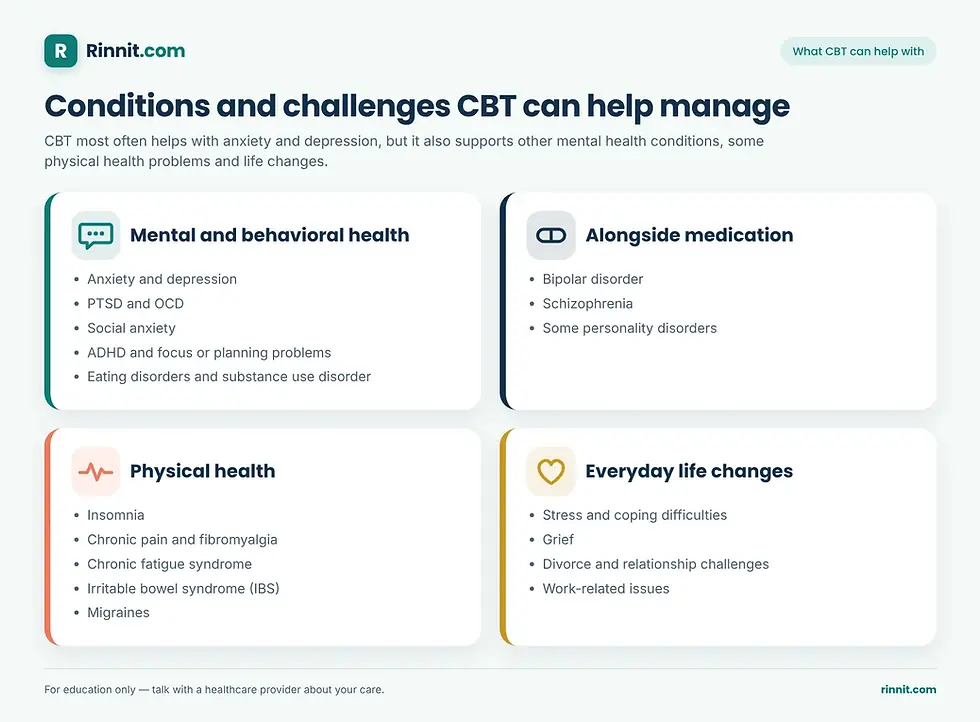
CBT supports mental health, some physical conditions and everyday life changes.
How does cognitive behavioral therapy work?
Cognitive behavioral therapy works by helping you see situations in a new way, then practicing healthier responses until they become habits.
It takes place in a safe, supportive and nonjudgmental setting. You speak openly and privately with a trained mental health provider, who works with you on your concerns and goals.
Your therapist uses questions and discussion to help you look at situations differently. Over time, you learn healthier ways to manage unhelpful thoughts and respond to stress.
Progress doesn't happen overnight. Many skills take practice, and some parts of therapy may feel uncomfortable. That discomfort is a normal part of change.
What happens during cognitive behavioral therapy?
Cognitive behavioral therapy usually moves through four stages, from sharing your concerns to practicing new ways of thinking and acting.
Stage | What happens |
1. Sharing your concerns | You talk about the challenges you face, symptoms you've noticed and any diagnoses you have. You and your therapist set treatment goals together. |
2. Exploring thoughts and feelings | Your therapist asks questions about past experiences, worries, fears and behaviors. You explore how your thoughts shape the way you feel and respond. |
3. Noticing unhelpful patterns | You learn to pay closer attention to the thoughts, emotions and behaviors that make things harder for you. |
4. Making helpful changes | You practice new ways of thinking and behaving, so you can handle stress and future challenges more effectively. |

What to expect in CBT: four stages, sessions of about 60 minutes and often eight to 12 visits.
What techniques does cognitive behavioral therapy use?
Cognitive behavioral therapy uses three main techniques: noticing automatic thoughts, challenging unhelpful thinking patterns and changing behaviors.
Noticing thoughts. CBT helps you spot the quick thoughts that pop into your mind right away. These are called automatic thoughts, and they can affect how you feel and act.
Challenging unhelpful thinking patterns. You learn to recognize thinking habits that aren't accurate or helpful. Then you question them and replace them with more balanced thoughts.
Unhelpful thinking pattern | What it means |
All-or-nothing thinking | Seeing things in extremes, with no middle ground |
Expecting the worst | Frequently assuming things will go badly |
Mind reading | Assuming you know what other people are thinking |
Changing behaviors. Therapy uses practical steps to help you act differently. For example, if depression made you withdraw from activities you enjoy, you might slowly return to them. Clear routines, rewards and feedback can also improve focus and behavior.
What coping skills do you learn in cognitive behavioral therapy?
Cognitive behavioral therapy teaches everyday coping skills that help you handle difficult situations, both during therapy and after it ends.
Handling strong emotions: Instead of fighting fear or sadness, you learn to let feelings rise and fall on their own.
Mindfulness: You focus on the present moment without judging yourself. This may reduce overthinking and stress. Deep breathing can help bring your attention back to the present.
Thinking more flexibly: Instead of jumping to scary conclusions, you learn to look at situations from different angles.
How long does cognitive behavioral therapy take?
Cognitive behavioral therapy usually involves sessions of about 60 minutes, and many people attend eight to 12 visits.
Detail | What to expect |
Session length | About 60 minutes |
How often | Weekly, every two weeks or monthly, depending on your needs |
Typical number of visits | 8 to 12 |
Longer courses | Sometimes more sessions are needed |
CBT should move at a pace that feels right for you. If a topic feels too hard to talk about, or you don't feel ready yet, it's OK to say so. Telling your therapist how you feel helps them adjust your care.
What are the benefits of cognitive behavioral therapy?
The main benefits of cognitive behavioral therapy are that it's structured, personalized, works with or without medication and gives you skills you keep for life.
Structured and goal-focused: You work on specific skills to change unhelpful thoughts and behaviors, which can make problems feel more manageable.
Collaborative and personalized: Your therapist works with you at your own pace and focuses on your needs and goals.
Flexible: You can try CBT on its own or alongside antidepressants or other medications. For some conditions, combining CBT with medication may work better than either treatment alone.
Long-lasting skills: You build tools you can keep using after therapy ends.
Research shows CBT may support a wide range of mental health conditions and some physical conditions. Progress, though, takes time and practice.
What are the limitations of cognitive behavioral therapy?
Cognitive behavioral therapy doesn't work the same way for everyone, and several factors can limit how well it helps.
Limitation | What it means |
Other needs come first | Urgent issues like severe depression, suicidal thoughts, psychosis or unsafe housing may need attention before CBT can be effective. |
Finding the right fit | You may meet more than one therapist before finding someone you feel comfortable with. This is common and expected. |
Uncomfortable feelings | Talking about difficult thoughts or experiences may feel upsetting. Your therapist helps you manage strong emotions as they come up. |
Practical barriers | Cost, transportation, childcare, work schedules or limited access to trained therapists can make regular sessions hard. |
Motivation and support | CBT works best when you practice between sessions. Feeling unsure, unsupported or pressured can slow progress. |
Stigma | Worry about judgment around mental health care can make it harder to start or stay in therapy. |
CBT is one option among many, including approaches like interpersonal psychotherapy and exposure therapy. A healthcare provider or therapist can help you decide whether CBT fits you and suggest other approaches if your needs change.
How do you find a cognitive behavioral therapist?
You can find a cognitive behavioral therapist through your primary care provider, people you trust, therapist directories or your insurance company.
Ask for recommendations. Start with your primary care provider, or ask trusted friends or family members.
Search online. Look through local or national psychology associations and therapist directories.
Check your insurance. Your insurance company may have a list of covered providers.
Confirm credentials. Make sure the therapist is licensed where you live and has experience treating your specific concern.
Ask questions first. Many therapists list their experience on their website. If you're unsure, call or email their office before booking.
Finding the right therapist can take time, so try not to get discouraged.
When should someone in cognitive behavioral therapy contact a healthcare provider?
Anyone in cognitive behavioral therapy should contact their healthcare provider if symptoms get worse or they notice a big change in how they feel.
Get help right away if you have thoughts about suicide or harming yourself or others. In the U.S., call or text the 988 Suicide & Crisis Lifeline, available 24/7. If you're in immediate danger, call 911 or your local emergency number.
Conclusion
Cognitive behavioral therapy is more than talking. It's about learning, practicing and building tools that help you face challenges with more confidence. Whether you're dealing with anxiety, depression, a health condition or simply feeling stuck, CBT may give you practical ways to understand yourself and respond differently.
Progress doesn't always come quickly. But each small step can help you feel more grounded and supported.
Ready to take the next step? Save or print this guide and bring it to your next appointment so you can ask your doctor whether CBT fits your needs. Then explore our plain-language guides to mental health conditions to understand your options before you decide.
FAQ
Is cognitive behavioral therapy just talking?
No. CBT combines conversation with learning and practicing skills, such as noticing automatic thoughts, challenging unhelpful thinking and changing behaviors. You often practice small exercises between sessions.
How many sessions of CBT will I need?
Many people attend eight to 12 sessions of about 60 minutes each. Sessions may be weekly, every two weeks or monthly, and some people need more.
Can children have cognitive behavioral therapy?
Yes. People of all ages, including children, can benefit from CBT. Research also shows it helps children and adolescents with depression.
Can I do CBT while taking medication?
Yes. You can use CBT on its own or alongside medication. For some conditions, combining the two may work better than either one alone.
Does CBT feel uncomfortable?
It can. Talking about difficult thoughts or experiences may feel upsetting at times. That's a normal part of change, and your therapist helps you manage strong emotions as they come up.
Does CBT work for insomnia?
Yes. CBT is used for insomnia, and research in adults with chronic insomnia found it helped people fall asleep faster and spend less time awake during the night.
Is CBT right for everyone?
Not always. Urgent issues like severe depression, suicidal thoughts, psychosis or unsafe housing may need attention first. A healthcare provider or therapist can help you decide whether CBT is a good fit.
Will the skills last after therapy ends?
Yes. One benefit of CBT is that you build coping skills you can keep using long after your last session.
Can CBT be done online?
Yes. CBT can be done by video, by phone or through structured online programs. For many people, these options work about as well as in-person sessions.
How is CBT different from other talk therapy?
CBT is structured, focused on goals and works on current problems. You learn practical skills to change unhelpful thoughts and behaviors, and you often practice them between sessions.
Related Reading
Resilience Training: How It Works, Skills and Benefits explains resilience training.
Habit Reversal Training: Steps, Uses and How It Works explains habit reversal training.
Psychotherapy (Talk Therapy): Types, Uses and What to Expect explains how talk therapy works and its main types.
References
Cleveland Clinic. Cognitive Behavioral Therapy (CBT): What It Is & What It Treats. Cleveland Clinic. Last updated July 27, 2026. https://my.clevelandclinic.org/health/treatments/21208-cognitive-behavioral-therapy-cbt
Chand SP, Kuckel DP, Huecker MR. Cognitive Behavior Therapy. StatPearls (NCBI Bookshelf). Last updated May 23, 2023. https://www.ncbi.nlm.nih.gov/books/NBK470241/
American Psychological Association. What Is Cognitive Behavioral Therapy? APA.org. Created 2017. https://www.apa.org/ptsd-guideline/patients-and-families/cognitive-behavioral
National Institute of Mental Health. Psychotherapies. NIMH. Last reviewed February 2024. https://www.nimh.nih.gov/health/topics/psychotherapies
Cuijpers P, Miguel C, Harrer M, et al. Cognitive behavior therapy vs. control conditions, other psychotherapies, pharmacotherapies and combined treatment for depression: a comprehensive meta-analysis including 409 trials with 52,702 patients. World Psychiatry. 2023;22(1):105-115. PMID 36640411. https://doi.org/10.1002/wps.21069
Carpenter JK, Andrews LA, Witcraft SM, et al. Cognitive behavioral therapy for anxiety and related disorders: A meta-analysis of randomized placebo-controlled trials. Depression and Anxiety. 2018;35(6):502-514. PMID 29451967. https://doi.org/10.1002/da.22728
Trauer JM, Qian MY, Doyle JS, et al. Cognitive Behavioral Therapy for Chronic Insomnia: A Systematic Review and Meta-analysis. Annals of Internal Medicine. 2015;163(3):191-204. PMID 26054060. https://doi.org/10.7326/M14-2841
Disclaimer
This article is for general education only and does not replace professional medical advice, diagnosis or treatment. Always talk with a qualified healthcare provider about your symptoms and treatment options. If you are in crisis, contact your local emergency number right away.



Comments