Psychotherapy (Talk Therapy): Types, Uses and What to Expect

Updated: 2 days ago
Written and medically reviewed by Dr. Baraa Alnahhal, MD · Last reviewed: November 2026 · How we review
Quick Answer
Psychotherapy, also called talk therapy, is treatment in which you work with a trained mental health professional to understand and change unhelpful thoughts, emotions and behaviors. It helps with depression, anxiety, PTSD, relationship problems, grief and stress. Common types include cognitive behavioral therapy (CBT) and dialectical behavior therapy (DBT). About 75% of people who try psychotherapy benefit.
What the research says
Psychotherapy helps many mental health conditions: in 441 trials with 33,881 patients, psychotherapy beat control conditions for most disorders, with response rates of 42% for depression and 32% to 38% for anxiety disorders, PTSD and OCD (Cuijpers P et al., World Psychiatry, 2024) [2]
Benefits for depression can last for years: in 191 trials with 33,691 adults with depression, the benefit of psychotherapy peaked at 3 months, stayed moderate at about 1 year and was still measurable after 5 years (Cuijpers P et al., World Psychiatry, 2026) [3]
Key takeaways
Psychotherapy is talk therapy with a trained mental health professional.
It treats depression, anxiety, PTSD and many life challenges.
CBT, DBT, IPT and psychodynamic therapy are common types.
About 75% of people benefit.
Sessions are confidential, with a few safety exceptions.
What is psychotherapy?
Psychotherapy uses evidence-based conversations to help you identify what's troubling you and build skills to cope. The terms therapy, counseling and psychotherapy are often used interchangeably, though counseling is usually shorter and focused on a specific issue. Therapy works best when you participate actively, trust your therapist and practice skills between sessions. Sources: [1]
Why it's used
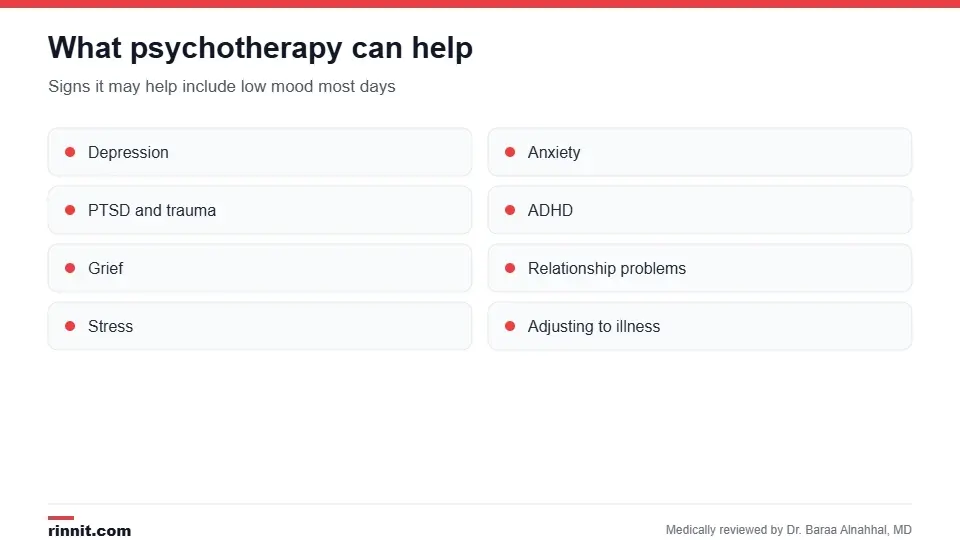
Signs it may help include a low mood most days and losing interest in things you enjoy.
Types of psychotherapy
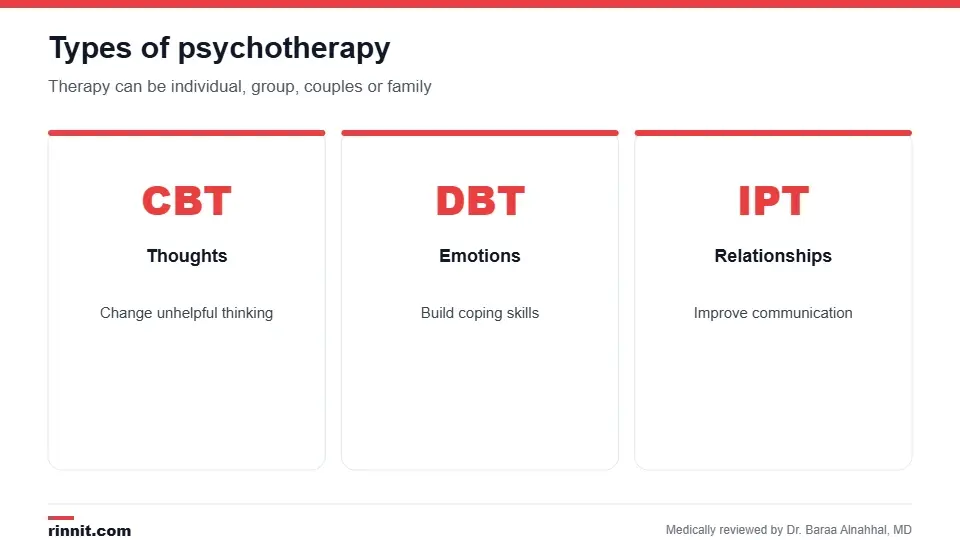
Therapy can be individual, group, couples or family.
Type | Focus |
Changing unhelpful thoughts and behaviors | |
Managing intense emotions and building coping skills | |
Improving relationships and communication | |
Understanding how past experiences shape current feelings |
Therapy can also include animal-assisted, creative arts or play therapy. It can be one-on-one or in groups, couples or families. Psychologists, psychiatrists, psychiatric nurses, social workers and family therapists can provide therapy. Sources: [1]
Finding a therapist
Ask your primary care provider, friends or family for referrals, or check your state psychological association.
Choose a licensed therapist who treats your concern.
Ask about their training, experience and the type of therapy they recommend.
Ask how long therapy may take and how to reach them between sessions. Sources: [1]
What to expect
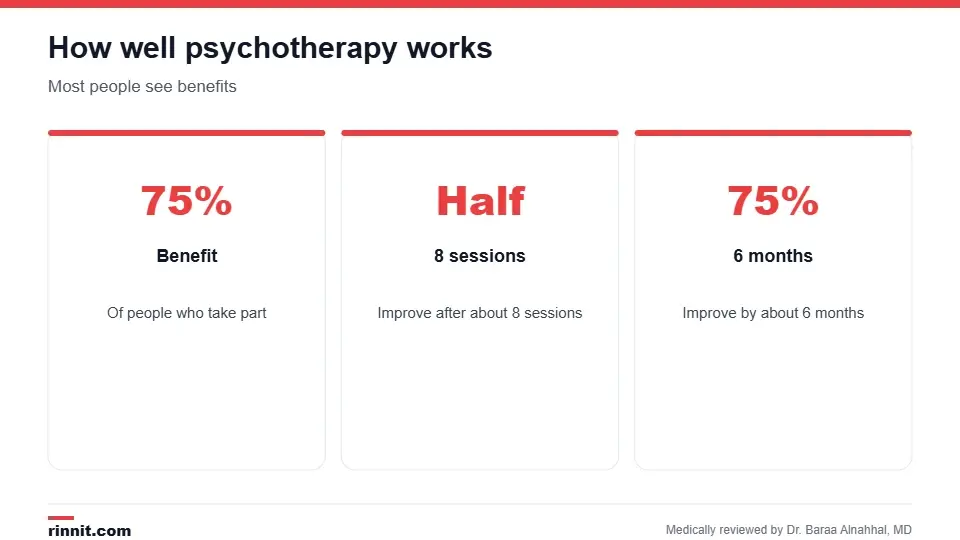
Half of people improve after about eight sessions.
Sessions take place in a safe, non-judgmental setting.
You'll talk openly, learn skills and may have homework.
Short-term issues may take a few weeks or months; complex or long-term problems may take several months or years.
What you say is confidential, except when there's a risk of harm to you or others, or suspected abuse or neglect. Sources: [1]
How well it works
Measure | Result |
People who benefit | About 75% |
Improved after 8 sessions | About half |
Improved after 6 months | About 75% |
Benefits can include fewer sick days, better work and life satisfaction, and better involvement in medical decisions. Sources: [1, 2, 3]
When to talk to your provider
Therapy isn't helping after a while; your provider may suggest adding medication.
You're in crisis or thinking about suicide: go to the nearest emergency room, call 911, or call or text 988 to reach the Suicide and Crisis Lifeline, available 24/7. Sources: [1]
Conclusion
Psychotherapy is an effective, well-studied treatment for many mental health conditions and life challenges. Finding the right therapist and staying actively involved give you the best chance of lasting improvement.
Keep learning: read about cognitive behavioral therapy and dialectical behavior therapy.
Frequently asked questions
What is psychotherapy?
Talk therapy with a trained mental health professional.
What does psychotherapy treat?
Depression, anxiety, PTSD, ADHD, grief, stress and relationship problems.
What are the main types?
CBT, DBT, interpersonal therapy and psychodynamic therapy.
How well does it work?
About 75% of people who try it benefit.
How long does therapy take?
A few weeks or months for short-term issues; longer for complex problems.
Is therapy confidential?
Yes, except when there's a risk of harm or suspected abuse.
What's the difference between counseling and psychotherapy?
Counseling is usually shorter and focused on one issue.
Who provides psychotherapy?
Psychologists, psychiatrists, psychiatric nurses, social workers and family therapists.
Can therapy be combined with medicine?
Yes. Your provider may suggest both.
What if I'm in crisis?
Call or text 988, call 911 or go to the nearest emergency room.
Related Reading
Assertive Community Treatment (ACT): What It Is and Benefits explains assertive community treatment.
Ketamine Therapy: Uses, How It Works and Side Effects explains ketamine therapy for depression and pain.
Cognitive Behavioral Therapy (CBT): What It Is, What It Treats and What to Expect the most widely used type of psychotherapy.
Dialectical Behavior Therapy (DBT): What It Is, the 4 Skills, and How It Works therapy for intense emotions.
Exploring Psychodynamic Therapy: Understanding Your Past to Shape Your Future therapy that explores past experiences.
Interpersonal Psychotherapy (IPT): Healing Through Better Relationships therapy focused on relationships.
What Is Clinical Depression (Major Depressive Disorder)? Symptoms, Causes, Diagnosis and Treatment a condition often treated with psychotherapy.
References
Cleveland Clinic. Psychotherapy: What It Is, Why It Is Done & Types. Cleveland Clinic. Last updated June 30, 2022. https://my.clevelandclinic.org/health/treatments/23445-psychotherapy
Cuijpers P, Miguel C, Ciharova M, et al. Absolute and relative outcomes of psychotherapies for eight mental disorders: a systematic review and meta-analysis. World Psychiatry. 2024;23(2):267-275. PMID 38727072. https://doi.org/10.1002/wps.21203
Cuijpers P, Miguel C, Kaya Aglio E, et al. Long-term effects of psychotherapies for depression: an advanced meta-analysis. World Psychiatry. 2026;25(2):287-294. PMID 42136430. https://doi.org/10.1002/wps.70065
Medical disclaimer
This article is for general education only and does not replace advice from a qualified healthcare professional. Talk to your doctor about your own diagnosis and treatment, and seek emergency care right away for severe or sudden symptoms.



Comments