Ketamine Therapy: Uses, How It Works and Side Effects

Updated: 2 days ago
Written and medically reviewed by Dr. Baraa Alnahhal, MD · Last reviewed: November 2026 · How we review
Quick Answer
Ketamine therapy is a treatment that uses low doses of ketamine, an anesthetic, for certain mental health conditions and chronic pain. The FDA has approved a nasal spray form, esketamine, for treatment-resistant depression. Some people feel better within hours, but effects can fade within days or weeks. Common side effects include dissociation, nausea and higher blood pressure.
What the research says
Ketamine worked as well as ECT: in the ELEKT-D trial of 403 people with treatment-resistant depression, 55.4% responded to IV ketamine versus 41.2% to electroconvulsive therapy (ECT), with less memory loss (Anand A et al., New England Journal of Medicine, 2023) [2]
Esketamine nasal spray eased depression: in the TRANSFORM-2 trial of 227 adults, esketamine plus a new antidepressant lowered depression scores 4 points more than the antidepressant alone at 4 weeks; side effects usually faded within 1.5 hours (Popova V et al., American Journal of Psychiatry, 2019) [3]
Key takeaways
Ketamine therapy uses low doses of an anesthetic to treat depression and other conditions.
Esketamine nasal spray is FDA-approved for treatment-resistant depression.
IV ketamine is used off-label for depression, PTSD, anxiety and pain.
Some people improve within hours, but several sessions are often needed.
You'll be monitored after each dose and need a driver home.
What is ketamine therapy?
Ketamine is a fast-acting anesthetic that can cause a short-term feeling of relaxation or detachment. At low doses under medical supervision, it may lift mood quickly. When combined with talk therapy, it's called ketamine-assisted psychotherapy. Sources: [1]
What it's used for
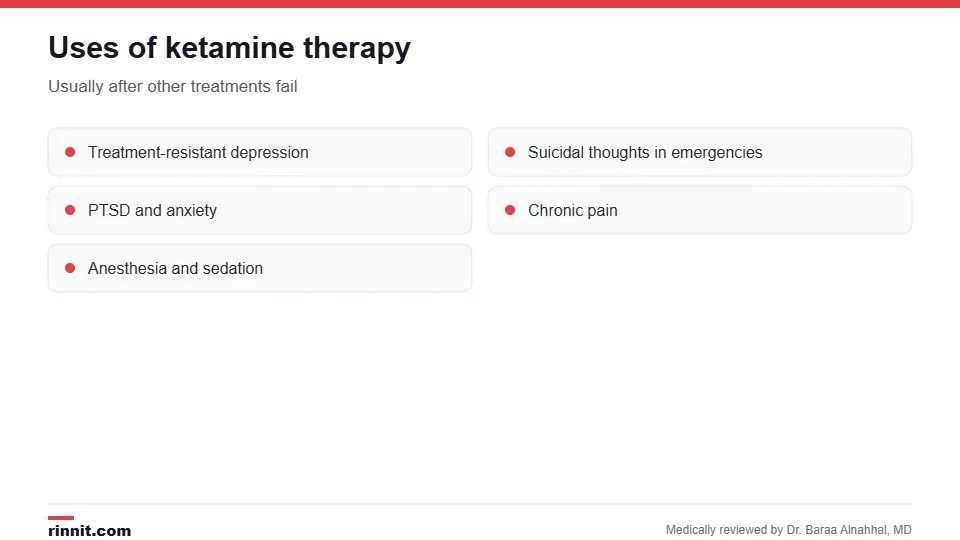
It's usually for people who haven't found relief with other treatments.
Use | Status |
Treatment-resistant depression | FDA-approved as esketamine nasal spray |
Anesthesia and sedation | FDA-approved |
PTSD and anxiety | Off-label |
Chronic pain | Off-label; may reduce opioid needs |
Suicidal thoughts in an emergency | Off-label |
It's usually offered to people with depression or other conditions that haven't improved with standard treatments. Sources: [1]
Who shouldn't have it
People with a ketamine allergy or past bad reaction.
People with a history of psychosis or substance use disorder.
People with an aortic aneurysm or dissection, a recent heart attack or uncontrolled high blood pressure.
People with increased pressure in the brain or liver disease.
Talk to your provider if you're pregnant or breastfeeding. Sources: [1]
Forms of ketamine

All forms are given under medical supervision.
Form | How it's given |
Esketamine nasal spray | You spray it yourself in the clinic, usually with an antidepressant |
IV infusion | Through a small tube in your arm |
Ketamine-assisted psychotherapy | Ketamine combined with talk therapy |
Sources: [1]
What to expect during a session
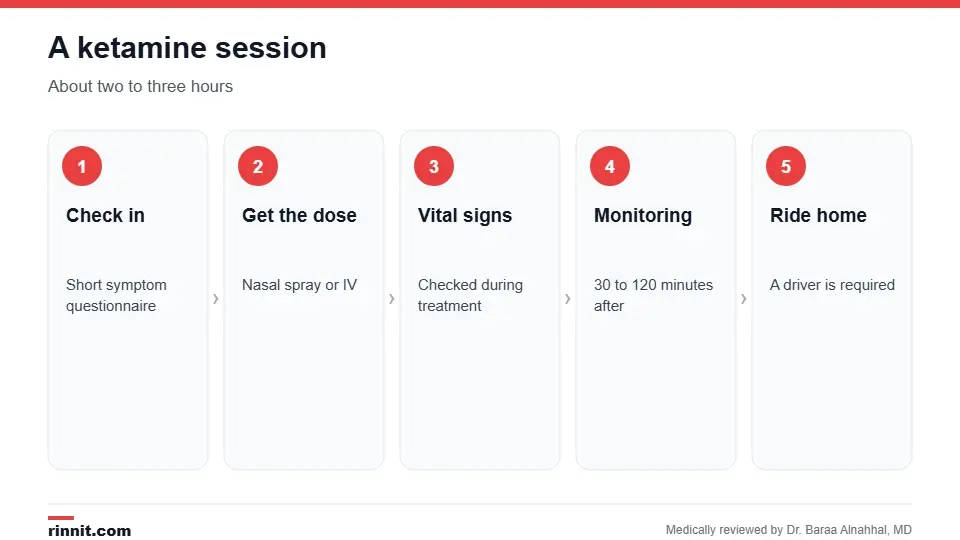
Each visit takes about two to three hours.
Check in and answer a short questionnaire about your symptoms.
Use the nasal spray or have a small IV placed.
Your blood pressure and other vital signs are checked during treatment.
You're monitored afterward; with esketamine nasal spray, FDA rules require at least 2 hours of monitoring. Esketamine carries an FDA boxed warning for sedation, dissociation, breathing problems, misuse and suicidal thoughts.
A driver takes you home. Sources: [1]
You may feel dreamlike or out of your body, notice brighter lights or sounds, or feel lightheaded or tingly. Avoid eating for two hours and drinking for 30 minutes beforehand, and avoid work or big decisions that day. Sources: [1]
Side effects
Type | Examples |
Common | Dissociation, anxiety or restlessness, blurred vision, nausea or vomiting, higher blood pressure |
Rare | Allergic reaction, bladder or liver problems, hallucinations |
Long term | Still being studied; dependence is uncommon with medical use |
Sources: [1, 3]
Recovery and results
You may feel groggy for about 30 minutes and tired for the rest of the day; most people feel normal by the next day. Benefits can appear within hours but may fade within days or weeks, so ongoing sessions and continued psychotherapy are often part of the plan. Sources: [1, 2]
Conclusion
Ketamine therapy offers a fast-acting option for people whose depression or other conditions haven't responded to standard treatments. Careful screening and medical supervision help keep it safe.
Keep learning: read about clinical depression and psychotherapy.
Frequently asked questions
What is ketamine therapy?
Low-dose ketamine used to treat depression, other mental health conditions and pain.
Is ketamine FDA-approved for depression?
The esketamine nasal spray is approved for treatment-resistant depression and for depression with suicidal thoughts or actions.
How fast does ketamine work?
Some people feel better within hours.
How long do the effects last?
Days to weeks, so repeat sessions are often needed.
How is ketamine given?
As a nasal spray or an IV infusion.
What does ketamine feel like?
Often dreamlike or detached, with brighter lights and sounds.
What are the side effects?
Dissociation, nausea, anxiety and higher blood pressure.
Can I drive after a session?
No. You need someone to drive you home.
Is ketamine addictive?
Dependence is uncommon with occasional medical use.
Who shouldn't have ketamine therapy?
People with psychosis, substance use disorder or certain heart conditions.
Related Reading
What Is Clinical Depression (Major Depressive Disorder)? Symptoms, Causes, Diagnosis and Treatment the main condition ketamine therapy treats.
Psychotherapy (Talk Therapy): Types, Uses and What to Expect talk therapy often paired with ketamine.
Complex PTSD (C-PTSD): Symptoms, Causes, and Treatment Guide a condition ketamine is being used for.
What Are Mood Disorders? A Plain-Language Guide to Depression, Bipolar Disorder, and Getting Help an overview of mood disorders.
General Anesthesia: How It Works, Risks and Recovery ketamine's original medical use.
References
Cleveland Clinic. Ketamine Therapy: What It Is, How It Works & Side Effects. Cleveland Clinic. Last updated January 16, 2026. https://my.clevelandclinic.org/health/treatments/ketamine-therapy
Anand A, Mathew SJ, Sanacora G, et al. Ketamine versus ECT for nonpsychotic treatment-resistant major depression. New England Journal of Medicine. 2023;388(25):2315-2325. PMID 37224232. https://doi.org/10.1056/NEJMoa2302399
Popova V, Daly EJ, Trivedi M, et al. Efficacy and safety of flexibly dosed esketamine nasal spray combined with a newly initiated oral antidepressant in treatment-resistant depression: a randomized double-blind active-controlled study. American Journal of Psychiatry. 2019;176(6):428-438. PMID 31109201. https://doi.org/10.1176/appi.ajp.2019.19020172
Medical disclaimer
This article is for general education only and does not replace advice from a qualified healthcare professional. Talk to your doctor about your own diagnosis and treatment, and seek emergency care right away for severe or sudden symptoms. If you're having thoughts of suicide, call or text 988 in the U.S.



Comments