What Are Mood Disorders? A Plain-Language Guide to Depression, Bipolar Disorder, and Getting Help

Updated: 3 days ago
Medically reviewed by Dr. Baraa Alnahhal, MD · Last reviewed: October 2026
Quick Answer: Key Facts About Mood Disorders
Mood disorders are conditions that affect a person emotionally, in two major groups: depressive disorders, with lasting sadness and loss of pleasure, and bipolar disorders, with swings between emotional highs and lows. They are more common in women, unlikely to go away on their own and may worsen, so early help matters. [1] Treatment usually involves talk therapy, medicines or both. [2]
Question | Answer |
What is a mood disorder? | A condition that affects a person emotionally — the two major groups are depressive disorders and bipolar disorders. |
How do the two groups differ? | Depression brings lasting sadness and loss of pleasure; bipolar disorder brings mood swings between emotional highs and lows. |
Is it common? | Depressive disorders are common and often long-lasting, and mood disorders overall are more common in women. |
Will it go away on its own? | A mood disorder is not likely to go away on its own and may get worse over time — which is why early professional help matters. |
How is it treated? | For most people, with talk therapy, medicines, or both; CBT and family-focused therapy help manage symptoms, and brain stimulation therapies are options when other treatments don't work. |
What the research says
Women have about twice the odds of a major depression diagnosis as men — but men are affected too. A meta-analysis of national samples covering 1,716,195 people in more than 90 nations found an odds ratio of 1.95 (95% CI 1.88–2.03) for the gender difference. It appeared by age 12 and peaked in adolescence. (Salk et al., Psychol Bull, 2017) [3]
Therapy plus medicine works better than medicine alone. A meta-analysis of 52 trials (3,623 adults with depressive or anxiety disorders) found combined treatment was more effective than antidepressants alone (Hedges' g 0.43; 95% CI 0.31–0.56; number needed to treat 4.2), with clear benefit in major depression. (Cuijpers et al., World Psychiatry, 2014) [4]
Bipolar disorder often goes undiagnosed for years. A review of 30 studies (23 in the meta-analyses) found a pooled average of 9.1 years of undiagnosed or untreated bipolar disorder, and longer delays may be linked to worse outcomes — one reason early screening matters. (Keramatian et al., Br J Psychiatry, 2025) [5]
What Are Mood Disorders?
Mood disorders are conditions that affect people emotionally. [1] The word "mood" here doesn't mean an ordinary bad day. It means emotional states that last long enough to affect how a person lives, works, and relates to others.
Mood disorders fall into two major groups: depressive disorders and bipolar disorders. [1] Each group includes several different types, covered below.
Mood disorders are more common in women. Having a mood disorder may also raise the risk of suicide. That risk is higher when the mood disorder is serious and the person also has problems with alcohol or drugs. [1]
If you are thinking about suicide, help is available right now. In the U.S., call or text 988 to reach the Suicide & Crisis Lifeline — free and available 24 hours a day, every day. [1] Spanish speakers can call the Lifeline's Spanish-language line at 1-888-628-9454 (toll-free). [1] If you are outside the U.S., contact your local emergency number or a local crisis service.

What Are the Different Types of Depressive Disorders?
Depressive disorders cause a loss of pleasure in most or all activities — and over time they affect a person's quality of life. Along the way, a person could have less energy, trouble sleeping, trouble concentrating, changes in appetite, and lack of interest. Feelings of worthlessness or guilt, pain, and tiredness are common too. [1]
Type | What it looks like |
Major depression | Typically lasts for at least two weeks and often longer than four weeks [1] |
Seasonal affective disorder | Occurs at certain times of the year, typically with a change of season [1] |
Persistent depressive disorder | A long-term form of depression causing feelings of sadness, emptiness, and often hopelessness [1] |
Disruptive mood dysregulation disorder | A diagnosis for children and teenagers; constant, serious, lasting testiness with frequent temper outbursts not consistent with the child's age [1] |
Premenstrual dysphoric disorder | Mood changes, hopelessness, and feeling overwhelmed or out of control in the 10 days before a menstrual period; symptoms go away within a few days after a period begins [1] |
Depression related to a medical condition | Great loss of pleasure due to the physical effects of another health problem [1] |
Depression related to substance or medicine use | Symptoms start during or soon after using a street drug or medicine, or after withdrawal [1] |
What Are the Different Types of Bipolar Disorders?
Bipolar disorders feature mood swings that include emotional highs — called manic or hypomanic episodes — and lows, called depressive episodes. These highs and lows are usually continuous. But they can also change from high to low, or low to high, or shift into a normal mood. [1]
Sometimes the highs and lows happen together. This is called a mixed episode. During a mixed episode, a person could be easily distracted, have racing thoughts, and have their sleep affected. [1]
Type | What it looks like |
Bipolar I disorder | A constantly elevated mood lasting at least one week (a manic episode); affects overall ability to function and raises the chance of risky behavior [1] |
Bipolar II disorder | Elevated moods called hypomanias lasting at least four days but less than one week; risky behaviors may occur, but function is usually less affected; others should notice something is different [1] |
Cyclothymia | Shifts from highs to lows that can affect function, but the ups and downs are not as extreme as in bipolar I or II [1] |
Bipolar related to a medical condition | The same symptoms, but caused by a medical condition such as Cushing's disease, multiple sclerosis, stroke, or traumatic brain injury [1] |
Bipolar related to substance use | The same symptoms, but caused by alcohol, street drugs, or medicine [1] |

What Symptoms Should You Watch For?
Symptoms depend on the type of mood disorder. [1]
Depressive Disorder Symptoms
Depressive disorders are common and often long-lasting. They can cause: [1]
Symptom | How it shows up |
Sad or empty feelings | Feeling sad, empty, anxious, and cranky [1] |
Focus and function | Trouble concentrating and getting things done [1] |
Loss of pleasure | Little or no enjoyment in most or all activities [1] |
Energy and quality of life | Lower energy and reduced quality of life [1] |
Self-worth | Feelings of worthlessness or guilt [1] |
Eating and sleeping | Changes in how much you eat and sleep [1] |
Suicidal thoughts | Raised thoughts about suicide [1] |
Bipolar Disorder Symptoms
Bipolar disorders may feature:
Symptom | How it shows up |
Mood swings | Moods going back and forth between highs (mania or hypomania) and lows (depression) [1] |
Feeling invincible | Feeling on top of the world, superior to others, or so strong that nothing can harm or change you [1] |
Racing thoughts | Thoughts moving faster than usual [1] |
Increased energy | Energy levels that feel unusually high [1] |
Disrupted sleep | Usually a decreased need for sleep, yet a continued high energy level [1] |
Impulsive behaviors | Acting without thinking things through [1] |
A person with a bipolar disorder could also be easily distracted and more likely to think about suicide or plan for suicide, depending on how serious the symptoms are. [1] Other types of mood disorders may include other symptoms. [1]
What Causes Mood Disorders?
Mood disorders are caused by traits passed down to a person, as well as environmental factors and life events. Environmental factors can include childhood experiences and stressful life events. [1]
Some prescription drugs can also play a role. These include corticosteroids and medicines for Parkinson's disease — and street drugs can cause mood disorders too. [1]
Who Is Most at Risk?
Risk factors include life experiences and stressful life events that increase the risk of certain types of mood disorders. [1]
Mood disorders may also occur along with neurological disorders — conditions that affect the brain and the nervous system. Depression is common among people with multiple sclerosis, dementia, traumatic brain injury, stroke, and epilepsy. Depression also often occurs in people with movement disorders like Parkinson's disease and those who have other long-term health conditions. [1]
When Should You See a Doctor?
If you're concerned that you may have a mood disorder, see your doctor or a mental health professional as soon as you can. If you're not sure you want to seek treatment, talk to a friend or loved one, a faith leader, or someone else you trust. [1]
Situation | What to do |
Emotions get in the way of work, relationships, or daily life, or you've stopped taking part in social activities | See a doctor or mental health professional soon [1] |
You're having trouble with alcohol or drugs | Talk to a health care professional [1] |
You're thinking about taking your own life | Seek emergency treatment at once [1] |
Keep two things in mind. A mood disorder is not likely to go away on its own — and it may get worse over time. Getting professional help early makes it easier to treat. [1]
How Are Mood Disorders Diagnosed?
To find out whether you have a mood disorder, your doctor or primary care professional may start with a physical exam. This looks for other signs of illness that could explain what you're feeling. [2]
Your doctor will review your symptoms, your medical and family histories, and your history of alcohol or drug use. They will also want to know about past episodes of a mood disorder: [2]
How long were past episodes?
How long did you go in between episodes?
How strong were these episodes?
Were any of these episodes affected by the use of street drugs or medicines?
Your doctor will ask about other current or past mental health issues too. If needed, you may be referred to a mental health professional. [2]
How Are Mood Disorders Treated?
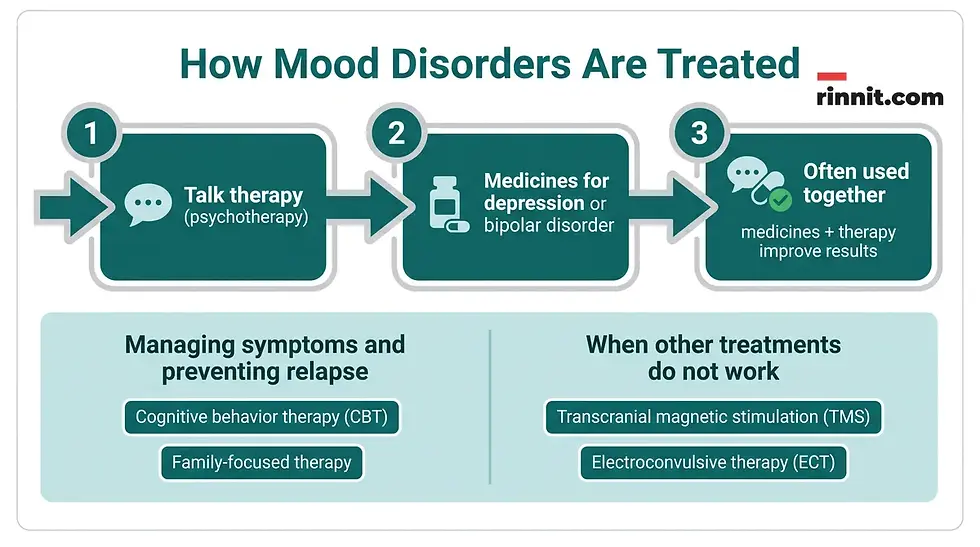
For most people, mood disorders can be treated with talk therapy, medicines, or both. [2]
Talk therapy is also known as psychotherapy. It's a general term for treating a mood disorder by talking about your condition and related issues with a mental health professional. [2]
Medicines can be used to treat depression and bipolar disorder. The drug that works best for you depends on how well it controls your symptoms, how well you tolerate it, and your preferences. Importantly, medicines should be used along with talk therapy to improve results. [2]
Cognitive behavior therapy (CBT), family-focused therapy, or other types of therapy can be an important part of treatment — for managing symptoms or stopping them from coming back. [2]
For some people with depression, brain stimulation therapies may be suggested. These include transcranial magnetic stimulation (TMS) and electroconvulsive therapy (ECT). These are typically considered secondary treatments — used when other treatments do not work. [2]
Treatment | What it is | When it's used |
Talk therapy (psychotherapy) | Talking about your condition and related issues with a mental health professional [2] | For most people, alone or with medicines [2] |
Medicines | Drugs that treat depression and bipolar disorder, chosen by symptom control, tolerance, and preference [2] | For most people, alongside talk therapy [2] |
Cognitive behavior therapy (CBT) | A structured type of talk therapy focused on thoughts and behaviors | Managing symptoms or preventing relapse [2] |
Family-focused therapy | Therapy that involves family members | Managing symptoms or preventing relapse [2] |
Brain stimulation (TMS, ECT) | Transcranial magnetic stimulation and electroconvulsive therapy [2] | Secondary treatments when other treatments do not work [2] |
How Should You Prepare for a Doctor's Appointment?
Before your visit, it helps to be ready. Think about your symptoms, including when they started and how long past episodes lasted. Note any family history of mood disorders, and bring a list of all medicines you take — including street drugs or substances if they're part of the picture — because substance use can shape both the diagnosis and the treatment plan.
It can also help to bring a trusted person along. They can help you remember what the doctor says and support you in deciding on next steps.
Questions worth asking include: What type of mood disorder might I have? What tests or evaluations will we do? Will I need medicines, talk therapy, or both? And how often should I come back?
The Bottom Line
Mood disorders are real, common, and treatable — whether the pattern looks like lasting sadness and emptiness, or swings between emotional highs and lows. The most important thing to know is that these conditions don't usually improve on their own, and they can worsen over time. [1] Early help isn't a sign of weakness; it's the strategy that gives treatment the best chance of working.
If your emotions are crowding out your work, your relationships, or the activities you used to enjoy, that's worth acting on — and so are any thoughts of taking your own life, which deserve emergency care at once.
If your moods are affecting your daily life, reach out to a doctor or mental health professional. Treatment works best when it starts early — and you don't have to figure it out alone.
Frequently Asked Questions
What is a mood disorder?
A mood disorder is a condition that affects a person emotionally. The two major groups are depressive disorders, which bring lasting sadness and loss of pleasure, and bipolar disorders, which feature mood swings between emotional highs and lows. [1]
What's the difference between depression and bipolar disorder?
Depression involves persistent sadness, emptiness, and loss of interest in activities. Bipolar disorder involves mood swings — emotional highs called manic or hypomanic episodes and lows called depressive episodes — that usually follow a continuous pattern. [1]
What are the signs of a manic episode?
Feeling on top of the world or superior to others, racing thoughts, increased energy, a decreased need for sleep while still feeling energetic, impulsive behaviors, and feeling easily distracted. [1]
What causes mood disorders?
A mix of inherited traits, environmental factors like childhood experiences, and stressful life events. Some prescription drugs (such as corticosteroids and Parkinson's medicines) and street drugs can also cause mood disorders. [1]
Are mood disorders linked to other health conditions?
Yes. They can occur along with neurological disorders. Depression is common in people with multiple sclerosis, dementia, traumatic brain injury, stroke, epilepsy, and Parkinson's disease, as well as other long-term health conditions. [1]
Will a mood disorder go away on its own?
A mood disorder is not likely to go away on its own and may get worse over time. Getting professional help early makes it easier to treat. [1]
How are mood disorders treated?
For most people, with talk therapy (psychotherapy), medicines, or both. CBT and family-focused therapy help manage symptoms or prevent relapse, and brain stimulation therapies like TMS and ECT are used when other treatments don't work. [2]
When should I seek emergency help?
If you're thinking about taking your own life, seek emergency treatment at once. In the U.S., you can call or text 988 to reach the Suicide & Crisis Lifeline, which is free and available 24 hours a day. [1]
Related Reading
Ketamine Therapy: Uses, How It Works and Side Effects explains ketamine therapy for depression and pain.
Read next on Rinnit.com:
References
Mayo Clinic Staff. Mood disorders - Symptoms & causes. Mayo Clinic. January 31, 2024. https://www.mayoclinic.org/diseases-conditions/mood-disorders/symptoms-causes/syc-20365057
Mayo Clinic Staff. Mood disorders - Diagnosis and treatment. Mayo Clinic. January 31, 2024. https://www.mayoclinic.org/diseases-conditions/mood-disorders/diagnosis-treatment/drc-20365058
Salk RH, et al. Gender differences in depression in representative national samples: Meta-analyses of diagnoses and symptoms. Psychol Bull. 2017;143(8):783-822. PMID 28447828. https://doi.org/10.1037/bul0000102
Cuijpers P, et al. Adding psychotherapy to antidepressant medication in depression and anxiety disorders: a meta-analysis. World Psychiatry. 2014;13(1):56-67. PMID 24497254. https://doi.org/10.1002/wps.20089
Keramatian K, et al. Duration of untreated or undiagnosed bipolar disorder and clinical characteristics and outcomes: systematic review and meta-analysis. Br J Psychiatry. 2025;227(3):622-632. PMID 40337852. https://doi.org/10.1192/bjp.2025.63
Medical disclaimer
This article is for general information only and is not medical advice. Always consult a qualified healthcare professional for diagnosis and treatment decisions. If you are in crisis in the U.S., call or text 988 to reach the Suicide & Crisis Lifeline; elsewhere, contact your local emergency number or crisis service.



Comments