Dialectical Behavior Therapy (DBT): What It Is, the 4 Skills, and How It Works

Updated: 6 days ago
Written and medically reviewed by Dr. Baraa Alnahhal, MD · Last reviewed: October 2026 · How we review
Quick Answer: What is dialectical behavior therapy (DBT)?
Dialectical behavior therapy (DBT) is a type of talk therapy, adapted from cognitive behavioral therapy, for people who feel emotions very intensely. It balances acceptance with change and teaches four skills: mindfulness, distress tolerance, interpersonal effectiveness and emotion regulation. DBT is a common treatment for borderline personality disorder and usually lasts six months to a year. [1][2]
What the research says
DBT reduced self-harm and suicidal behavior across 18 controlled trials. A meta-analysis found DBT lowered self-directed violence (d = −0.32) and cut the use of psychiatric crisis services (d = −0.38). It did not show a significant pooled effect on suicidal thoughts alone (d = −0.23), which may reflect DBT's focus on behavior first. (DeCou et al., Behavior Therapy, 2019) [4]
In borderline personality disorder, DBT outperformed usual care on three key outcomes. A review of 75 randomized trials (4,507 participants) found DBT reduced BPD severity (SMD −0.60; 3 trials, 149 people), self-harm (SMD −0.28; 7 trials, 376 people) and improved daily functioning (SMD −0.36; 6 trials, 225 people) compared with treatment as usual — all based on low-quality evidence. (Storebø et al., Cochrane Database of Systematic Reviews, 2020) [3]
The adolescent version of DBT reduced self-harm and suicidal thoughts in teens aged 12–19. Across 21 studies covering 1,673 adolescents, DBT for adolescents showed small-to-moderate reductions in self-harm (g = −0.44) and suicidal ideation (g = −0.31) compared with control groups. (Kothgassner et al., Psychological Medicine, 2021) [5]
Key takeaways
DBT is a skills-based talk therapy built on cognitive behavioral therapy and adapted for intense emotions. [1]
Its core idea is balance: accepting yourself as you are while working to change unhelpful behaviors. [1]
Treatment usually combines weekly individual therapy, group skills training and between-session phone coaching. [1][2]
DBT usually takes at least six months to a year; for borderline personality disorder, it can take several years. [1]
In a crisis, contact your therapist; if they are unavailable, call a crisis line or emergency services. [1]
What does "dialectical" mean in dialectical behavior therapy?
"Dialectical" means combining two opposite ideas — in DBT, acceptance and change. [1] The therapy helps you accept the reality of your life and your behaviors while also learning to change your life, including behaviors that are not helping you.

Your therapist's main goal is to strike a balance between validating who you are and your challenges, and showing you the benefits of change. [1]
Dialectical behavior therapy was developed in the 1970s by American psychologist Marsha Linehan. [1] It grew out of early efforts to apply standard behavior therapy to people who were highly suicidal, and was refined largely through clinical experience. [2]
What conditions does dialectical behavior therapy treat?
Dialectical behavior therapy treats conditions linked to difficulty managing and regulating emotions, most notably borderline personality disorder. [1] It has proven effective for a wide range of mental health conditions:
Condition | Why DBT can help |
The condition DBT is best known for treating | |
Self-harm | Builds safer ways to cope with overwhelming emotions |
Suicidal behavior | Reducing suicidal and self-harming behavior is a top treatment priority |
Strengthens emotion regulation and distress tolerance | |
Substance use disorder | Replaces substance use as a way to control painful emotions |
Eating disorders — binge eating disorder and bulimia | Targets eating behaviors used to manage emotions |
Depression | Teaches skills to understand and manage low mood |
Builds mindfulness and emotion-regulation skills |
Sources: [1]
What links these conditions is a common pattern: each is thought to involve unhealthy or problematic efforts to control intense, negative emotions. [1] Instead of relying on behaviors that cause harm, DBT teaches healthier ways to cope.
What are the four DBT skills?
The four DBT skills are mindfulness, distress tolerance, interpersonal effectiveness and emotion regulation. [1] They are taught in skills-training groups and aim to strengthen your ability to handle day-to-day life.
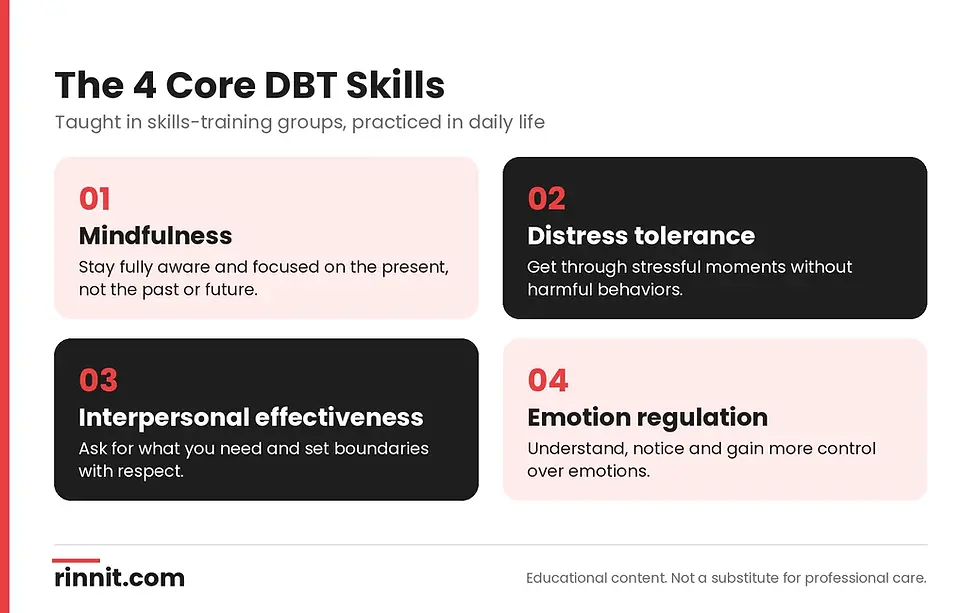
DBT skill | What it means | What it helps you do |
Mindfulness | Being fully aware and focused on the present | Stop getting pulled into worries about the past or future |
Distress tolerance | Understanding and managing emotions in difficult or stressful moments | Get through a crisis without harmful behaviors |
Interpersonal effectiveness | Asking for what you want and need, and setting boundaries | Keep respect for yourself and others in relationships |
Emotion regulation | Understanding, noticing and controlling your emotions | Feel more in charge of how you respond |
Sources: [1]
How does dialectical behavior therapy work?
Dialectical behavior therapy works by combining several types of sessions that teach new emotion-regulation skills and help you use them in real life. [1] The exact structure can vary between therapists, but a full DBT program usually includes the parts below.

Part of DBT | How often | What happens |
Pre-assessment | Before treatment starts | Your therapist checks whether DBT suits you and asks you to commit to it |
Individual therapy | Weekly, about 40–60 minutes | One-on-one work on safety, goals and skills |
Skills training group | Regularly, in a group | Classroom-style teaching of the four skills |
Telephone crisis coaching | As needed, within agreed times | Brief calls for help in a crisis or with using a skill |
Therapist consultation team | Ongoing (for the therapist) | Therapists meet to support and guide their own DBT work |
Sources: [1][2]
DBT pre-assessment
Before starting, your therapist may assess whether DBT is right for you by asking questions and explaining how it works. [1] If you decide to go ahead, they will ask you to commit to the treatment and its length.
Individual DBT therapy
Individual DBT therapy means weekly one-on-one sessions of about 40 to 60 minutes. [1] These sessions aim to:
Keep you safe by reducing suicidal and self-harming behaviors, if present.
Limit behaviors that get in the way of productive therapy.
Improve your quality of life by tackling what blocks your progress, such as a mental health condition or relationship problems.
Help you learn new skills to replace unhelpful behaviors.
Your therapist will likely ask you to keep a diary of your emotions and actions. You bring it to each session so you can spot patterns and decide together what to work on. [1]
DBT skills training groups
DBT skills training is a teaching session in a group, not traditional group therapy. [1] You are not there to discuss your problems with others — think of it as a classroom where you learn the four DBT skills.
Telephone crisis coaching
Telephone crisis coaching lets you call your therapist at agreed times for support between sessions. [1] You might call when you face an immediate crisis, such as an urge to self-harm, or when you want advice on using a skill you have learned.
Your therapist will set clear boundaries on when you can call. Calls are usually brief and do not replace individual or group sessions. [1]
Therapist consultation team
DBT also includes a consultation team for therapists. [2] It is one of the standard parts of comprehensive DBT, and it is worth asking a potential therapist whether they belong to one. [1]
How is dialectical behavior therapy different from CBT?
Dialectical behavior therapy is based on cognitive behavioral therapy (CBT) but is specially adapted for people who experience emotions very intensely. [1] CBT focuses on how thoughts affect emotions and behaviors; DBT adds a strong emphasis on accepting yourself while you work on change.
Feature | CBT | DBT |
Foundation | Original approach | Built on CBT |
Main focus | How thoughts affect emotions and behaviors | Balancing acceptance and change |
Designed for | A broad range of concerns | People who experience emotions very intensely |
Core structure | Talk therapy | Individual therapy, skills groups and phone coaching |
Sources: [1][2]
What are the benefits of dialectical behavior therapy?
Dialectical behavior therapy has been shown in several studies to help people with mental health conditions, especially borderline personality disorder. [1] For people with BPD, DBT results in:
Less self-harm and anger.
Fewer days spent in inpatient hospital care.
Less drug and alcohol misuse.
Improved depression symptoms.
Sources: [1]
Because DBT is modular and structured, it has also been adapted for other groups and settings, including the use of DBT skills on their own. [2]
Who is dialectical behavior therapy a good fit for?
Dialectical behavior therapy is a good fit for people who are ready to commit to change and to the work therapy involves. [1] DBT is not for everyone, and it can be very difficult.
DBT is more likely to work for you if you:
Are committed to making positive changes.
Are ready to fully commit to therapy and complete homework assignments.
Are ready to focus mostly on your present and future, rather than your past.
Feel able to do some sessions in a group with others.
Sources: [1]
How long does dialectical behavior therapy take?
Dialectical behavior therapy usually takes at least six months to a year. [1] Everyone is different, and mental health conditions are complex, so you should not expect to be completely symptom-free after one year.
Situation | Typical length |
Standard DBT program | At least 6 months to 1 year |
Borderline personality disorder | Often several years, according to many therapists |
Sources: [1]
Try not to be discouraged by the timeline. Seeking help is the important step — and any progress is good progress.
How do you find a qualified DBT therapist?
You can find a DBT therapist through a referral from your primary healthcare provider, a trusted friend or family member, or local and state psychological associations. [1] A DBT therapist can be a psychiatrist, psychiatric nurse, psychologist, social worker or family therapist.
Make sure the therapist is a certified, licensed mental health professional who treats your specific concern, such as eating disorders, BPD or self-harm. [1] Finding the right fit can take time, so try not to give up.
Questions worth asking a potential DBT therapist:
What training do you have in DBT?
Do you provide comprehensive DBT or a modified version? If modified, why?
Do you belong to a DBT consultation team?
What is your policy on phone calls and emails during the week?
How long will you ask me to commit to therapy overall?
Sources: [1]
When should you get urgent help during DBT?
You should get urgent help right away if you are in crisis, such as feeling suicidal. [1] Call your therapist first if you can.
If your therapist is unavailable, call the 988 Suicide and Crisis Lifeline (in the U.S.), which answers 24 hours a day, seven days a week, or call emergency services or go to the nearest emergency room. [1] Outside the U.S., contact your local emergency number.
Between crises, attend every scheduled individual session and skills group — consistency is part of what makes DBT work. [1]
Conclusion
Dialectical behavior therapy is an effective, structured treatment for people who experience very intense, negative emotions. It pairs acceptance with change and teaches four practical skills — mindfulness, distress tolerance, interpersonal effectiveness and emotion regulation — through individual therapy, group training and phone coaching.
DBT takes commitment, and finding the right therapist can take time. The sooner you start and stay with it, the sooner you can build a better quality of life. [1]
Next step: If DBT has been suggested for borderline personality disorder, read our complete guide to borderline personality disorder to understand the condition it treats best — then bring your questions to a licensed DBT therapist.
FAQ
What is DBT in simple terms?
DBT is a skills-based talk therapy that helps people who feel emotions very intensely. It teaches you to accept yourself as you are while learning healthier ways to handle emotions and relationships.
What is DBT mainly used for?
DBT is best known as a treatment for borderline personality disorder. It is also used for self-harm, suicidal behavior, PTSD, substance use disorder, binge eating disorder, bulimia, depression and anxiety.
What are the four DBT skills?
The four DBT skills are mindfulness, distress tolerance, interpersonal effectiveness and emotion regulation. You learn them in skills-training groups and practice them in daily life.
How long does DBT take to work?
DBT usually takes at least six months to a year. For borderline personality disorder, treatment can often take several years, and progress happens gradually.
Is DBT the same as CBT?
No. DBT is based on cognitive behavioral therapy but is adapted for people who experience emotions very intensely, with a strong focus on balancing acceptance and change.
Is DBT done in a group or one-on-one?
Both. Comprehensive DBT combines weekly one-on-one sessions of about 40–60 minutes with group skills training, which works like a class rather than group therapy.
Can I call my DBT therapist between sessions?
Yes, many DBT programs include telephone crisis coaching within times your therapist agrees to. Calls are brief and are meant for crises or help using a skill, not to replace sessions.
What should I do in a crisis during DBT?
Call your therapist if you can. If they are unavailable, call the 988 Suicide and Crisis Lifeline in the U.S., your local emergency number, or go to the nearest emergency room.
Is DBT effective?
Yes. DBT has strong research support, especially for reducing self-harm and suicidal behavior in people with borderline personality disorder. It is also used for other conditions involving intense emotions.
What is a DBT diary card?
A diary card is a daily log where you track your emotions, urges, behaviors and the skills you used. You review it with your therapist to see patterns and plan what to work on.
Related Reading
Psychotherapy (Talk Therapy): Types, Uses and What to Expect explains how talk therapy works and its main types.
References
Cleveland Clinic. Dialectical Behavior Therapy (DBT): What It Is & Purpose. Cleveland Clinic. Last updated April 19, 2022. https://my.clevelandclinic.org/health/treatments/22838-dialectical-behavior-therapy-dbt
Linehan MM, Wilks CR. The Course and Evolution of Dialectical Behavior Therapy. Am J Psychother. 2015;69(2):97-110. PMID 26160617. https://doi.org/10.1176/appi.psychotherapy.2015.69.2.97
Storebø OJ, Stoffers-Winterling JM, Völlm BA, et al. Psychological therapies for people with borderline personality disorder. Cochrane Database Syst Rev. 2020;5(5):CD012955. PMID 32368793. https://doi.org/10.1002/14651858.CD012955.pub2
DeCou CR, Comtois KA, Landes SJ. Dialectical Behavior Therapy Is Effective for the Treatment of Suicidal Behavior: A Meta-Analysis. Behav Ther. 2019;50(1):60-72. PMID 30661567. https://doi.org/10.1016/j.beth.2018.03.009
Kothgassner OD, Goreis A, Robinson K, et al. Efficacy of dialectical behavior therapy for adolescent self-harm and suicidal ideation: a systematic review and meta-analysis. Psychol Med. 2021;51(7):1057-1067. PMID 33875025. https://doi.org/10.1017/S0033291721001355
Disclaimer
This article is for general educational purposes only and does not replace professional medical or mental health advice, diagnosis or treatment. Always speak with a qualified healthcare provider about your own situation. If you are in crisis or thinking about harming yourself, contact emergency services or a crisis line immediately.



Comments